
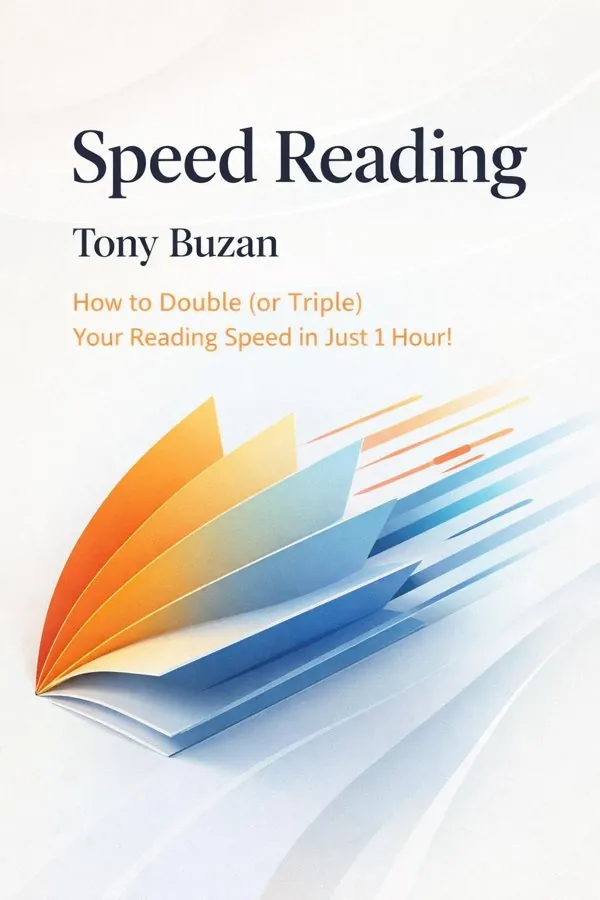
Speed Reading: How to Double (or Triple) Your Reading Speed in Just 1 Hour!: Summary & Key Insights
by Tony Buzan
 10 min9 chaptersAudio available
Key Takeaways from Speed Reading: How to Double (or Triple) Your Reading Speed in Just 1 Hour!
Most people do not read slowly because they must; they read slowly because they were trained to.
Reading is often taught as if it were only a language exercise, but Buzan insists it is actually a whole-brain activity.
One of Buzan’s most practical recommendations is surprisingly simple: use your finger, a pen, or another visual guide as you read.
A major barrier to faster reading is not mental slowness but narrow visual intake.
Many people begin reading with no clear objective and then blame themselves for poor concentration.
What Is Speed Reading: How to Double (or Triple) Your Reading Speed in Just 1 Hour! About?
Speed Reading: How to Double (or Triple) Your Reading Speed in Just 1 Hour! by Tony Buzan is a productivity book spanning 7 pages. Tony Buzan’s Speed Reading: How to Double (or Triple) Your Reading Speed in Just 1 Hour! is a compact guide to one of the most valuable productivity skills in modern life: learning faster without sacrificing understanding. At its core, the book argues that most people are not limited by their intelligence or memory, but by outdated reading habits they were never taught to question. By replacing slow, linear reading patterns with more natural techniques that match how the brain actually processes information, readers can dramatically increase both speed and comprehension. What makes this book matter is its practicality. Buzan does not treat reading as a passive act of moving through words one by one. He presents it as an active mental process involving attention, pattern recognition, anticipation, memory, and visual guidance. The result is a system that helps students, professionals, and lifelong learners absorb information more efficiently in a world overloaded with text. Buzan brings unusual authority to the subject. Best known as the creator of mind mapping and a global advocate for mental literacy, he spent decades studying how people learn, remember, and think. This book distills that expertise into clear methods that can be applied immediately.
This FizzRead summary covers all 9 key chapters of Speed Reading: How to Double (or Triple) Your Reading Speed in Just 1 Hour! in approximately 10 minutes, distilling the most important ideas, arguments, and takeaways from Tony Buzan's work. Also available as an audio summary and Key Quotes Podcast.
Speed Reading: How to Double (or Triple) Your Reading Speed in Just 1 Hour!
Tony Buzan’s Speed Reading: How to Double (or Triple) Your Reading Speed in Just 1 Hour! is a compact guide to one of the most valuable productivity skills in modern life: learning faster without sacrificing understanding. At its core, the book argues that most people are not limited by their intelligence or memory, but by outdated reading habits they were never taught to question. By replacing slow, linear reading patterns with more natural techniques that match how the brain actually processes information, readers can dramatically increase both speed and comprehension.
What makes this book matter is its practicality. Buzan does not treat reading as a passive act of moving through words one by one. He presents it as an active mental process involving attention, pattern recognition, anticipation, memory, and visual guidance. The result is a system that helps students, professionals, and lifelong learners absorb information more efficiently in a world overloaded with text.
Buzan brings unusual authority to the subject. Best known as the creator of mind mapping and a global advocate for mental literacy, he spent decades studying how people learn, remember, and think. This book distills that expertise into clear methods that can be applied immediately.
Who Should Read Speed Reading: How to Double (or Triple) Your Reading Speed in Just 1 Hour!?
This book is perfect for anyone interested in productivity and looking to gain actionable insights in a short read. Whether you're a student, professional, or lifelong learner, the key ideas from Speed Reading: How to Double (or Triple) Your Reading Speed in Just 1 Hour! by Tony Buzan will help you think differently.
- ✓Readers who enjoy productivity and want practical takeaways
- ✓Professionals looking to apply new ideas to their work and life
- ✓Anyone who wants the core insights of Speed Reading: How to Double (or Triple) Your Reading Speed in Just 1 Hour! in just 10 minutes
Want the full summary?
Get instant access to this book summary and 100K+ more with Fizz Moment.
Get Free SummaryAvailable on App Store • Free to download
Key Chapters
Most people do not read slowly because they must; they read slowly because they were trained to. Tony Buzan argues that inefficient reading is usually the result of automatic habits that quietly drain speed, attention, and confidence. Three of the most common are subvocalization, regression, and narrow fixation. Subvocalization is the tendency to silently "say" every word in your head, tying reading speed to speaking speed. Regression is the habit of repeatedly going back over words or lines without a real need. Narrow fixation refers to seeing very few words at each eye stop, which makes reading choppy and laborious.
Buzan’s key insight is that these habits feel safe, but they often reduce comprehension instead of improving it. When readers constantly backtrack or sound out every word, they interrupt the flow of ideas. Meaning becomes fragmented. By contrast, skilled readers move more smoothly, trust context, and process groups of words rather than isolated terms.
Imagine reading a business report. A slow reader may pause at every sentence, reread clauses, and mentally pronounce each word. A more efficient reader looks for structure, absorbs phrases, and allows the argument to unfold. The second approach is not careless; it is more aligned with how the brain naturally recognizes patterns.
To improve, Buzan recommends becoming conscious of these habits first. Track when your eyes jump backward, when your inner voice dominates, and how few words you take in at a glance. Then deliberately reduce these tendencies using pacing tools and phrase-based reading.
Actionable takeaway: For your next 10 minutes of reading, focus on taking in 2 to 4 words at a time and avoid unnecessary rereading unless comprehension genuinely breaks down.
Reading is often taught as if it were only a language exercise, but Buzan insists it is actually a whole-brain activity. The brain does not simply decode words one by one like a machine. It notices visual patterns, predicts meaning, links ideas through association, and constructs understanding from context. When readers rely too heavily on slow verbal decoding, they underuse the brain’s far greater ability to process chunks, relationships, and mental imagery.
This matters because speed and comprehension are not natural enemies. In many cases, they support each other. Faster reading can improve understanding by forcing the mind to stay engaged with larger units of meaning. Instead of getting stuck on individual words, the reader begins to grasp sentences, arguments, and themes. Momentum helps the brain connect information into a coherent whole.
Consider how you recognize a familiar road sign or a friend’s face. You do not analyze each detail separately before understanding what you see. You perceive the pattern almost instantly. Buzan believes reading can become more like that. As your visual span widens and your confidence grows, you shift from word-by-word decoding toward phrase and idea recognition.
This approach is especially useful for non-fiction, where structure matters as much as wording. In a chapter about leadership, for example, your brain can quickly pick up repeated themes, transitions, and key examples if you read with an eye for patterns.
Actionable takeaway: During your next reading session, ask yourself not "What does each word say?" but "What pattern or idea is this paragraph building?" Train your attention toward meaning clusters rather than isolated terms.
One of Buzan’s most practical recommendations is surprisingly simple: use your finger, a pen, or another visual guide as you read. Many adults assume this is childish because they were told in school to stop pointing at words. Buzan argues the opposite. A visual guide helps the eyes move smoothly across the page, reduces distraction, and establishes a faster rhythm than the reader would typically maintain alone.
The underlying principle is attentional control. The eyes and mind wander easily, especially when material is dense or fatigue sets in. A guide creates a physical anchor. It tells the eyes where to go next and encourages forward movement. This can sharply reduce regression because the reader is less likely to drift backward. It also nudges the brain to keep up with the chosen pace.
Think of it like running with a metronome or exercising with a trainer. The guide sets a tempo that makes better performance easier. If you slide your finger under each line at a slightly challenging speed, your eyes begin adapting. Over time, what once felt rushed becomes normal.
This technique works well for articles, textbooks, reports, and even digital reading if you use a cursor or stylus. Start by reading at your usual speed with a guide, then increase the pace for short bursts. You may initially feel less comfortable, but Buzan sees that discomfort as part of retraining. The goal is not panic; it is controlled stretch.
Actionable takeaway: For the next 15 pages you read, use a finger or pen as a pacer and move it 10 to 20 percent faster than your normal pace while staying relaxed and focused.
A major barrier to faster reading is not mental slowness but narrow visual intake. Buzan explains that many readers fixate on each word or on very small clusters of text, forcing the eyes to stop too often. Each stop consumes time and energy. By expanding your perceptual span, you can capture more words in each glance and reduce the number of eye movements needed per line.
This is where skimming and scanning become valuable, not as shortcuts for lazy reading, but as training tools for broader perception. Skimming teaches you to move quickly through text to identify main ideas, structure, and emphasis. Scanning trains you to search purposefully for names, dates, concepts, or evidence. Together, these techniques sharpen selective attention and strengthen the ability to see more at once.
Suppose you are reviewing a chapter before a meeting. Instead of starting at line one and crawling forward, you first skim headings, opening sentences, bold terms, and summaries. This gives your brain a map. Then, if you need a specific statistic or argument, you scan for it efficiently. The result is not less understanding but smarter allocation of attention.
Buzan also encourages readers to soften their focus slightly so they are not staring rigidly at the center of each word. The aim is to perceive phrase units and use peripheral vision more effectively. With practice, this leads to fewer fixations and stronger flow.
Actionable takeaway: Before reading any chapter in full, spend two minutes skimming headings, first sentences, and highlighted terms, then read with the intention of seeing phrase groups rather than single words.
Many people begin reading with no clear objective and then blame themselves for poor concentration. Buzan points out that reading speed improves dramatically when the brain knows what it is looking for. Purpose acts like a filter. It helps you distinguish what deserves attention, what can be skimmed, and what should be remembered.
This idea may seem obvious, yet it changes everything. A student reading a history chapter to prepare for an exam reads differently from someone browsing out of curiosity. A manager reviewing a proposal for key risks reads differently from someone evaluating writing style. Without a purpose, every sentence seems equally important, and reading becomes slow because the mind cannot prioritize.
Buzan recommends previewing material and setting questions before diving in. What is the author trying to prove? What do I need to learn, decide, or recall? Which sections are likely to matter most? These questions prime the mind for active reading. Instead of passively receiving information, you begin hunting for meaning.
For example, if you are reading a book on negotiation, your goal might be to identify three tactics you can use this week. With that target in mind, you naturally read more selectively and remember more. The text becomes relevant, and relevance boosts attention.
Purpose also reduces the anxiety that drives overreading. You do not need to treat every page as sacred. Some parts deserve close attention; others are background.
Actionable takeaway: Before your next reading session, write one sentence completing this prompt: "By the end of this reading, I want to know or be able to..." Let that goal determine your pace and focus.
Reading faster is only useful if you can remember what matters. Buzan addresses this by linking speed reading to memory principles, especially association and visualization. The brain tends to remember what is vivid, connected, and meaningful, not what is mechanically repeated. If you simply move your eyes over text, information fades quickly. If you convert ideas into mental images and tie them to what you already know, retention rises sharply.
This reflects one of Buzan’s broader beliefs: memory is not a storage problem so much as a connection problem. Facts become memorable when they are linked to existing knowledge, emotional significance, or striking imagery. A dry concept in a finance chapter can become easier to recall if you picture it in action, compare it to a familiar situation, or connect it to a real decision you face.
For instance, if you are reading about compound interest, do not just note the formula. Imagine a small snowball rolling downhill and growing larger with every turn. If you are reading about organizational bottlenecks, picture traffic narrowing from four lanes into one. These images act as retrieval hooks.
Buzan’s methods work especially well when paired with post-reading recall. After finishing a section, pause and summarize the key ideas from memory before looking back. This effort strengthens learning more than rereading passively.
Actionable takeaway: After each section you read today, stop for 30 seconds and create one mental image that captures the main idea, then explain it aloud or in notes without looking at the text.
Concentration is not just a personality trait; it is a trainable form of mental endurance. Buzan emphasizes that many reading problems stem less from lack of intelligence than from tired attention. Readers drift, get bored, think about other tasks, and then reread because they were not mentally present the first time. Speed reading, in this sense, is also attention training.
The paradox is that slow reading often encourages distraction. When the pace is too sluggish, the mind has room to wander. A slightly faster pace can create a productive level of challenge that keeps attention locked in. This is similar to how an engaging conversation or a fast sport demands focus because there is no space for mental drift.
To build endurance, Buzan suggests reading in timed bursts rather than in vague, passive stretches. Short sessions with a clear target can improve intensity. Over time, you extend the duration as your concentration strengthens. Physical environment matters too: proper lighting, posture, and reduced interruptions all support cognitive performance.
A practical example is a 20-minute study sprint. During that time, you use a visual pacer, maintain a brisk but manageable rhythm, and commit to no checking messages or stopping unnecessarily. Afterward, you take a short break and briefly review what you learned. This structure prevents the stop-start inefficiency that makes reading feel harder than it is.
Actionable takeaway: Use one focused reading sprint today: 20 minutes, no distractions, clear purpose, visual pacer, and a 2-minute recall review at the end.
Not all reading should be done at the same speed, and one of Buzan’s most useful lessons is strategic flexibility. Efficient readers adjust their approach depending on the material, purpose, and required depth. Reading a novel, a legal contract, an email newsletter, a scientific article, and a textbook chapter all demand different speeds and levels of scrutiny. Productivity comes not from always reading fast, but from reading appropriately.
This distinction protects speed reading from a common misunderstanding. Buzan is not advocating reckless acceleration. He is teaching control. Sometimes you scan. Sometimes you skim. Sometimes you read rapidly for overview. Sometimes you slow down for analysis, nuance, or memorization. Skilled reading is variable, not uniform.
For example, when handling a stack of professional material, you might scan inbox messages for urgency, skim a market report for trends, read a proposal quickly for structure and recommendations, and then slow down when reviewing numbers, legal wording, or critical assumptions. That sequence saves time without sacrificing judgment.
The same applies to students. A learner might first skim a chapter for structure, read core sections at moderate speed, and then slow down only for formulas, definitions, or exam-relevant passages. This layered approach prevents wasting energy on easy or repetitive material.
The key is to stop treating all text as equally demanding. Some writing is meant to be navigated quickly; some deserves closer inspection. Knowing the difference is a major source of efficiency.
Actionable takeaway: Before reading any document, label it with one of four intentions: scan, skim, read, or study. Choose your speed based on that label instead of defaulting to the same pace every time.
Improvement becomes far more likely when it is measured. Buzan encourages readers to treat speed reading as a skill that can be trained systematically rather than a mysterious talent some people happen to possess. This means establishing a baseline, practicing with intention, and tracking progress over time. What gets measured gets improved, especially when feedback is immediate.
A simple training cycle might begin with timing yourself for a few minutes on a suitable text and estimating words per minute alongside comprehension. Then you practice with techniques such as pacing, phrase grouping, reduced regression, and previewing. After another timed interval, you compare results. Even small gains matter because they build confidence and show the brain that change is possible.
This process is important psychologically. Many readers assume their current speed is fixed because it has felt normal for years. Measurement reveals that reading rate is elastic. Once people see that they can increase speed without collapsing comprehension, motivation rises. Progress becomes concrete instead of theoretical.
Buzan also favors short, repeated practice over occasional long effort. Five to fifteen minutes of focused training can be more effective than an hour of unfocused reading. The goal is skill development, not just page completion. Over time, the techniques become automatic and transfer into everyday reading.
A student preparing for exams, for instance, might do three 10-minute speed drills each week on non-critical material, gradually raising pace while checking recall. A professional might test different pacing levels on articles and reports to find the fastest sustainable rhythm.
Actionable takeaway: This week, do two timed reading tests on similar material, record speed and comprehension, and aim for gradual improvement rather than instant perfection.
All Chapters in Speed Reading: How to Double (or Triple) Your Reading Speed in Just 1 Hour!
About the Author
Tony Buzan (1942–2019) was a British author, speaker, and educational consultant whose work focused on improving learning, memory, creativity, and thinking skills. He became internationally known for developing and popularizing mind mapping, a visual note-taking method designed to reflect the brain’s associative processes. Over his career, he wrote numerous books on mental performance, including titles on memory improvement, study skills, intelligence, and speed reading. Buzan was a prominent advocate of what he called “mental literacy,” the idea that people should be taught how to use their minds more effectively in everyday life. Through books, lectures, and training programs, he helped bring cognitive self-improvement into mainstream education and personal development.
Get This Summary in Your Preferred Format
Read or listen to the Speed Reading: How to Double (or Triple) Your Reading Speed in Just 1 Hour! summary by Tony Buzan anytime, anywhere. FizzRead offers multiple formats so you can learn on your terms — all free.
Available formats: App · Audio · PDF · EPUB — All included free with FizzRead
Download Speed Reading: How to Double (or Triple) Your Reading Speed in Just 1 Hour! PDF and EPUB Summary
Key Quotes from Speed Reading: How to Double (or Triple) Your Reading Speed in Just 1 Hour!
“Most people do not read slowly because they must; they read slowly because they were trained to.”
“Reading is often taught as if it were only a language exercise, but Buzan insists it is actually a whole-brain activity.”
“One of Buzan’s most practical recommendations is surprisingly simple: use your finger, a pen, or another visual guide as you read.”
“A major barrier to faster reading is not mental slowness but narrow visual intake.”
“Many people begin reading with no clear objective and then blame themselves for poor concentration.”
Frequently Asked Questions about Speed Reading: How to Double (or Triple) Your Reading Speed in Just 1 Hour!
Speed Reading: How to Double (or Triple) Your Reading Speed in Just 1 Hour! by Tony Buzan is a productivity book that explores key ideas across 9 chapters. Tony Buzan’s Speed Reading: How to Double (or Triple) Your Reading Speed in Just 1 Hour! is a compact guide to one of the most valuable productivity skills in modern life: learning faster without sacrificing understanding. At its core, the book argues that most people are not limited by their intelligence or memory, but by outdated reading habits they were never taught to question. By replacing slow, linear reading patterns with more natural techniques that match how the brain actually processes information, readers can dramatically increase both speed and comprehension. What makes this book matter is its practicality. Buzan does not treat reading as a passive act of moving through words one by one. He presents it as an active mental process involving attention, pattern recognition, anticipation, memory, and visual guidance. The result is a system that helps students, professionals, and lifelong learners absorb information more efficiently in a world overloaded with text. Buzan brings unusual authority to the subject. Best known as the creator of mind mapping and a global advocate for mental literacy, he spent decades studying how people learn, remember, and think. This book distills that expertise into clear methods that can be applied immediately.
More by Tony Buzan
You Might Also Like
Browse by Category
Ready to read Speed Reading: How to Double (or Triple) Your Reading Speed in Just 1 Hour!?
Get the full summary and 100K+ more books with Fizz Moment.