
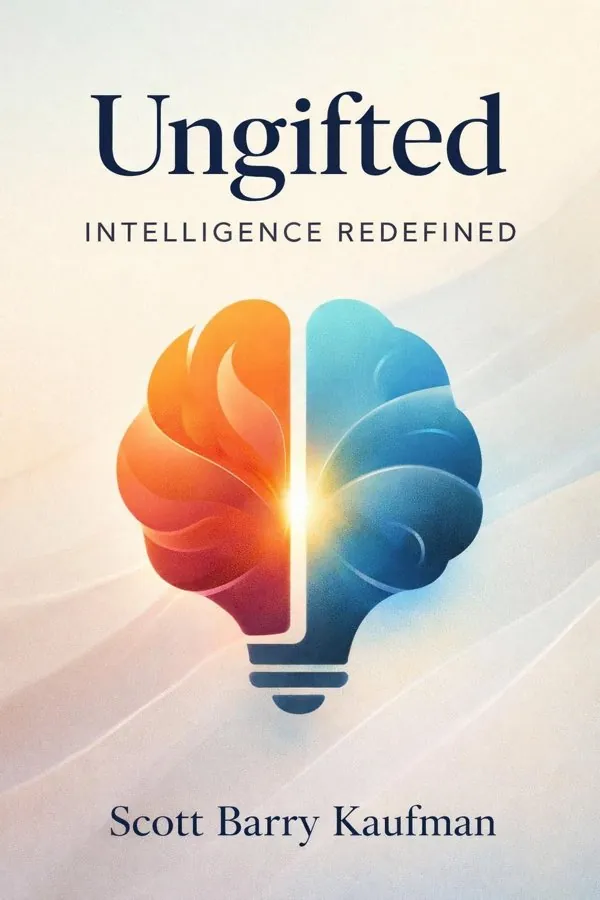
Ungifted: Intelligence Redefined: Summary & Key Insights
 10 min11 chaptersAudio available
What Is Ungifted: Intelligence Redefined About?
Ungifted: Intelligence Redefined by Scott Barry Kaufman is a psychology book spanning 11 pages. In this groundbreaking work, psychologist Scott Barry Kaufman challenges traditional notions of intelligence and giftedness. Drawing on cutting-edge research in cognitive science, neuroscience, and psychology, Kaufman argues that intelligence is not a fixed trait measured solely by IQ tests but a dynamic, multifaceted capacity shaped by creativity, motivation, and personal meaning. The book explores how diverse forms of intelligence can flourish when individuals are given the freedom to pursue their passions and develop their unique potential.
This FizzRead summary covers all 11 key chapters of Ungifted: Intelligence Redefined in approximately 10 minutes, distilling the most important ideas, arguments, and takeaways from Scott Barry Kaufman's work. Also available as an audio summary and Key Quotes Podcast.
Ungifted: Intelligence Redefined
In this groundbreaking work, psychologist Scott Barry Kaufman challenges traditional notions of intelligence and giftedness. Drawing on cutting-edge research in cognitive science, neuroscience, and psychology, Kaufman argues that intelligence is not a fixed trait measured solely by IQ tests but a dynamic, multifaceted capacity shaped by creativity, motivation, and personal meaning. The book explores how diverse forms of intelligence can flourish when individuals are given the freedom to pursue their passions and develop their unique potential.
Who Should Read Ungifted: Intelligence Redefined?
This book is perfect for anyone interested in psychology and looking to gain actionable insights in a short read. Whether you're a student, professional, or lifelong learner, the key ideas from Ungifted: Intelligence Redefined by Scott Barry Kaufman will help you think differently.
- ✓Readers who enjoy psychology and want practical takeaways
- ✓Professionals looking to apply new ideas to their work and life
- ✓Anyone who wants the core insights of Ungifted: Intelligence Redefined in just 10 minutes
Want the full summary?
Get instant access to this book summary and 100K+ more with Fizz Moment.
Get Free SummaryAvailable on App Store • Free to download
Key Chapters
To understand how deeply the notion of fixed intelligence has shaped our institutions, we have to revisit its origins. The story begins in the late nineteenth century, when psychologists like Francis Galton and later Alfred Binet attempted to quantify mental ability. Galton’s obsession with measurement launched the idea that cognitive skill could be captured through standardized metrics. Binet’s pioneering work intended to help identify children who needed extra support—not to label the gifted or ungifted. Yet, when his methods crossed the Atlantic, the purpose changed. In America, intelligence testing became a gatekeeper.
Through the twentieth century, the IQ test evolved from a simple diagnostic tool into a cultural emblem. Charles Spearman’s concept of 'g', or general intelligence, further reinforced the idea that there was a single core mental capacity underlying all others. The military, school systems, and even immigration authorities adopted these metrics to classify people. Standardized testing came to symbolize fairness and objectivity, but beneath that promise lurked a profound limitation: the assumption that intelligence is stable and measurable through logical reasoning and verbal ability alone.
This institutionalization of testing overlooked creativity, emotional intelligence, and social skill. It ignored motivation and didn’t account for the vast variability in how minds develop. IQ tests became, as I often describe, a measuring stick for potential—a stick that never quite fits the shape of a human being. My goal here wasn’t to dismiss psychometrics but to illuminate their historical context: these tests were designed to simplify a complex reality. In doing so, they unintentionally diminished the very diversity they sought to understand.
Throughout my career, I have been haunted by a question: if intelligence is truly fixed, how do people achieve transformations that seem impossible within conventional boundaries? Consider a child written off as low-performing who later becomes a creative innovator or leader. Such stories aren’t exceptions—they are evidence against rigidity.
Fixed intelligence models rest on the belief that mental capacity is biologically constrained. But decades of psychological and neuroscientific research reveal that the mind is far more adaptable. Intelligence isn’t a single reservoir of ability; it’s a dynamic interplay among attention, memory, creativity, and emotion. Traditional models also neglect the role of identity and motivation. When a student feels seen and valued, their cognitive performance can change dramatically—not through magic, but through engagement.
In 'Ungifted,' I dismantle the cultural myth that people’s careers and capacities can be predicted by early test performances. I explain how these metrics ignore developmental plasticity—the brain’s ability to adapt and reorganize—and how they conflate potential with performance. We cling to fixed models because they make prediction easy and status clear. But true intelligence, as I argue, resists simplification. It grows in complexity and richness precisely when life challenges the boundaries of what we thought we knew.
+ 9 more chapters — available in the FizzRead app
All Chapters in Ungifted: Intelligence Redefined
About the Author
Scott Barry Kaufman is an American cognitive scientist and humanistic psychologist known for his research on intelligence, creativity, and the human potential. He has taught at Columbia University, the University of Pennsylvania, and other institutions, and is the author of several influential books on psychology and personal growth.
Get This Summary in Your Preferred Format
Read or listen to the Ungifted: Intelligence Redefined summary by Scott Barry Kaufman anytime, anywhere. FizzRead offers multiple formats so you can learn on your terms — all free.
Available formats: App · Audio · PDF · EPUB — All included free with FizzRead
Download Ungifted: Intelligence Redefined PDF and EPUB Summary
Key Quotes from Ungifted: Intelligence Redefined
“To understand how deeply the notion of fixed intelligence has shaped our institutions, we have to revisit its origins.”
“Throughout my career, I have been haunted by a question: if intelligence is truly fixed, how do people achieve transformations that seem impossible within conventional boundaries?”
Frequently Asked Questions about Ungifted: Intelligence Redefined
Ungifted: Intelligence Redefined by Scott Barry Kaufman is a psychology book that explores key ideas across 11 chapters. In this groundbreaking work, psychologist Scott Barry Kaufman challenges traditional notions of intelligence and giftedness. Drawing on cutting-edge research in cognitive science, neuroscience, and psychology, Kaufman argues that intelligence is not a fixed trait measured solely by IQ tests but a dynamic, multifaceted capacity shaped by creativity, motivation, and personal meaning. The book explores how diverse forms of intelligence can flourish when individuals are given the freedom to pursue their passions and develop their unique potential.
More by Scott Barry Kaufman
You Might Also Like
The Body Keeps the Score
Bessel van der Kolk
10 min
Surrounded by Idiots
Thomas Erikson
10 min
Emotional Intelligence
Daniel Goleman
10 min
Attached
Amir Levine
10 min
Why Does He Do That
Lundy Bancroft
10 min
Women Who Run with the Wolves
Clarissa Pinkola Estés
10 minBrowse by Category
Ready to read Ungifted: Intelligence Redefined?
Get the full summary and 100K+ more books with Fizz Moment.