
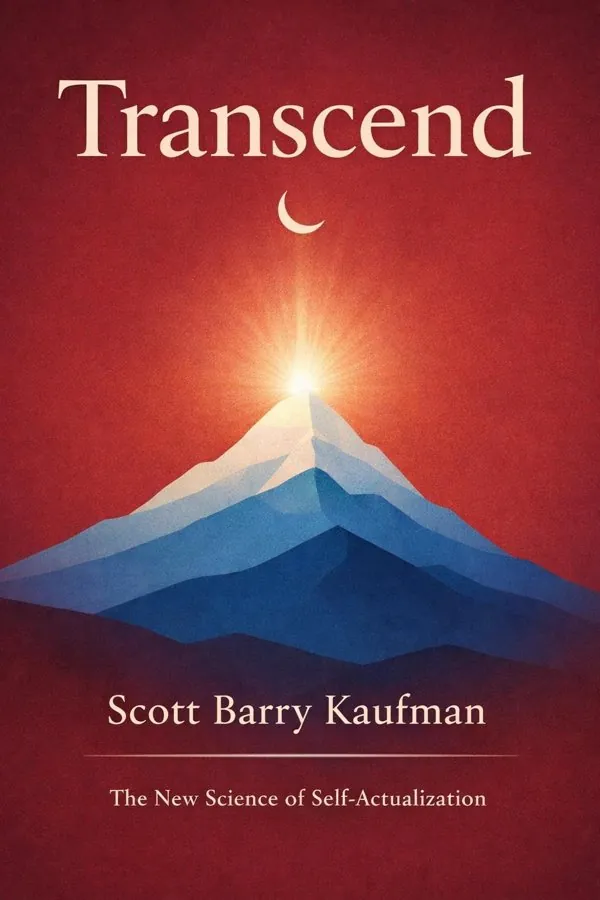
Transcend: The New Science of Self-Actualization: Summary & Key Insights
 10 min9 chaptersAudio available
What Is Transcend: The New Science of Self-Actualization About?
Transcend: The New Science of Self-Actualization by Scott Barry Kaufman is a positive_psych book spanning 9 pages. In this groundbreaking work, psychologist Scott Barry Kaufman reimagines Abraham Maslow’s hierarchy of needs for the modern era. Drawing on cutting-edge research in psychology and neuroscience, Kaufman explores how individuals can move beyond basic survival and security toward creativity, purpose, and transcendence. The book integrates scientific insights with practical guidance for achieving self-actualization and living a more fulfilling life.
This FizzRead summary covers all 9 key chapters of Transcend: The New Science of Self-Actualization in approximately 10 minutes, distilling the most important ideas, arguments, and takeaways from Scott Barry Kaufman's work. Also available as an audio summary and Key Quotes Podcast.
Transcend: The New Science of Self-Actualization
In this groundbreaking work, psychologist Scott Barry Kaufman reimagines Abraham Maslow’s hierarchy of needs for the modern era. Drawing on cutting-edge research in psychology and neuroscience, Kaufman explores how individuals can move beyond basic survival and security toward creativity, purpose, and transcendence. The book integrates scientific insights with practical guidance for achieving self-actualization and living a more fulfilling life.
Who Should Read Transcend: The New Science of Self-Actualization?
This book is perfect for anyone interested in positive_psych and looking to gain actionable insights in a short read. Whether you're a student, professional, or lifelong learner, the key ideas from Transcend: The New Science of Self-Actualization by Scott Barry Kaufman will help you think differently.
- ✓Readers who enjoy positive_psych and want practical takeaways
- ✓Professionals looking to apply new ideas to their work and life
- ✓Anyone who wants the core insights of Transcend: The New Science of Self-Actualization in just 10 minutes
Want the full summary?
Get instant access to this book summary and 100K+ more with Fizz Moment.
Get Free SummaryAvailable on App Store • Free to download
Key Chapters
One of the first things I ask readers to reconsider is the idea that human needs rise in a simple sequence. Maslow’s model was never intended to be a rigid ladder where one need must be perfectly satisfied before another can emerge. Yet that interpretation became common, and it constrains how we view human potential. In reality, our motivations are dynamic and fluid; they shift with context, emotion, and environment.
Through decades of psychological research, we now understand that security and growth coexist in continual tension. We seek safety because it stabilizes us, but we also seek novelty because it energizes us. The interplay between these drives is the essence of psychological vitality. I show how needs for competence, connection, autonomy, and purpose overlap, influencing each other through feedback loops rather than discrete stages. Neuroscience supports this view: the same brain networks that regulate fear also guide curiosity. Survival mechanisms and creative impulses are wired together, each informing the other as we adapt to our surroundings.
Our motivation arises from integration, not separation. When we honor both our protective instincts and our expansive aspirations, we discover resilience—the capacity to recover and grow from challenge. In this sense, human development is less about climbing upward and more about learning to balance opposing forces within a complex ecosystem of needs. Recognizing this interdependence frees us from the illusion that self-improvement requires perfection. Growth happens in motion, amid turbulence, when we learn to hold both security and wonder in the same breath.
Before we can open our sails to the winds of exploration, we must ensure our hull is secure. Security is not merely about physical safety—it encompasses emotional grounding, trust, belonging, and self-esteem. It gives us a place to return to when life’s waves grow rough. Yet paradoxically, too much emphasis on security can lead to stagnation. Fear of the unknown often masquerades as prudence. My research shows that psychological health thrives on balance between safety and challenge. People who feel securely attached to others, who trust in their value and place in the world, are far more likely to take creative risks and pursue ambitious goals.
I emphasize that growth is not the absence of fear but the mastery of it. Security provides the confidence to step into uncertainty without being paralyzed. In the sailboat metaphor, the hull protects us, while the sail catches the wind. Both must work together. If the hull is cracked, we sink; if the sail is furled, we remain adrift. True wellbeing comes when we can strengthen our foundation while staying open to new exploration.
To cultivate this state, we need relationships that affirm our worth and an internal narrative that supports our sense of competence. Security does not mean avoiding failure—it means believing that failure does not define us. When that foundation is in place, growth naturally follows, not as forced achievement but as authentic unfolding of potential.
+ 7 more chapters — available in the FizzRead app
All Chapters in Transcend: The New Science of Self-Actualization
About the Author
Scott Barry Kaufman is an American cognitive scientist and humanistic psychologist known for his research on intelligence, creativity, and self-actualization. He has taught at Columbia University, NYU, and the University of Pennsylvania, and hosts the popular psychology podcast 'The Psychology Podcast'.
Get This Summary in Your Preferred Format
Read or listen to the Transcend: The New Science of Self-Actualization summary by Scott Barry Kaufman anytime, anywhere. FizzRead offers multiple formats so you can learn on your terms — all free.
Available formats: App · Audio · PDF · EPUB — All included free with FizzRead
Download Transcend: The New Science of Self-Actualization PDF and EPUB Summary
Key Quotes from Transcend: The New Science of Self-Actualization
“One of the first things I ask readers to reconsider is the idea that human needs rise in a simple sequence.”
“Before we can open our sails to the winds of exploration, we must ensure our hull is secure.”
Frequently Asked Questions about Transcend: The New Science of Self-Actualization
Transcend: The New Science of Self-Actualization by Scott Barry Kaufman is a positive_psych book that explores key ideas across 9 chapters. In this groundbreaking work, psychologist Scott Barry Kaufman reimagines Abraham Maslow’s hierarchy of needs for the modern era. Drawing on cutting-edge research in psychology and neuroscience, Kaufman explores how individuals can move beyond basic survival and security toward creativity, purpose, and transcendence. The book integrates scientific insights with practical guidance for achieving self-actualization and living a more fulfilling life.
More by Scott Barry Kaufman

You Might Also Like

Don't Sweat the Small Stuff... and It's All Small Stuff
Richard Carlson
10 min
Option B
Sheryl Sandberg & Adam Grant
10 min
Hallelujah Anyway: Rediscovering Mercy
Anne Lamott
10 min
I Can Do It: How to Use Affirmations to Change Your Life
Louise Hay
10 min
The Coffee Bean: A Simple Lesson to Create Positive Change
Jon Gordon, Damon West
10 min
The Happiness Hypothesis: Finding Modern Truth in Ancient Wisdom
Jonathan Haidt
10 minBrowse by Category
Ready to read Transcend: The New Science of Self-Actualization?
Get the full summary and 100K+ more books with Fizz Moment.