
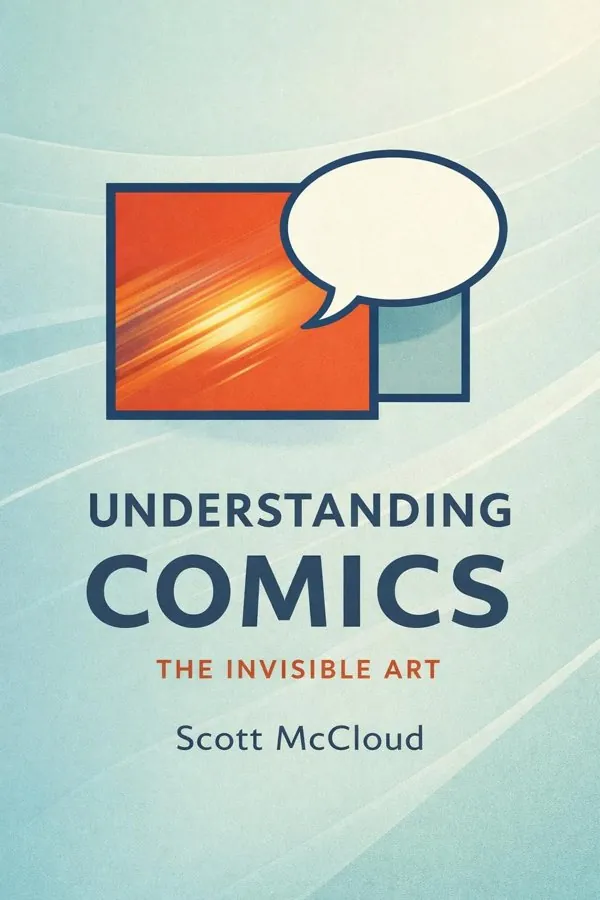
Understanding Comics: The Invisible Art: Summary & Key Insights
 10 min10 chaptersAudio available
What Is Understanding Comics: The Invisible Art About?
Understanding Comics: The Invisible Art by Scott McCloud is a creativity book spanning 10 pages. Understanding Comics: The Invisible Art is a groundbreaking work that explores the theory, structure, and language of comics as a medium. Scott McCloud dissects how comics communicate through the interplay of words and images, examining concepts such as time, motion, and visual metaphor. The book is both an academic analysis and a creative manifesto, presented in comic form itself, making it accessible and engaging for readers and artists alike.
This FizzRead summary covers all 10 key chapters of Understanding Comics: The Invisible Art in approximately 10 minutes, distilling the most important ideas, arguments, and takeaways from Scott McCloud's work. Also available as an audio summary and Key Quotes Podcast.
Understanding Comics: The Invisible Art
Understanding Comics: The Invisible Art is a groundbreaking work that explores the theory, structure, and language of comics as a medium. Scott McCloud dissects how comics communicate through the interplay of words and images, examining concepts such as time, motion, and visual metaphor. The book is both an academic analysis and a creative manifesto, presented in comic form itself, making it accessible and engaging for readers and artists alike.
Who Should Read Understanding Comics: The Invisible Art?
This book is perfect for anyone interested in creativity and looking to gain actionable insights in a short read. Whether you're a student, professional, or lifelong learner, the key ideas from Understanding Comics: The Invisible Art by Scott McCloud will help you think differently.
- ✓Readers who enjoy creativity and want practical takeaways
- ✓Professionals looking to apply new ideas to their work and life
- ✓Anyone who wants the core insights of Understanding Comics: The Invisible Art in just 10 minutes
Want the full summary?
Get instant access to this book summary and 100K+ more with Fizz Moment.
Get Free SummaryAvailable on App Store • Free to download
Key Chapters
To understand what comics are, we have to remember that sequential art has ancient roots. The medium didn’t appear overnight with superhero costumes or Sunday strips—it’s as old as humanity’s will to narrate. In Egyptian tomb paintings, the Bayeux Tapestry, and pre-Columbian codices, we already see the basic impulse to arrange images in deliberate sequence. What we call comics today simply inherits and refines this ancient continuum.
I trace this lineage to remind readers that comics aren’t a modern fad; they’re a natural evolution of visual communication. The only difference is that the printing press, mass literacy, and the rise of popular culture gave sequential art a new playground. When Rodolphe Töpffer published his humorous picture stories in the 19th century, he began fusing text and image in a form recognizable to modern eyes. By the time of *The Yellow Kid* or Winsor McCay’s *Little Nemo*, the structure of what we call comics—panels in sequence, word balloons, stylized art—was in place.
But evolution is more than history—it’s transformation. Understanding where comics came from helps us recognize how artists continually reinvent the medium, shaping new ways to think visually. Comics’ roots stretch deeply through time, and acknowledging that depth gives legitimacy to their status as an art form.
Every art form has its grammar, its invisible set of rules for meaning-making. For comics, that grammar lives in panels, borders, balloons, and, above all, in the space between them—the gutter. In that silent white expanse between frames, your mind performs a small miracle. You see one image of a raised axe and another of a scream, and instantly you know what happened in between. That act of connecting the unseen is what I call *closure*.
Closure is the secret sauce of comics. It allows static drawings to move, still faces to speak, and time itself to flow on a two-dimensional page. Explain closure, and you understand how comics transform static design into living sequence. Each panel is a frozen moment; the reader completes the motion. The magic lies in participation—your brain becomes the projector that turns pictures into narrative.
Once you grasp this vocabulary, you’ll see comics everywhere—not just in books, but in diagrams, ads, and storyboards. Sequential art is a universal language, and learning to speak it opens new ways to think visually.
+ 8 more chapters — available in the FizzRead app
All Chapters in Understanding Comics: The Invisible Art
About the Author
Scott McCloud is an American cartoonist and theorist best known for his works on comics theory, including Understanding Comics, Reinventing Comics, and Making Comics. His innovative approach to explaining the mechanics and artistry of comics has made him a leading voice in the study of visual storytelling.
Get This Summary in Your Preferred Format
Read or listen to the Understanding Comics: The Invisible Art summary by Scott McCloud anytime, anywhere. FizzRead offers multiple formats so you can learn on your terms — all free.
Available formats: App · Audio · PDF · EPUB — All included free with FizzRead
Download Understanding Comics: The Invisible Art PDF and EPUB Summary
Key Quotes from Understanding Comics: The Invisible Art
“To understand what comics are, we have to remember that sequential art has ancient roots.”
“Every art form has its grammar, its invisible set of rules for meaning-making.”
Frequently Asked Questions about Understanding Comics: The Invisible Art
Understanding Comics: The Invisible Art by Scott McCloud is a creativity book that explores key ideas across 10 chapters. Understanding Comics: The Invisible Art is a groundbreaking work that explores the theory, structure, and language of comics as a medium. Scott McCloud dissects how comics communicate through the interplay of words and images, examining concepts such as time, motion, and visual metaphor. The book is both an academic analysis and a creative manifesto, presented in comic form itself, making it accessible and engaging for readers and artists alike.
More by Scott McCloud
You Might Also Like
Dimensions Of Creativity
Margaret A. Boden
10 min
How to Fly a Horse: The Secret History of Creation, Invention, and Discovery
Kevin Ashton
10 min
Imagine: How Creativity Works
Jonah Lehrer
10 min
The Accidental Creative: How to Be Brilliant at a Moment's Notice
Todd Henry
10 min
The Origins of Creativity
Edward O. Wilson
10 min
Wired to Create: Unraveling the Mysteries of the Creative Mind
Scott Barry Kaufman, Carolyn Gregoire
10 minBrowse by Category
Ready to read Understanding Comics: The Invisible Art?
Get the full summary and 100K+ more books with Fizz Moment.