
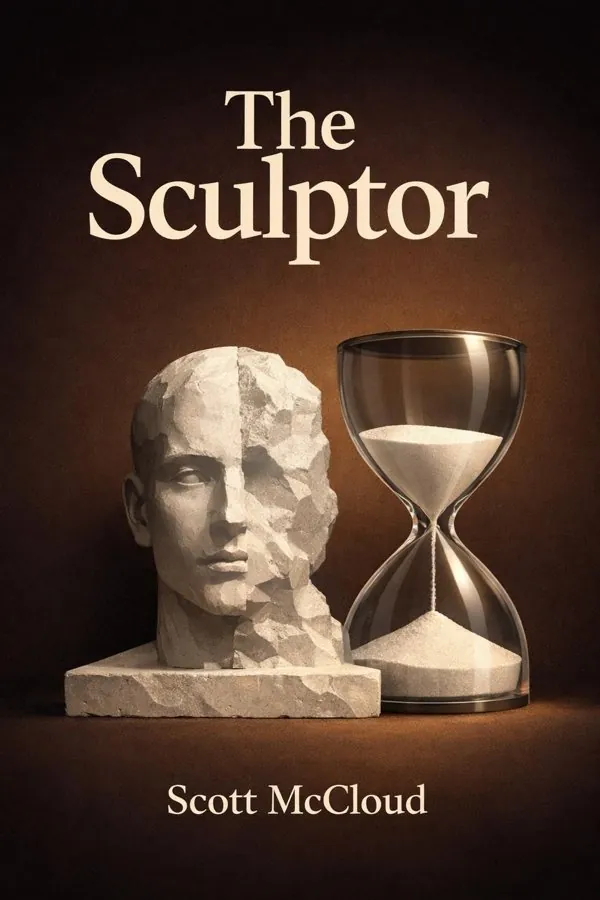
The Sculptor: Summary & Key Insights
 10 min9 chaptersAudio available
Key Takeaways from The Sculptor
Great talent alone does not free a creator; sometimes the real prison is time.
A life organized entirely around achievement can become strangely hollow, even when the dream is noble.
Many creators say they want to make something that lasts, but few examine what “lasting” really means.
Passion is often praised without qualification, but obsession can quietly turn a calling into a cage.
Many people believe their greatest work will begin once conditions are finally perfect.
What Is The Sculptor About?
The Sculptor by Scott McCloud is a creativity book spanning 3 pages. What would you trade to make the work you know is inside you? That question drives The Sculptor, Scott McCloud’s haunting graphic novel about David Smith, a talented but forgotten New York artist who strikes a bargain with Death: for 200 days, he will be able to shape any material with his bare hands into whatever he imagines. After that, he dies. What follows is not just a high-concept fantasy, but a deeply emotional story about ambition, love, failure, and the unbearable pressure of limited time. As David races to create something meaningful, he discovers that artistic greatness cannot be separated from human connection, vulnerability, and loss. The book matters because it speaks to anyone who has ever wanted to leave a mark on the world, whether through art, work, family, or ideas. McCloud brings unusual authority to this story. Best known for Understanding Comics and Making Comics, he is one of the most influential thinkers on visual storytelling. In The Sculptor, he uses that mastery not to lecture, but to deliver a visually inventive and emotionally devastating meditation on creativity and mortality.
This FizzRead summary covers all 9 key chapters of The Sculptor in approximately 10 minutes, distilling the most important ideas, arguments, and takeaways from Scott McCloud's work. Also available as an audio summary and Key Quotes Podcast.
The Sculptor
What would you trade to make the work you know is inside you? That question drives The Sculptor, Scott McCloud’s haunting graphic novel about David Smith, a talented but forgotten New York artist who strikes a bargain with Death: for 200 days, he will be able to shape any material with his bare hands into whatever he imagines. After that, he dies. What follows is not just a high-concept fantasy, but a deeply emotional story about ambition, love, failure, and the unbearable pressure of limited time. As David races to create something meaningful, he discovers that artistic greatness cannot be separated from human connection, vulnerability, and loss. The book matters because it speaks to anyone who has ever wanted to leave a mark on the world, whether through art, work, family, or ideas. McCloud brings unusual authority to this story. Best known for Understanding Comics and Making Comics, he is one of the most influential thinkers on visual storytelling. In The Sculptor, he uses that mastery not to lecture, but to deliver a visually inventive and emotionally devastating meditation on creativity and mortality.
Who Should Read The Sculptor?
This book is perfect for anyone interested in creativity and looking to gain actionable insights in a short read. Whether you're a student, professional, or lifelong learner, the key ideas from The Sculptor by Scott McCloud will help you think differently.
- ✓Readers who enjoy creativity and want practical takeaways
- ✓Professionals looking to apply new ideas to their work and life
- ✓Anyone who wants the core insights of The Sculptor in just 10 minutes
Want the full summary?
Get instant access to this book summary and 100K+ more with Fizz Moment.
Get Free SummaryAvailable on App Store • Free to download
Key Chapters
Great talent alone does not free a creator; sometimes the real prison is time. In The Sculptor, David Smith begins as a young sculptor whose early promise has curdled into obscurity, debt, resentment, and despair. When Death appears in the form of David’s late uncle, the encounter feels less like a supernatural attack than a grim recognition of how trapped David already is. Death offers him a terrifying gift: for 200 days, David will be able to sculpt anything he imagines with his hands, shaping metal, stone, wood, or any other material instantly. In exchange, his life will end when the deadline arrives.
This bargain gives physical form to a truth most artists eventually face: every creative life is finite, but we often behave as if there will always be more time. David’s deal externalizes the urgency that many people only dimly feel. Suddenly, every day matters. Every distraction has a cost. Every choice becomes moral as well as practical.
The power itself is also symbolic. David no longer struggles with technique, tools, or execution. The bottleneck is no longer craft, but judgment, purpose, and emotional clarity. That mirrors real life more than it first appears. Many creators think their problem is lack of resources, software, equipment, connections, or time. Sometimes those are real barriers. But often the harder problem is deciding what is actually worth making.
In practical terms, David’s bargain asks readers to consider their own invisible deadline. What project have you postponed because you assume there will be a better moment? What conversation, body of work, or experiment have you delayed out of fear? The book suggests that urgency can be painful, but also clarifying. Actionable takeaway: choose one meaningful creative goal and give it a concrete deadline that forces commitment rather than endless preparation.
A life organized entirely around achievement can become strangely hollow, even when the dream is noble. David enters The Sculptor believing that artistic greatness will justify everything: loneliness, humiliation, obsession, and sacrifice. Then Meg arrives, and the emotional geometry of the book changes. She is messy where David is severe, improvisational where he is controlling, luminous where he is withdrawn. An aspiring actress struggling with mental health, instability, and her own uncertain future, Meg is not a tidy source of inspiration. She is fully human, and that is precisely why she matters.
Their relationship becomes one of the book’s most powerful revelations. Meg does not simply motivate David to make better art. She challenges the very hierarchy that places art above life. Through her, David experiences joy that is unstrategic and unearned. He begins to see that being witnessed, loved, and interrupted by another person is not a distraction from meaning; it is one of meaning’s central forms.
McCloud avoids reducing romance to a cure-all. Meg is not there to fix David, nor is David equipped to save Meg. Their bond is tender but fragile, shaped by misunderstanding, emotional volatility, and the secret of David’s impending death. Yet even in its instability, the relationship humanizes David in a way artistic ambition alone never could.
This idea applies beyond romantic love. Many driven people quietly believe they must earn connection after they prove themselves. The Sculptor argues the reverse: connection may be what allows work to matter at all. A fulfilling life rarely comes from maximizing output while minimizing vulnerability.
Consider how often you treat relationships as interruptions to your “real work.” The book invites a different view. Conversations, affection, care, and presence are not detours from a meaningful life; they are evidence of one. Actionable takeaway: invest deliberate time in one important relationship this week without treating it as secondary to productivity.
Many creators say they want to make something that lasts, but few examine what “lasting” really means. As David’s 200 days begin running out, The Sculptor turns from fantasy and romance toward legacy, grief, and the painful gap between private meaning and public recognition. David wants to produce an undeniable masterpiece, something so original and overwhelming that the world will finally see him. Yet the closer he gets to death, the less stable that ambition becomes. He must face a brutal question: is art valuable because it secures remembrance, or because it expresses a truth in the time we have?
The final phase of David’s journey is saturated with loss. He loses illusions about fame, control, and the idea that one single creation can resolve a life. He also confronts the fact that love and art cannot protect anyone from mortality. This is where McCloud’s emotional and thematic ambition becomes clearest. The ending does not merely ask whether David will finish his work; it asks what counts as completion in a finite life.
Legacy in the book is not treated as simple immortality. Public acclaim is fickle. People misread art, ignore it, commodify it, or discover it too late. Yet this does not make creation meaningless. Instead, McCloud suggests that art matters because it records attention. It is a human being saying, “I saw this, felt this, and shaped this while I was here.” That is smaller than immortality, but truer.
In practical life, many people postpone meaningful expression because they imagine they need one grand, definitive achievement. The Sculptor resists that fantasy. A body of sincere work, a moment of courage, or an honest act of making may matter more than the perfect monument.
Actionable takeaway: stop measuring your creative efforts only by permanence or applause; focus on making one piece of work that honestly captures what feels urgent to you now.
Passion is often praised without qualification, but obsession can quietly turn a calling into a cage. David is not merely committed to sculpture; he is consumed by it. He experiences artistic frustration as a verdict on his worth, and he treats recognition not as a bonus but as proof that his life matters. This gives The Sculptor much of its intensity. David’s hunger to create is real and admirable, yet it is also corrosive. It narrows his vision, isolates him from others, and makes him vulnerable to destructive choices.
McCloud’s portrayal is especially sharp because David’s obsession is understandable. He has talent, he has been overlooked, and he lives in a culture that romanticizes the suffering artist. The idea that true art requires total sacrifice feels seductive, especially to people who fear mediocrity. But the novel exposes the hidden costs of that mythology. If everything is sacrificed to the work, the work may become burdened with impossible expectations. It must provide identity, love, justice, transcendence, and permanence all at once.
That dynamic is not limited to artists. Entrepreneurs, academics, founders, performers, and even parents can over-identify with one role until every setback feels existential. When a project becomes the sole container for meaning, failure becomes intolerable and success becomes strangely unsatisfying.
A healthier approach does not mean becoming less serious. It means allowing your work to be important without allowing it to consume the whole self. Ambition works best when it is held inside a larger life that includes friendship, rest, play, grief, and change.
Ask yourself whether your current pursuit is still serving your values or has started to replace them. If your identity vanished with your latest project, what would remain? Actionable takeaway: define yourself in at least three ways beyond your primary work so that purpose is distributed rather than dangerously concentrated.
Many people believe their greatest work will begin once conditions are finally perfect. The Sculptor dismantles that comforting illusion. David starts with what seems like the ultimate advantage: instant mastery over materials. No technical barrier remains. He can execute breathtaking sculptures on command, at scale, with impossible speed. But this miraculous power does not remove uncertainty. In some ways, it intensifies it. If he can make anything, then what should he make? If execution is effortless, then ideas and intention become the real challenge.
This is one of McCloud’s most practical insights for creative readers. We often tell ourselves that progress depends on external upgrades: more time, better tools, more money, more expertise, more validation. Those things can help, but they do not solve the central problem of art, which is choosing what deserves your attention and why. Unlimited possibility can produce paralysis just as easily as freedom.
David’s struggle shows that waiting for perfect readiness is a way of avoiding vulnerability. The imagined future masterpiece becomes safer than the actual imperfect work you could begin today. It remains pure because it remains unrealized.
In everyday life, this appears as endless outlining without drafting, buying equipment without practicing, researching without publishing, or postponing projects until your confidence catches up. But confidence often follows commitment rather than preceding it. Clarity emerges through making, not before it.
The book encourages a humbler and more productive mindset. Instead of asking, “What is the one great work that will prove me?” ask, “What honest work can I make with what I know right now?” That question reduces fantasy and increases movement.
Actionable takeaway: choose a project you have been overplanning and complete a rough first version within a short, fixed window, even if it falls far short of your ideal.
Deadlines reveal priorities. That is the cruel and clarifying engine of The Sculptor. David’s 200-day lifespan does not merely compress the plot; it changes the moral weight of ordinary decisions. Sleep, conversation, experiments, detours, and hesitation all become charged. Under extreme time pressure, he cannot pretend that all desires are equally important. He must choose, and each choice excludes another possible life.
This gives the novel its unusual power as a meditation on mortality. Death is not presented only as an ending but as a framing device. Because life is limited, meaning cannot be abstract. It has to show up in calendars, commitments, and trade-offs. The fantasy premise dramatizes what is already true for everyone: our lives are finite enough that every yes quietly contains a no.
For readers, this insight can be both unsettling and liberating. Many people experience low-level anxiety not because they are doing nothing, but because they are trying to keep every option open. They avoid committing to a path, project, or person because commitment feels like loss. The Sculptor suggests the opposite. Refusing to choose is also a choice, and often a more costly one than we admit.
Mortality can sharpen presence rather than produce despair. Knowing time is limited may encourage us to stop performing busyness and start honoring what genuinely matters. That might mean making more art, but it could also mean reconciling with someone, protecting your health, or reducing distractions that consume attention without enriching life.
A useful exercise is to ask what your schedule would look like if you treated time as precious rather than reusable. Which obligations would remain? Which ambitions would seem inflated? Which pleasures would become essential? Actionable takeaway: review your next seven days and remove one low-value commitment to make room for something meaningfully aligned with your values.
Some stories tell you what a character feels; The Sculptor often lets you inhabit it. Scott McCloud’s expertise in comics theory gives the novel a distinctive power: its ideas are not only written into dialogue and plot, but built into pacing, layout, scale, movement, and silence. Expansive cityscapes emphasize alienation. Sudden panel shifts create panic or tenderness. The blue-toned visual world gives the book a dreamlike melancholy that reinforces its themes of longing, distance, and inevitability.
This matters because The Sculptor is not just a story about creativity; it is an argument for what comics can do. McCloud uses the medium to collapse external action and internal experience. A sculptural gesture can feel instantaneous and miraculous. A moment of intimacy can stretch across the page. A descent into grief can be rendered not through explanation alone, but through rhythm and visual fragmentation.
For readers and creators alike, this offers a broader lesson about communication. Form is not decoration. The way an idea is presented shapes its emotional force and memorability. A teacher choosing an example, a manager structuring a presentation, a designer arranging information, or a writer pacing a story is doing more than packaging content. They are influencing how meaning is felt.
The practical application is to think less about what you want to say in isolation and more about the experience through which others will receive it. Dense information may need visual simplification. A difficult message may need narrative framing. Emotional truth may require pause, contrast, or image rather than explanation.
Actionable takeaway: when sharing an important idea, redesign the form as carefully as the content by asking how structure, sequence, and visual presentation can make your message clearer and more emotionally resonant.
External validation feels essential when you are deprived of it, but it rarely solves the deeper hunger beneath ambition. David spends much of The Sculptor chasing recognition: from galleries, critics, peers, and the broader public. He wants the world to confirm what he suspects about his talent. This desire is understandable. Artists need audiences, and neglect can be painful and materially damaging. Yet McCloud shows that recognition, while meaningful, is unstable as a foundation for self-worth.
The reason is simple: acclaim is delayed, uneven, often political, and never complete. Even if David were fully celebrated, praise could not erase mortality, guarantee love, or settle every doubt. The artist who builds identity on applause becomes permanently dependent on forces outside personal control. The result is a life of emotional volatility, where every reception becomes a referendum on the self.
This pattern extends far beyond art. Social media metrics, promotions, awards, academic prestige, and public reputation can become addictive substitutes for grounded purpose. They provide spikes of reassurance, but rarely lasting peace. When pursued without an internal compass, they create a treadmill of comparison.
The Sculptor does not dismiss audience or legacy. It simply insists that they are not enough. Meaningful work usually requires a different anchor: curiosity, devotion to craft, service to others, emotional honesty, or love of the process itself. Recognition can then become welcome feedback rather than spiritual oxygen.
A practical way to test your motives is to imagine doing your current project anonymously. Would it still feel worth doing? If the answer is no, that does not mean quit, but it may mean your motivational structure needs rebalancing.
Actionable takeaway: define one internal measure of success for your work this month, such as consistency, honesty, or growth, and track that instead of relying only on external response.
The deepest insight in The Sculptor is not that art conquers death, but that art becomes meaningful because death cannot be conquered. David’s powers are extraordinary, yet they do not grant rescue from human limits. The more he tries to force permanence, the more the story returns him to a humbler truth: creativity is precious precisely because it is temporary, embodied, and made under conditions of uncertainty.
This is why the novel resonates with readers beyond the art world. You do not need to be a sculptor to understand David’s longing. Anyone who has tried to build something meaningful in a finite life will recognize it. A business, a family, a performance, a research project, a community, even a small private act of beauty all carry the same fragile dignity. We make because we will not be here forever.
McCloud’s achievement is to hold despair and hope together. The book does not deny loss. It insists on it. But within that reality, it locates a fierce tenderness. To care, to make, to love, and to offer one’s inner life outward are all risky acts. They matter not because they guarantee permanence, but because they honor existence while it is still unfolding.
In practical terms, this can soften perfectionism. If your work is part of a mortal life rather than a bid for invulnerability, then sincerity may matter more than flawlessness. You can aim high without requiring transcendence.
When you next feel the pressure to produce something immortal, remember that even temporary acts can shape lives. A piece of art, a note, a performance, a lesson, or a generous act can ripple far beyond its moment.
Actionable takeaway: create or share one small thing this week not because it will last forever, but because it is true, generous, and alive right now.
All Chapters in The Sculptor
About the Author
Scott McCloud is an American cartoonist, writer, and comics theorist widely recognized as one of the most important voices in modern comics. He gained international acclaim through Understanding Comics, a groundbreaking exploration of how comics work as a visual and narrative medium. He later expanded those ideas in Reinventing Comics and Making Comics, influencing generations of artists, educators, and readers. McCloud is known for combining intellectual clarity with deep enthusiasm for the possibilities of visual storytelling. In The Sculptor, he brings that expertise into a large-scale fictional work, using the graphic novel form to explore creativity, mortality, and human connection with unusual formal sophistication. His work has helped elevate comics as both an art form and a serious mode of literary expression.
Get This Summary in Your Preferred Format
Read or listen to the The Sculptor summary by Scott McCloud anytime, anywhere. FizzRead offers multiple formats so you can learn on your terms — all free.
Available formats: App · Audio · PDF · EPUB — All included free with FizzRead
Download The Sculptor PDF and EPUB Summary
Key Quotes from The Sculptor
“Great talent alone does not free a creator; sometimes the real prison is time.”
“A life organized entirely around achievement can become strangely hollow, even when the dream is noble.”
“Many creators say they want to make something that lasts, but few examine what “lasting” really means.”
“Passion is often praised without qualification, but obsession can quietly turn a calling into a cage.”
“Many people believe their greatest work will begin once conditions are finally perfect.”
Frequently Asked Questions about The Sculptor
The Sculptor by Scott McCloud is a creativity book that explores key ideas across 9 chapters. What would you trade to make the work you know is inside you? That question drives The Sculptor, Scott McCloud’s haunting graphic novel about David Smith, a talented but forgotten New York artist who strikes a bargain with Death: for 200 days, he will be able to shape any material with his bare hands into whatever he imagines. After that, he dies. What follows is not just a high-concept fantasy, but a deeply emotional story about ambition, love, failure, and the unbearable pressure of limited time. As David races to create something meaningful, he discovers that artistic greatness cannot be separated from human connection, vulnerability, and loss. The book matters because it speaks to anyone who has ever wanted to leave a mark on the world, whether through art, work, family, or ideas. McCloud brings unusual authority to this story. Best known for Understanding Comics and Making Comics, he is one of the most influential thinkers on visual storytelling. In The Sculptor, he uses that mastery not to lecture, but to deliver a visually inventive and emotionally devastating meditation on creativity and mortality.
More by Scott McCloud
You Might Also Like
Dimensions Of Creativity
Margaret A. Boden
10 min
How to Fly a Horse: The Secret History of Creation, Invention, and Discovery
Kevin Ashton
10 min
Imagine: How Creativity Works
Jonah Lehrer
10 min
The Accidental Creative: How to Be Brilliant at a Moment's Notice
Todd Henry
10 min
The Origins of Creativity
Edward O. Wilson
10 min
Wired to Create: Unraveling the Mysteries of the Creative Mind
Scott Barry Kaufman, Carolyn Gregoire
10 minBrowse by Category
Ready to read The Sculptor?
Get the full summary and 100K+ more books with Fizz Moment.