
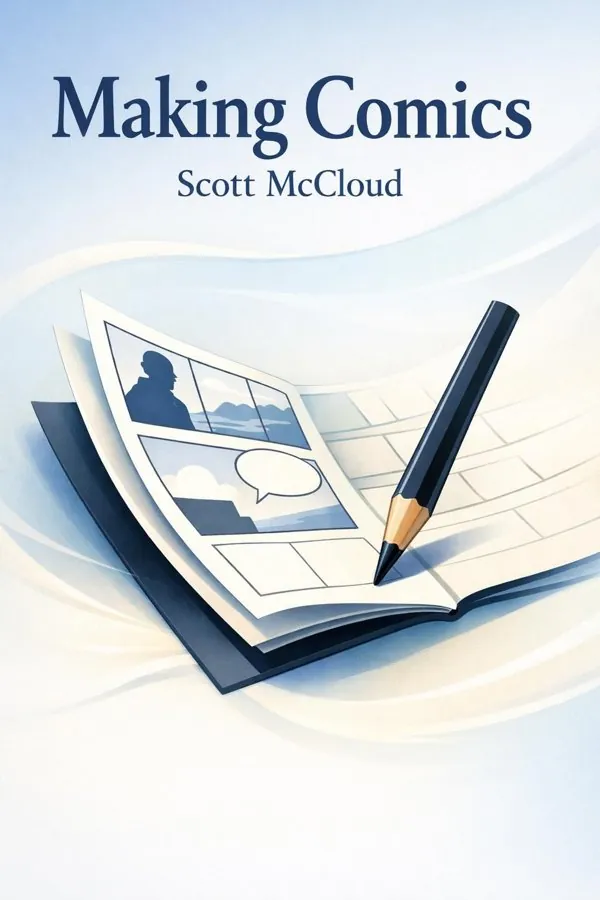
Making Comics: Storytelling Secrets of Comics, Manga and Graphic Novels: Summary & Key Insights
 10 min12 chaptersAudio available
What Is Making Comics: Storytelling Secrets of Comics, Manga and Graphic Novels About?
Making Comics: Storytelling Secrets of Comics, Manga and Graphic Novels by Scott McCloud is a design book spanning 12 pages. In this comprehensive guide, Scott McCloud explores the art and craft of creating comics, from visual storytelling and character design to pacing, composition, and reader engagement. Building on his earlier work 'Understanding Comics', McCloud provides practical insights and techniques for artists and writers who want to master the language of sequential art.
This FizzRead summary covers all 12 key chapters of Making Comics: Storytelling Secrets of Comics, Manga and Graphic Novels in approximately 10 minutes, distilling the most important ideas, arguments, and takeaways from Scott McCloud's work. Also available as an audio summary and Key Quotes Podcast.
Making Comics: Storytelling Secrets of Comics, Manga and Graphic Novels
In this comprehensive guide, Scott McCloud explores the art and craft of creating comics, from visual storytelling and character design to pacing, composition, and reader engagement. Building on his earlier work 'Understanding Comics', McCloud provides practical insights and techniques for artists and writers who want to master the language of sequential art.
Who Should Read Making Comics: Storytelling Secrets of Comics, Manga and Graphic Novels?
This book is perfect for anyone interested in design and looking to gain actionable insights in a short read. Whether you're a student, professional, or lifelong learner, the key ideas from Making Comics: Storytelling Secrets of Comics, Manga and Graphic Novels by Scott McCloud will help you think differently.
- ✓Readers who enjoy design and want practical takeaways
- ✓Professionals looking to apply new ideas to their work and life
- ✓Anyone who wants the core insights of Making Comics: Storytelling Secrets of Comics, Manga and Graphic Novels in just 10 minutes
Want the full summary?
Get instant access to this book summary and 100K+ more with Fizz Moment.
Get Free SummaryAvailable on App Store • Free to download
Key Chapters
Before discussing narrative choices, let’s ground ourselves in the tangible world of comics creation—the tools we use to make our stories real. Every artist begins with choices: paper or pixel, brush or mouse, ink or toner. These decisions shape not only how your work looks but also how it feels to make it. I’ve experimented with both traditional and digital methods, and what matters most isn’t the medium—it’s how you use it to serve clarity and expressiveness.
Traditional materials—pencils, pens, brushes, and ink—offer tactile feedback that many artists find invaluable. There’s a rhythm in the resistance of the page, a pace that teaches patience and precision. Digital tools, on the other hand, bring flexibility and freedom: layers, undo buttons, instant color. Each carries its own discipline. If drawing traditionally feels meditative, digital work often feels architectural—building with layers instead of lines.
More important than tools themselves is how they fit your habits. The best equipment is what makes you forget it exists because your focus stays on storytelling. Whether you prefer penciling on bristol board or sketching on a tablet, your goal is to create a flow between your hand, your eye, and your imagination.
Comics have historically thrived on constraints—from margin sizes to printing costs. Those limits helped artists innovate in composition and pacing. Today, digital publishing widens those boundaries to infinite canvases and virtual spaces, but the same principle applies: tools should expand expression, not distract from it. So start simple. Choose the tools that make you draw more, think less about mechanics, and keep storytelling front and center.
Words and pictures are not teammates that take turns; they are partners whose dance creates comics’ unique language. If one leads too strongly, the story falters. In *Making Comics*, I emphasize that comics writing is visual writing—the rhythm, structure, and choice of imagery must speak as eloquently as the text. When drawing a conversation, the look in a character’s eyes can often say more than the speech balloon above.
To harmonize word and image, think of each as having its own type of voice. Words articulate what pictures show implicitly; pictures give shape and emotion to what words cannot capture. The real magic lies in how they overlap and sometimes contradict each other, producing irony, humor, or tension. Writing visually means anticipating what the reader’s eyes will do—how they’ll travel across a page, how they’ll interpret silence and space.
Every balloon placement, every caption box creates rhythm. The goal is not literal accuracy but emotional truth. Let’s say a character feels trapped. You could write that feeling, or you could shrink the panel around their body until the borders themselves feel claustrophobic. The latter lets readers *experience* the emotion rather than be told about it. That’s writing with pictures.
Comics evolve when we stop seeing words and drawings as separate departments. For developing stories, scripting can happen through thumbnails—little sketches that act as thinking tools. By roughing out both text and image simultaneously, you learn to edit visually. Clarity emerges not just from language but from how the reader moves from one idea to the next seamlessly.
In comics, writing isn’t limited to dialogue or exposition—it’s in every shadow, every gesture, every angle of composition. To make comics is to write in two alphabets at once, and when they interlock perfectly, communication becomes invisible. The reader isn’t aware of decoding; they simply *see* and *feel* the story.
+ 10 more chapters — available in the FizzRead app
All Chapters in Making Comics: Storytelling Secrets of Comics, Manga and Graphic Novels
About the Author
Scott McCloud is an American cartoonist and theorist best known for his works on comics theory, including 'Understanding Comics' and 'Reinventing Comics'. His books have become essential reading for anyone interested in the medium’s artistic and narrative potential.
Get This Summary in Your Preferred Format
Read or listen to the Making Comics: Storytelling Secrets of Comics, Manga and Graphic Novels summary by Scott McCloud anytime, anywhere. FizzRead offers multiple formats so you can learn on your terms — all free.
Available formats: App · Audio · PDF · EPUB — All included free with FizzRead
Download Making Comics: Storytelling Secrets of Comics, Manga and Graphic Novels PDF and EPUB Summary
Key Quotes from Making Comics: Storytelling Secrets of Comics, Manga and Graphic Novels
“Before discussing narrative choices, let’s ground ourselves in the tangible world of comics creation—the tools we use to make our stories real.”
“Words and pictures are not teammates that take turns; they are partners whose dance creates comics’ unique language.”
Frequently Asked Questions about Making Comics: Storytelling Secrets of Comics, Manga and Graphic Novels
Making Comics: Storytelling Secrets of Comics, Manga and Graphic Novels by Scott McCloud is a design book that explores key ideas across 12 chapters. In this comprehensive guide, Scott McCloud explores the art and craft of creating comics, from visual storytelling and character design to pacing, composition, and reader engagement. Building on his earlier work 'Understanding Comics', McCloud provides practical insights and techniques for artists and writers who want to master the language of sequential art.
More by Scott McCloud
You Might Also Like
The Design of Everyday Things
Don Norman
10 min
The Better Angels of Our Nature
Steven Pinker
10 min
A Designer's Art
Paul Rand
10 min
Architects' Sketchbooks
Various Editors
10 min
Architectural Graphic Standards
The American Institute of Architects
10 min
Design Is Storytelling
Ellen Lupton
10 minBrowse by Category
Ready to read Making Comics: Storytelling Secrets of Comics, Manga and Graphic Novels?
Get the full summary and 100K+ more books with Fizz Moment.