
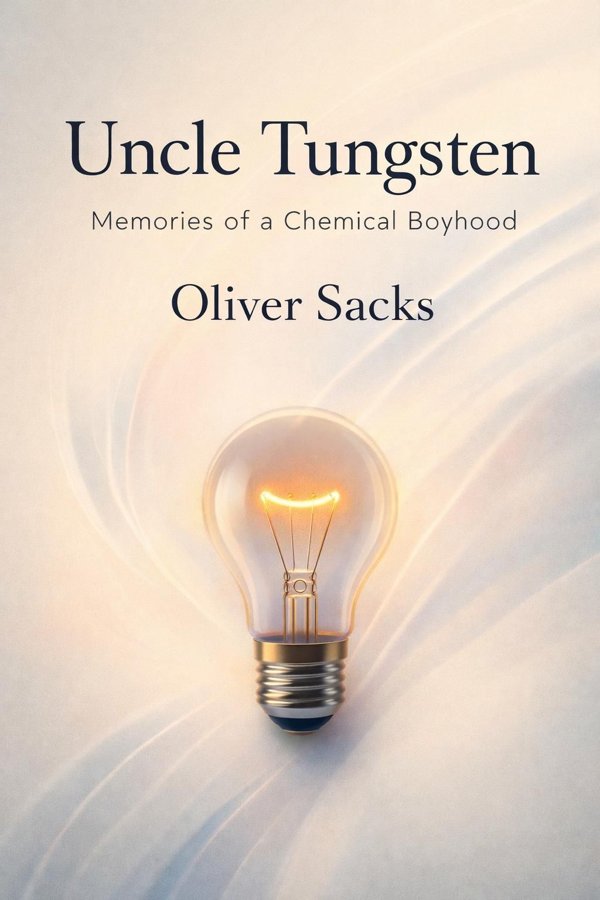
Uncle Tungsten: Memories of a Chemical Boyhood: Summary & Key Insights
by Oliver Sacks
 10 min9 chaptersAudio available
What Is Uncle Tungsten: Memories of a Chemical Boyhood About?
Uncle Tungsten: Memories of a Chemical Boyhood by Oliver Sacks is a biographies book spanning 9 pages. Uncle Tungsten es una memoria de Oliver Sacks sobre su infancia en Inglaterra durante la Segunda Guerra Mundial. El libro describe su fascinación temprana por la química y la ciencia, inspirada por su tío Dave, quien fabricaba bombillas con filamentos de tungsteno. Sacks narra cómo su entorno familiar, lleno de médicos y científicos, moldeó su curiosidad y su amor por la materia y la luz.
This FizzRead summary covers all 9 key chapters of Uncle Tungsten: Memories of a Chemical Boyhood in approximately 10 minutes, distilling the most important ideas, arguments, and takeaways from Oliver Sacks's work. Also available as an audio summary and Key Quotes Podcast.
Uncle Tungsten: Memories of a Chemical Boyhood
Uncle Tungsten es una memoria de Oliver Sacks sobre su infancia en Inglaterra durante la Segunda Guerra Mundial. El libro describe su fascinación temprana por la química y la ciencia, inspirada por su tío Dave, quien fabricaba bombillas con filamentos de tungsteno. Sacks narra cómo su entorno familiar, lleno de médicos y científicos, moldeó su curiosidad y su amor por la materia y la luz.
Who Should Read Uncle Tungsten: Memories of a Chemical Boyhood?
This book is perfect for anyone interested in biographies and looking to gain actionable insights in a short read. Whether you're a student, professional, or lifelong learner, the key ideas from Uncle Tungsten: Memories of a Chemical Boyhood by Oliver Sacks will help you think differently.
- ✓Readers who enjoy biographies and want practical takeaways
- ✓Professionals looking to apply new ideas to their work and life
- ✓Anyone who wants the core insights of Uncle Tungsten: Memories of a Chemical Boyhood in just 10 minutes
Want the full summary?
Get instant access to this book summary and 100K+ more with Fizz Moment.
Get Free SummaryAvailable on App Store • Free to download
Key Chapters
My family formed the atmosphere of science in which my early self inhaled and grew. Both my parents were physicians, absorbed in their patients and their instruments. My mother’s surgery occupied one part of our home, and I remember, even as a small boy, the strange intimacy of anatomy—the quiet rigor with which she worked on living tissue. My father, gentle and observant, would allow me to accompany him on his house calls, where compassion and precision came together in his craft. But it was not merely my immediate parents who shaped my sense of the physical world; my extended family was equally production-minded, always designing, repairing, or inventing.
Among them all, my Uncle Dave—"Uncle Tungsten"—burned brightest. He worked in the family’s lightbulb factory, experimenting with tungsten filaments that could endure higher temperatures and emit a clearer light. The family’s inventiveness was contagious. Around our dining table, conversation flowed effortlessly from medicine to astronomy to ethics, from practical engineering to abstract physics. I saw no separation between the life of the mind and that of the hands. When I grew impatient to touch the very materials that fascinated me, no one discouraged me; on the contrary, they smiled, as if recognizing themselves reborn in me. That is perhaps why, when war cut through our lives, the spark of that family tradition became for me a kind of compass—a direction toward the steady, rational beauty of nature.
My first experiments were crude but full of passion. I turned the basement into a laboratory filled with smudged bottles, improvised crucibles, and the faintly apocalyptic smell of sulfur. I read about the great chemists of the eighteenth and nineteenth centuries—Priestley, Cavendish, Davy—and felt I was their heir. The world they had entered—a world where air could be decomposed, where metal could ‘breathe’—felt accessible even to a boy if he had curiosity and a bit of luck in obtaining chemicals.
In those days of postwar austerity, supplies were rare, and that scarcity sharpened both wit and devotion. I scavenged materials, dissolved coins, melted lead. Every new reaction seemed to me a small cosmological event. My fascination with the periodic table grew from these efforts; it was both an oracle and an invitation. I began to grasp, intuitively at first, that the elements were not merely different kinds of matter but part of a grand architecture—order, law, and eternity visible through the medium of flame and color.
The vivid transformations on my benchtop paralleled the transformations in my imagination. I lived for the glow of sodium vapor, the lavender puff of potassium in water, the luminous green of boron. The excitement bordered on mystical revelation. I was, in those moments, not a child in a bombed city but an explorer uncovering the logic of existence itself.
+ 7 more chapters — available in the FizzRead app
All Chapters in Uncle Tungsten: Memories of a Chemical Boyhood
About the Author
Oliver Sacks fue un neurólogo y escritor británico conocido por sus libros que exploran las complejidades de la mente humana. Nació en Londres en 1933 y trabajó gran parte de su vida en Nueva York. Sus obras combinan ciencia, empatía y narrativa literaria, destacando títulos como 'Awakenings' y 'The Man Who Mistook His Wife for a Hat'.
Get This Summary in Your Preferred Format
Read or listen to the Uncle Tungsten: Memories of a Chemical Boyhood summary by Oliver Sacks anytime, anywhere. FizzRead offers multiple formats so you can learn on your terms — all free.
Available formats: App · Audio · PDF · EPUB — All included free with FizzRead
Download Uncle Tungsten: Memories of a Chemical Boyhood PDF and EPUB Summary
Key Quotes from Uncle Tungsten: Memories of a Chemical Boyhood
“My family formed the atmosphere of science in which my early self inhaled and grew.”
“My first experiments were crude but full of passion.”
Frequently Asked Questions about Uncle Tungsten: Memories of a Chemical Boyhood
Uncle Tungsten: Memories of a Chemical Boyhood by Oliver Sacks is a biographies book that explores key ideas across 9 chapters. Uncle Tungsten es una memoria de Oliver Sacks sobre su infancia en Inglaterra durante la Segunda Guerra Mundial. El libro describe su fascinación temprana por la química y la ciencia, inspirada por su tío Dave, quien fabricaba bombillas con filamentos de tungsteno. Sacks narra cómo su entorno familiar, lleno de médicos y científicos, moldeó su curiosidad y su amor por la materia y la luz.
More by Oliver Sacks
You Might Also Like
An American Marriage
Tayari Jones
10 min
Benjamin Franklin: An American Life
Walter Isaacson
10 min
I Know Why The Caged Bird Sings
Maya Angelou
10 min
Long Walk to Freedom
Nelson Mandela
10 min
Persepolis
Marjane Satrapi
10 min
Surely You're Joking, Mr. Feynman!
Richard P. Feynman
10 minBrowse by Category
Ready to read Uncle Tungsten: Memories of a Chemical Boyhood?
Get the full summary and 100K+ more books with Fizz Moment.