
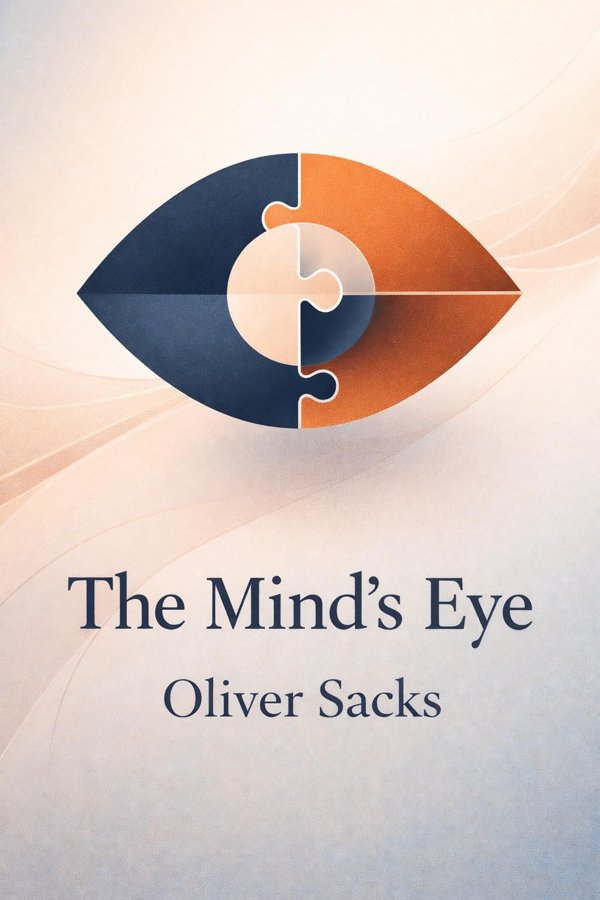
The Mind’s Eye: Summary & Key Insights
by Oliver Sacks
 10 min9 chaptersAudio available
Key Takeaways from The Mind’s Eye
Sacks tells the story of Sue Barry, known as “Stereo Sue,” who lived for decades with impaired binocular vision.
Recognizing a face seems effortless—until it is not.
Words on a page look simple, but reading is one of the brain’s most sophisticated achievements.
Many people assume that everyone can summon images in the mind’s eye, but Sacks shows that inner visualization varies dramatically from person to person.
To look at an object and still not know what it is may sound impossible, yet visual agnosia makes exactly that fracture visible.
What Is The Mind’s Eye About?
The Mind’s Eye by Oliver Sacks is a neuroscience book spanning 9 pages. What does it really mean to see? In The Mind’s Eye, neurologist Oliver Sacks shows that vision is not simply a matter of healthy eyes taking in the world. It is a deeply creative act involving memory, recognition, imagination, language, and the brain’s astonishing ability to adapt when something goes wrong. Through a series of vivid case studies—some drawn from his patients, some from other researchers, and some from his own life—Sacks explores what happens when people lose depth perception, the ability to recognize faces, the power to read, or even the capacity to form mental images. Rather than treating these conditions as cold clinical anomalies, he reveals them as profoundly human experiences that reshape identity, work, relationships, and self-understanding. The book matters because it turns neurological impairment into a lens for understanding ordinary perception itself: how much of what we “see” is really constructed by the mind. Few writers were better equipped to tell this story than Sacks, whose rare combination of scientific rigor, literary grace, and deep empathy made him one of the most trusted interpreters of the human brain.
This FizzRead summary covers all 9 key chapters of The Mind’s Eye in approximately 10 minutes, distilling the most important ideas, arguments, and takeaways from Oliver Sacks's work. Also available as an audio summary and Key Quotes Podcast.
The Mind’s Eye
What does it really mean to see? In The Mind’s Eye, neurologist Oliver Sacks shows that vision is not simply a matter of healthy eyes taking in the world. It is a deeply creative act involving memory, recognition, imagination, language, and the brain’s astonishing ability to adapt when something goes wrong. Through a series of vivid case studies—some drawn from his patients, some from other researchers, and some from his own life—Sacks explores what happens when people lose depth perception, the ability to recognize faces, the power to read, or even the capacity to form mental images. Rather than treating these conditions as cold clinical anomalies, he reveals them as profoundly human experiences that reshape identity, work, relationships, and self-understanding. The book matters because it turns neurological impairment into a lens for understanding ordinary perception itself: how much of what we “see” is really constructed by the mind. Few writers were better equipped to tell this story than Sacks, whose rare combination of scientific rigor, literary grace, and deep empathy made him one of the most trusted interpreters of the human brain.
Who Should Read The Mind’s Eye?
This book is perfect for anyone interested in neuroscience and looking to gain actionable insights in a short read. Whether you're a student, professional, or lifelong learner, the key ideas from The Mind’s Eye by Oliver Sacks will help you think differently.
- ✓Readers who enjoy neuroscience and want practical takeaways
- ✓Professionals looking to apply new ideas to their work and life
- ✓Anyone who wants the core insights of The Mind’s Eye in just 10 minutes
Want the full summary?
Get instant access to this book summary and 100K+ more with Fizz Moment.
Get Free SummaryAvailable on App Store • Free to download
Key Chapters
We often assume that depth perception is either present from childhood or absent forever, but The Mind’s Eye opens with a startling alternative: the brain can sometimes learn to see in three dimensions far later in life than expected. Sacks tells the story of Sue Barry, known as “Stereo Sue,” who lived for decades with impaired binocular vision. Because her eyes did not coordinate properly, the world appeared comparatively flat. She navigated life successfully, but without the vivid depth most people take for granted. Then, through vision therapy and persistent training, she began to develop stereoscopic vision as an adult.
This case matters because it challenges a rigid view of neurological development. Barry’s transformation suggests that the visual brain retains more plasticity than scientists once believed. Her new perception was not merely technical; it changed how she experienced space, movement, beauty, and even emotional presence. Everyday scenes became richer and more immersive. A staircase, a tree branch, or a person’s face no longer appeared as a set of visual cues arranged on a surface, but as something volumetric and alive.
The practical lesson extends beyond vision science. Many abilities we think are fixed may be partly trainable if the brain is given the right stimulation and enough repetition. Rehabilitation, therapy, and deliberate practice can unlock capacities that seemed permanently lost or undeveloped. Whether in sensory recovery, motor learning, or cognitive retraining, the brain is often more changeable than our assumptions.
Actionable takeaway: question any “I’m just wired this way” belief and look for structured exercises, expert guidance, and consistent practice that might help your brain develop new ways of perceiving and functioning.
Recognizing a face seems effortless—until it is not. One of the most emotionally resonant themes in The Mind’s Eye is prosopagnosia, or face blindness, a condition in which people cannot reliably identify faces, sometimes even those of close friends, spouses, or their own reflection. Sacks writes about this not only as a neurologist but also from personal experience, giving the topic unusual depth and honesty. For people with prosopagnosia, the problem is not poor eyesight. They can often see features perfectly well. What is missing is the brain’s ability to unify those features into a recognizable person.
This condition reveals how much social life depends on rapid, unconscious acts of recognition. Without that ability, ordinary situations become fraught with uncertainty and embarrassment. A person may fail to greet a colleague, mistake a stranger for a relative, or rely on nonfacial cues such as hairstyle, posture, voice, clothing, or context. Social confidence can erode, not because the person is inattentive or uncaring, but because the recognition system itself is impaired.
Sacks uses prosopagnosia to show that perception is selective and constructed. We do not simply “see” a face and know it; the brain performs highly specialized processing that can fail in specific ways. The implications are practical. When someone seems aloof, forgetful, or socially awkward, the explanation may be neurological rather than personal. Awareness can reduce stigma and improve accommodation.
Actionable takeaway: if you or someone you know struggles with face recognition, build alternative identification strategies—use voices, settings, distinctive accessories, and introductions—and replace self-blame with informed understanding.
Words on a page look simple, but reading is one of the brain’s most sophisticated achievements. In The Mind’s Eye, Sacks examines disorders in which people can still see letters clearly yet lose the ability to recognize words fluently or read meaningfully. Such conditions expose reading as a complex collaboration among visual processing, language systems, memory, and pattern recognition. Seeing text is not the same as understanding it.
By exploring patients whose reading abilities have been damaged or altered, Sacks demonstrates that literacy is not housed in a single mental box. A person may retain speech but lose reading speed. Another may identify individual letters but fail to assemble them into words. Others may compensate by tracing shapes, reading aloud slowly, or relying more heavily on auditory input. These workarounds show how the brain recruits neighboring systems when a specialized circuit breaks down.
The broader insight is that skills we treat as automatic are usually layered and fragile. Reading, driving, typing, and even recognizing a familiar place all depend on hidden cognitive choreography. When one element fails, the whole act can feel newly strange. This has direct applications in education and rehabilitation. Struggling readers may need targeted support based on the specific component that is impaired rather than generic repetition. Likewise, adults recovering from neurological injury may benefit from multisensory approaches that combine text with sound, touch, and context.
Actionable takeaway: if reading becomes difficult for you or someone else, do not assume lack of effort—break the task into components and use practical supports such as audiobooks, enlarged text, guided reading, or specialist assessment.
Many people assume that everyone can summon images in the mind’s eye, but Sacks shows that inner visualization varies dramatically from person to person. Some individuals can picture scenes with cinematic vividness, while others experience little or no visual imagery at all. In The Mind’s Eye, he explores patients who lose the capacity to visualize, alongside reflections on how imagery supports memory, creativity, orientation, and emotional life. The result is a powerful reminder that the invisible theater of the mind is not universal in form.
Mental imagery influences how we remember a childhood home, anticipate a route, imagine a future event, or understand a metaphor. A person with diminished imagery may still think clearly, reason well, and live fully, but often through different channels—language, logic, rhythm, spatial abstraction, or emotional association. Conversely, those with vivid imagery may depend heavily on pictures to solve problems or recall information. Sacks resists ranking these styles. Instead, he emphasizes cognitive diversity: there are many ways to think.
This idea has practical implications for learning and communication. Some people benefit from diagrams, maps, and visual rehearsal. Others remember best through verbal explanation, repetition, or physical practice. In creative work, too, imagination need not be strictly pictorial. A novelist may hear voices more than see scenes; a mathematician may sense structure rather than form images.
Actionable takeaway: notice how your own mind generates ideas and memories, then match your study, work, and creative methods to that style instead of assuming one-size-fits-all thinking.
To look at an object and still not know what it is may sound impossible, yet visual agnosia makes exactly that fracture visible. In The Mind’s Eye, Sacks revisits a theme central to his work: perception is not complete when the eyes register shape and color. The brain must also connect sensory input to meaning. In visual agnosia, this link is disrupted. A person may describe an object’s edges, texture, or movement and still fail to identify it as a cup, a glove, or a flower until they touch it or hear it used.
This condition demonstrates that recognition is an active cognitive act. The world feels immediate, but the mind is constantly interpreting raw information, comparing it with memory, and assigning significance. When that interpretive layer is damaged, everyday life becomes oddly alien. Familiar surroundings lose their obviousness. Objects may have to be understood through sound, touch, context, or routine rather than instant visual identification.
Sacks’s account encourages humility about our confidence in perception. Even normal seeing is inferential. We do not merely receive reality; we construct a usable version of it. This insight matters in design, caregiving, and communication. Clear labels, consistent environments, tactile cues, and predictable layouts can make a major difference for someone with recognition impairments. It also reminds us that intelligence may remain intact even when recognition is impaired.
Actionable takeaway: when helping someone with perceptual difficulties, simplify visual clutter and add multisensory cues so that understanding does not depend on vision alone.
One of the most striking aspects of The Mind’s Eye is that Sacks does not remain a detached observer. He writes about his own experience with ocular melanoma, a serious eye cancer that threatened not only his health but also his visual world. This personal chapter deepens the book by showing how even a seasoned neurologist can be unsettled by the instability of perception when illness intrudes. Vision is never merely a clinical function when it is your own.
Sacks describes the emotional and perceptual consequences of disease with unusual clarity. Changes in vision can alter confidence, orientation, mood, and one’s sense of continuity with the world. A medical diagnosis affects not just a body part but the whole person: habits, identity, work, and fears about the future. By including his own vulnerability, Sacks bridges the gap between doctor and patient. He acknowledges uncertainty, dependence, and the strange intimacy of becoming a case history oneself.
This perspective matters because medicine often focuses narrowly on measurable deficits while overlooking the lived experience of losing a faculty that shapes daily life. Sacks insists that subjective experience belongs at the center of neurological understanding. Symptoms are not abstractions; they reorganize how a person inhabits reality.
For readers, this chapter offers a practical ethical lesson. Whether in healthcare, family life, or friendship, people coping with illness need more than technical explanations. They need to be heard as interpreters of their own altered experience.
Actionable takeaway: when facing illness—your own or another’s—pay attention not only to diagnosis and treatment, but also to how perception, identity, and daily meaning are changing.
Loss is rarely the end of the story; often it is the beginning of adaptation. Across The Mind’s Eye, Sacks returns to neuroplasticity—the brain’s ability to reorganize, recruit alternative pathways, and compensate for damaged or underdeveloped systems. His cases are compelling not because they present neat recoveries, but because they show real people crafting livable strategies in response to altered perception. A person who cannot recognize faces learns to depend on voice and movement. Someone with reading difficulties leans on sound. A patient with visual disruption may cultivate touch, memory, or pattern-based routines.
Sacks does not romanticize impairment. Compensation is often effortful, partial, and exhausting. Yet he also resists the assumption that function is all-or-nothing. The nervous system is dynamic. When one channel weakens, another may become more refined. This can happen through formal therapy, repeated practice, supportive environments, and the sheer necessity of daily life. Adaptation is not always full restoration, but it can still be profound.
The lesson extends beyond neurology. Human beings continually compensate for limitations—sensory, emotional, cognitive, and social. Tools, habits, relationships, and environments become extensions of the mind. A calendar supports memory. A GPS supports navigation. A checklist supports attention. Rather than signs of weakness, these are often examples of intelligent external scaffolding.
Actionable takeaway: instead of asking only how to fix a deficit, ask what systems, routines, technologies, and habits can help you work around it effectively and sustainably.
The deepest revelation of The Mind’s Eye is that vision is not only a neurological process but a philosophical mystery. We trust our eyes as our primary connection to reality, yet Sacks repeatedly shows that what feels immediate is mediated by interpretation, memory, expectation, and neural architecture. To see is already to know in a certain way—and when the machinery of seeing is altered, the nature of knowing becomes newly visible.
This is why the book reaches beyond medicine. Cases of face blindness, visual agnosia, or lost imagery do not simply catalogue deficits; they force us to ask what a self is when familiar channels of recognition fail. How much of identity depends on stable perception? How much of the world is given, and how much is mentally assembled? Sacks never answers these questions in abstract philosophical jargon. Instead, he lets lived cases do the thinking. A patient unable to visualize still possesses a rich inner life. Someone who cannot recognize faces may remain emotionally responsive and intellectually whole. Impairment exposes the hidden assumptions built into ordinary experience.
This perspective can cultivate intellectual humility. If perception is partially constructed, then certainty deserves scrutiny. It can also deepen compassion. People may inhabit radically different experiential worlds while appearing outwardly normal. Recognizing that broadens our understanding of human variation.
Actionable takeaway: treat your own perception as a useful interpretation rather than a perfect mirror of reality, and approach other minds with curiosity instead of quick judgment.
All Chapters in The Mind’s Eye
About the Author
Oliver Sacks (1933–2015) was a British neurologist, physician, and acclaimed author whose books transformed public understanding of the brain. Educated at Oxford and later based largely in New York, he became known for combining clinical insight with literary sensitivity. Rather than writing about neurological disorders in abstract terms, Sacks told the stories of individuals living with them, revealing both the strangeness of the mind and the dignity of his patients. His best-known works include Awakenings, The Man Who Mistook His Wife for a Hat, An Anthropologist on Mars, and Musicophilia. Sacks’s writing explored perception, memory, movement, music, and identity with rare warmth and clarity. He remains one of the most influential interpreters of neuroscience for general readers, admired for his empathy, curiosity, and ability to connect science with the lived experience of being human.
Get This Summary in Your Preferred Format
Read or listen to the The Mind’s Eye summary by Oliver Sacks anytime, anywhere. FizzRead offers multiple formats so you can learn on your terms — all free.
Available formats: App · Audio · PDF · EPUB — All included free with FizzRead
Download The Mind’s Eye PDF and EPUB Summary
Key Quotes from The Mind’s Eye
“Sacks tells the story of Sue Barry, known as “Stereo Sue,” who lived for decades with impaired binocular vision.”
“Recognizing a face seems effortless—until it is not.”
“Words on a page look simple, but reading is one of the brain’s most sophisticated achievements.”
“Many people assume that everyone can summon images in the mind’s eye, but Sacks shows that inner visualization varies dramatically from person to person.”
“To look at an object and still not know what it is may sound impossible, yet visual agnosia makes exactly that fracture visible.”
Frequently Asked Questions about The Mind’s Eye
The Mind’s Eye by Oliver Sacks is a neuroscience book that explores key ideas across 9 chapters. What does it really mean to see? In The Mind’s Eye, neurologist Oliver Sacks shows that vision is not simply a matter of healthy eyes taking in the world. It is a deeply creative act involving memory, recognition, imagination, language, and the brain’s astonishing ability to adapt when something goes wrong. Through a series of vivid case studies—some drawn from his patients, some from other researchers, and some from his own life—Sacks explores what happens when people lose depth perception, the ability to recognize faces, the power to read, or even the capacity to form mental images. Rather than treating these conditions as cold clinical anomalies, he reveals them as profoundly human experiences that reshape identity, work, relationships, and self-understanding. The book matters because it turns neurological impairment into a lens for understanding ordinary perception itself: how much of what we “see” is really constructed by the mind. Few writers were better equipped to tell this story than Sacks, whose rare combination of scientific rigor, literary grace, and deep empathy made him one of the most trusted interpreters of the human brain.
More by Oliver Sacks



You Might Also Like
Anxious
Joseph LeDoux
10 min
Hallucinations
Oliver Sacks
10 min
The Biological Mind: How Brain, Body, and Environment Collaborate to Make Us Who We Are
Alan Jasanoff
10 min
The Feeling of Life Itself: Why Consciousness Is Widespread but Can't Be Computed
Christof Koch
10 min
The No-Nonsense Meditation Book
Steven Laureys
10 min
A General Theory of Love
Thomas Lewis, Fari Amini, Richard Lannon
10 minBrowse by Category
Ready to read The Mind’s Eye?
Get the full summary and 100K+ more books with Fizz Moment.