
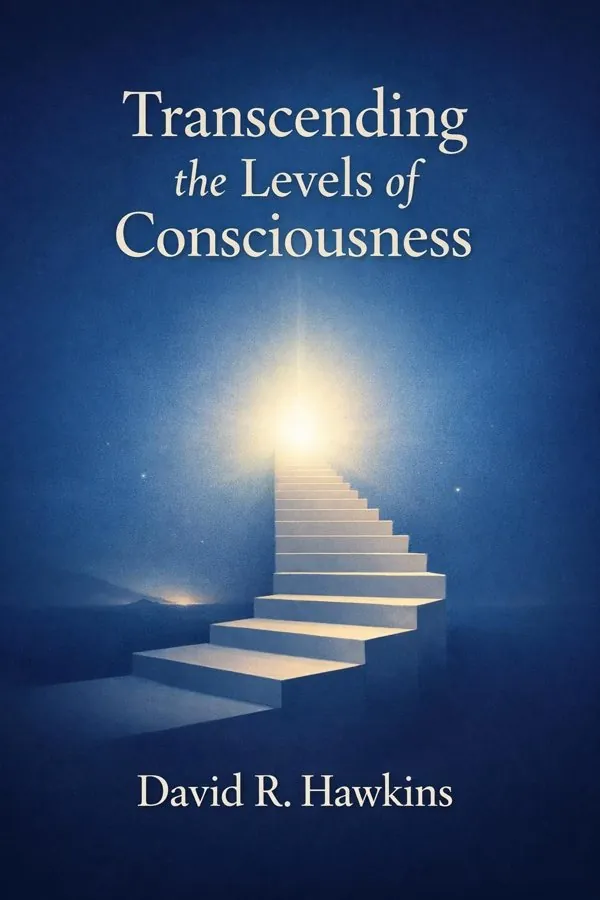
Transcending the Levels of Consciousness: The Stairway to Enlightenment: Summary & Key Insights
 10 min9 chaptersAudio available
Key Takeaways from Transcending the Levels of Consciousness: The Stairway to Enlightenment
Most people assume consciousness is vague and impossible to organize, yet Hawkins argues that awareness unfolds in recognizable patterns.
A central Hawkins insight is that force and power may look similar on the surface, but they arise from opposite sources.
One of the book’s most sobering claims is that lower levels of consciousness do not simply feel bad—they actually distort reality.
Hawkins describes the transition from lower to higher consciousness as passing a crucial threshold: courage.
At the heart of Hawkins’s teaching is the claim that the ego is not merely a personality structure but a survival-based illusion that mistakes itself for the whole self.
What Is Transcending the Levels of Consciousness: The Stairway to Enlightenment About?
Transcending the Levels of Consciousness: The Stairway to Enlightenment by David R. Hawkins is a eastern_wisdom book spanning 13 pages. What if your daily emotions, reactions, and spiritual struggles were not random, but reflected a definable level of consciousness? In Transcending the Levels of Consciousness: The Stairway to Enlightenment, David R. Hawkins expands his influential framework from Power vs. Force and presents a spiritual map of human awareness, from the densest states of shame, guilt, and fear to the liberating heights of love, peace, and enlightenment. The book is both descriptive and practical: it explains why people get stuck in lower states, how the ego maintains suffering, and what inner attitudes support genuine transcendence. Hawkins writes from a rare combination of backgrounds: he was a psychiatrist, clinician, spiritual teacher, and longtime student of mystical traditions. That blend gives the book its distinctive tone—part psychology, part metaphysics, part spiritual instruction. Whether or not readers accept every element of his calibration system, the book offers a powerful lens for examining motives, perception, and inner growth. Its central value lies in showing that spiritual progress is less about acquiring beliefs and more about surrendering what obscures truth. For readers interested in Eastern wisdom, nonduality, and personal transformation, this is a challenging but deeply provocative guide.
This FizzRead summary covers all 9 key chapters of Transcending the Levels of Consciousness: The Stairway to Enlightenment in approximately 10 minutes, distilling the most important ideas, arguments, and takeaways from David R. Hawkins's work. Also available as an audio summary and Key Quotes Podcast.
Transcending the Levels of Consciousness: The Stairway to Enlightenment
What if your daily emotions, reactions, and spiritual struggles were not random, but reflected a definable level of consciousness? In Transcending the Levels of Consciousness: The Stairway to Enlightenment, David R. Hawkins expands his influential framework from Power vs. Force and presents a spiritual map of human awareness, from the densest states of shame, guilt, and fear to the liberating heights of love, peace, and enlightenment. The book is both descriptive and practical: it explains why people get stuck in lower states, how the ego maintains suffering, and what inner attitudes support genuine transcendence.
Hawkins writes from a rare combination of backgrounds: he was a psychiatrist, clinician, spiritual teacher, and longtime student of mystical traditions. That blend gives the book its distinctive tone—part psychology, part metaphysics, part spiritual instruction. Whether or not readers accept every element of his calibration system, the book offers a powerful lens for examining motives, perception, and inner growth. Its central value lies in showing that spiritual progress is less about acquiring beliefs and more about surrendering what obscures truth. For readers interested in Eastern wisdom, nonduality, and personal transformation, this is a challenging but deeply provocative guide.
Who Should Read Transcending the Levels of Consciousness: The Stairway to Enlightenment?
This book is perfect for anyone interested in eastern_wisdom and looking to gain actionable insights in a short read. Whether you're a student, professional, or lifelong learner, the key ideas from Transcending the Levels of Consciousness: The Stairway to Enlightenment by David R. Hawkins will help you think differently.
- ✓Readers who enjoy eastern_wisdom and want practical takeaways
- ✓Professionals looking to apply new ideas to their work and life
- ✓Anyone who wants the core insights of Transcending the Levels of Consciousness: The Stairway to Enlightenment in just 10 minutes
Want the full summary?
Get instant access to this book summary and 100K+ more with Fizz Moment.
Get Free SummaryAvailable on App Store • Free to download
Key Chapters
Most people assume consciousness is vague and impossible to organize, yet Hawkins argues that awareness unfolds in recognizable patterns. His Map of Consciousness is presented as a calibrated scale that describes the energetic and experiential quality of different human states. At the low end are contraction, survival, blame, and despair; at the high end are acceptance, love, joy, peace, and enlightenment. The point of the map is not to label people as superior or inferior, but to reveal that perception changes with inner development. A person in fear sees threats everywhere; a person in acceptance sees challenge and opportunity; a person in love sees meaning and connection.
This framework matters because it shifts the focus from outer events to inner interpretation. Two people can experience the same loss, conflict, or success and respond from entirely different levels of consciousness. One collapses into resentment, while the other uses the moment for humility and learning. Hawkins invites readers to treat emotional states not as final identities but as temporary positions on a larger path of evolution.
In practical terms, the map can be used for self-observation. When you react strongly to criticism, ask: am I responding from pride, anger, fear, or courage? When making a decision, notice whether the motive is control, approval, service, or truth. This creates a spiritual vocabulary for inner honesty.
Actionable takeaway: For one week, track your dominant emotional state three times a day and identify which level of consciousness it most resembles. Awareness of your current level is the first step toward transcending it.
A central Hawkins insight is that force and power may look similar on the surface, but they arise from opposite sources. Force is driven by ego, pressure, manipulation, and resistance. It must constantly push because it lacks inner stability. Power, by contrast, comes from alignment with truth, integrity, and higher consciousness. It does not need coercion because it carries its own authority. This distinction, first emphasized in Power vs. Force, is refined here as a core principle for spiritual maturity.
In everyday life, force appears as arguing to dominate, managing others through guilt, overworking out of insecurity, or clinging to control when situations become uncertain. Power appears as calm conviction, clear boundaries, patient leadership, and actions rooted in principle rather than emotional reactivity. Hawkins suggests that when we rely on force, we temporarily intensify outcomes but weaken ourselves inwardly. When we act from power, we may appear less dramatic, but our choices become more sustainable and more life-giving.
This idea has practical implications in relationships, work, and spiritual practice. A parent using force may demand obedience through fear, while a parent using power teaches through consistency and example. A manager using force micromanages; a leader using power inspires trust. Even internally, forcing yourself into spiritual growth through self-hatred is very different from committing to truth through humility.
Actionable takeaway: The next time you face conflict, pause before reacting and ask, "Am I trying to control this through pressure, or can I respond from calm integrity?" Choose one conversation this week in which you deliberately practice power instead of force.
One of the book’s most sobering claims is that lower levels of consciousness do not simply feel bad—they actually distort reality. In states such as shame, guilt, apathy, grief, fear, anger, and pride, people do not see the world clearly. They perceive through contraction. Shame says, "I am unworthy." Guilt says, "I deserve punishment." Fear says, "Danger is everywhere." Anger says, "I must attack to survive." Pride says, "I am safe as long as I stay superior." Each level contains a hidden worldview that shapes thought, behavior, and relationships.
Hawkins does not present these states to condemn them. Instead, he treats them as developmental positions that can be understood and transcended. This is important because many people try to solve their suffering at the level of circumstances while ignoring the consciousness from which they are interpreting those circumstances. If someone living in chronic fear changes jobs, cities, or partners without addressing the underlying level, fear simply reorganizes itself around new situations.
You can see this in ordinary life. A proud person may seem successful, but remains hypersensitive to disrespect. A fearful person may over-prepare for every possibility yet still feel unsafe. An angry person may gain temporary energy from outrage but lose peace and perspective. The problem is not merely emotion itself, but identification with the lens the emotion imposes.
Actionable takeaway: When a negative state takes over, do not ask only, "What happened?" Also ask, "What is this state making me believe?" Write down the hidden belief and challenge its absolute truth.
Hawkins describes the transition from lower to higher consciousness as passing a crucial threshold: courage. Below courage, life is dominated by reactivity, blame, and victimhood. At courage, a person begins to take responsibility for experience. This does not mean self-blame. It means recognizing that growth becomes possible only when we stop locating the source of all suffering outside ourselves. Courage marks the shift from helplessness to agency.
This threshold is spiritually decisive because it changes the orientation of the self. Instead of asking, "Why is life doing this to me?" a person begins asking, "What can I learn? What is mine to face? What truth have I been avoiding?" From there, neutrality, willingness, and acceptance become possible. These middle and upper-middle levels are less glamorous than mystical ecstasy, but they are where much real transformation happens. Willingness allows disciplined practice. Acceptance brings emotional stability. Reason helps organize life intelligently. Together they form the bridge to love and deeper spiritual realization.
In practical terms, courage may look modest: admitting addiction, apologizing sincerely, seeking therapy, meditating consistently, leaving a dishonest job, or finally grieving a loss instead of avoiding it. Hawkins suggests that transcendence often begins not with cosmic visions but with a simple willingness to face what is true.
Actionable takeaway: Identify one area where you have felt stuck, resentful, or powerless. Ask yourself, "What would courage look like here in one concrete step?" Then take that step within the next 48 hours.
At the heart of Hawkins’s teaching is the claim that the ego is not merely a personality structure but a survival-based illusion that mistakes itself for the whole self. The ego divides reality into subject and object, me and you, gain and loss, attack and defense. It survives through identification: my story, my status, my wounds, my opinions, my desires. Because it depends on separation, it cannot generate lasting peace. Even its pleasures are unstable, because they are tied to possession, comparison, and fear of loss.
Hawkins aligns here with nondual and Eastern spiritual traditions, which teach that suffering arises from misidentification. We suffer because we take the transient self to be our true identity. The ego resists surrender because it equates surrender with death, yet what dies is only illusion. As consciousness matures, the need to defend a fixed self-image begins to soften. One becomes less invested in being right, admired, or special, and more interested in truth itself.
This has immediate application in daily conflict. Notice how quickly the ego wants to justify itself, replay insults, compare achievements, or interpret neutral events as personal threats. Spiritual practice then becomes less about decorating the ego with spiritual language and more about observing its habits without obedience. Meditation, prayer, contemplation, and honest self-inquiry can all expose the false center from which so much suffering arises.
Actionable takeaway: The next time you feel offended or defensive, pause and ask, "What identity am I trying to protect right now?" Sit with the question before speaking. That moment of observation weakens egoic automaticity.
A common misunderstanding about spiritual growth is that it involves accumulating knowledge, techniques, or special experiences. Hawkins turns this assumption upside down. He argues that transcendence occurs primarily through surrender—the release of attachments, positionalities, resistance, and false identification. Enlightenment is not something the ego achieves; it is what becomes evident when the obstacles maintained by the ego are relinquished.
This is why effort alone can become paradoxical. Discipline matters, but if spiritual practice is secretly driven by ambition—wanting to be superior, pure, advanced, or invulnerable—it reinforces the very self-structure that must be seen through. Hawkins emphasizes letting go: of grievances, of compulsive judgment, of emotional payoff from suffering, of the need to control outcomes, and even of attachment to spiritual progress itself.
In ordinary life, surrender is often misunderstood as passivity. Hawkins means something different. True surrender is a willing alignment with reality as it is, without mental resistance. It can coexist with decisive action. You surrender denial, not responsibility. You surrender hostility, not discernment. You surrender egoic insistence, not intelligent effort. For example, someone facing illness can surrender resentment and fear while still pursuing treatment. Someone in a difficult relationship can surrender fantasies and blame while still setting clear boundaries.
The deeper implication is liberating: peace is not manufactured; it is uncovered. The more one releases inner obstruction, the more naturally higher states become accessible.
Actionable takeaway: Choose one recurring source of mental suffering and ask, "What am I refusing to let go of here?" Name the attachment in a sentence and practice releasing it each time it arises.
Hawkins is widely known for his controversial method of consciousness calibration, which he presents as a way of discerning truth from falsehood. Whether readers interpret this literally, symbolically, or skeptically, the broader principle is clear: not all ideas, teachers, institutions, and inner impulses carry the same degree of truth. Spiritual progress therefore requires discernment, not naivete. A pleasant feeling is not always truth, and discomfort is not always falsehood. One must learn to distinguish the ego’s preferences from deeper alignment.
Within the book, discernment functions as a safeguard. It prevents spirituality from becoming sentimentality or blind belief. Hawkins urges readers to examine intention, context, and the quality of consciousness behind teachings and actions. Is a message driven by fear, self-importance, and manipulation, or by humility, compassion, and coherence? Does a practice leave you more peaceful, honest, and responsible, or more grandiose and dependent?
This idea is useful even for readers who do not adopt Hawkins’s calibration system. In everyday terms, discernment means testing what is true by its fruits. A worldview that consistently increases hatred, confusion, and fragmentation is likely operating at a lower level than one that supports clarity, reverence, and service. Discernment also applies inwardly: not every thought deserves trust, and not every urge deserves expression.
Actionable takeaway: Evaluate one influence in your life this week—a media source, teacher, habit, or belief—and ask, "What qualities does this increase in me? Fear or peace? Vanity or humility? Reactivity or compassion?" Let the answer guide your next step.
One reason Hawkins continues to attract attention is his attempt to bridge scientific language with spiritual insight. He speaks of calibration, energy fields, attractor patterns, and observable levels of consciousness, while also drawing from mysticism, devotion, and nondual realization. Critics may question aspects of his methodology, but the larger ambition is significant: to show that inner life is not irrational chaos, and that spiritual truths may have lawful structure.
This integration matters because many modern readers feel split between two worlds. Science is seen as rigorous but spiritually thin; religion or mysticism as meaningful but insufficiently grounded. Hawkins tries to overcome that divide by presenting consciousness as both experiential and investigable. Even when readers remain unconvinced by his technical claims, they may still find value in his effort to treat spiritual development with seriousness rather than sentiment.
Practically, the lesson is that personal transformation benefits from both observation and reverence. You can study your patterns with almost scientific precision while also honoring mystery. For example, meditation can be approached as a spiritual discipline and as an experiment in attention. Emotional triggers can be observed not just morally but phenomenologically: what thought appeared, what sensation followed, what belief was activated? This blend of devotion and inquiry can deepen practice.
Actionable takeaway: Bring both curiosity and humility to your inner life. This week, observe one recurring pattern—such as irritation, craving, or anxiety—with the mind of a researcher and the heart of a spiritual seeker. Write down what you learn without judgment.
The book’s final movement points beyond theory toward embodiment. For Hawkins, higher consciousness is not merely a private mystical state; it transforms how one lives, relates, chooses, and serves. Love becomes less romantic attachment and more a stable recognition of the sacred in all beings. Peace is no longer dependent on favorable conditions. Compassion arises naturally because the boundaries of the separate self begin to loosen. Enlightenment, in this view, is not self-improvement taken to the extreme, but freedom from the self one was trying to improve.
This does not mean an enlightened or highly conscious life becomes passive or detached from the world’s pain. Rather, action becomes less ego-driven and more aligned with service, clarity, and nonattachment. A person living from higher consciousness may still work, parent, create, lead, and grieve, but with less inner conflict and less compulsion to derive identity from outcomes. The ordinary becomes the field of realization.
For modern readers, this is an important corrective. It is easy to idealize awakening as something exotic—visions, powers, extraordinary states. Hawkins repeatedly suggests that the signs of genuine advancement are simpler and more demanding: less judgment, less fear, less manipulation, more humility, more forgiveness, more devotion to truth. The real test is how consciousness expresses itself in traffic, in disagreement, in failure, and in unobserved moments.
Actionable takeaway: Choose one ordinary activity—listening to a loved one, doing your work, eating a meal—and practice bringing full presence, nonjudgment, and gratitude to it. Spiritual realization matures through repeated embodiment in daily life.
All Chapters in Transcending the Levels of Consciousness: The Stairway to Enlightenment
About the Author
David R. Hawkins (1927–2012) was an American psychiatrist, physician, spiritual teacher, and bestselling author whose work explored the nature of consciousness, healing, and enlightenment. Trained in medicine and psychiatry, he spent many years in clinical practice before devoting increasing attention to spiritual study and teaching. Hawkins became widely known through books such as Power vs. Force, Letting Go, and Transcending the Levels of Consciousness, in which he proposed a Map of Consciousness to describe stages of human awareness. His writing blended psychology, philosophy, devotion, and nondual spirituality, drawing interest from readers across self-help, religion, and contemplative traditions. He also founded the Institute for Spiritual Research. Though some of his methods remain controversial, Hawkins continues to be an influential voice for readers seeking a systematic approach to inner growth and spiritual realization.
Get This Summary in Your Preferred Format
Read or listen to the Transcending the Levels of Consciousness: The Stairway to Enlightenment summary by David R. Hawkins anytime, anywhere. FizzRead offers multiple formats so you can learn on your terms — all free.
Available formats: App · Audio · PDF · EPUB — All included free with FizzRead
Download Transcending the Levels of Consciousness: The Stairway to Enlightenment PDF and EPUB Summary
Key Quotes from Transcending the Levels of Consciousness: The Stairway to Enlightenment
“Most people assume consciousness is vague and impossible to organize, yet Hawkins argues that awareness unfolds in recognizable patterns.”
“A central Hawkins insight is that force and power may look similar on the surface, but they arise from opposite sources.”
“One of the book’s most sobering claims is that lower levels of consciousness do not simply feel bad—they actually distort reality.”
“Hawkins describes the transition from lower to higher consciousness as passing a crucial threshold: courage.”
“At the heart of Hawkins’s teaching is the claim that the ego is not merely a personality structure but a survival-based illusion that mistakes itself for the whole self.”
Frequently Asked Questions about Transcending the Levels of Consciousness: The Stairway to Enlightenment
Transcending the Levels of Consciousness: The Stairway to Enlightenment by David R. Hawkins is a eastern_wisdom book that explores key ideas across 9 chapters. What if your daily emotions, reactions, and spiritual struggles were not random, but reflected a definable level of consciousness? In Transcending the Levels of Consciousness: The Stairway to Enlightenment, David R. Hawkins expands his influential framework from Power vs. Force and presents a spiritual map of human awareness, from the densest states of shame, guilt, and fear to the liberating heights of love, peace, and enlightenment. The book is both descriptive and practical: it explains why people get stuck in lower states, how the ego maintains suffering, and what inner attitudes support genuine transcendence. Hawkins writes from a rare combination of backgrounds: he was a psychiatrist, clinician, spiritual teacher, and longtime student of mystical traditions. That blend gives the book its distinctive tone—part psychology, part metaphysics, part spiritual instruction. Whether or not readers accept every element of his calibration system, the book offers a powerful lens for examining motives, perception, and inner growth. Its central value lies in showing that spiritual progress is less about acquiring beliefs and more about surrendering what obscures truth. For readers interested in Eastern wisdom, nonduality, and personal transformation, this is a challenging but deeply provocative guide.
More by David R. Hawkins


You Might Also Like

A New Earth
Eckhart Tolle
10 min
The Daily Stoic
Ryan Holiday, Stephen Hanselman
10 min
Buddhism: Plain and Simple
Steve Hagen
10 min
Enchiridion
Epictetus
10 min
The Book of Tea
Kakuzō Okakura
10 min
The Light We Give: How Sikh Wisdom Can Transform Your Life
Simran Jeet Singh
10 minBrowse by Category
Ready to read Transcending the Levels of Consciousness: The Stairway to Enlightenment?
Get the full summary and 100K+ more books with Fizz Moment.