
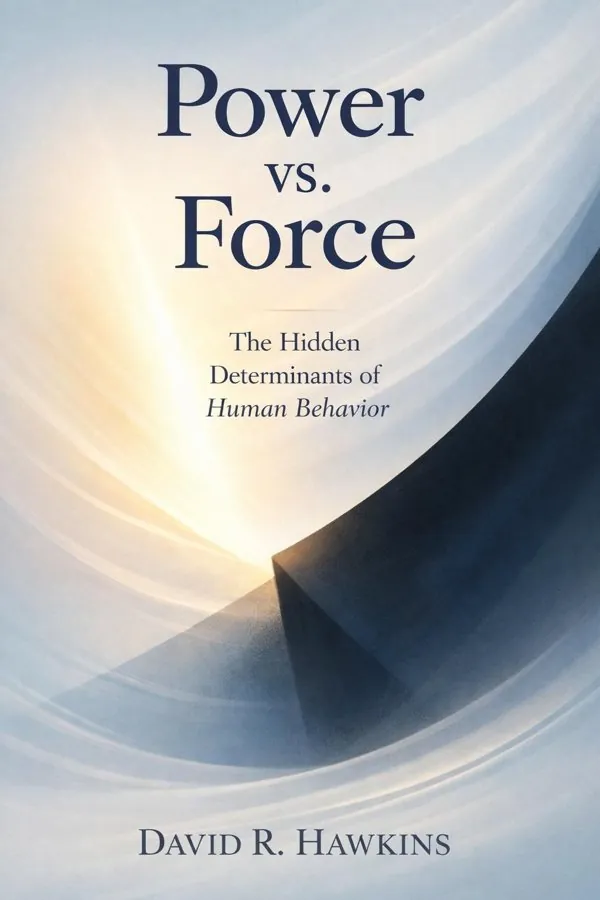
Power vs. Force: The Hidden Determinants of Human Behavior: Summary & Key Insights
 10 min5 chaptersAudio available
What Is Power vs. Force: The Hidden Determinants of Human Behavior About?
Power vs. Force: The Hidden Determinants of Human Behavior by David R. Hawkins is a mindset book spanning 5 pages. This seminal work by Dr. David R. Hawkins explores the relationship between human consciousness and power. Drawing from kinesiology and spiritual philosophy, Hawkins presents a calibrated scale of consciousness that measures the energy levels of emotions, thoughts, and behaviors. The book argues that true power arises from higher states of awareness and integrity, while force stems from lower, ego-driven states. It has become a cornerstone text in the study of consciousness and personal development.
This FizzRead summary covers all 5 key chapters of Power vs. Force: The Hidden Determinants of Human Behavior in approximately 10 minutes, distilling the most important ideas, arguments, and takeaways from David R. Hawkins's work. Also available as an audio summary and Key Quotes Podcast.
Power vs. Force: The Hidden Determinants of Human Behavior
This seminal work by Dr. David R. Hawkins explores the relationship between human consciousness and power. Drawing from kinesiology and spiritual philosophy, Hawkins presents a calibrated scale of consciousness that measures the energy levels of emotions, thoughts, and behaviors. The book argues that true power arises from higher states of awareness and integrity, while force stems from lower, ego-driven states. It has become a cornerstone text in the study of consciousness and personal development.
Who Should Read Power vs. Force: The Hidden Determinants of Human Behavior?
This book is perfect for anyone interested in mindset and looking to gain actionable insights in a short read. Whether you're a student, professional, or lifelong learner, the key ideas from Power vs. Force: The Hidden Determinants of Human Behavior by David R. Hawkins will help you think differently.
- ✓Readers who enjoy mindset and want practical takeaways
- ✓Professionals looking to apply new ideas to their work and life
- ✓Anyone who wants the core insights of Power vs. Force: The Hidden Determinants of Human Behavior in just 10 minutes
Want the full summary?
Get instant access to this book summary and 100K+ more with Fizz Moment.
Get Free SummaryAvailable on App Store • Free to download
Key Chapters
My inquiry began with a fascination for the fabric of consciousness itself — the invisible substrate upon which all human experience is projected. As a psychiatrist, I saw firsthand how different mental states carry palpable energetic fields. Through research and collaboration with other scientists, I began to explore applied kinesiology — a technique in which the body’s muscle response can reveal subtle energetic truths. This discovery became an instrument to measure consciousness itself.
When the body encounters truth, it aligns and strengthens. When it encounters falsehood or negativity, it weakens. It was astonishing to witness the consistency of these results across cultures, languages, and beliefs. Through tens of thousands of calibrated tests, it became clear that consciousness has an objective structure. It exists as a continuum, each level associated with specific emotional patterns, worldviews, and physiological states. The logarithmic scale I developed — ranging from 1 to 1000 — quantifies this continuum, allowing us to calibrate the energy of everything from personal emotions to historical figures and even nations.
By understanding this, one begins to appreciate that consciousness is not created by the brain; rather, the brain perceives the field of consciousness, much like a radio receives frequencies. Each level of awareness radiates a distinct attractor field, drawing to itself experiences and interpretations consistent with its vibration. In truth, reality itself is fluid — it modifies according to the perceiver’s level of consciousness. When we calibrate higher, life transforms effortlessly because we perceive through the lens of truth rather than distortion.
The deeper implication is that power emerges naturally from higher consciousness — it does not require struggle or manipulation. Force, however, always diminishes itself. It operates through opposition, dependent on control, coercion, and fear. When we understand that our personal energy contributes to the collective field, we begin to take profound responsibility for the quality of our inner life. Each thought and emotion, consciously or unconsciously, helps sculpt the destiny of humanity.
The Map of Consciousness was the fruit of decades of observation and calibration. It begins at the lowest frequency — shame, which calibrates at 20 — and ascends toward the pinnacle of human awareness — enlightenment at 700–1000. Each level corresponds to a worldview, behavioral patterns, and psychological tendencies.
At the lower end of the scale dwell emotions and perceptions rooted in survival and separation. Shame, guilt, and apathy are heavy attractor fields, perpetuating patterns of withdrawal and despair. As one ascends, the energy lightens: fear gives way to desire, anger to pride. Yet, while pride may feel empowering, it remains within the domain of force, for it depends on external validation and resists humility. It is only at courage — calibrated at 200 — that we cross a critical threshold. Here begins true power. At this level, one moves from negative to positive energy, from contraction to expansion.
Above courage lies neutrality, where flexibility replaces rigidity, and life becomes a field of possibilities rather than threats. Then comes willingness — the joy of service and contribution — followed by acceptance, where forgiveness and emotional balance bring serenity. Reason follows, representing the clarity of intellect, but even reason, for all its brilliance, is bound by duality. Beyond reason, one enters the realms of love (500), joy (540), peace (600), and ultimately enlightenment, where self and world dissolve into unity.
It is important to recognize that these levels are not moral judgments but energetic realities. A person at any level is worthy of compassion, for consciousness evolves through experience. Each frequency is a lesson in the remembrance of truth. The ultimate invitation is to surrender the illusions that bind us to force and to awaken to the limitless radiance of being.
+ 3 more chapters — available in the FizzRead app
All Chapters in Power vs. Force: The Hidden Determinants of Human Behavior
About the Author
David R. Hawkins, M.D., Ph.D., was an American psychiatrist, spiritual teacher, and author known for his research on consciousness and spirituality. He founded the Institute for Advanced Spiritual Research and wrote several influential books on human awareness and enlightenment, including 'The Eye of the I' and 'Letting Go'.
Get This Summary in Your Preferred Format
Read or listen to the Power vs. Force: The Hidden Determinants of Human Behavior summary by David R. Hawkins anytime, anywhere. FizzRead offers multiple formats so you can learn on your terms — all free.
Available formats: App · Audio · PDF · EPUB — All included free with FizzRead
Download Power vs. Force: The Hidden Determinants of Human Behavior PDF and EPUB Summary
Key Quotes from Power vs. Force: The Hidden Determinants of Human Behavior
“My inquiry began with a fascination for the fabric of consciousness itself — the invisible substrate upon which all human experience is projected.”
“The Map of Consciousness was the fruit of decades of observation and calibration.”
Frequently Asked Questions about Power vs. Force: The Hidden Determinants of Human Behavior
Power vs. Force: The Hidden Determinants of Human Behavior by David R. Hawkins is a mindset book that explores key ideas across 5 chapters. This seminal work by Dr. David R. Hawkins explores the relationship between human consciousness and power. Drawing from kinesiology and spiritual philosophy, Hawkins presents a calibrated scale of consciousness that measures the energy levels of emotions, thoughts, and behaviors. The book argues that true power arises from higher states of awareness and integrity, while force stems from lower, ego-driven states. It has become a cornerstone text in the study of consciousness and personal development.
More by David R. Hawkins


You Might Also Like

Browse by Category
Ready to read Power vs. Force: The Hidden Determinants of Human Behavior?
Get the full summary and 100K+ more books with Fizz Moment.