
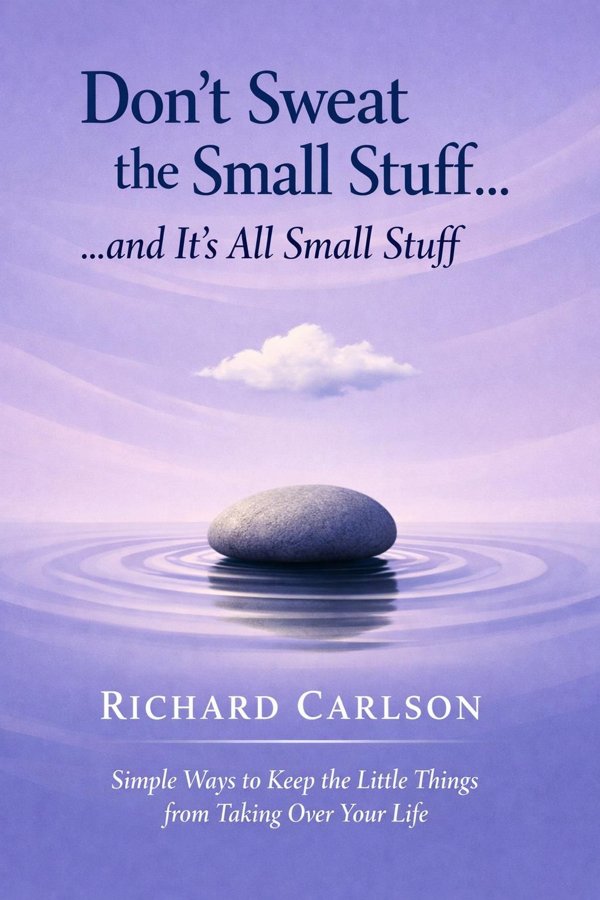
Don't Sweat the Small Stuff... and It's All Small Stuff: Summary & Key Insights
 10 min8 chaptersAudio available
Key Takeaways from Don't Sweat the Small Stuff... and It's All Small Stuff
A surprising amount of stress is self-created by the meaning we attach to events.
Much anxiety comes from trying to manage what was never fully ours to manage.
Many people miss the life they are living because they are busy mentally rehearsing the next problem.
One of Carlson’s most disarming observations is that being right is often overrated.
A peaceful life is less about eliminating problems than about shrinking our overreactions.
What Is Don't Sweat the Small Stuff... and It's All Small Stuff About?
Don't Sweat the Small Stuff... and It's All Small Stuff by Richard Carlson is a positive_psych book published in 1997 spanning 13 pages. Richard Carlson’s Don't Sweat the Small Stuff... and It’s All Small Stuff is a practical guide to reclaiming peace of mind in a world that constantly invites overreaction. Rather than offering a complex theory of happiness, Carlson presents a simple but powerful idea: much of our stress comes from how we respond to ordinary inconveniences, not from the inconveniences themselves. Through brief, accessible chapters, he shows readers how to let go of irritation, stop turning minor problems into emotional emergencies, and approach daily life with more perspective, patience, and kindness. What makes the book enduring is its focus on everyday psychology. Carlson was a psychotherapist who understood that people rarely collapse only under major crises; more often, they wear themselves down through constant mental friction—worrying, rushing, judging, controlling, and replaying small frustrations. His advice is gentle, practical, and deeply applicable, whether you are dealing with work pressure, relationship tension, family stress, or your own inner restlessness. This book matters because it reminds us that a calmer life is not built by eliminating every problem, but by changing the way we meet them.
This FizzRead summary covers all 8 key chapters of Don't Sweat the Small Stuff... and It's All Small Stuff in approximately 10 minutes, distilling the most important ideas, arguments, and takeaways from Richard Carlson's work. Also available as an audio summary and Key Quotes Podcast.
Don't Sweat the Small Stuff... and It's All Small Stuff
Richard Carlson’s Don't Sweat the Small Stuff... and It’s All Small Stuff is a practical guide to reclaiming peace of mind in a world that constantly invites overreaction. Rather than offering a complex theory of happiness, Carlson presents a simple but powerful idea: much of our stress comes from how we respond to ordinary inconveniences, not from the inconveniences themselves. Through brief, accessible chapters, he shows readers how to let go of irritation, stop turning minor problems into emotional emergencies, and approach daily life with more perspective, patience, and kindness.
What makes the book enduring is its focus on everyday psychology. Carlson was a psychotherapist who understood that people rarely collapse only under major crises; more often, they wear themselves down through constant mental friction—worrying, rushing, judging, controlling, and replaying small frustrations. His advice is gentle, practical, and deeply applicable, whether you are dealing with work pressure, relationship tension, family stress, or your own inner restlessness. This book matters because it reminds us that a calmer life is not built by eliminating every problem, but by changing the way we meet them.
Who Should Read Don't Sweat the Small Stuff... and It's All Small Stuff?
This book is perfect for anyone interested in positive_psych and looking to gain actionable insights in a short read. Whether you're a student, professional, or lifelong learner, the key ideas from Don't Sweat the Small Stuff... and It's All Small Stuff by Richard Carlson will help you think differently.
- ✓Readers who enjoy positive_psych and want practical takeaways
- ✓Professionals looking to apply new ideas to their work and life
- ✓Anyone who wants the core insights of Don't Sweat the Small Stuff... and It's All Small Stuff in just 10 minutes
Want the full summary?
Get instant access to this book summary and 100K+ more with Fizz Moment.
Get Free SummaryAvailable on App Store • Free to download
Key Chapters
A surprising amount of stress is self-created by the meaning we attach to events. Carlson’s central insight is that life’s small hassles become large mainly because we interpret them as threats, disrespect, failures, or signs that things are going wrong. A delayed meeting, a messy kitchen, or someone’s rude comment may be inconvenient, but the suffering expands when the mind starts adding a story: “This always happens to me,” “People don’t value my time,” or “My whole day is ruined.” In that sense, perspective is not a decorative extra; it is the lens through which emotional reality is formed.
Carlson encourages readers to step back and ask whether a situation truly deserves the energy they are giving it. Often, what feels urgent in the moment becomes forgettable within a day or a week. This simple realization weakens the grip of irritation. It also creates room for humility. We begin to see that not every disagreement is a crisis, not every inconvenience is injustice, and not every mistake requires self-punishment.
In practice, this means pausing before reacting. If someone cuts you off in traffic, instead of building a chain of resentment, you can notice the impulse and choose a broader view: it is a minor moment in a much larger day. If a coworker is curt, you can consider that they may be stressed rather than hostile. Perspective does not deny difficulty; it prevents exaggeration.
Actionable takeaway: When something upsets you, ask, “Will this matter in a week?�� Let that question interrupt your automatic reaction and restore proportion.
Much anxiety comes from trying to manage what was never fully ours to manage. Carlson argues that people often believe peace will arrive once everything is organized, predictable, and under control. Yet the opposite tends to happen: the more we demand certainty, the more fragile we become when life behaves like life—messy, delayed, and unpredictable. Control can feel comforting, but when it becomes an emotional requirement, it turns ordinary uncertainty into chronic tension.
This idea is especially relevant in relationships, parenting, work, and planning. We want people to respond as expected, schedules to unfold perfectly, and outcomes to match effort. But reality includes other personalities, random setbacks, market shifts, traffic jams, illnesses, and misunderstandings. Carlson does not suggest becoming passive or irresponsible. He suggests distinguishing between influence and control. You can prepare well, communicate clearly, and do your best. You cannot guarantee how everything will turn out.
Letting go of excessive control softens perfectionism. It also improves relationships, because people feel less managed and more accepted. Instead of insisting that your partner load the dishwasher your way, your child learn at your pace, or your colleagues think exactly like you, you begin to leave room for difference. This creates less friction and more emotional resilience.
A helpful application is to notice “control language” in your mind: “should,” “must,” “have to,” and “why can’t they just.” These are often signs that peace is being outsourced to conditions beyond your command.
Actionable takeaway: Make two lists when stressed—what you can influence and what you cannot—and consciously release the second list.
Many people miss the life they are living because they are busy mentally rehearsing the next problem. Carlson repeatedly returns to the value of being present. Stress often comes not from this moment itself, but from the mind’s habit of leaving the present to revisit the past or pre-live the future. We replay embarrassing conversations, anticipate criticism, predict failure, or imagine worst-case scenarios. In doing so, we abandon the only place where life is actually happening.
Living in the present does not mean ignoring responsibility. It means bringing full attention to the task, person, or experience in front of you rather than scattering energy across mental noise. When you eat while checking messages, worry during conversations, or think about tomorrow while driving home, your nervous system never fully rests. Presence calms the body because it removes the illusion that all imagined problems must be solved immediately.
Carlson’s version of presence is practical and accessible. It can look like listening without preparing your reply, washing dishes without resentment, taking a breath before entering a meeting, or feeling your feet on the ground when your thoughts spiral. These tiny acts of awareness reduce mental speed and increase emotional steadiness.
This idea also changes how we relate to joy. Many meaningful moments are small and easily overlooked: a walk, a quiet morning, a child’s question, sunlight through a window. When we are never mentally here, those moments pass unnoticed.
Actionable takeaway: Choose one routine activity each day—drinking coffee, walking, showering, or commuting—and do it with full attention instead of multitasking.
One of Carlson’s most disarming observations is that being right is often overrated. Much daily conflict is sustained not by major moral differences, but by ego investment—the need to prove, correct, defend, or win. Compassion interrupts this cycle. When you remember that other people are also struggling, insecure, distracted, and imperfect, your reactions become gentler. You stop treating every annoying behavior as a personal offense and begin seeing it as part of the shared human condition.
Compassion is not weakness or lack of boundaries. It is the choice to respond with understanding before judgment. For example, if a cashier seems impatient, a compassionate lens allows for the possibility that they are tired or overwhelmed. If a family member repeats an irritating habit, compassion may help you address it kindly instead of explosively. This shift preserves your own peace as much as it benefits others.
Carlson also suggests that compassion can make us less self-centered. Much suffering grows when we constantly measure whether life is going our way. But when attention turns outward—toward being helpful, forgiving, patient, or encouraging—the mind becomes less cramped by personal grievances. Simple acts of kindness can therefore be psychological medicine.
In daily practice, compassion may mean letting someone finish speaking, giving another person the benefit of the doubt, or asking what burden they may be carrying. It can also mean extending grace to yourself when you are tired, imperfect, or behind.
Actionable takeaway: Once a day, deliberately replace a judgmental thought about someone with a more generous interpretation and observe how your mood changes.
A peaceful life is less about eliminating problems than about shrinking our overreactions. Carlson’s title itself points to the pattern he wants readers to notice: we turn tiny disturbances into full emotional events. We slam doors internally over lateness, clutter, slow service, noise, forgotten errands, and offhand remarks. Each reaction may seem justified in isolation, but together they create a state of chronic agitation.
Overreaction often becomes habitual because it feels automatic. The body tightens, the mind narrates, and irritation presents itself as necessary. Yet Carlson argues that most of these reactions do not improve anything. They simply drain energy, sour relationships, and make us less available for what really matters. Learning not to sweat the small stuff is therefore not denial; it is emotional economy.
A practical strategy is to create a small pause between stimulus and response. That pause might be a breath, a sip of water, or silently counting to five. During that moment, you can ask whether escalating the situation will help. Usually it will not. If your child spills juice, if technology freezes, or if your plans change unexpectedly, the event is already inconvenient. Anger adds a second layer of suffering.
Carlson also encourages a sense of humor. Many annoyances lose power when viewed lightly. A missed turn, a mix-up, or a minor misunderstanding is often more survivable than your nervous system initially claims.
Actionable takeaway: Pick one recurring irritation this week and commit to responding to it with one calm breath instead of your usual reaction.
Busyness is often worn like a badge of importance, but Carlson sees it as one of the great thieves of peace. Many people are not only doing too much; they are thinking too much, rushing too much, and treating every item as equally urgent. The result is a life that feels crowded even when it is productive. Carlson invites readers to simplify—not necessarily by abandoning responsibility, but by becoming more intentional about what deserves attention and what does not.
Simplifying priorities begins with honesty. Some stress is unavoidable, but much of it is self-generated by saying yes too often, overcommitting, multitasking relentlessly, and acting as if rest must be earned after total completion. Yet life rarely reaches total completion. There is always another email, task, appointment, or unresolved detail. If inner peace depends on a perfectly cleared schedule, it will remain permanently postponed.
Slowing down is not laziness. In Carlson’s framework, it is a way of reclaiming sanity. When you slow your speech, your walking, your transitions, and your expectations, you become less accident-prone mentally and emotionally. You listen better, make fewer impulsive mistakes, and feel less chased by time. Even ordinary routines become easier.
This principle can be applied by reducing unnecessary complexity. Limit trivial decisions, leave margin between commitments, and stop treating small delays as catastrophes. Ask what truly matters today instead of trying to win at everything at once.
Actionable takeaway: At the start of each day, identify your top three priorities and consciously allow the rest to be secondary.
The mind naturally scans for what is missing, unfair, unfinished, or disappointing. Carlson counters this tendency with three stabilizing practices: gratitude, acceptance, and forgiveness. Together, they loosen the mental habits that make life feel harsher than it is. Gratitude redirects attention to what is already working. Acceptance reduces resistance to what cannot be changed immediately. Forgiveness frees us from carrying old injuries as present burdens.
Gratitude does not require a perfect life. It simply means noticing that even in stressful seasons, not everything is wrong. There may be a supportive friend, a healthy body, a safe home, a skill, a lesson, or a moment of beauty available right now. This shift matters because attention shapes emotion. A mind trained to notice blessings becomes less dominated by irritations.
Acceptance is equally important. Carlson is not advocating resignation to injustice or passivity in the face of real problems. He is pointing out that fighting reality emotionally before addressing it practically wastes energy. If traffic is stopped, the meeting is delayed, or someone has a personality you dislike, acceptance says, “This is what is happening right now.” From that calmer position, wiser action becomes possible.
Forgiveness may be the hardest of the three. Holding grudges can feel morally satisfying, but it ties your well-being to old pain. Forgiveness does not mean approving what happened; it means refusing to let the past occupy permanent mental rent-free space.
Actionable takeaway: End each day by naming one thing you accept, one thing you appreciate, and one resentment you are ready to loosen.
Achievement loses much of its sweetness when it is driven by constant dissatisfaction. Carlson does not reject ambition, growth, or excellence. Instead, he questions the common assumption that happiness must be postponed until the next milestone is reached. Many people live as if contentment will become available after promotion, recognition, financial security, weight loss, or external validation. But when the habit of striving is not balanced by gratitude and presence, each accomplishment simply gives way to the next demand.
The deeper issue is identity. If you believe your worth depends on output, status, or efficiency, rest feels dangerous and ordinary moments feel insufficient. Carlson invites readers to cultivate contentment now, not later. This does not kill motivation; it purifies it. You can work hard, pursue meaningful goals, and improve your life without making emotional peace contingent on outcomes.
This shift is especially useful for high performers. Instead of asking, “How much more do I need to do to feel okay?” the better question becomes, “Can I act with purpose while remaining inwardly steady?” That attitude prevents success from becoming another form of stress. It also protects relationships, because people driven by relentless striving often become impatient with themselves and others.
Mindful communication and criticism fit here as well. When ego is less attached to proving value, feedback becomes easier to hear and conversations become less defensive. You can disagree without collapsing, improve without self-hatred, and speak more gently.
Actionable takeaway: Pursue your goals, but once a day remind yourself, “I am allowed to be at peace before everything is finished.”
All Chapters in Don't Sweat the Small Stuff... and It's All Small Stuff
About the Author
Richard Carlson (1961–2006) was an American psychotherapist, motivational speaker, and bestselling author whose work focused on stress reduction, emotional balance, and everyday well-being. He earned widespread recognition with Don't Sweat the Small Stuff... and It’s All Small Stuff, which became an international success and launched a long-running series of related books. Carlson had a gift for translating psychological insight into simple, practical advice that ordinary readers could apply immediately. Rather than emphasizing dramatic transformation, he encouraged small shifts in perspective, patience, gratitude, and compassion. His warm, accessible style helped millions of people rethink how they handled pressure, relationships, and daily frustration. Though his life was cut short, his writing remains influential in the fields of self-help and positive psychology.
Get This Summary in Your Preferred Format
Read or listen to the Don't Sweat the Small Stuff... and It's All Small Stuff summary by Richard Carlson anytime, anywhere. FizzRead offers multiple formats so you can learn on your terms — all free.
Available formats: App · Audio · PDF · EPUB — All included free with FizzRead
Download Don't Sweat the Small Stuff... and It's All Small Stuff PDF and EPUB Summary
Key Quotes from Don't Sweat the Small Stuff... and It's All Small Stuff
“A surprising amount of stress is self-created by the meaning we attach to events.”
“Much anxiety comes from trying to manage what was never fully ours to manage.”
“Many people miss the life they are living because they are busy mentally rehearsing the next problem.”
“One of Carlson’s most disarming observations is that being right is often overrated.”
“A peaceful life is less about eliminating problems than about shrinking our overreactions.”
Frequently Asked Questions about Don't Sweat the Small Stuff... and It's All Small Stuff
Don't Sweat the Small Stuff... and It's All Small Stuff by Richard Carlson is a positive_psych book that explores key ideas across 8 chapters. Richard Carlson’s Don't Sweat the Small Stuff... and It’s All Small Stuff is a practical guide to reclaiming peace of mind in a world that constantly invites overreaction. Rather than offering a complex theory of happiness, Carlson presents a simple but powerful idea: much of our stress comes from how we respond to ordinary inconveniences, not from the inconveniences themselves. Through brief, accessible chapters, he shows readers how to let go of irritation, stop turning minor problems into emotional emergencies, and approach daily life with more perspective, patience, and kindness. What makes the book enduring is its focus on everyday psychology. Carlson was a psychotherapist who understood that people rarely collapse only under major crises; more often, they wear themselves down through constant mental friction—worrying, rushing, judging, controlling, and replaying small frustrations. His advice is gentle, practical, and deeply applicable, whether you are dealing with work pressure, relationship tension, family stress, or your own inner restlessness. This book matters because it reminds us that a calmer life is not built by eliminating every problem, but by changing the way we meet them.
You Might Also Like
Option B
Sheryl Sandberg & Adam Grant
10 min
Hallelujah Anyway: Rediscovering Mercy
Anne Lamott
10 min
I Can Do It: How to Use Affirmations to Change Your Life
Louise Hay
10 min
The Coffee Bean: A Simple Lesson to Create Positive Change
Jon Gordon, Damon West
10 min
The Happiness Hypothesis: Finding Modern Truth in Ancient Wisdom
Jonathan Haidt
10 min
59 Seconds: Think a Little, Change a Lot
Richard Wiseman
10 minFeatured In
Browse by Category
Ready to read Don't Sweat the Small Stuff... and It's All Small Stuff?
Get the full summary and 100K+ more books with Fizz Moment.