
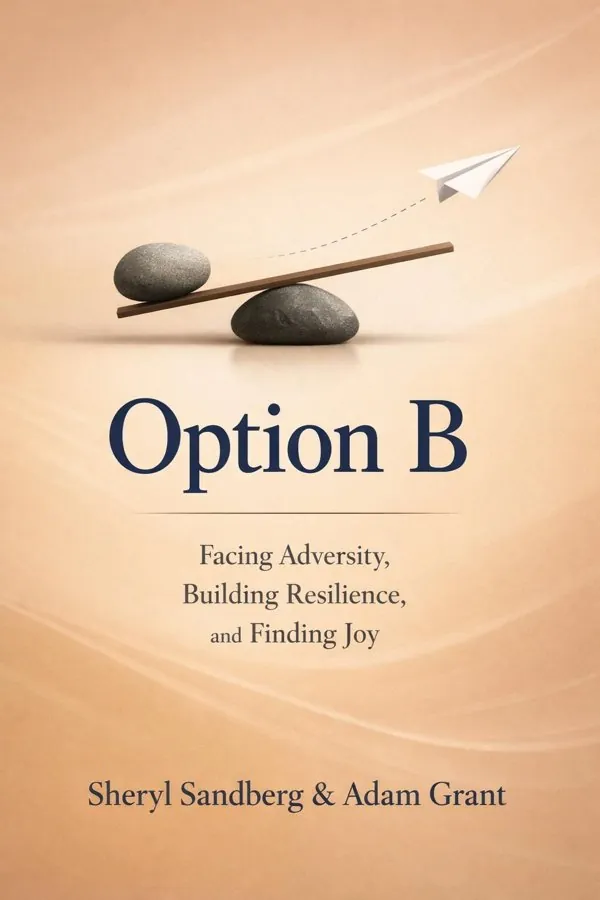
Option B: Summary & Key Insights
by Sheryl Sandberg, Adam Grant
 10 min9 chaptersAudio available
Key Takeaways from Option B
Some of life’s hardest moments begin with a sentence we never expected to say: this was not supposed to happen.
Pain becomes heavier when we feel we must hide it.
Many people think resilience is something you either have or you do not.
A setback becomes more damaging when we tell ourselves the wrong story about it.
We often speak to ourselves most harshly when we are already hurting.
What Is Option B About?
Option B by Sheryl Sandberg & Adam Grant is a positive_psych book published in 2017 spanning 9 pages. Option B is a deeply human book about what happens after life shatters the future you expected. Co-written by Sheryl Sandberg and psychologist Adam Grant, it begins with Sandberg’s devastating loss after the sudden death of her husband, Dave Goldberg, and expands into a broader exploration of how people survive grief, trauma, disappointment, illness, job loss, and other painful setbacks. The central idea is simple but powerful: when Option A is no longer available, we must learn how to live with Option B. What makes the book so compelling is its combination of raw personal honesty and rigorous psychological research. Sandberg gives the topic emotional truth, describing grief not as an abstract concept but as a lived reality. Grant contributes evidence-based insights on resilience, recovery, self-compassion, and post-traumatic growth. Together, they show that resilience is not a fixed trait reserved for the naturally strong. It is a set of habits, interpretations, and relationships that can be developed. For anyone facing loss—or trying to support someone who is—Option B offers both comfort and practical guidance. It reminds readers that pain may be unavoidable, but despair does not have to be permanent.
This FizzRead summary covers all 9 key chapters of Option B in approximately 10 minutes, distilling the most important ideas, arguments, and takeaways from Sheryl Sandberg & Adam Grant's work. Also available as an audio summary and Key Quotes Podcast.
Option B
Option B is a deeply human book about what happens after life shatters the future you expected. Co-written by Sheryl Sandberg and psychologist Adam Grant, it begins with Sandberg’s devastating loss after the sudden death of her husband, Dave Goldberg, and expands into a broader exploration of how people survive grief, trauma, disappointment, illness, job loss, and other painful setbacks. The central idea is simple but powerful: when Option A is no longer available, we must learn how to live with Option B.
What makes the book so compelling is its combination of raw personal honesty and rigorous psychological research. Sandberg gives the topic emotional truth, describing grief not as an abstract concept but as a lived reality. Grant contributes evidence-based insights on resilience, recovery, self-compassion, and post-traumatic growth. Together, they show that resilience is not a fixed trait reserved for the naturally strong. It is a set of habits, interpretations, and relationships that can be developed.
For anyone facing loss—or trying to support someone who is—Option B offers both comfort and practical guidance. It reminds readers that pain may be unavoidable, but despair does not have to be permanent.
Who Should Read Option B?
This book is perfect for anyone interested in positive_psych and looking to gain actionable insights in a short read. Whether you're a student, professional, or lifelong learner, the key ideas from Option B by Sheryl Sandberg & Adam Grant will help you think differently.
- ✓Readers who enjoy positive_psych and want practical takeaways
- ✓Professionals looking to apply new ideas to their work and life
- ✓Anyone who wants the core insights of Option B in just 10 minutes
Want the full summary?
Get instant access to this book summary and 100K+ more with Fizz Moment.
Get Free SummaryAvailable on App Store • Free to download
Key Chapters
Some of life’s hardest moments begin with a sentence we never expected to say: this was not supposed to happen. That is the emotional starting point of Option B. Sheryl Sandberg explains that after her husband’s sudden death, she found herself longing for the life she had planned—the future that had vanished. In one heartbreaking moment, she said she wanted “Option A,” and a friend replied, “Option A is not available. So let’s just kick the hell out of Option B.” That idea becomes the book’s defining framework.
Option B does not mean pretending tragedy is acceptable or forcing gratitude before you are ready. It means acknowledging reality without surrendering your future to it. Many people spend enormous emotional energy replaying what should have happened: the marriage that should have lasted, the career that should have advanced, the body that should have stayed healthy, the parent who should still be alive. While this longing is natural, healing begins when we slowly shift from resistance to adaptation.
This concept applies far beyond bereavement. A failed business, divorce, diagnosis, redundancy, or betrayal can all erase Option A. The challenge is not to replace what was lost with something equally perfect. It is to build a meaningful life under new conditions. Sandberg and Grant emphasize that resilience starts not with optimism alone, but with acceptance: this is the life in front of me now, and I can still shape it.
A practical way to apply this idea is to ask: What parts of my future are gone, and what parts can still be rebuilt? Naming the loss clearly can reduce confusion. Then identify one concrete next step—a conversation, a routine, a support group, a small goal—that belongs to Option B, not the old plan.
Actionable takeaway: Stop measuring your present against the life that vanished, and choose one meaningful step toward the life you can still create.
Pain becomes heavier when we feel we must hide it. One of the book’s most honest insights is that adversity often brings not only suffering, but fear, disorientation, and loss of basic functioning. After Dave’s death, Sandberg describes how ordinary responsibilities became overwhelming and how grief invaded even simple moments. This matters because many people wrongly assume resilience means staying composed, productive, and positive from the start.
Grant’s research helps explain why trauma can make everyday life feel unsafe. The brain becomes alert to danger; the body reacts as if the world is no longer predictable. In that state, people may struggle to concentrate, make decisions, sleep, or perform routine tasks. Recognizing this is important because it replaces self-judgment with understanding. You are not weak because you cannot “move on” quickly. You are reacting to a profound disruption.
The authors argue that resilience begins with truth-telling. Naming reality—“I am devastated,” “I am scared,” “I cannot do this alone”—is not surrender. It is the first step toward recovery. Denial can temporarily numb pain, but it also delays adaptation. Facing adversity means allowing grief, anger, confusion, and uncertainty to exist without letting them define your whole identity forever.
In practical terms, this can look like scaling expectations to your actual capacity. Someone grieving may need help with childcare, meals, paperwork, or work deadlines. Someone after a career setback may need to pause major decisions until their thinking clears. A family in crisis may need structure before they need advice.
People supporting others should also avoid clichés like “everything happens for a reason.” Better support often sounds like: “This is awful. I’m here. What would help today?” Emotional honesty builds connection and safety.
Actionable takeaway: Replace pressure to appear strong with permission to be honest, and ask for one specific form of support that matches what you truly need right now.
Many people think resilience is something you either have or you do not. Option B challenges that myth directly. Grant shows that resilience is less like a gift and more like a muscle: uneven across people, but strengthenable through practice, perspective, and support. This is empowering because it means our response to hardship is not fixed.
The book identifies several foundations of resilience. The first is personal agency—the belief that even in painful circumstances, some actions remain within our control. The second is social support, because recovery happens faster when people are seen, helped, and connected. The third is flexible thinking: the ability to interpret setbacks in ways that leave room for change rather than permanent defeat.
Sandberg’s experience illustrates this. In the aftermath of loss, she did not become resilient because she felt strong. She became more resilient gradually by relying on friends, establishing routines, showing up for her children, and allowing herself to experience both grief and moments of joy. Resilience often looks ordinary before it feels heroic.
A useful application of this idea is creating “micro-recoveries.” After adversity, the future can feel too large to handle. Instead of asking, “How do I rebuild my life?” ask, “What helps me get through this day?” That might mean walking outside, attending therapy, answering one overdue email, eating a proper meal, or talking to someone who understands. Small repeated actions restore a sense of competence.
The authors also stress that resilience is not the absence of suffering. You can be heartbroken and resilient at the same time. In fact, resilience often grows through learning that pain can be survived.
Actionable takeaway: Treat resilience as a daily practice by choosing small, repeatable actions that restore control, connection, and stability.
A setback becomes more damaging when we tell ourselves the wrong story about it. Drawing on Martin Seligman’s work, Option B highlights three toxic thought patterns that undermine resilience: personalization, pervasiveness, and permanence. These are called the “Three Ps,” and they shape how we interpret pain.
Personalization means blaming yourself for events beyond your control. After a loss or failure, people often think, “This happened because of me,” even when the situation was more complex. Pervasiveness means assuming one bad event contaminates everything: “My career failed, so my whole life is ruined.” Permanence means believing the pain or damage will last forever: “I will never feel normal again.” Together, these beliefs create hopelessness.
Grant argues that resilient people learn to challenge these automatic interpretations. That does not mean becoming unrealistically positive. It means becoming more accurate. A layoff may reflect market conditions, not personal worth. A breakup may be painful without proving you are unlovable. A period of grief may be intense without being emotionally endless.
This framework is powerful because it gives people a language for catching destructive thinking in real time. For example, if you make a mistake at work and think, “I always ruin everything,” you can ask: Am I personalizing? Am I making this pervasive? Am I assuming permanence? The answer is often yes. Reframing might sound like: “I handled this badly, but one mistake does not define my abilities, and I can repair it.”
Parents, managers, and friends can also use this lens to support others. Instead of offering empty reassurance, help people separate one painful event from their entire identity and future.
Actionable takeaway: When adversity hits, write down your first interpretation of it and deliberately challenge any signs of personalization, pervasiveness, or permanence.
We often speak to ourselves most harshly when we are already hurting. One of the book’s most valuable lessons is that self-compassion is not indulgence; it is a critical ingredient of resilience. Sandberg describes the guilt, regret, and self-criticism that can follow tragedy. Many people replay what they should have done, should have known, or should have prevented. But this mindset deepens suffering without creating healing.
Grant and Sandberg argue that self-compassion allows people to recover because it reduces shame and restores emotional energy. If you are constantly attacking yourself, you have fewer resources left to adapt. Self-compassion means responding to your own pain the way you would respond to someone you love: with honesty, patience, and care.
This does not require minimizing responsibility. If you made a mistake, you can acknowledge it and still reject cruelty toward yourself. There is a profound difference between “I failed” and “I am a failure.” The first invites learning. The second creates paralysis.
The book also connects self-compassion to post-traumatic growth—the possibility that people can develop greater wisdom, empathy, and strength after hardship. Growth does not erase pain, and it should never be demanded. But when people stop punishing themselves for being broken, they become more open to rebuilding.
Practical examples include speaking kindly to yourself after a difficult day, reducing impossible expectations, and accepting help without framing it as weakness. A grieving parent might allow themselves to miss a social event. A person recovering from burnout might need rest before ambition. A student after failure might seek tutoring rather than shame.
Actionable takeaway: The next time you feel overwhelmed, replace self-blame with one compassionate sentence you would offer a close friend in the same situation.
People often want to help those who are suffering, but fear saying the wrong thing. Option B shows that silence, avoidance, and platitudes can unintentionally deepen loneliness. One of the most practical contributions of the book is its guidance on supporting others through grief and hardship.
Sandberg recalls how painful it felt when people disappeared, changed the subject, or avoided mentioning Dave because they feared causing more pain. In reality, the pain was already there. What hurt more was the sense that others could not tolerate it. Grant explains that effective support is less about perfect words and more about presence. People in grief do not need their suffering explained away; they need it acknowledged.
Helpful responses are specific, sincere, and concrete. Instead of saying, “Let me know if you need anything,” offer a clear action: “I’m bringing dinner on Thursday,” “I can pick up the kids,” or “I’m free to sit with you this evening.” Instead of trying to fix the pain, validate it: “I don’t have the right words, but I’m here.” This reduces the burden on the grieving person, who may be too exhausted to articulate their needs.
The book also emphasizes remembering dates that matter. Holidays, birthdays, anniversaries, and ordinary routines can reopen grief. A short message such as “Thinking of you and of Dave today” can mean far more than generic sympathy.
At work, support may mean flexibility, patience, and practical accommodations. In friendships, it may mean continuing to invite the person even if they sometimes decline. Consistency communicates care.
Actionable takeaway: When someone is hurting, do not wait for the perfect phrase—reach out with one honest acknowledgment and one specific offer of help.
No one becomes resilient entirely alone. Option B widens its focus beyond individual coping to show how families, schools, workplaces, and communities shape recovery. Hardship is personal, but resilience is social. The environments around us can either intensify suffering or create conditions for healing.
For families, one key lesson is the value of open emotional communication. Sandberg shares how important it was to make space for her children’s grief instead of shielding them from every difficult conversation. Children do not benefit from pretending everything is fine when they can already sense pain. They benefit from honesty that is age-appropriate, loving, and stabilizing. Families can build resilience by naming emotions, preserving routines, and reminding one another that sadness and joy can coexist.
Communities matter just as much. Schools that teach children emotional skills, workplaces that respond compassionately to loss, and neighborhoods that reduce isolation all strengthen resilience before crises even happen. Grant’s research suggests that people recover better when they feel they belong and when support is normalized rather than exceptional.
This has practical implications. A manager can create a culture where asking for help is respected. A teacher can help students identify emotions and challenge destructive thinking. Friends can organize meal trains or childcare. Religious groups, clubs, and online communities can offer structure and belonging when people feel untethered.
The broader message is that resilience should not be treated only as personal responsibility. Individuals matter, but systems matter too. Compassionate communities reduce the cost of suffering and widen the path back to functioning.
Actionable takeaway: Strengthen resilience collectively by creating regular habits of emotional honesty, practical support, and belonging in your family, workplace, or community.
After loss, many people fear that feeling happy again is a betrayal. One of the most moving ideas in Option B is that joy and grief are not opposites that cancel each other out. They can coexist. Sandberg writes about the difficulty of allowing laughter, pleasure, and gratitude back into life when sorrow still feels so present. This tension is common: people worry that smiling means forgetting, or that moving forward means loving less.
The book argues that this belief traps people in unnecessary guilt. Healing does not dishonor what was lost. In fact, returning to moments of connection, play, and meaning can be part of how we honor those we loved and the life we still have. Grant notes that positive emotions do not erase pain, but they broaden our capacity to think, connect, and cope. Even small experiences of joy can act as psychological relief valves.
Sandberg introduces the practice of noting moments of joy, however brief. This could be a child’s joke, a beautiful meal, music, sunlight, or a conversation that feels unexpectedly easy. Such moments do not solve grief, but they remind us that suffering is not the only truth available.
This idea also applies beyond bereavement. After failure or trauma, people may feel they must earn happiness by fully fixing their life first. But waiting for perfect closure can postpone healing indefinitely. Meaning often returns in fragments before it returns as confidence.
A practical approach is to stop judging positive moments and simply notice them. Instead of asking, “Do I deserve to feel okay?” ask, “What life-giving moment can I allow today?”
Actionable takeaway: Give yourself permission to notice and welcome small moments of joy, even while grief or hardship is still present.
Resilience is most powerful when developed before the next crisis arrives. While Option B is rooted in recovery after loss, it also offers a forward-looking lesson: we can build psychological strength in advance. Since adversity is unavoidable, preparation matters.
Grant explains that resilience grows through habits of interpretation, connection, and emotional skill. People who regularly challenge catastrophic thinking, invest in supportive relationships, and practice asking for help are better equipped when life becomes difficult. This is not about becoming invulnerable. It is about reducing fragility.
Sandberg’s experience also reveals how much practical infrastructure matters in hard times. Friendships, family habits, workplace flexibility, and emotional literacy all become more valuable during crisis. If those systems are neglected in ordinary times, setbacks can feel even more destabilizing.
Preparation can take many forms. Individuals can develop routines that support mental health: sleep, exercise, journaling, therapy, mindfulness, or spiritual practices. Families can discuss values, communicate openly, and normalize emotional expression. Teams can create cultures where setbacks are discussed without blame and support is offered without stigma. Parents can teach children to reframe failure as part of learning rather than proof of inadequacy.
The goal is not to anticipate every possible tragedy. It is to cultivate a mindset and network that make adaptation more likely. Future pain may still be severe, but it need not leave us helpless.
A useful reflection is: If something difficult happened tomorrow, who could I call, what routines would steady me, and what beliefs would help me endure? The answers reveal where resilience is already strong and where it needs reinforcement.
Actionable takeaway: Build resilience proactively by strengthening your support network, daily coping habits, and thinking patterns before adversity forces you to use them.
All Chapters in Option B
About the Authors
Sheryl Sandberg is a technology executive, author, and advocate best known for serving as Chief Operating Officer of Meta, formerly Facebook. She is also the founder of LeanIn.Org and OptionB.Org, organizations focused on leadership, equality, and resilience. Adam Grant is a renowned organizational psychologist, professor at the Wharton School of the University of Pennsylvania, and bestselling author of books on motivation, work, and human behavior. He is widely respected for translating academic research into practical ideas for everyday life. In Option B, Sandberg brings the emotional force of personal experience after the sudden loss of her husband, while Grant contributes scientific insight into resilience and recovery. Together, they create a rare blend of memoir, psychology, and actionable guidance.
Get This Summary in Your Preferred Format
Read or listen to the Option B summary by Sheryl Sandberg & Adam Grant anytime, anywhere. FizzRead offers multiple formats so you can learn on your terms — all free.
Available formats: App · Audio · PDF · EPUB — All included free with FizzRead
Download Option B PDF and EPUB Summary
Key Quotes from Option B
“Some of life’s hardest moments begin with a sentence we never expected to say: this was not supposed to happen.”
“Pain becomes heavier when we feel we must hide it.”
“Many people think resilience is something you either have or you do not.”
“A setback becomes more damaging when we tell ourselves the wrong story about it.”
“We often speak to ourselves most harshly when we are already hurting.”
Frequently Asked Questions about Option B
Option B by Sheryl Sandberg & Adam Grant is a positive_psych book that explores key ideas across 9 chapters. Option B is a deeply human book about what happens after life shatters the future you expected. Co-written by Sheryl Sandberg and psychologist Adam Grant, it begins with Sandberg’s devastating loss after the sudden death of her husband, Dave Goldberg, and expands into a broader exploration of how people survive grief, trauma, disappointment, illness, job loss, and other painful setbacks. The central idea is simple but powerful: when Option A is no longer available, we must learn how to live with Option B. What makes the book so compelling is its combination of raw personal honesty and rigorous psychological research. Sandberg gives the topic emotional truth, describing grief not as an abstract concept but as a lived reality. Grant contributes evidence-based insights on resilience, recovery, self-compassion, and post-traumatic growth. Together, they show that resilience is not a fixed trait reserved for the naturally strong. It is a set of habits, interpretations, and relationships that can be developed. For anyone facing loss—or trying to support someone who is—Option B offers both comfort and practical guidance. It reminds readers that pain may be unavoidable, but despair does not have to be permanent.
You Might Also Like

Don't Sweat the Small Stuff... and It's All Small Stuff
Richard Carlson
10 min
Hallelujah Anyway: Rediscovering Mercy
Anne Lamott
10 min
I Can Do It: How to Use Affirmations to Change Your Life
Louise Hay
10 min
The Coffee Bean: A Simple Lesson to Create Positive Change
Jon Gordon, Damon West
10 min
The Happiness Hypothesis: Finding Modern Truth in Ancient Wisdom
Jonathan Haidt
10 min
59 Seconds: Think a Little, Change a Lot
Richard Wiseman
10 minFeatured In
Browse by Category
Ready to read Option B?
Get the full summary and 100K+ more books with Fizz Moment.