
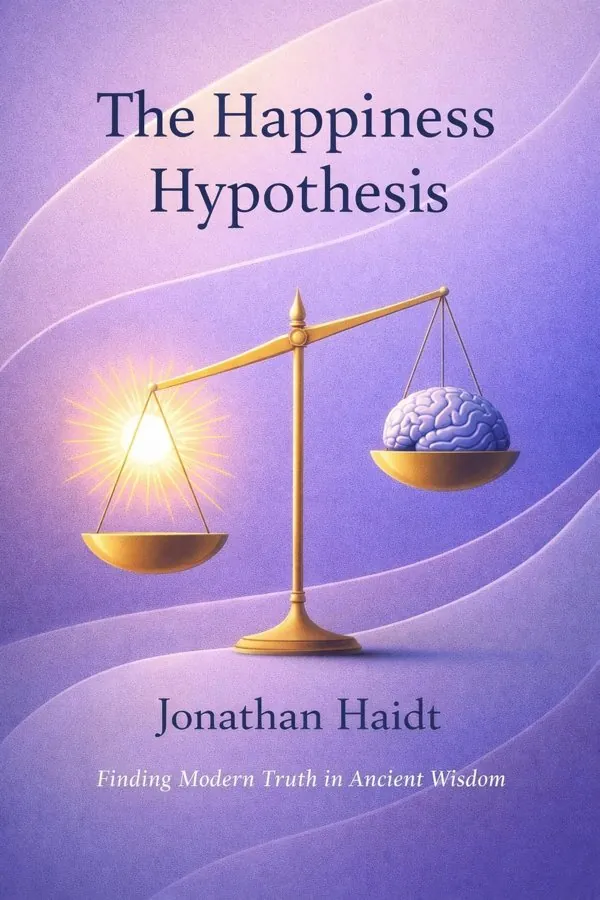
The Happiness Hypothesis: Finding Modern Truth in Ancient Wisdom: Summary & Key Insights
 10 min9 chaptersAudio available
Key Takeaways from The Happiness Hypothesis: Finding Modern Truth in Ancient Wisdom
One of Haidt’s most memorable insights is that the mind works like a rider on an elephant: reason is the rider, while emotion and intuition are the elephant.
A powerful challenge in Haidt’s book is the idea that happiness does not come only from inner attitudes or private achievement.
One of the book’s most hopeful ideas is that suffering, while painful and unwanted, can sometimes deepen a person’s life.
A central message in The Happiness Hypothesis is that a good life cannot be reduced to feeling good.
Haidt revives an old but important idea: happiness is closely tied to virtue.
What Is The Happiness Hypothesis: Finding Modern Truth in Ancient Wisdom About?
The Happiness Hypothesis: Finding Modern Truth in Ancient Wisdom by Jonathan Haidt is a positive_psych book. What if the best advice for living well was discovered thousands of years ago, then confirmed by modern psychology? In The Happiness Hypothesis, social psychologist Jonathan Haidt explores that possibility by testing ancient wisdom against contemporary research on happiness, morality, relationships, suffering, and meaning. Rather than offering quick-fix self-help slogans, Haidt examines enduring ideas from philosophers, religious traditions, and moral teachers, asking which ones still hold up under scientific scrutiny. The book matters because it bridges two worlds that are often kept apart: timeless guidance about how to live and evidence-based insights about how the mind actually works. Haidt argues that human beings are not fully rational creatures directing their lives with pure logic. We are shaped by emotion, instinct, habit, and social connection, and any serious path to happiness must account for that reality. Haidt brings rare authority to the subject. As a leading psychologist known for his work on morality, emotion, and human flourishing, he combines scientific rigor with intellectual openness. The result is a thoughtful, practical, and deeply engaging book that helps readers understand not just what happiness is, but how a good life is actually built.
This FizzRead summary covers all 9 key chapters of The Happiness Hypothesis: Finding Modern Truth in Ancient Wisdom in approximately 10 minutes, distilling the most important ideas, arguments, and takeaways from Jonathan Haidt's work. Also available as an audio summary and Key Quotes Podcast.
The Happiness Hypothesis: Finding Modern Truth in Ancient Wisdom
What if the best advice for living well was discovered thousands of years ago, then confirmed by modern psychology? In The Happiness Hypothesis, social psychologist Jonathan Haidt explores that possibility by testing ancient wisdom against contemporary research on happiness, morality, relationships, suffering, and meaning. Rather than offering quick-fix self-help slogans, Haidt examines enduring ideas from philosophers, religious traditions, and moral teachers, asking which ones still hold up under scientific scrutiny.
The book matters because it bridges two worlds that are often kept apart: timeless guidance about how to live and evidence-based insights about how the mind actually works. Haidt argues that human beings are not fully rational creatures directing their lives with pure logic. We are shaped by emotion, instinct, habit, and social connection, and any serious path to happiness must account for that reality.
Haidt brings rare authority to the subject. As a leading psychologist known for his work on morality, emotion, and human flourishing, he combines scientific rigor with intellectual openness. The result is a thoughtful, practical, and deeply engaging book that helps readers understand not just what happiness is, but how a good life is actually built.
Who Should Read The Happiness Hypothesis: Finding Modern Truth in Ancient Wisdom?
This book is perfect for anyone interested in positive_psych and looking to gain actionable insights in a short read. Whether you're a student, professional, or lifelong learner, the key ideas from The Happiness Hypothesis: Finding Modern Truth in Ancient Wisdom by Jonathan Haidt will help you think differently.
- ✓Readers who enjoy positive_psych and want practical takeaways
- ✓Professionals looking to apply new ideas to their work and life
- ✓Anyone who wants the core insights of The Happiness Hypothesis: Finding Modern Truth in Ancient Wisdom in just 10 minutes
Want the full summary?
Get instant access to this book summary and 100K+ more with Fizz Moment.
Get Free SummaryAvailable on App Store • Free to download
Key Chapters
One of Haidt’s most memorable insights is that the mind works like a rider on an elephant: reason is the rider, while emotion and intuition are the elephant. Most of us like to believe the rider is in charge, making deliberate choices and steering life with logic. But in reality, the elephant is far larger and stronger. Our instincts, automatic reactions, desires, and fears often determine where we go, while reason mostly explains or justifies the journey afterward.
This metaphor helps explain why people struggle to change even when they know what would be best. Someone may understand the benefits of exercise, patience, or gratitude, yet still avoid the gym, lose their temper, or dwell on resentment. Knowledge alone is weak if it does not engage the emotional systems that truly drive behavior. Haidt’s point is not that reason is useless, but that it works best as a guide, trainer, and negotiator rather than a dictator.
In practical life, this means successful self-improvement depends less on sheer willpower and more on shaping habits, environments, and emotional cues. If you want to read more, place books where you can see them and reduce digital distractions. If you want to be kinder, pause before reacting and rehearse better responses. If you want to eat better, redesign your kitchen rather than relying on constant self-control.
The deeper lesson is humbling: we are not as rational as we imagine, and accepting that fact makes change more realistic. Actionable takeaway: stop trying to overpower yourself with logic alone, and instead build routines and surroundings that help your emotional “elephant” move in the right direction.
A powerful challenge in Haidt’s book is the idea that happiness does not come only from inner attitudes or private achievement. It also emerges from the quality of our relationships. Human beings are profoundly social creatures, and much of what feels meaningful, joyful, and stabilizing in life comes from the bonds we form with others. We often chase happiness as if it were a personal possession, but Haidt suggests it is more often a shared construction.
This insight corrects the modern tendency to treat well-being as a solo project. Career success, personal growth, and self-esteem matter, but they do not fully satisfy our deepest needs. Love, friendship, trust, belonging, and mutual care create emotional nourishment that solitary accomplishment cannot replace. Even pleasures are amplified when shared, while pain becomes more bearable in supportive communities.
Haidt draws on psychology to show that strong relationships are among the most reliable predictors of long-term well-being. A person with average income and deep friendships may be far happier than someone with status and wealth but little connection. This has practical implications for how we spend our time. Investing in conversation, family rituals, supportive teams, and community participation is not a distraction from happiness; it is one of its foundations.
In daily life, this could mean prioritizing dinner with family over another hour of email, calling an old friend instead of scrolling social media, or joining a local group aligned with your values. Happiness is often built through repeated acts of presence and loyalty.
Actionable takeaway: treat your relationships as essential well-being practices, and deliberately schedule time each week to strengthen the people and communities that make life meaningful.
One of the book’s most hopeful ideas is that suffering, while painful and unwanted, can sometimes deepen a person’s life. Haidt does not romanticize trauma or claim that all hardship is good. Instead, he points to a subtler truth recognized by many wisdom traditions and supported by psychology: people often emerge from struggle with greater strength, clarity, gratitude, or compassion.
This phenomenon, sometimes described as post-traumatic growth, happens when adversity disrupts old assumptions and forces reflection. A serious illness may cause someone to rethink priorities. A professional failure may redirect a person toward more meaningful work. Grief may deepen empathy and make relationships feel more precious. Hardship can crack open a previously narrow view of life.
The key is not pain itself but how it is interpreted and integrated. Some suffering overwhelms, especially without support, and not every wound becomes wisdom. Yet people can often find growth through meaning-making, social connection, and a willingness to ask, “What can this experience teach me?” Ancient philosophies often stressed that adversity reveals character; modern psychology adds that it can also help build character when processed in healthy ways.
Practical applications include journaling after difficult events, seeking therapy or trusted support, identifying values clarified by the experience, and resisting the urge to define oneself solely as a victim. Someone recovering from divorce, for example, might discover new independence, stronger boundaries, or a clearer sense of what love requires.
Actionable takeaway: when life hurts, do not rush to deny the pain, but ask what strengths, values, or new directions this challenge might help uncover over time.
A central message in The Happiness Hypothesis is that a good life cannot be reduced to feeling good. Pleasure matters, but meaning matters more. Human beings do not thrive simply by maximizing comfort, entertainment, or positive emotion. They thrive when life feels purposeful, connected to something larger, and guided by worthwhile commitments.
This distinction helps explain why people can feel empty despite material success or endless convenience. A life full of pleasurable moments may still feel shallow if it lacks contribution, direction, and coherence. By contrast, raising children, serving a cause, creating art, building a business, or caring for others may be stressful and demanding, yet deeply fulfilling. Meaning often requires effort, sacrifice, and discipline, which is why it can be mistaken for the opposite of happiness when it is actually one of its deepest forms.
Haidt’s analysis aligns with both ancient teachings and modern research. Philosophers long distinguished hedonistic pleasure from eudaimonic flourishing, and psychology now shows that purpose, mastery, and belonging are major contributors to well-being. This means we should ask not only “What do I enjoy?” but also “What am I for?” and “What kind of life is worth building?”
In practice, this might involve choosing work that aligns with your values, volunteering for causes that matter to you, mentoring younger people, or committing to long-term projects that express your identity. Meaning usually grows through responsibility and sustained engagement, not through passive consumption.
Actionable takeaway: spend time identifying one responsibility, craft, or cause that gives your life purpose, and invest in it consistently rather than chasing only short-term pleasure.
Haidt revives an old but important idea: happiness is closely tied to virtue. In many modern discussions, morality is treated as restrictive, while happiness is framed as personal freedom and self-expression. But ancient thinkers often believed that developing good character was one of the surest paths to a good life. Haidt argues that this older view deserves renewed respect.
Virtue includes qualities such as honesty, self-control, courage, fairness, gratitude, humility, and kindness. These traits do not just make society function better; they also shape inner life. A person who is habitually dishonest may gain short-term advantage but often pays with anxiety, distrust, and fragmentation. A person who develops discipline can pursue meaningful goals more effectively. Someone who practices gratitude becomes less trapped by envy and dissatisfaction.
Modern psychology supports many of these claims. Character strengths are associated with resilience, stronger relationships, and greater life satisfaction. Virtue creates stability because it aligns behavior with values, reducing inner conflict. It also improves social trust, which feeds back into well-being. This is why being good and feeling fulfilled are often less separate than people assume.
The practical challenge is that virtues are not fixed traits we either possess or lack. They are cultivated through repetition, reflection, and correction. You become more patient by practicing patience in small moments. You become more courageous by acting despite fear. You become more generous by giving before it feels fully convenient.
Actionable takeaway: choose one virtue you want to strengthen this month, define what it looks like in daily behavior, and practice it deliberately until it becomes part of your character.
Many people think of happiness as an individual state, but Haidt reminds us that emotional security begins in attachment. The way we bond with parents, partners, and close others shapes our capacity for trust, intimacy, and resilience. Love is not just a pleasant extra in life; it is one of the psychological systems that organizes who we become.
Drawing on attachment theory, Haidt highlights how early relationships influence later patterns. People who experience reliable care often develop a stronger sense that others can be trusted and that they themselves are worthy of love. Those with inconsistent or painful attachment may become clingy, avoidant, or fearful in relationships. These patterns are not destiny, but they can quietly shape adult happiness.
Romantic love, friendship, and family bonds all contribute to emotional regulation. A caring relationship can calm anxiety, encourage growth, and provide a secure base from which to face challenges. This helps explain why conflict-ridden or lonely lives are so damaging, even when external success looks impressive. Psychological health is rarely sustained in emotional isolation.
Haidt’s broader point is that flourishing requires both receiving and giving love. That means learning how to listen, how to apologize, how to create trust, and how to stay present. It also means recognizing destructive patterns and doing the work to heal them. Therapy, honest communication, and conscious relationship habits can all shift attachment patterns over time.
Actionable takeaway: identify one close relationship that matters deeply to your well-being, and improve it through a concrete act of care, honesty, or consistency this week.
One of Haidt’s most influential arguments is that moral judgment usually begins with intuition, not reasoning. People often have immediate feelings that something is right, wrong, noble, or disgusting, and only afterward construct explanations. This reverses the common belief that we carefully analyze moral questions and then arrive at conclusions. More often, we feel first and justify second.
This idea helps explain why moral disagreement can be so intense and unproductive. When two people clash over politics, religion, or ethics, they may believe they are debating facts or logic, while actually defending deeply rooted intuitions tied to identity, upbringing, and social belonging. Reason becomes a lawyer for instinct rather than an impartial judge.
Haidt does not say reasoning is useless. Instead, he suggests it is better at influencing others within trusted relationships and helping groups coordinate than at independently discovering moral truth. Understanding this can make us more humble and more effective in dialogue. Instead of assuming opponents are stupid or evil, we can ask what values or emotional triggers are shaping their view.
In practical terms, this insight matters for leadership, parenting, communication, and conflict resolution. If you want to persuade someone, facts alone may not work. Stories, empathy, shared identity, and respectful conversation may matter more. A manager trying to build an ethical culture, for example, should model values and shape norms, not merely issue rational policies.
Actionable takeaway: in your next disagreement, pause before arguing your case and first try to identify the moral intuition or core value driving both your perspective and the other person’s.
A recurring theme in the book is that human beings are internally divided. We contain conflicting desires, roles, impulses, and ideals. Part of us wants comfort, another part wants excellence. Part wants freedom, another wants commitment. This inner tension is not a flaw unique to a few troubled people; it is a normal feature of the human condition.
Ancient traditions understood this division in different ways, describing struggles between appetite and reason, selfishness and duty, lower and higher selves. Haidt reframes these ideas using modern psychology. The mind is made of multiple systems that do not always agree, which is why people procrastinate, betray values, or feel torn between immediate satisfaction and long-term goals.
The goal, then, is not total control or perfect consistency. It is integration. A wise life coordinates different parts of the self so that impulses, habits, relationships, and values work together more often than they clash. Rituals, moral commitments, meditation, therapy, and healthy communities can all support this process by bringing order to inner conflict.
For example, someone who values health but constantly overeats might stop blaming themselves as weak and instead recognize a conflict between stress relief and long-term well-being. Once named, the conflict can be addressed more intelligently through better routines, emotional coping tools, and supportive accountability.
Haidt’s insight is compassionate as well as practical: inner struggle does not mean failure. It means you are human. Actionable takeaway: identify one recurring internal conflict in your life, write down the competing needs involved, and design a routine that helps those parts cooperate rather than collide.
Perhaps the most expansive idea in The Happiness Hypothesis is that some of life’s highest moments come when we transcend the self. Human beings are often trapped in ego concerns: status, resentment, comparison, anxiety, and self-protection. Yet there are experiences that temporarily quiet this mental noise and make us feel connected to something larger. These moments can occur through nature, music, love, worship, meditation, collective celebration, or deep immersion in meaningful work.
Haidt treats transcendence seriously because it answers a dimension of human need that purely material or individualistic models of happiness overlook. People do not only want comfort and success; they also long for awe, unity, elevation, and sacredness. These states can renew perspective, reduce self-absorption, and increase generosity. They remind us that life is not only about managing the self, but also about losing ourselves in worthwhile realities.
Modern culture often underestimates this source of well-being, especially when it reduces happiness to consumption or personal achievement. But experiences of transcendence can be deeply stabilizing. A hike in silence, participation in communal singing, caring for a newborn, or entering a state of flow while creating something excellent can all shift consciousness beyond everyday ego concerns.
The practical implication is not that everyone must adopt religion, though spiritual traditions often cultivate these experiences well. It is that flourishing grows when we intentionally make space for awe, reverence, and self-forgetting engagement.
Actionable takeaway: create a regular practice that invites transcendence, such as time in nature, meditation, artistic immersion, communal ritual, or any activity that helps you feel connected to something larger than yourself.
All Chapters in The Happiness Hypothesis: Finding Modern Truth in Ancient Wisdom
About the Author
Jonathan Haidt is an American social psychologist and author best known for his research on morality, emotion, politics, and human flourishing. He earned his PhD in psychology from the University of Pennsylvania and has taught at institutions including the University of Virginia and New York University’s Stern School of Business. Haidt’s work often explores how intuition shapes moral judgment and why people disagree so strongly about ethics and politics. He is widely recognized for making complex psychological ideas accessible to general readers through influential books such as The Happiness Hypothesis, The Righteous Mind, and The Coddling of the American Mind. His writing combines academic rigor with philosophical curiosity, making him one of the most important contemporary voices on how people think, relate, and pursue a meaningful life.
Get This Summary in Your Preferred Format
Read or listen to the The Happiness Hypothesis: Finding Modern Truth in Ancient Wisdom summary by Jonathan Haidt anytime, anywhere. FizzRead offers multiple formats so you can learn on your terms — all free.
Available formats: App · Audio · PDF · EPUB — All included free with FizzRead
Download The Happiness Hypothesis: Finding Modern Truth in Ancient Wisdom PDF and EPUB Summary
Key Quotes from The Happiness Hypothesis: Finding Modern Truth in Ancient Wisdom
“One of Haidt’s most memorable insights is that the mind works like a rider on an elephant: reason is the rider, while emotion and intuition are the elephant.”
“A powerful challenge in Haidt’s book is the idea that happiness does not come only from inner attitudes or private achievement.”
“One of the book’s most hopeful ideas is that suffering, while painful and unwanted, can sometimes deepen a person’s life.”
“A central message in The Happiness Hypothesis is that a good life cannot be reduced to feeling good.”
“Haidt revives an old but important idea: happiness is closely tied to virtue.”
Frequently Asked Questions about The Happiness Hypothesis: Finding Modern Truth in Ancient Wisdom
The Happiness Hypothesis: Finding Modern Truth in Ancient Wisdom by Jonathan Haidt is a positive_psych book that explores key ideas across 9 chapters. What if the best advice for living well was discovered thousands of years ago, then confirmed by modern psychology? In The Happiness Hypothesis, social psychologist Jonathan Haidt explores that possibility by testing ancient wisdom against contemporary research on happiness, morality, relationships, suffering, and meaning. Rather than offering quick-fix self-help slogans, Haidt examines enduring ideas from philosophers, religious traditions, and moral teachers, asking which ones still hold up under scientific scrutiny. The book matters because it bridges two worlds that are often kept apart: timeless guidance about how to live and evidence-based insights about how the mind actually works. Haidt argues that human beings are not fully rational creatures directing their lives with pure logic. We are shaped by emotion, instinct, habit, and social connection, and any serious path to happiness must account for that reality. Haidt brings rare authority to the subject. As a leading psychologist known for his work on morality, emotion, and human flourishing, he combines scientific rigor with intellectual openness. The result is a thoughtful, practical, and deeply engaging book that helps readers understand not just what happiness is, but how a good life is actually built.
More by Jonathan Haidt
The Righteous Mind: Why Good People Are Divided by Politics and Religion
Jonathan Haidt
10 min
The Coddling of the American Mind: How Good Intentions and Bad Ideas Are Setting Up a Generation for Failure
Greg Lukianoff, Jonathan Haidt
10 min
The Anxious Generation: How the Great Rewiring of Childhood Is Causing an Epidemic of Mental Illness
Jonathan Haidt
10 minYou Might Also Like
Don't Sweat the Small Stuff... and It's All Small Stuff
Richard Carlson
10 min
Option B
Sheryl Sandberg & Adam Grant
10 min
Hallelujah Anyway: Rediscovering Mercy
Anne Lamott
10 min
I Can Do It: How to Use Affirmations to Change Your Life
Louise Hay
10 min
The Coffee Bean: A Simple Lesson to Create Positive Change
Jon Gordon, Damon West
10 min
59 Seconds: Think a Little, Change a Lot
Richard Wiseman
10 minBrowse by Category
Ready to read The Happiness Hypothesis: Finding Modern Truth in Ancient Wisdom?
Get the full summary and 100K+ more books with Fizz Moment.