
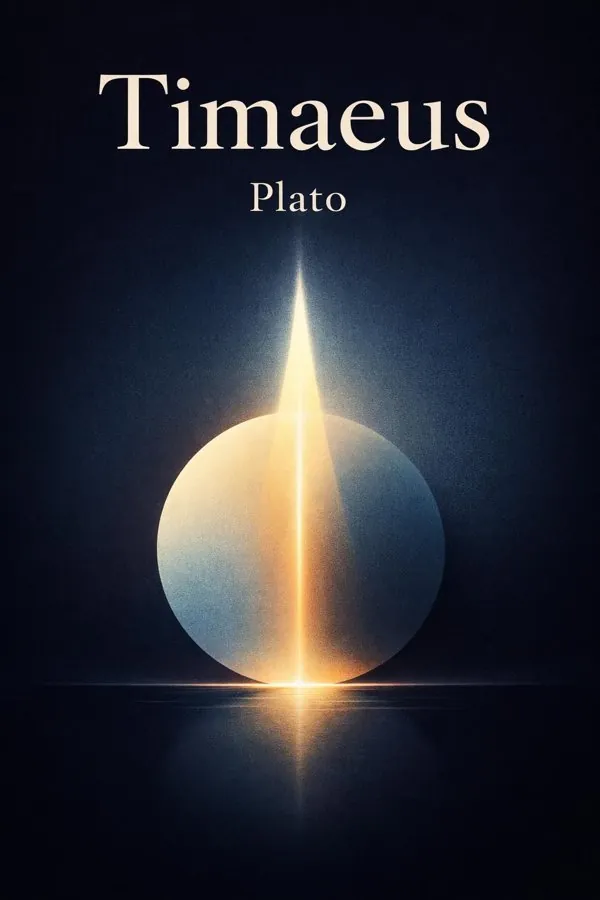
Timaeus: Summary & Key Insights
by Plato
 10 min10 chaptersAudio available
Key Takeaways from Timaeus
A striking feature of Timaeus is that it does not begin with stars or atoms, but with politics.
The story of Atlantis is memorable not because Plato wanted to entertain readers with a lost civilization, but because myth can reveal truths argument alone may fail to illuminate.
One of the most influential ideas in Timaeus is that the world is the product of intelligence rather than accident.
Plato’s universe is not a dead machine.
Before shaping the physical body of the universe, the Demiurge creates its soul.
What Is Timaeus About?
Timaeus by Plato is a western_phil book spanning 11 pages. Plato’s Timaeus is one of the foundational texts of Western philosophy because it asks a question so large that few works even attempt it: how did the universe come to be, and what does its structure reveal about human life? Framed as a dialogue among Socrates, Critias, Timaeus, and Hermocrates, the work moves from politics to cosmology, from the ideal city to the making of the world, from the motion of the stars to the formation of the human body and soul. Its central speaker, Timaeus, offers not a modern scientific theory but a grand philosophical account in which order, intelligence, proportion, and purpose shape reality. The universe, in this vision, is not random matter but a living, intelligible whole fashioned by divine reason. That idea influenced ancient philosophy, early Christian theology, medieval cosmology, and later reflections on nature and design. Plato’s authority rests not on technical astronomy alone, but on his unmatched ability to connect metaphysics, ethics, and human self-understanding into a single vision. Timaeus still matters because it challenges us to see our lives as part of a larger cosmic order.
This FizzRead summary covers all 10 key chapters of Timaeus in approximately 10 minutes, distilling the most important ideas, arguments, and takeaways from Plato's work. Also available as an audio summary and Key Quotes Podcast.
Timaeus
Plato’s Timaeus is one of the foundational texts of Western philosophy because it asks a question so large that few works even attempt it: how did the universe come to be, and what does its structure reveal about human life? Framed as a dialogue among Socrates, Critias, Timaeus, and Hermocrates, the work moves from politics to cosmology, from the ideal city to the making of the world, from the motion of the stars to the formation of the human body and soul. Its central speaker, Timaeus, offers not a modern scientific theory but a grand philosophical account in which order, intelligence, proportion, and purpose shape reality. The universe, in this vision, is not random matter but a living, intelligible whole fashioned by divine reason. That idea influenced ancient philosophy, early Christian theology, medieval cosmology, and later reflections on nature and design. Plato’s authority rests not on technical astronomy alone, but on his unmatched ability to connect metaphysics, ethics, and human self-understanding into a single vision. Timaeus still matters because it challenges us to see our lives as part of a larger cosmic order.
Who Should Read Timaeus?
This book is perfect for anyone interested in western_phil and looking to gain actionable insights in a short read. Whether you're a student, professional, or lifelong learner, the key ideas from Timaeus by Plato will help you think differently.
- ✓Readers who enjoy western_phil and want practical takeaways
- ✓Professionals looking to apply new ideas to their work and life
- ✓Anyone who wants the core insights of Timaeus in just 10 minutes
Want the full summary?
Get instant access to this book summary and 100K+ more with Fizz Moment.
Get Free SummaryAvailable on App Store • Free to download
Key Chapters
A striking feature of Timaeus is that it does not begin with stars or atoms, but with politics. Socrates opens by recalling the ideal city described in the Republic and asks to see that city in motion, tested in action rather than left as an abstract model. This transition matters because Plato suggests that political order and cosmic order belong to the same search: what does a well-arranged whole look like? Critias answers with the story of ancient Athens and Atlantis, while Timaeus takes up the larger task of describing the universe itself.
The deeper idea is that human society cannot be understood in isolation from the structure of reality. A just city is not merely a convenient social arrangement; it mirrors proportion, harmony, and intelligible order. Likewise, disorder in politics reflects disorder in the soul, and both become easier to diagnose when placed against a larger model of balance. Plato is effectively saying that ethics, politics, and cosmology are continuous. The same principles that make a soul healthy or a city just also explain why the cosmos is a rational whole rather than chaos.
This is still practical today. We often separate personal well-being, civic life, and our worldview, as if they have nothing to do with one another. Plato invites us to ask whether our institutions, habits, and beliefs fit together. Does the way we live reflect what we think is true about reality? Do our communities reward harmony or fragmentation?
Actionable takeaway: examine one area of your life—work, relationships, or civic engagement—and ask whether it reflects the order and values you claim to believe in.
The story of Atlantis is memorable not because Plato wanted to entertain readers with a lost civilization, but because myth can reveal truths argument alone may fail to illuminate. Critias presents Atlantis as a powerful island empire that grew wealthy, ambitious, and morally corrupt, while ancient Athens appears as a disciplined and virtuous city capable of resisting imperial excess. Whether the tale is historical, symbolic, or both, its philosophical function is clear: it dramatizes the difference between a society ordered by virtue and one ruled by appetite.
In Timaeus, Atlantis is not an isolated curiosity. It extends the conversation from the Republic by giving political ideals narrative form. Plato understands that people grasp complex ideas more deeply when they see them embodied in a story. Atlantis becomes a cautionary image of what happens when material prosperity outpaces moral formation. Strength without wisdom collapses inward. Expansion without self-rule invites ruin.
This idea remains relevant in every age. Organizations, nations, and even individuals can become Atlantean when success creates arrogance. A company that prizes growth above ethics, a government that confuses power with justice, or a person whose talents outrun discipline may all display the same pattern: external magnificence hiding internal decay.
Plato’s lesson is not anti-success. It is anti-disorder. Wealth, power, and technological achievement are not enough to secure flourishing if the soul of a community has lost proportion.
Actionable takeaway: whenever you evaluate success—your own or your society’s—ask not only what has been gained, but what kind of character has been formed in the process.
One of the most influential ideas in Timaeus is that the world is the product of intelligence rather than accident. Timaeus describes a divine craftsman, the Demiurge, who fashions the cosmos by looking to an eternal model of intelligible perfection. This figure does not create from nothing in the later theological sense, nor does he act out of jealousy or whim. He is good, and because he is good, he wishes all things to become as ordered and excellent as possible.
The philosophical force of this image lies in its union of goodness and rationality. Plato is not merely giving the universe a maker; he is explaining why the world exhibits structure, measure, and intelligibility. The Demiurge imposes order on disorderly necessity, shaping becoming in the image of being. The visible world is therefore imperfect but meaningful: it is a crafted likeness of eternal forms, not a meaningless accident.
Even if modern readers do not accept Plato’s cosmology literally, the idea still has practical depth. It encourages us to view order as something valuable and purposive. A well-designed home, institution, or life does not emerge by neglect. It requires attention to patterns, ends, and fitting relationships. Good making involves looking to a model and shaping materials accordingly.
In daily life, this means asking what ideal guides your choices. If you are building a team, raising children, or designing a schedule, what form of excellence are you trying to embody? Random effort rarely creates harmony.
Actionable takeaway: choose one project in your life and define the model of excellence you want it to reflect before you continue shaping it.
Plato’s universe is not a dead machine. Timaeus presents the cosmos as a single living being endowed with soul and intelligence, complete and self-sufficient. This is one of the dialogue’s boldest claims. The world is not just a container in which life happens; it is itself alive in the highest sense available to the visible order. Because it is fashioned after an eternal intelligible living model, the cosmos contains within itself all living things and stands as the most beautiful generated being.
Why does this matter? Because it transforms the relationship between humans and nature. If the world is a living whole, then we are not detached observers standing outside it. We are participants within an ordered organism. The same principles that govern the larger whole also operate in us. Human life becomes intelligible when seen as a small-scale reflection of cosmic life.
This way of thinking can still reshape perception. Modern habits often encourage us to treat the world as inert material for use. Plato encourages reverence instead. To see reality as ordered, interconnected, and internally meaningful is to cultivate humility. It becomes harder to live as if our desires alone define what matters.
There is also a practical psychological benefit here. When people feel fragmented, they often need a larger frame of belonging. Plato offers one: your life is not an isolated episode but part of a greater order. This can inspire responsibility without despair.
Actionable takeaway: spend time observing a natural pattern—the sky, seasons, plant growth, or bodily rhythms—and practice seeing yourself as part of an interconnected whole rather than a separate center.
Before shaping the physical body of the universe, the Demiurge creates its soul. This sequence is crucial. In Plato’s thought, soul precedes body because intelligence and motion must guide material structure, not the other way around. The World Soul is formed through intricate mathematical and harmonic proportions, blending sameness, difference, and being into a dynamic unity. It is then stretched across the cosmos so that the universe can know, move, and sustain ordered life.
The immediate point is cosmological, but the deeper implication is epistemological and ethical. If reality is intelligible because soul and reason are woven into its structure, then human understanding is possible because our own souls participate in that same rational pattern. Knowledge is not a private construction imposed on chaos; it is a tuning of the mind to what is objectively ordered.
Plato’s use of ratios and harmonies also suggests that thought itself flourishes through proportion. We may not use his exact mathematics, but we still experience this truth. Good judgment requires balancing stability and flexibility, identity and openness, analysis and synthesis. Minds become distorted when one principle dominates without limit.
This applies in practical settings such as leadership, education, and self-management. A healthy team, like a healthy mind, needs coherence without rigidity and diversity without disintegration. A healthy person needs routines but also adaptability.
Actionable takeaway: identify one area where your thinking has fallen out of balance—too fixed, too scattered, too emotional, or too detached—and deliberately restore proportion through a complementary habit.
Plato’s account of matter in Timaeus is among the earliest attempts to explain the physical world through mathematical structure. The four traditional elements—fire, air, water, and earth—are associated with geometric solids built from triangles. Fire corresponds to the tetrahedron, earth to the cube, air to the octahedron, and water to the icosahedron. Behind this strange but elegant model lies a profound conviction: the visible world is intelligible because its underlying order can be described through form and number.
Plato is not doing modern chemistry, but he is pioneering a key intellectual move that shaped later science: treating nature as mathematically ordered. Matter is not mere lumpish stuff. It has structure. Change can be analyzed. Complexity can be traced back to simpler patterns. This is one reason Timaeus proved so influential across centuries.
For readers today, the practical lesson is less about adopting ancient element theory and more about learning to look for hidden structure beneath appearances. Many problems seem messy on the surface—business failures, personal habits, social conflicts—but become manageable once their underlying patterns are identified. Good analysis often means moving from the visible symptom to the invisible architecture.
Think of budgeting, exercise, or communication breakdowns. The immediate issue may look emotional or chaotic, but often a structural pattern is driving it: poor incentives, inconsistent routines, or unexamined assumptions.
Actionable takeaway: when faced with a confusing problem, ask what underlying structure produces it. Instead of reacting only to surface events, map the deeper pattern shaping the outcome.
In Timaeus, the movements of the heavens are not decorative background; they are central to how time, knowledge, and order become visible. The Demiurge sets the sun, moon, and planets into their courses so that the revolutions of the celestial bodies can mark time and display rational motion. Time itself is described as a moving image of eternity. Eternity remains stable and fully present, while time unfolds through measurable cycles in the visible cosmos.
This is one of Plato’s most beautiful insights. The heavens become a bridge between the eternal and the changing. By observing regular celestial motions, human beings encounter order made visible. Astronomy, for Plato, is therefore not merely practical or predictive. It has educational value. It trains the soul to admire stable intelligibility rather than surrender to distraction and flux.
The idea can be translated into modern life without requiring ancient astronomy. Human beings need recurring patterns that orient them. Calendars, rituals, routines, seasons, and long-term cycles help us remember that not everything is random urgency. A life lived without rhythm becomes fragmented; a life shaped by repeated order gains perspective.
This also speaks to attention. Constant stimulation traps the mind in the immediate. Plato suggests that disciplined contemplation of regular patterns can reeducate our inner life.
Actionable takeaway: establish one recurring practice tied to a larger rhythm—daily reflection, weekly planning, monthly review, or seasonal reset—to help your mind move from chaos toward order.
Plato’s account of human creation is deliberately layered. The gods fashion the mortal aspects of human life under the guidance of the Demiurge, while the rational soul is of higher origin. Human beings are thus a mixture of divine aspiration and bodily necessity. We are capable of reason, truth, and moral order, yet we are also bound to appetite, sensation, vulnerability, and decay. Timaeus presents this not as a defect to be resented but as the essential drama of embodied existence.
The dialogue then maps the soul’s parts onto the body. Reason is placed in the head, spirited energy in the chest, and appetite near the liver and lower organs. However symbolic this may be, the point is clear: the human person contains multiple drives that must be arranged in proper hierarchy. Flourishing depends not on eliminating the lower parts but on ensuring that reason governs and harmonizes them.
This remains a sharp psychological insight. Many struggles in life arise not because we lack goals, but because different parts of us want different things. We want health and comfort, honesty and approval, discipline and indulgence. Plato’s framework helps explain why self-mastery is difficult and why education must shape desire, not just supply information.
In practical terms, a good life requires training habits so that our emotions and appetites support rather than sabotage our better judgment.
Actionable takeaway: identify one recurring inner conflict in your life and design a small habit that lets reason lead before appetite reacts—such as a pause, plan, or rule you follow automatically.
Timaeus does not sharply separate physical health from moral and intellectual order. Plato discusses the body’s composition, the causes of disease, and the disturbances that arise when natural proportions are disrupted. He also links psychological disorder to bodily imbalance and environmental influences. While many specific medical claims are ancient and outdated, the broader principle is enduring: health depends on harmony, and disharmony spreads across the whole person.
For Plato, this means that education, exercise, music, diet, movement, and thought all matter because human beings are integrated creatures. A neglected body can cloud the mind; a disordered mind can misuse the body. Excess, deficiency, and imbalance create suffering. The wise person therefore seeks measured living rather than extreme indulgence or harsh suppression.
This is surprisingly modern in spirit. We now know that sleep affects judgment, stress affects the immune system, physical activity shapes mood, and social environment influences behavior. Plato would not be surprised. He assumes that our lives form a system. To care for one dimension while ignoring the others is shortsighted.
There is also an ethical dimension. If the soul mirrors the cosmos best when well ordered, then daily habits become metaphysical practices, not trivial routines. How we eat, move, rest, and think either tunes us toward harmony or deepens disorder.
Actionable takeaway: improve one basic rhythm of embodied life—sleep, movement, food, breathing, or mental rest—and treat it as part of philosophical self-governance, not merely self-optimization.
The final practical force of Timaeus lies in its ethical vision: to live well is to bring the human soul into alignment with the rational order of the cosmos. Plato does not present morality as arbitrary rules imposed from outside. Instead, virtue is a form of attunement. Since the universe is structured by intelligence, goodness, and proportion, the best human life is one that reflects those qualities in thought and action.
This makes philosophy a form of reordering. We are born into confusion, bodily pressures, misleading appearances, and unstable desires. Education, contemplation, and disciplined living help restore our inner revolutions to match the orderly revolutions of the cosmos. The wise person becomes less ruled by impulse and more guided by truth. Justice, moderation, courage, and understanding are not social ornaments; they are ways of participating in reality correctly.
For contemporary readers, this can be understood as an invitation to coherence. A good life is not simply busy, successful, or pleasurable. It is integrated. Your beliefs, habits, values, and relationships should form a pattern rather than a contradiction. Plato’s cosmic language pushes us to ask whether our lives are aligned with anything greater than preference.
This is especially valuable in an age of fragmentation. We often optimize pieces of life while losing the whole. Timaeus calls us back to wholeness.
Actionable takeaway: define the three qualities you believe reflect the deepest order of a good life—such as truthfulness, moderation, and responsibility—and use them as a daily standard for decision-making.
All Chapters in Timaeus
About the Author
Plato (c. 427–347 BCE) was one of the most influential philosophers in history. Born into an aristocratic Athenian family, he became a devoted student of Socrates, whose trial and execution deeply shaped his thought. After Socrates’ death, Plato traveled widely and eventually founded the Academy in Athens, a school that became one of the most important centers of learning in the ancient world. He wrote philosophical dialogues rather than treatises, using conversation, argument, and myth to explore questions about justice, knowledge, reality, the soul, politics, and the good life. His major works include the Republic, Symposium, Phaedo, and Timaeus. Plato’s thought shaped Aristotle, Neoplatonism, Christian theology, Islamic philosophy, and the entire development of Western metaphysics and political philosophy.
Get This Summary in Your Preferred Format
Read or listen to the Timaeus summary by Plato anytime, anywhere. FizzRead offers multiple formats so you can learn on your terms — all free.
Available formats: App · Audio · PDF · EPUB — All included free with FizzRead
Download Timaeus PDF and EPUB Summary
Key Quotes from Timaeus
“A striking feature of Timaeus is that it does not begin with stars or atoms, but with politics.”
“The story of Atlantis is memorable not because Plato wanted to entertain readers with a lost civilization, but because myth can reveal truths argument alone may fail to illuminate.”
“One of the most influential ideas in Timaeus is that the world is the product of intelligence rather than accident.”
“Timaeus presents the cosmos as a single living being endowed with soul and intelligence, complete and self-sufficient.”
“Before shaping the physical body of the universe, the Demiurge creates its soul.”
Frequently Asked Questions about Timaeus
Timaeus by Plato is a western_phil book that explores key ideas across 10 chapters. Plato’s Timaeus is one of the foundational texts of Western philosophy because it asks a question so large that few works even attempt it: how did the universe come to be, and what does its structure reveal about human life? Framed as a dialogue among Socrates, Critias, Timaeus, and Hermocrates, the work moves from politics to cosmology, from the ideal city to the making of the world, from the motion of the stars to the formation of the human body and soul. Its central speaker, Timaeus, offers not a modern scientific theory but a grand philosophical account in which order, intelligence, proportion, and purpose shape reality. The universe, in this vision, is not random matter but a living, intelligible whole fashioned by divine reason. That idea influenced ancient philosophy, early Christian theology, medieval cosmology, and later reflections on nature and design. Plato’s authority rests not on technical astronomy alone, but on his unmatched ability to connect metaphysics, ethics, and human self-understanding into a single vision. Timaeus still matters because it challenges us to see our lives as part of a larger cosmic order.
More by Plato
You Might Also Like
A Little History of Philosophy
Nigel Warburton
10 min
Areopagitica
John Milton
10 min
How To Think Like A Philosopher: Essential Principles For Clear Thinking
Peter Cave
10 min
Language, Truth and Logic
A. J. Ayer
10 min
The Age of Reason
Thomas Paine
10 min
The Essays
Michel De Montaigne
10 minBrowse by Category
Ready to read Timaeus?
Get the full summary and 100K+ more books with Fizz Moment.