
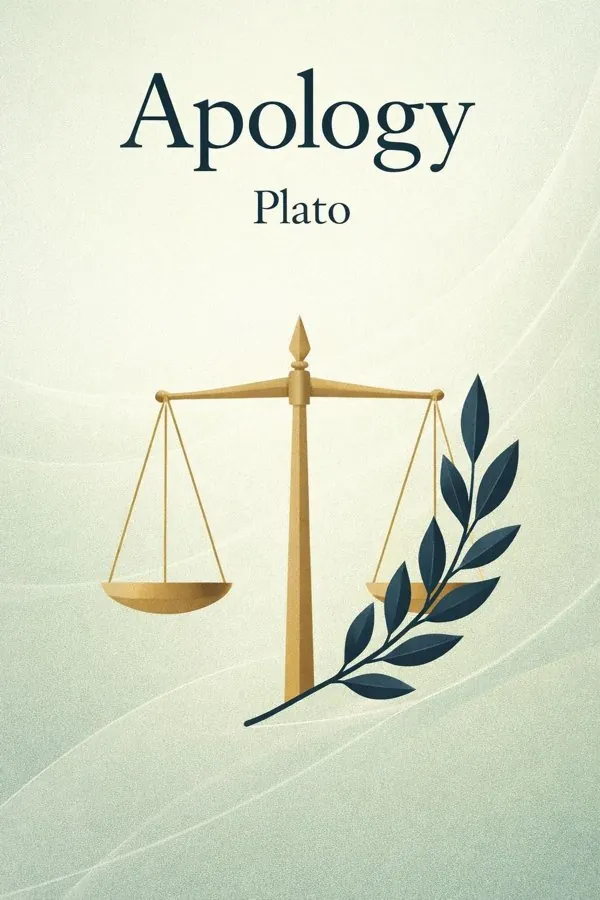
Apology: Summary & Key Insights
by Plato
 10 min9 chaptersAudio available
Key Takeaways from Apology
A person can be condemned long before any formal accusation is made.
The most dangerous kind of ignorance is the kind that believes itself wise.
Accusations often tell us as much about a society’s anxieties as they do about the accused.
A meaningful life usually begins when duty becomes more important than comfort.
External loss is real, but Socrates draws a sharper line between what can happen to us and what can corrupt us.
What Is Apology About?
Apology by Plato is a western_phil book spanning 3 pages. Plato’s Apology is one of the most powerful defenses ever spoken in the history of ideas. Set during the trial of Socrates in 399 BCE, the dialogue presents the philosopher answering charges of impiety and corrupting the youth of Athens. But this is far more than a courtroom speech. It is a profound meditation on truth, moral courage, public opinion, and the duty to examine one’s life. Rather than pleading for mercy, Socrates uses the trial to clarify what philosophy is and why an honest person must follow reason and conscience even when doing so invites hostility. His refusal to flatter the jury or abandon his principles gives the work its enduring force. The book matters because it asks questions that remain urgent: What do we owe the truth? How should we respond when society misunderstands us? Is it better to preserve one’s life or one’s integrity? Plato, Socrates’ student and one of the founding figures of Western philosophy, preserves this defense with dramatic clarity and philosophical depth. Apology remains essential reading for anyone interested in ethics, justice, education, free inquiry, and the cost of living an examined life.
This FizzRead summary covers all 9 key chapters of Apology in approximately 10 minutes, distilling the most important ideas, arguments, and takeaways from Plato's work. Also available as an audio summary and Key Quotes Podcast.
Apology
Plato’s Apology is one of the most powerful defenses ever spoken in the history of ideas. Set during the trial of Socrates in 399 BCE, the dialogue presents the philosopher answering charges of impiety and corrupting the youth of Athens. But this is far more than a courtroom speech. It is a profound meditation on truth, moral courage, public opinion, and the duty to examine one’s life. Rather than pleading for mercy, Socrates uses the trial to clarify what philosophy is and why an honest person must follow reason and conscience even when doing so invites hostility. His refusal to flatter the jury or abandon his principles gives the work its enduring force.
The book matters because it asks questions that remain urgent: What do we owe the truth? How should we respond when society misunderstands us? Is it better to preserve one’s life or one’s integrity? Plato, Socrates’ student and one of the founding figures of Western philosophy, preserves this defense with dramatic clarity and philosophical depth. Apology remains essential reading for anyone interested in ethics, justice, education, free inquiry, and the cost of living an examined life.
Who Should Read Apology?
This book is perfect for anyone interested in western_phil and looking to gain actionable insights in a short read. Whether you're a student, professional, or lifelong learner, the key ideas from Apology by Plato will help you think differently.
- ✓Readers who enjoy western_phil and want practical takeaways
- ✓Professionals looking to apply new ideas to their work and life
- ✓Anyone who wants the core insights of Apology in just 10 minutes
Want the full summary?
Get instant access to this book summary and 100K+ more with Fizz Moment.
Get Free SummaryAvailable on App Store • Free to download
Key Chapters
A person can be condemned long before any formal accusation is made. Socrates begins his defense by addressing not only the legal charges against him but also the older, deeper suspicion that has surrounded his name for years. He knows that reputation often shapes judgment more powerfully than evidence. The Athenians have heard that he is a clever speaker, a dangerous thinker, and a man who makes the weaker argument appear stronger. Rather than countering this with polished rhetoric, he does something more radical: he speaks plainly and says he will use the ordinary language he always uses.
This opening matters because Socrates identifies a permanent human problem. We often inherit opinions about people before we ever encounter them directly. A colleague may be labeled difficult, a teacher may be dismissed as harsh, or a public figure may be praised or condemned on hearsay alone. Once a narrative settles in, facts struggle to compete with it. Socrates therefore starts by separating truth from performance. He asks to be judged not by style, but by substance.
His honesty is also strategic in a deeper sense. By refusing theatrical persuasion, he demonstrates the very character under examination. He does not merely claim to value truth over appearances; he performs that value in real time. In modern life, this lesson applies whenever we are tempted to manage impressions instead of clarifying reality. In meetings, conflicts, and public discourse, plain speech can be morally stronger than verbal display.
Actionable takeaway: when defending your work, your beliefs, or your character, begin by naming the misconceptions clearly and then speak with directness. Ask others to judge you by evidence and consistency, not by rumor or polish.
The most dangerous kind of ignorance is the kind that believes itself wise. Socrates explains that his reputation began with the Oracle at Delphi, which declared that no one was wiser than Socrates. Puzzled, because he did not think himself wise, he set out to test the oracle by questioning politicians, poets, and craftsmen who were thought to possess knowledge. What he discovered was not that they knew nothing, but that many of them mistook partial knowledge for complete wisdom. They were confident far beyond what their understanding justified.
Socrates concludes that if he is wiser at all, it is only in this narrow but crucial respect: he does not think he knows what he does not know. This insight becomes a cornerstone of philosophy. Intellectual humility is not weakness; it is the starting point of real inquiry. In everyday life, this principle matters whenever certainty outruns evidence. Leaders make poor decisions when they cannot say “I don’t know.” Relationships suffer when people assume motives without asking questions. Learning stalls when students defend their opinions rather than examine them.
Socrates also reveals why humility provokes resentment. People often prefer admiration to examination. When their false confidence is exposed, they may attack the one who questioned them instead of revising themselves. This helps explain why truth-tellers can become unpopular in organizations, communities, and politics.
Practical application is straightforward: in any domain where stakes are high, replace premature certainty with disciplined curiosity. Ask: What do I actually know? What am I assuming? What evidence would change my mind? Teams that normalize these questions make better decisions. Individuals who practice them become harder to deceive, including by themselves.
Actionable takeaway: once a day, identify one belief you hold confidently and examine the basis for it. The habit of testing your certainty is one of the clearest ways to live more wisely.
Accusations often tell us as much about a society’s anxieties as they do about the accused. The formal charges against Socrates are that he corrupts the youth and does not acknowledge the gods of the city, introducing new divine things instead. Socrates does not respond with panic or emotional pleading. Instead, he applies the same questioning method that made him controversial in the first place. He asks Meletus, his accuser, to explain who improves the youth if Socrates supposedly corrupts them. Meletus gives shallow answers, and Socrates exposes the inconsistency. If everyone improves the young except one man, the claim is already suspicious. If corruption is intentional, then Socrates would be harming himself by making those around him worse. If unintentional, he should be instructed, not prosecuted.
This exchange shows that vague accusations often depend on moral panic rather than careful reasoning. “Corrupting the youth” is the kind of charge that sounds serious because it invokes the future of society. Similar language appears today when questioning received beliefs is portrayed as dangerous in itself. Socrates demonstrates that criticism, questioning, and intellectual challenge are not the same as corruption. In fact, they may be conditions for genuine education.
The charge of impiety reveals another fear: that unconventional thought threatens civic order. Socrates points out the contradiction in saying he believes in spiritual matters while believing in no spiritual beings at all. By forcing his accuser into contradiction, he shows how public hostility can crystallize around claims no one has carefully examined.
In practical life, this teaches us to slow down when we hear broad moral accusations. Before joining a crowd, ask what exactly is being alleged, what evidence supports it, and whether the claim survives scrutiny.
Actionable takeaway: when confronted with a serious accusation in public or private life, define terms precisely and test the logic step by step before accepting the conclusion.
A meaningful life usually begins when duty becomes more important than comfort. Socrates presents his philosophical activity not as a hobby, career, or personal brand, but as a mission assigned by the god. He believes he has been placed in Athens to question, awaken, and challenge people who care too much about wealth, status, and reputation, and too little about wisdom and virtue. He compares himself to a gadfly stinging a sluggish horse: irritating, perhaps, but necessary to keep the city alive.
This is a striking redefinition of usefulness. Many societies praise productivity, conformity, and visible achievement. Socrates insists that the person who troubles complacency may serve the community more deeply than the one who merely flatters it. He turns criticism into service. To provoke reflection, on his view, is an act of civic care.
This idea has modern applications wherever institutions drift into routine. A good teacher who asks hard questions, an ethical employee who challenges misconduct, or a friend who confronts self-deception may be seen as inconvenient. Yet without such people, groups become intellectually lazy and morally compromised. Socrates shows that being socially useful is not the same as being socially pleasant.
At the same time, his sense of mission is disciplined by principle. He does not question for amusement or dominance. He questions in order to orient life toward what is good. That distinction matters. Critique without responsibility becomes cynicism; critique grounded in moral purpose becomes service.
Actionable takeaway: identify one setting in your life where silence has become easier than honesty. Ask how you can raise a necessary question in a way that serves the shared good rather than your ego.
External loss is real, but Socrates draws a sharper line between what can happen to us and what can corrupt us. After the verdict moves against him, he says that no evil can happen to a good person, either in life or after death. He does not mean that good people avoid pain, humiliation, or unjust treatment. He means that the deepest harm is moral harm: becoming unjust, cowardly, dishonest, or spiritually degraded. Others may imprison or kill the body, but they cannot force a person to betray what is right unless that person cooperates.
This claim gives Apology its unusual strength. Socrates refuses the common assumption that survival is always the highest good. If preserving your life requires abandoning justice, then the price is too high. In a world organized around fear, this is liberating. It shifts attention from controlling outcomes to governing character.
We can see the relevance in ordinary situations. A manager may be pressured to falsify numbers to protect a department. A student may cheat to preserve status. A friend may stay silent about wrongdoing to avoid exclusion. In each case, the temptation is to treat external consequences as supreme. Socrates asks us instead to ask: what kind of person will this choice make me?
This does not eliminate prudence. It does, however, reorder priorities. When people know that integrity matters more than immediate advantage, they become less manipulable. Fear loses some of its power. That is one reason moral conviction unsettles corrupt systems.
Actionable takeaway: in your next difficult decision, list not only the external risks but also the character costs. Choose the option that best preserves honesty, justice, and self-respect.
Much of human compromise begins in fear of what might happen. Socrates confronts the ultimate example: death. He argues that fearing death is a pretense of knowledge, because no one knows whether death is the greatest evil. It may be dreamless sleep, which would be peaceful, or a migration of the soul, which would open the possibility of continued conversation with the just and wise. In either case, death is not obviously something to dread more than wrongdoing.
The brilliance of this argument is not that it proves an afterlife. Rather, it exposes how often people make fear out of ignorance. We imagine the unknown as catastrophe and then organize our decisions around that projection. Socrates will not do that. Since he does not know what death is, he refuses to rank it above moral failure, which he does know to be bad.
This has practical reach far beyond mortality. People fear career changes, honest conversations, public criticism, aging, rejection, and uncertainty. The unknown often governs behavior more than the known. Socrates teaches a disciplined response: distinguish between what is genuinely bad and what is merely unfamiliar. You may not know whether a hard transition will hurt or help, but you can know whether betraying your principles to avoid it is wrong.
By reducing the authority of fear, Socrates expands the space for courage. Courage, in this sense, is not emotional numbness. It is acting according to reason despite uncertainty. That is why Apology still speaks so directly to anyone standing before a difficult choice.
Actionable takeaway: when you notice fear guiding a decision, write down what you actually know and what you are only imagining. Then base your action on values and evidence, not on projected disaster.
A full life is not measured only by activity, success, or comfort, but by the quality of one’s reflection. Socrates’ most famous claim in Apology is that the unexamined life is not worth living. This does not mean that every person must become a professional philosopher. It means that a human life falls short when it never pauses to ask basic questions: What is good? What do I owe others? What kind of person am I becoming? Why do I value what I value?
Without examination, people easily drift into borrowed priorities. They pursue money because others do, chase status because it is rewarded, or repeat opinions because they are common. Examination interrupts this automatic life. It asks whether our ambitions are coherent, whether our habits align with our principles, and whether our public selves match our private convictions.
In modern terms, examination can take many forms: journaling, honest conversation, therapy, philosophical reading, spiritual practice, or deliberate self-review after key decisions. A professional might ask whether career achievement has displaced family or integrity. A parent might consider whether fear is shaping discipline more than love. A citizen might question whether outrage has replaced understanding.
Socrates also implies that examination is communal. He examines others through dialogue because self-knowledge often requires friction. We need people who can ask us what we avoid asking ourselves. In that sense, reflective friendship is part of the examined life.
Actionable takeaway: build a weekly ritual of self-examination. Ask three questions: What did I pursue this week? Why did I pursue it? Did it make me more just, wise, or humane? Repeated honestly, those questions can gradually reshape a life.
Institutions fail when persuasion outruns principle. One of the most striking features of Socrates’ defense is what he refuses to do. He will not parade his children before the jury to stir pity. He will not beg for mercy in a conventional manner. He will not say whatever is necessary to secure acquittal. For him, a court should judge according to justice and truth, not emotion and spectacle. If verdicts can be won by tears, influence, or performance, then the legal process has already been corrupted.
This refusal reveals a larger ethical point. There are moments when appealing to sympathy is human and appropriate, but there is a moral difference between presenting one’s humanity and manipulating sentiment to evade judgment. Socrates insists that a citizen should honor the purpose of the institution he is addressing. In a court, that purpose is justice. In a school, it is learning. In public office, it is service.
Today, the temptation to substitute image for substance is everywhere. Politicians craft optics instead of policy. Employees defend mistakes with narratives instead of accountability. Social media rewards emotional signaling over careful truth. Socrates reminds us that when systems reward performance over reality, trust decays.
His example also applies personally. In conflict, we may try to win by dramatizing intentions rather than addressing facts. A more Socratic approach is to ask what standards should govern the conversation and then submit ourselves to them, even when doing so is uncomfortable.
Actionable takeaway: in your next disagreement or formal defense, resist the urge to rely on sympathy, status, or style alone. State the facts, clarify the principles involved, and ask to be judged by standards that would apply equally to everyone.
Social pressure becomes dangerous when belonging matters more than truth. Throughout Apology, Socrates stands as a model of inner freedom. He is surrounded by public hostility, legal danger, and the expectation that he should adapt his speech to survive. Yet he remains unwilling to say what he does not believe. This is not stubbornness for its own sake. It is fidelity to reasoned conviction.
Socrates shows that conformity often operates subtly. People do not always surrender principles because they are physically forced. More often, they want approval, safety, reputation, or ease. They begin by softening a question, then avoiding a topic, then repeating what they no longer believe. Over time, the cost is not only public dishonesty but internal division. The self becomes fragmented.
A free mind, in Socrates’ example, is not one without commitments. It is one not ruled by the crowd. This matters in education, workplaces, politics, and friendships. Students may silence genuine curiosity to avoid appearing ignorant. Professionals may echo bad ideas because a superior supports them. Citizens may adopt slogans instead of thought because dissent is costly. Socrates does the opposite: he accepts the cost of independence.
But inner freedom also requires discipline. One must be governed by something better than impulse or contrarian pride. For Socrates, that governing standard is the pursuit of truth and virtue. Freedom is not saying anything at all; it is refusing to betray what one has good reason to hold.
Actionable takeaway: notice one place where you are conforming against your better judgment. Practice a small act of intellectual honesty there, expressed respectfully but clearly, to strengthen the habit of inward freedom.
All Chapters in Apology
About the Author
Plato (c. 427–347 BCE) was an ancient Greek philosopher whose work helped lay the foundations of Western philosophy. Born into an aristocratic family in Athens, he became a devoted student of Socrates, whose trial and execution deeply shaped his thought. After Socrates’ death, Plato traveled widely and later founded the Academy in Athens, often regarded as the first enduring institution of higher learning in the Western world. His writings, mostly composed as dialogues, explore ethics, politics, knowledge, metaphysics, love, and the soul. In works such as Apology, Republic, Symposium, and Phaedo, Plato combined philosophical argument with literary artistry. Through both his ideas and his teaching, he influenced generations of thinkers, including Aristotle, and remains one of the most important intellectual figures in history.
Get This Summary in Your Preferred Format
Read or listen to the Apology summary by Plato anytime, anywhere. FizzRead offers multiple formats so you can learn on your terms — all free.
Available formats: App · Audio · PDF · EPUB — All included free with FizzRead
Download Apology PDF and EPUB Summary
Key Quotes from Apology
“A person can be condemned long before any formal accusation is made.”
“The most dangerous kind of ignorance is the kind that believes itself wise.”
“Accusations often tell us as much about a society’s anxieties as they do about the accused.”
“A meaningful life usually begins when duty becomes more important than comfort.”
“External loss is real, but Socrates draws a sharper line between what can happen to us and what can corrupt us.”
Frequently Asked Questions about Apology
Apology by Plato is a western_phil book that explores key ideas across 9 chapters. Plato’s Apology is one of the most powerful defenses ever spoken in the history of ideas. Set during the trial of Socrates in 399 BCE, the dialogue presents the philosopher answering charges of impiety and corrupting the youth of Athens. But this is far more than a courtroom speech. It is a profound meditation on truth, moral courage, public opinion, and the duty to examine one’s life. Rather than pleading for mercy, Socrates uses the trial to clarify what philosophy is and why an honest person must follow reason and conscience even when doing so invites hostility. His refusal to flatter the jury or abandon his principles gives the work its enduring force. The book matters because it asks questions that remain urgent: What do we owe the truth? How should we respond when society misunderstands us? Is it better to preserve one’s life or one’s integrity? Plato, Socrates’ student and one of the founding figures of Western philosophy, preserves this defense with dramatic clarity and philosophical depth. Apology remains essential reading for anyone interested in ethics, justice, education, free inquiry, and the cost of living an examined life.
More by Plato




You Might Also Like
A Little History of Philosophy
Nigel Warburton
10 min
Areopagitica
John Milton
10 min
How To Think Like A Philosopher: Essential Principles For Clear Thinking
Peter Cave
10 min
Language, Truth and Logic
A. J. Ayer
10 min
The Age of Reason
Thomas Paine
10 min
The Essays
Michel De Montaigne
10 minBrowse by Category
Ready to read Apology?
Get the full summary and 100K+ more books with Fizz Moment.