
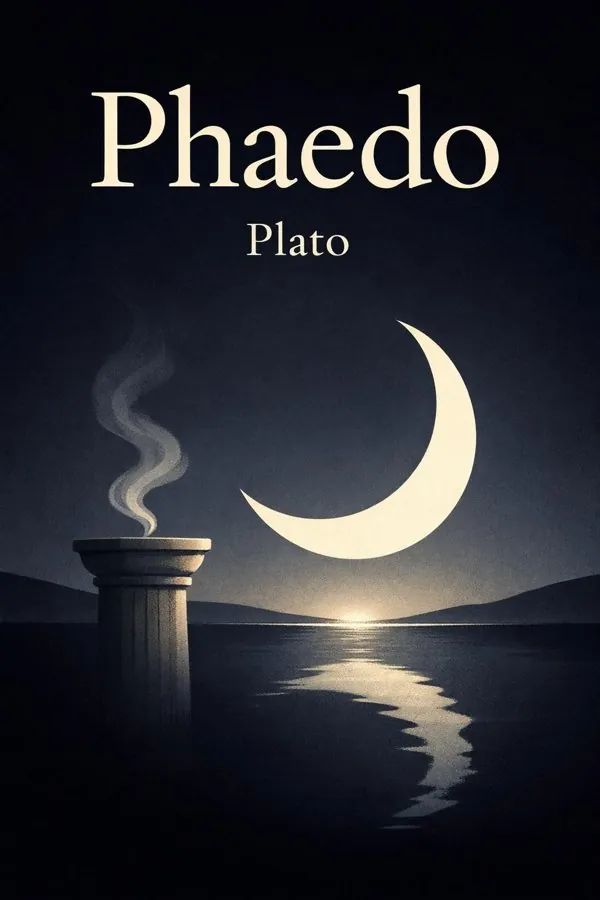
Phaedo: Summary & Key Insights
by Plato
 10 min10 chaptersAudio available
Key Takeaways from Phaedo
Great philosophy often begins where comfort ends.
How a person faces death reveals how that person has lived.
Some of Plato’s most intriguing arguments begin with an ordinary pattern.
Sometimes understanding feels less like discovering something new than recognizing something we somehow already knew.
We understand things partly by asking what they are most like.
What Is Phaedo About?
Phaedo by Plato is a western_phil book spanning 7 pages. Phaedo is Plato’s profound account of Socrates’ final day, but it is far more than a record of a death. Set in a prison cell in Athens, the dialogue stages one of philosophy’s most enduring conversations: whether the soul survives the body, what it means to live wisely, and why a life devoted to truth changes how one faces mortality. As Socrates speaks with his friends before drinking hemlock, grief, logic, memory, and moral conviction are woven into a remarkable meditation on what it means to be human. The dialogue matters because it brings together some of the central themes of Western philosophy in a single dramatic scene: the distinction between body and soul, the reliability of reason, the search for eternal realities, and the ethical discipline required for genuine wisdom. It is also one of Plato’s most emotionally resonant works, showing philosophy not as abstraction but as a way of living — and dying. Plato, Socrates’ student and one of history’s most influential thinkers, writes with unusual authority here. Through Phaedo, he preserves both the arguments and the moral example of the teacher who shaped his philosophy.
This FizzRead summary covers all 10 key chapters of Phaedo in approximately 10 minutes, distilling the most important ideas, arguments, and takeaways from Plato's work. Also available as an audio summary and Key Quotes Podcast.
Phaedo
Phaedo is Plato’s profound account of Socrates’ final day, but it is far more than a record of a death. Set in a prison cell in Athens, the dialogue stages one of philosophy’s most enduring conversations: whether the soul survives the body, what it means to live wisely, and why a life devoted to truth changes how one faces mortality. As Socrates speaks with his friends before drinking hemlock, grief, logic, memory, and moral conviction are woven into a remarkable meditation on what it means to be human.
The dialogue matters because it brings together some of the central themes of Western philosophy in a single dramatic scene: the distinction between body and soul, the reliability of reason, the search for eternal realities, and the ethical discipline required for genuine wisdom. It is also one of Plato’s most emotionally resonant works, showing philosophy not as abstraction but as a way of living — and dying.
Plato, Socrates’ student and one of history’s most influential thinkers, writes with unusual authority here. Through Phaedo, he preserves both the arguments and the moral example of the teacher who shaped his philosophy.
Who Should Read Phaedo?
This book is perfect for anyone interested in western_phil and looking to gain actionable insights in a short read. Whether you're a student, professional, or lifelong learner, the key ideas from Phaedo by Plato will help you think differently.
- ✓Readers who enjoy western_phil and want practical takeaways
- ✓Professionals looking to apply new ideas to their work and life
- ✓Anyone who wants the core insights of Phaedo in just 10 minutes
Want the full summary?
Get instant access to this book summary and 100K+ more with Fizz Moment.
Get Free SummaryAvailable on App Store • Free to download
Key Chapters
Great philosophy often begins where comfort ends. In Phaedo, Plato frames the dialogue as a remembered conversation: Phaedo recounts to Echecrates what happened during Socrates’ last hours in prison. This framing matters because it gives the work both emotional distance and human immediacy. We are not simply reading abstract doctrine; we are hearing how a group of friends watched their teacher prepare for death.
The prison setting becomes the dialogue’s philosophical anchor. The body is confined, the city has pronounced judgment, and time is running out. Yet within those walls, Socrates is intellectually freer than anyone around him. His friends are distraught, but he remains composed, turning the moment into an inquiry about the soul, truth, and the meaning of a philosophical life. The contrast is deliberate: external power can bind the body, but it cannot master a mind committed to reason.
This dramatic setting also shows Plato’s method. He does not present philosophy as a detached essay. He places arguments inside a lived scene where fear, affection, and mortality test every claim. That makes Phaedo uniquely powerful. The arguments about immortality are not offered in a classroom; they are offered under the pressure of imminent death. Their purpose is not merely to persuade intellectually, but to steady the soul.
In practical terms, the framing invites us to ask whether our deepest beliefs hold up in difficult moments. It is easy to speak about values when nothing is at stake. It is harder when loss, illness, or uncertainty arrives. Phaedo asks us to examine what principles remain credible under pressure.
Actionable takeaway: Reflect on one belief you claim to live by, and ask whether it would still guide you in a crisis. If not, examine it more deeply.
How a person faces death reveals how that person has lived. From the opening of the dialogue, Socrates challenges the sorrow filling the room. He does not dismiss his friends’ love, but he insists that their grief misunderstands philosophy’s purpose. If philosophy is the pursuit of truth beyond bodily distraction, then death — the separation of soul from body — is not simply an evil to be feared. For the true philosopher, it is a culmination of a lifelong practice.
Socrates’ calm acceptance is not based on recklessness or emotional numbness. He does not welcome death because life is worthless. He welcomes it because a life devoted to wisdom has already loosened the soul’s attachment to bodily appetites, vanity, and sensory confusion. Philosophers, he says, spend their lives preparing for death by training themselves to value reason above pleasure and truth above possession.
This claim is striking because it transforms death from a purely biological event into a moral and intellectual test. Fear of death often reflects fear of losing what we most cling to: status, pleasure, control, unfinished ambition. Socrates suggests that inner freedom depends on learning, before death arrives, how not to be ruled by such attachments. That does not eliminate sadness, but it changes its place.
In modern life, this idea can apply beyond literal death. Career change, aging, loss, and endings of relationships all involve forms of letting go. Those who define themselves only by what they possess or control tend to suffer these transitions more intensely. Those who cultivate inner orientation — through reflection, principles, and discipline — endure them more steadily.
Actionable takeaway: Notice one attachment that dominates your peace of mind, and practice loosening its grip by asking what remains valuable in you without it.
Some of Plato’s most intriguing arguments begin with an ordinary pattern. Socrates’ first major case for the soul’s immortality is the cyclical argument: many things come to be from their opposites. The larger comes from the smaller, waking from sleeping, and sleeping from waking. By analogy, life and death may also stand in a cycle. The living come from the dead, just as the dead come from the living.
The core intuition is that nature seems structured through reciprocal processes. If everything moved only in one direction, the process would eventually halt. If waking came from sleeping but sleeping never came from waking, the cycle would collapse. Likewise, if the living died but no life emerged again from death, then all things would end in death. For Socrates, this suggests that souls persist in some form after bodily death in order for life to continue.
On its own, this is not a modern scientific proof, and many readers will find it less compelling than later arguments. But its philosophical importance lies elsewhere. It introduces a key theme: death is not necessarily a final annihilation but may be part of a larger order. Socrates invites his listeners to look beyond surface appearances and consider whether reality is governed by intelligible patterns rather than isolated events.
The practical lesson is not that we must accept every ancient metaphysical argument. It is that our fears often depend on imagining endings as absolute voids. Yet many parts of life operate cyclically: decline and renewal, loss and growth, rest and action, forgetting and remembering. This broader perspective can soften despair and encourage patience during periods of transition.
Actionable takeaway: When facing an ending, ask what opposite process may already be beginning. Train yourself to see transitions not only as losses, but as parts of larger cycles.
Sometimes understanding feels less like discovering something new than recognizing something we somehow already knew. Socrates uses that familiar experience to develop the theory of recollection. He argues that when we judge two objects as equal but still imperfect compared with true Equality itself, we are measuring them against a standard not derived from the senses alone. This suggests that the soul knew such realities before birth and now recollects them through experience.
The argument begins with ordinary examples. We see two sticks or stones and call them equal, yet we also notice they fall short of perfect equality. Sense experience gives us shifting, imperfect instances. But the very act of judging imperfection seems to presuppose a notion of perfection. According to Socrates, that standard comes from prior acquaintance of the soul with intelligible realities such as Equality, Beauty, and Goodness.
Whether or not one accepts preexistence literally, the theory highlights an enduring philosophical point: knowledge is not mere accumulation of data. Learning requires the mind to organize, interpret, and compare experience according to standards that are not identical with any single sensory object. Education, then, is partly awakening. A good teacher does not just deposit information but helps the learner bring latent understanding into clarity.
This idea remains powerful in everyday life. Skilled mentoring often works by drawing out insight through questions, examples, and reflection. Likewise, moral growth can feel like remembering a standard we had neglected rather than inventing values from nothing. The theory of recollection also reinforces the dignity of rational inquiry: the mind is capable of reaching beyond appearances.
Actionable takeaway: When studying or solving a problem, do more than gather facts. Ask what deeper pattern or standard you are using to make sense of them.
We understand things partly by asking what they are most like. In the affinity argument, Socrates compares two kinds of reality. On one side are visible, changing, composite things: bodies, material objects, and everything grasped through the senses. On the other side are invisible, stable, intelligible realities: the Forms, such as the Just, the Beautiful, and the Equal. His claim is that the soul resembles the second kind more than the first.
Bodies are many, divisible, and constantly changing. They decay, scatter, and dissolve. The soul, by contrast, is associated with thought, order, and self-direction. When it reasons well, it turns away from sensory confusion toward what is stable and intelligible. Because it is more akin to the invisible and enduring than to the material and perishable, Socrates argues that the soul is more likely to survive bodily death.
The argument does not merely concern immortality. It also describes a psychology. The soul becomes like what it attends to. If a person lives enslaved to bodily pleasures and distractions, the soul is weighed down by what is changing and unstable. If a person lives in pursuit of truth and justice, the soul is purified through likeness to what is higher and more orderly. In this sense, immortality is connected with moral formation.
That insight has practical force even for secular readers. Attention shapes character. A life dominated by constant stimulation, comparison, and appetite often feels fragmented. A life disciplined by reflection, meaningful work, and devotion to enduring goods becomes more integrated. What we repeatedly contemplate, we gradually resemble.
Actionable takeaway: Audit your daily attention. Reduce one habit that scatters your mind, and replace it with one practice that orients you toward what is stable, meaningful, and lasting.
The deepest arguments in Phaedo are inseparable from a way of life. Socrates repeatedly says that philosophy is a preparation for death, but this can be misunderstood. He is not praising self-destruction or withdrawal from responsibility. He means that philosophy trains the soul to detach from the distortions caused by bodily cravings, emotional turbulence, and unexamined habit, so that it can perceive truth more clearly.
In the dialogue, the body is not evil in itself, but it is a source of distraction. Hunger, desire, fear, illness, and pleasure can dominate attention and pull the mind away from what is just and real. The philosopher therefore seeks purification: not contempt for life, but disciplined freedom from enslavement to impulse. This is why Socrates values moderation, self-command, and rational examination. Purity means the soul is not mixed up with every passing appetite.
This theme gives Phaedo a strong ethical dimension. Philosophy is not winning arguments. It is spiritual and moral housekeeping. To live philosophically is to simplify oneself, to reduce internal contradiction, and to align action with truth. Such a life makes death less terrifying because one has already practiced the art of not identifying entirely with the body and its demands.
In contemporary terms, this resembles any disciplined effort to prevent reactive impulses from ruling life. Mindfulness, moral inventory, voluntary simplicity, and reflective journaling can all function as forms of purification. The point is not ascetic performance, but inner clarity. A person who cannot resist every craving is not free, no matter how many options they have.
Actionable takeaway: Choose one recurring impulse that clouds your judgment — such as doomscrolling, vanity, or overindulgence — and create a simple rule that helps you regain self-command.
A philosophy worth trusting must be strong enough to face doubt. One of Phaedo’s greatest strengths is that Plato does not let Socrates’ arguments stand unchallenged. Simmias and Cebes, two of Socrates’ companions, raise serious objections. Simmias suggests that the soul may be like a harmony produced by a lyre: subtle and invisible, yet still dependent on the body and destroyed when the body is destroyed. Cebes proposes that even if the soul outlasts many bodies, it may still eventually wear out, like a cloak that survives several owners but not forever.
These objections sharpen the dialogue dramatically. They show that philosophical consolation cannot rest on vague reassurance. If immortality is to be believed, it must survive careful criticism. Socrates praises their willingness to question and warns against misology — the hatred of argument that can arise when people trust reasoning blindly, get disappointed, and then reject reason altogether. His response is not to abandon argument, but to use it better.
This is a timeless lesson. Many people swing between naivete and cynicism: first they accept claims too quickly, then they reject all claims when flaws appear. Socrates recommends a harder path: patient examination. Test assumptions, define terms, distinguish strong arguments from weak ones, and avoid letting emotional fatigue turn into intellectual despair.
In practical settings — work, politics, relationships, or personal beliefs — this approach is invaluable. Mature thinking requires both openness and scrutiny. We should not cling to comforting ideas because they soothe us, nor reject important truths because they are difficult. The quality of our reasoning shapes the quality of our lives.
Actionable takeaway: The next time you strongly agree with an idea, deliberately state the best objection to it. Let your beliefs become stronger through testing, not weaker through avoidance.
Lasting understanding requires more than observing what happens; it requires grasping why things are what they are. In the latter part of Phaedo, Socrates turns toward what is often called his “safe answer,” rooted in the theory of Forms. Instead of explaining things solely through physical causes, he argues that particulars are what they are by participating in Forms: beautiful things are beautiful because of Beauty itself, equal things because of Equality itself, and so on.
This move matters for two reasons. First, it reflects Socrates’ dissatisfaction with merely material explanations when they fail to capture meaning or essence. Knowing the bones and muscles that position a body does not tell us why a person chose justice over escape. Second, it helps support the immortality argument. If the soul is essentially that which brings life, then it cannot admit its opposite, death, just as fire cannot admit cold while remaining fire. Therefore, the soul, as bearer of life, is deathless.
Readers may debate the metaphysics, but the intellectual ambition is crucial. Plato is asking what makes knowledge possible in a world of change. If everything is always shifting, how can we think clearly about justice, equality, goodness, or life itself? The Forms provide stable reference points that make judgment and understanding possible.
In modern terms, we still rely on something similar whenever we distinguish ideals from flawed examples. We compare legal systems to justice, decisions to fairness, actions to courage. Even if we phrase it differently, we continue to measure changing realities against more stable standards.
Actionable takeaway: In an area where you feel confused — leadership, friendship, success — define the ideal more clearly. Better standards lead to better judgments.
Reason alone does not always move the human heart. After the rigorous arguments, Socrates ends with a mythic description of the afterlife: a cosmic geography of judgment, reward, purification, and punishment. Souls are sorted according to the lives they have lived. The just and purified fare better; the corrupt suffer consequences; some souls undergo cleansing before moving on. Plato presents this not as literal cartography to be mapped, but as a morally serious image of the soul’s destiny.
Why end a philosophical dialogue with myth? Because myth can express existential truth where discursive proof reaches its limit. Socrates has argued as far as reason can take him, yet he also recognizes that human beings need images that orient conduct. The myth gives narrative form to a central conviction: how we live matters beyond immediate appearances. Justice is not merely socially convenient. The soul carries its character with it.
This closing vision complements the earlier arguments rather than replacing them. Logic addresses the mind; myth addresses imagination and moral feeling. Together they shape a complete education. Plato understands that people are moved not only by propositions, but by the stories they inhabit about consequence, meaning, and hope.
Modern life uses similar moral myths, even when secular: stories about history bending toward justice, about legacy outlasting achievement, about character defining a life more than wealth. These narratives help us act when certainty is impossible. The challenge is to choose stories that ennoble rather than degrade us.
Actionable takeaway: Identify the story about consequence and meaning that governs your life. If it encourages short-term selfishness, replace it with one that supports integrity, responsibility, and long-range moral vision.
Ideas matter most when embodied. Phaedo culminates not simply in arguments, but in Socrates’ final moments: his calm conversation, his practical instructions, his willingness to drink the hemlock without theatrical fear, and his famous last words about owing a rooster to Asclepius. His death gives visible form to everything he has said. Philosophy appears here not as speculation, but as character.
What makes the scene unforgettable is the union of serenity and seriousness. Socrates comforts his grieving friends, attends to reason until the end, and meets death as a person who has already made peace with his principles. Plato’s portrait is not emotionally cold; the room is full of tears. But Socrates’ composure reveals a life ordered by convictions deeper than panic. He shows that wisdom is measured not by eloquence alone, but by how one inhabits unavoidable reality.
His final reference to Asclepius, the god of healing, has often been read as a suggestion that death is a cure — perhaps a release from the confusions of embodied life. Whether or not one accepts that interpretation, the line reinforces a recurring theme: the philosopher seeks healing of the soul through truth, discipline, and liberation from illusion.
For readers today, Socrates’ example raises a demanding question: do our habits prepare us to face hard truths with dignity? Most of us will not confront death in such dramatic circumstances, but we all face disappointment, limitation, and mortality. The way we meet them reveals whether our values are performative or real.
Actionable takeaway: Choose one value you admire — courage, honesty, calm, justice — and practice it in a small difficult situation this week so it becomes part of your character, not just your vocabulary.
All Chapters in Phaedo
About the Author
Plato (c. 427–347 BCE) was an ancient Greek philosopher whose work shaped the foundations of Western thought. A student of Socrates and later the teacher of Aristotle, he stands at the center of the classical philosophical tradition. After Socrates’ execution, Plato devoted himself to preserving his teacher’s legacy while developing his own far-reaching ideas about ethics, politics, knowledge, reality, and the soul. He founded the Academy in Athens, one of the earliest and most influential centers of learning in the ancient world. Plato wrote in dialogue form, blending argument, drama, and literary artistry in works such as Republic, Symposium, Apology, and Phaedo. His writings continue to influence philosophy, theology, political theory, and education more than two millennia after his death.
Get This Summary in Your Preferred Format
Read or listen to the Phaedo summary by Plato anytime, anywhere. FizzRead offers multiple formats so you can learn on your terms — all free.
Available formats: App · Audio · PDF · EPUB — All included free with FizzRead
Download Phaedo PDF and EPUB Summary
Key Quotes from Phaedo
“Great philosophy often begins where comfort ends.”
“How a person faces death reveals how that person has lived.”
“Some of Plato’s most intriguing arguments begin with an ordinary pattern.”
“Sometimes understanding feels less like discovering something new than recognizing something we somehow already knew.”
“We understand things partly by asking what they are most like.”
Frequently Asked Questions about Phaedo
Phaedo by Plato is a western_phil book that explores key ideas across 10 chapters. Phaedo is Plato’s profound account of Socrates’ final day, but it is far more than a record of a death. Set in a prison cell in Athens, the dialogue stages one of philosophy’s most enduring conversations: whether the soul survives the body, what it means to live wisely, and why a life devoted to truth changes how one faces mortality. As Socrates speaks with his friends before drinking hemlock, grief, logic, memory, and moral conviction are woven into a remarkable meditation on what it means to be human. The dialogue matters because it brings together some of the central themes of Western philosophy in a single dramatic scene: the distinction between body and soul, the reliability of reason, the search for eternal realities, and the ethical discipline required for genuine wisdom. It is also one of Plato’s most emotionally resonant works, showing philosophy not as abstraction but as a way of living — and dying. Plato, Socrates’ student and one of history’s most influential thinkers, writes with unusual authority here. Through Phaedo, he preserves both the arguments and the moral example of the teacher who shaped his philosophy.
More by Plato


You Might Also Like
A Little History of Philosophy
Nigel Warburton
10 min
Areopagitica
John Milton
10 min
How To Think Like A Philosopher: Essential Principles For Clear Thinking
Peter Cave
10 min
Language, Truth and Logic
A. J. Ayer
10 min
The Age of Reason
Thomas Paine
10 min
The Essays
Michel De Montaigne
10 minBrowse by Category
Ready to read Phaedo?
Get the full summary and 100K+ more books with Fizz Moment.