
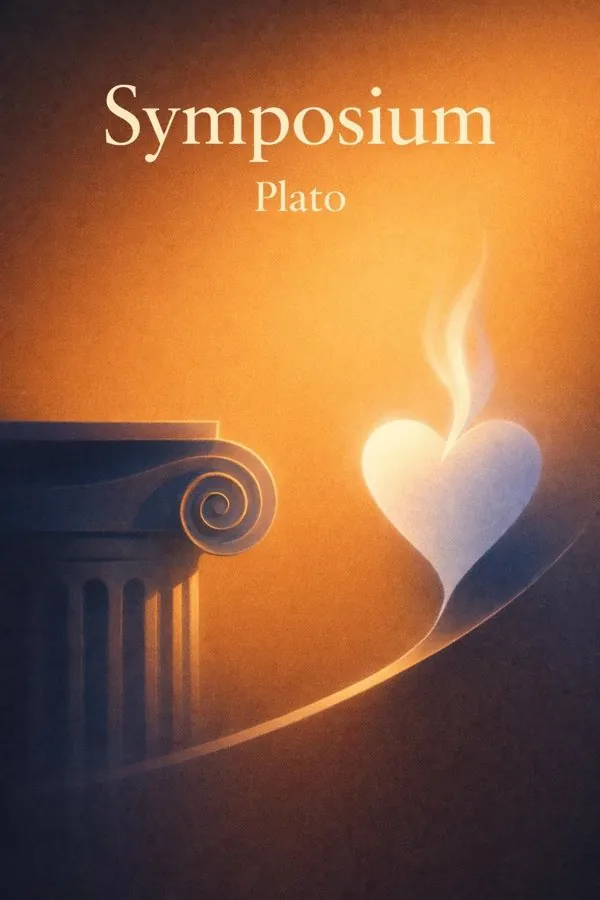
Symposium: Summary & Key Insights
by Plato
 10 min10 chaptersAudio available
Key Takeaways from Symposium
Great questions rarely arrive in classrooms first; they often appear in ordinary social life.
People often become their bravest selves when they feel deeply seen.
One of Symposium’s most practical insights is that the same word can hide very different realities.
What if love is not only a human feeling, but a principle of order woven through nature?
Some truths are easier to grasp through myth than through analysis.
What Is Symposium About?
Symposium by Plato is a western_phil book spanning 8 pages. Plato’s Symposium is one of the most enduring explorations of love ever written. Framed as a lively banquet conversation in classical Athens, the dialogue gathers poets, doctors, politicians, and philosophers to answer a deceptively simple question: what is love? Each speaker offers a different vision of Eros, moving from romance and desire to ethics, beauty, creativity, and spiritual awakening. What begins as a social exercise gradually becomes a profound inquiry into human longing itself. The work matters because it treats love not as a mere feeling, but as a force that shapes character, ambition, friendship, art, and the search for truth. Plato shows that the way we love reveals the way we live. Are we drawn only to bodies and pleasure, or can desire become a path toward wisdom and the good? Plato writes with unmatched authority. As Socrates’ student and one of the founding thinkers of Western philosophy, he transforms a dinner-party conversation into a timeless meditation on what humans most deeply seek. Symposium remains essential reading for anyone interested in philosophy, relationships, beauty, or the meaning of desire.
This FizzRead summary covers all 10 key chapters of Symposium in approximately 10 minutes, distilling the most important ideas, arguments, and takeaways from Plato's work. Also available as an audio summary and Key Quotes Podcast.
Symposium
Plato’s Symposium is one of the most enduring explorations of love ever written. Framed as a lively banquet conversation in classical Athens, the dialogue gathers poets, doctors, politicians, and philosophers to answer a deceptively simple question: what is love? Each speaker offers a different vision of Eros, moving from romance and desire to ethics, beauty, creativity, and spiritual awakening. What begins as a social exercise gradually becomes a profound inquiry into human longing itself.
The work matters because it treats love not as a mere feeling, but as a force that shapes character, ambition, friendship, art, and the search for truth. Plato shows that the way we love reveals the way we live. Are we drawn only to bodies and pleasure, or can desire become a path toward wisdom and the good?
Plato writes with unmatched authority. As Socrates’ student and one of the founding thinkers of Western philosophy, he transforms a dinner-party conversation into a timeless meditation on what humans most deeply seek. Symposium remains essential reading for anyone interested in philosophy, relationships, beauty, or the meaning of desire.
Who Should Read Symposium?
This book is perfect for anyone interested in western_phil and looking to gain actionable insights in a short read. Whether you're a student, professional, or lifelong learner, the key ideas from Symposium by Plato will help you think differently.
- ✓Readers who enjoy western_phil and want practical takeaways
- ✓Professionals looking to apply new ideas to their work and life
- ✓Anyone who wants the core insights of Symposium in just 10 minutes
Want the full summary?
Get instant access to this book summary and 100K+ more with Fizz Moment.
Get Free SummaryAvailable on App Store • Free to download
Key Chapters
Great questions rarely arrive in classrooms first; they often appear in ordinary social life. Plato begins Symposium not with a lecture hall, but with a retold memory of a drinking party at the house of the tragedian Agathon. Apollodorus narrates the event secondhand, and that layered framing immediately reminds us that philosophy is bound up with memory, interpretation, and storytelling. We are not simply receiving facts about love; we are entering a chain of human voices, each shaped by admiration, bias, and perspective.
This setting matters. A symposium was a place of pleasure, wit, status, and performance, so the dialogue takes place in the very environment where eros typically operates. Desire is not discussed from a distance; it is examined in the midst of friendship, competition, vanity, and admiration. The speakers agree to praise Love in turn, and the result is a parade of partial truths. Each speech reveals as much about the speaker as it does about eros itself. The dialogue’s form teaches one of Plato’s deepest lessons: complex human realities cannot be captured by a single definition or viewpoint.
In modern life, we often do something similar when discussing love through songs, films, therapy language, social media advice, or personal stories. Each framework highlights something real, yet none is complete. Symposium encourages us to listen for the assumptions hidden in every account: does this view reduce love to chemistry, morality, possession, or self-discovery?
Actionable takeaway: when reflecting on love, do not ask only what love is. Ask also who is speaking, from what experience, and with what blind spots.
People often become their bravest selves when they feel deeply seen. That is the starting point of Phaedrus’ speech. He praises Love as the oldest and noblest god and argues that eros produces virtue because no lover wants to appear shameful before the beloved. Under the gaze of someone admired, cowardice becomes unbearable and noble action becomes attractive. For Phaedrus, love is not merely private emotion; it is a force that can motivate heroic conduct.
He illustrates this through mythic examples, especially lovers who sacrifice themselves for one another. The point is not just that people in love act boldly, but that love creates a moral audience. When we care deeply about another person’s respect, we strive to become better than we otherwise would be. Love, then, is tied to honor, devotion, and the willingness to give oneself for something beyond immediate comfort.
This idea still resonates. Many people improve their habits, become more responsible, or act with greater integrity when they enter meaningful relationships. A parent works harder because a child depends on them. A partner learns patience because they do not want to wound someone they cherish. A mentor pushes a student toward excellence out of loving regard. In each case, love becomes a training ground for virtue.
Yet Plato also invites caution. If our goodness depends entirely on being watched by someone we admire, it may remain fragile. The speech is powerful, but incomplete, because it links morality strongly to reputation in the beloved’s eyes.
Actionable takeaway: notice where love makes you aspire upward, and consciously turn that aspiration into stable character, not just performance for approval.
One of Symposium’s most practical insights is that the same word can hide very different realities. Pausanias challenges the idea that all love is noble by distinguishing between two kinds of Aphrodite and, therefore, two forms of eros: Common Love and Heavenly Love. Common Love pursues bodies, pleasure, and immediate gratification. Heavenly Love seeks the soul, character, and a relationship directed toward virtue and growth.
This distinction introduces ethics into desire. Love is not judged simply by intensity, but by its aim. A relationship may feel passionate yet remain shallow, manipulative, or exploitative. Another may involve attraction while also encouraging wisdom, discipline, loyalty, and mutual elevation. Pausanias does not condemn physical desire outright; instead, he argues that desire becomes worthy when governed by a concern for what is truly good in the beloved.
In contemporary terms, this is the difference between wanting someone and caring for their flourishing. A manager may flatter a talented employee only to use them. A romantic partner may demand constant attention but have little interest in the other’s development. By contrast, a strong friendship, mentorship, or marriage often includes challenge, honesty, and a shared commitment to becoming better people.
Pausanias also suggests that social norms matter. Cultures shape which loves are encouraged, tolerated, or degraded. That means our desires are never purely private; they are educated by laws, customs, and models of excellence. The speech pushes us to evaluate not just whom we love, but how and why.
Actionable takeaway: examine your closest relationships and ask whether they are driven mainly by possession and pleasure, or by a genuine commitment to mutual moral growth.
What if love is not only a human feeling, but a principle of order woven through nature? That is the bold move made by Eryximachus, the physician. Expanding on Pausanias, he argues that eros operates in bodies, music, seasons, medicine, and the cosmos itself. Healthy love produces balance; unhealthy love creates disorder. From his medical perspective, the art of healing is the art of guiding competing forces into harmony.
This speech may seem strange at first, but it broadens the meaning of love in a valuable way. Desire is no longer confined to romance. It becomes the tendency of things to seek fitting proportion. In the body, health depends on balance among elements. In music, harmony arises when different notes are brought into right relation. In civic life, peace requires competing interests to be moderated rather than left to chaos. Eryximachus treats love as a unifying power that can either be cultivated wisely or mismanaged destructively.
There is a practical lesson here for modern readers. We often think of desire as something to indulge or suppress, but Plato suggests a third possibility: educate it. Good living involves tuning our appetites, emotions, work rhythms, and relationships so they reinforce rather than sabotage one another. Consider sleep, diet, exercise, ambition, and intimacy. When these elements fall out of proportion, life becomes noisy and fragmented. When brought into order, they support one another.
Eryximachus may over-systematize love, yet his perspective is useful because it treats flourishing as a matter of balance rather than excess. Love can heal when it creates alignment.
Actionable takeaway: identify one area of life that feels out of tune, and restore harmony by making one small adjustment that brings body, mind, and relationships into better balance.
Some truths are easier to grasp through myth than through analysis. Aristophanes offers the most famous image in Symposium: human beings were once whole, rounded creatures who were split in two by the gods, leaving each half searching for its lost counterpart. Love, in this comic yet poignant story, is the longing to be restored to completeness.
The enduring power of this speech lies in how vividly it captures human vulnerability. People often experience love as recognition, as if they have found someone who answers a hidden absence in them. We speak of chemistry, soulmates, or feeling understood without explanation. Aristophanes gives poetic form to that intuition. Love is not just wanting pleasure; it is the ache of incompleteness reaching toward reunion.
At the same time, Plato subtly exposes the limits of this ideal. If love is only the search for a missing half, then the beloved risks becoming a remedy for our lack rather than a person in their own right. Modern relationships often suffer from this expectation. Someone enters a partnership hoping the other will cure loneliness, insecurity, or purposelessness. The result can be dependence, idealization, and disappointment.
Still, Aristophanes identifies something psychologically profound: desire reveals that human beings are not self-sufficient. We are relational creatures who seek intimacy, understanding, and belonging. The challenge is to honor this longing without turning it into fusion or possession. Healthy love offers connection while preserving personhood.
Actionable takeaway: cherish the human desire for closeness, but do not ask another person to complete what you must also cultivate within yourself—self-knowledge, purpose, and inner stability.
Praise often reveals what a culture loves most. Agathon, the celebrated host and tragedian, gives the most elegant and decorative speech in the dialogue. He describes Love as youthful, delicate, beautiful, refined, and the source of every grace. His speech is dazzling, rhetorically polished, and emotionally attractive. Yet Plato uses its brilliance to pose a deeper question: is beautiful language the same as truth?
Agathon’s praise captures an important aspect of eros. Love does seem connected with beauty, creativity, softness, and the flowering of life. When people are in love, they often become more poetic, generous, and alive to the world’s charm. Art, courtship, and admiration share a common sensitivity to beauty’s power. Agathon’s speech honors this luminous side of desire.
But Socrates will soon expose its weakness. Agathon speaks as though love itself already possesses all the qualities it seeks. He turns eros into an object of admiration rather than a condition of lack and longing. In doing so, he confuses the beautiful with the seeker of beauty. This is one of Plato’s recurring warnings: eloquence can conceal conceptual confusion. A moving speech can flatter our feelings without clarifying reality.
The lesson is highly relevant today. We are surrounded by polished narratives about love in advertising, entertainment, and online culture. These stories often glorify intensity, aesthetic appeal, and emotional immediacy while ignoring discipline, sacrifice, and moral development. Beautiful presentation can mask shallow understanding.
Actionable takeaway: when a vision of love feels especially attractive, pause and ask whether it merely sounds beautiful or whether it actually helps you understand desire, responsibility, and human flourishing more truthfully.
The turning point of Symposium comes when Socrates stops praising Love and starts questioning what love really is. Recounting the teachings of the wise woman Diotima, he argues that eros is neither a god nor a state of perfection. Love is a daimon, an in-between force born of resource and poverty, always needy yet inventive, always reaching for what it does not fully possess. We love because we lack, and we pursue what seems good and beautiful because we want fulfillment.
Diotima’s insight reframes desire with extraordinary depth. To love something is to seek perpetual possession of the good. This means that every form of eros, from romance to ambition, points toward a more basic human longing for happiness and flourishing. People do not simply want beautiful things; they want what they believe will complete life and make it worth living.
This helps explain why desire can be both creative and dangerous. Because we seek the good through partial objects, we often mistake one attractive thing for the whole of happiness. A person may pursue status, sex, recognition, or wealth as if it could finally satisfy them. For a time it may seem to work, but the deeper hunger returns. Diotima teaches that desire is dynamic and educable. It can remain trapped in substitutes, or it can be redirected toward what is more lasting.
In practical life, this means examining recurring pursuits. Why do you want what you want? What good are you hoping it will deliver? Often the object is secondary; underneath it lies a deeper wish for security, significance, belonging, or meaning.
Actionable takeaway: trace one strong desire back to the deeper good you hope it will provide, and ask whether your current pursuit truly leads there.
The most influential idea in Symposium is Diotima’s ladder of love. She describes a gradual ascent in which a lover begins by being attracted to one beautiful body, then recognizes beauty in many bodies, then values the beauty of souls more than physical appearance, then appreciates beauty in laws and practices, then in knowledge, and finally contemplates Beauty itself—unchanging, pure, and beyond all particular examples.
This is not a rejection of physical attraction so much as its education. Plato does not deny that desire often starts with a person’s appearance. His claim is that if we reflect properly, love can grow from attachment to one instance of beauty into an awakening to beauty as such. The lover becomes less possessive and more contemplative, less fixated on consumption and more oriented toward understanding. Desire becomes a path of ascent.
The ladder offers a profound model for self-development. Many of our loves begin narrowly. We admire one teacher, then come to love learning itself. We are inspired by one act of courage, then become committed to justice. We are moved by one beautiful place, then become attentive to order and meaning in the world. Mature love does not cling to a single object as if it were absolute; it lets particular beauty lead beyond itself.
This has practical significance in relationships too. Loving someone well includes seeing them not as a possession but as a participant in truth, goodness, and beauty. The best relationships enlarge the soul rather than enclosing it.
Actionable takeaway: use whatever you find beautiful as a starting point for growth—ask how that attraction can lead you toward deeper appreciation of character, wisdom, and enduring values.
Human beings know they are finite, yet they ache for permanence. Diotima explains this by saying that love aims at immortality through generation. At the bodily level, people seek it through children. At the level of the soul, they seek it through laws, poems, institutions, discoveries, and acts of virtue that outlast them. Eros, then, is not only sexual longing but the impulse to create something enduring.
This idea expands the meaning of intimacy and ambition. A scientist pursuing a breakthrough, an artist shaping a masterpiece, a founder building an institution, or a parent forming a child’s character are all responding to the same deep structure of desire. They want their lives to matter beyond the moment. Love pushes them to bring forth something beautiful that can resist time, at least partially.
This interpretation helps make sense of why creativity often feels urgent and vulnerable. To create is to expose one’s inner life to judgment in hopes that something worthwhile will survive. It also clarifies why people can become distorted in their pursuit of legacy. When the desire for immortality loses connection to the good, it may turn into vanity, domination, or obsession with reputation.
For modern readers, the question becomes: what are you trying to leave behind, and why? Not every lasting achievement is noble. Plato suggests that the highest form of generativity is the cultivation of wisdom and virtue in oneself and others. The best legacy is not merely being remembered, but contributing to what is genuinely good.
Actionable takeaway: choose one project, relationship, or practice through which you can create something lasting that reflects not just your ambition, but your highest values.
Philosophy becomes most convincing when tested against a real human life. That is why Alcibiades’ drunken entrance at the end of Symposium is so memorable. Bursting into the banquet crowned with ivy and full of admiration, jealousy, and pain, he shifts the discussion from abstract theory to lived experience. Instead of praising Love directly, he praises Socrates, portraying him as irresistibly compelling yet impossible to possess.
Alcibiades confesses that Socrates awakened shame in him by exposing the gap between the life he admired and the life he actually lived. He desired Socrates intensely, even trying to seduce him, but Socrates could not be mastered by beauty, status, or sensual temptation. He loved truth more than flattery and self-command more than pleasure. In this portrait, Socrates becomes the embodiment of Diotima’s teaching: someone who has been educated by eros rather than ruled by it.
This final scene adds realism and tension. Love is not neat spiritual ascent; it involves confusion, projection, frustration, admiration, and wounded pride. Alcibiades loves what he cannot control and resents being judged by the very person he most reveres. Many people know this dynamic. We are drawn to those who reveal a better version of ourselves, yet we may resist the transformation they demand.
The scene also warns that insight alone does not guarantee virtue. Alcibiades recognizes greatness but remains divided between philosophy and ambition.
Actionable takeaway: pay attention to the people who both attract and unsettle you; they may be exposing not only your desires, but the kind of life you know you ought to pursue.
All Chapters in Symposium
About the Author
Plato (c. 427–347 BCE) was one of the most influential philosophers in history. Born into an aristocratic family in Athens, he became a devoted student of Socrates, whose trial and execution deeply shaped his thought. After Socrates’ death, Plato traveled and later founded the Academy, a pioneering school of philosophy that would educate generations of thinkers, including Aristotle. He wrote in dialogue form, using conversation, drama, and irony to explore questions about justice, knowledge, politics, reality, the soul, and the good life. Rather than offering rigid systems, Plato often invites readers into inquiry itself. Works such as Republic, Phaedo, and Symposium remain central to philosophy, literature, and political theory. His influence extends across ethics, metaphysics, theology, education, and aesthetics, making him a foundational figure in Western intellectual history.
Get This Summary in Your Preferred Format
Read or listen to the Symposium summary by Plato anytime, anywhere. FizzRead offers multiple formats so you can learn on your terms — all free.
Available formats: App · Audio · PDF · EPUB — All included free with FizzRead
Download Symposium PDF and EPUB Summary
Key Quotes from Symposium
“Great questions rarely arrive in classrooms first; they often appear in ordinary social life.”
“People often become their bravest selves when they feel deeply seen.”
“One of Symposium’s most practical insights is that the same word can hide very different realities.”
“What if love is not only a human feeling, but a principle of order woven through nature?”
“Some truths are easier to grasp through myth than through analysis.”
Frequently Asked Questions about Symposium
Symposium by Plato is a western_phil book that explores key ideas across 10 chapters. Plato’s Symposium is one of the most enduring explorations of love ever written. Framed as a lively banquet conversation in classical Athens, the dialogue gathers poets, doctors, politicians, and philosophers to answer a deceptively simple question: what is love? Each speaker offers a different vision of Eros, moving from romance and desire to ethics, beauty, creativity, and spiritual awakening. What begins as a social exercise gradually becomes a profound inquiry into human longing itself. The work matters because it treats love not as a mere feeling, but as a force that shapes character, ambition, friendship, art, and the search for truth. Plato shows that the way we love reveals the way we live. Are we drawn only to bodies and pleasure, or can desire become a path toward wisdom and the good? Plato writes with unmatched authority. As Socrates’ student and one of the founding thinkers of Western philosophy, he transforms a dinner-party conversation into a timeless meditation on what humans most deeply seek. Symposium remains essential reading for anyone interested in philosophy, relationships, beauty, or the meaning of desire.
More by Plato


You Might Also Like
A Little History of Philosophy
Nigel Warburton
10 min
Areopagitica
John Milton
10 min
How To Think Like A Philosopher: Essential Principles For Clear Thinking
Peter Cave
10 min
Language, Truth and Logic
A. J. Ayer
10 min
The Age of Reason
Thomas Paine
10 min
The Essays
Michel De Montaigne
10 minBrowse by Category
Ready to read Symposium?
Get the full summary and 100K+ more books with Fizz Moment.