
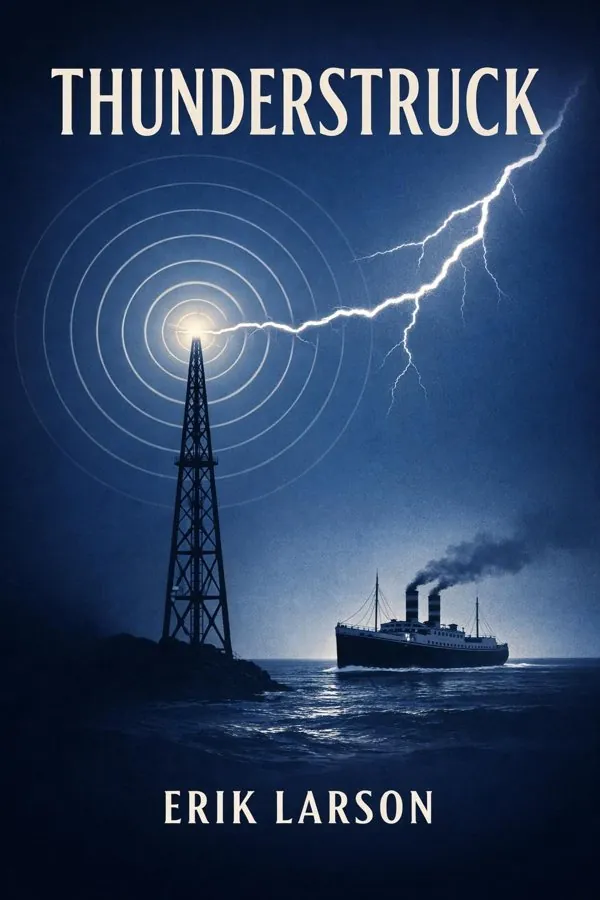
Thunderstruck: Summary & Key Insights
by Erik Larson
 10 min8 chaptersAudio available
What Is Thunderstruck About?
Thunderstruck by Erik Larson is a world_history book spanning 8 pages. Thunderstruck narra la historia paralela de Guglielmo Marconi, el inventor de la telegrafía inalámbrica, y Hawley Harvey Crippen, un médico británico que se convirtió en uno de los criminales más infames de principios del siglo XX. A través de una narrativa meticulosamente documentada, Erik Larson entrelaza la innovación científica con un caso de asesinato que capturó la atención mundial, mostrando cómo la tecnología emergente ayudó a resolver un crimen y cambió la comunicación para siempre.
This FizzRead summary covers all 8 key chapters of Thunderstruck in approximately 10 minutes, distilling the most important ideas, arguments, and takeaways from Erik Larson's work. Also available as an audio summary and Key Quotes Podcast.
Thunderstruck
Thunderstruck narra la historia paralela de Guglielmo Marconi, el inventor de la telegrafía inalámbrica, y Hawley Harvey Crippen, un médico británico que se convirtió en uno de los criminales más infames de principios del siglo XX. A través de una narrativa meticulosamente documentada, Erik Larson entrelaza la innovación científica con un caso de asesinato que capturó la atención mundial, mostrando cómo la tecnología emergente ayudó a resolver un crimen y cambió la comunicación para siempre.
Who Should Read Thunderstruck?
This book is perfect for anyone interested in world_history and looking to gain actionable insights in a short read. Whether you're a student, professional, or lifelong learner, the key ideas from Thunderstruck by Erik Larson will help you think differently.
- ✓Readers who enjoy world_history and want practical takeaways
- ✓Professionals looking to apply new ideas to their work and life
- ✓Anyone who wants the core insights of Thunderstruck in just 10 minutes
Want the full summary?
Get instant access to this book summary and 100K+ more with Fizz Moment.
Get Free SummaryAvailable on App Store • Free to download
Key Chapters
As I delved into the life of Marconi, I couldn’t help but be captivated by his boyish wonder for invisible forces. Born in Bologna to a mixed Italian and Irish heritage, Marconi was an unlikely inventor: not formally trained as a scientist, often dismissed as a dilettante, yet possessed of an extraordinary intuition for possibility. He devoured the works of Hertz and Maxwell, and somewhere in those equations and experiments, he found the spark for an obsession—could electromagnetic waves be used to send messages through the air, without wires?
His early experiments in his family’s attic reflected the kind of faith that marks all true pioneers: the quiet conviction that what others see as absurd may in time prove revolutionary. By connecting a transmitter to a bell receiver across a room and watching it sound—a simple act, yet audacious—Marconi sensed he was touching the future. It is easy to underestimate how radical the idea was in the 1890s. The telegraph, dependent on wire, had unified continents. To imagine the same connection without iron and copper seemed like fantasy. Yet Marconi, stubborn and self-possessed, was already hearing messages in the ether.
I wanted readers to feel the texture of that world—its fascination with electricity, its hunger for discovery. The Italian government ignored him, so he packed up his prototype and traveled to England, where the climate for innovation was more receptive. There, amid skepticism and intrigue, he found mentors and allies willing to test the improbable. This was the first of many moments where faith and persistence mattered as much as science. In Marconi’s story, exploration is never clean or linear; it is improvised, lonely, full of setbacks. His early dreams were as fragile as his circuits, yet each failure carried him closer to success.
If invention is a solitary act, recognition is a collective one—and that was Marconi’s greatest challenge. When I retraced his rise in Britain, I was struck by how much of his life became a battle against disbelief. He demonstrated his wireless signals to naval authorities and journalists, but suspicion lingered. Rival scientists accused him of hijacking their ideas, of relying on glib showmanship more than substance. Yet Marconi persisted. He knew that science required not only ideas but spectacle—and he played that card beautifully.
By 1899, when his company—the Wireless Telegraph & Signal Company Limited—was founded, Marconi had begun to turn his vision into infrastructure. Antennas rose along shorelines; transmitters were mounted on ships. He was no longer merely proving his concept but commercializing it. I found this to be one of the most human dimensions of his story: how quickly dreams become business, and how easily creativity gets tangled with ambition. The Marconi Company bridged nations not only by waves of energy but by contracts and patents. He moved from outsider to industrial magnate.
That transformation, however, came at a cost. The scientific community’s resentment intensified, and Marconi’s relationships frayed. His romantic life, too, bore the strain of perpetual labor and public scrutiny. In these chapters, the reader experiences the dual weight of vision and vulnerability—the emotional cost of genius. Marconi was learning that recognition doesn’t come simply from proving what is true but from persuading the world to believe.
+ 6 more chapters — available in the FizzRead app
All Chapters in Thunderstruck
About the Author
Erik Larson es un autor y periodista estadounidense conocido por sus obras de no ficción histórica que combinan investigación rigurosa y narrativa literaria. Entre sus libros más reconocidos se encuentran 'The Devil in the White City' y 'Dead Wake'.
Get This Summary in Your Preferred Format
Read or listen to the Thunderstruck summary by Erik Larson anytime, anywhere. FizzRead offers multiple formats so you can learn on your terms — all free.
Available formats: App · Audio · PDF · EPUB — All included free with FizzRead
Download Thunderstruck PDF and EPUB Summary
Key Quotes from Thunderstruck
“As I delved into the life of Marconi, I couldn’t help but be captivated by his boyish wonder for invisible forces.”
“If invention is a solitary act, recognition is a collective one—and that was Marconi’s greatest challenge.”
Frequently Asked Questions about Thunderstruck
Thunderstruck by Erik Larson is a world_history book that explores key ideas across 8 chapters. Thunderstruck narra la historia paralela de Guglielmo Marconi, el inventor de la telegrafía inalámbrica, y Hawley Harvey Crippen, un médico británico que se convirtió en uno de los criminales más infames de principios del siglo XX. A través de una narrativa meticulosamente documentada, Erik Larson entrelaza la innovación científica con un caso de asesinato que capturó la atención mundial, mostrando cómo la tecnología emergente ayudó a resolver un crimen y cambió la comunicación para siempre.
More by Erik Larson

In the Garden of Beasts: Love, Terror, and an American Family in Hitler's Berlin
Erik Larson
10 min
The Splendid and the Vile: A Saga of Churchill, Family, and Defiance During the Blitz
Erik Larson
10 min
The Devil in the White City: Murder, Magic, and Madness at the Fair That Changed America
Erik Larson
10 min
Isaac's Storm: A Man, a Time, and the Deadliest Hurricane in History
Erik Larson
10 minYou Might Also Like
The Age of Capital
Eric Hobsbawm
10 min
The Gulag Archipelago
Aleksandr Solzhenitsyn
10 min
Jerusalem: The Biography
Simon Sebag Montefiore
10 min
The Anglo-Saxons
James Campbell
10 min
The Boer War
Thomas Pakenham
10 min
The Industrial Revolutionaries: The Making of the Modern World 1776–1914
Gavin Weightman
10 minBrowse by Category
Ready to read Thunderstruck?
Get the full summary and 100K+ more books with Fizz Moment.