
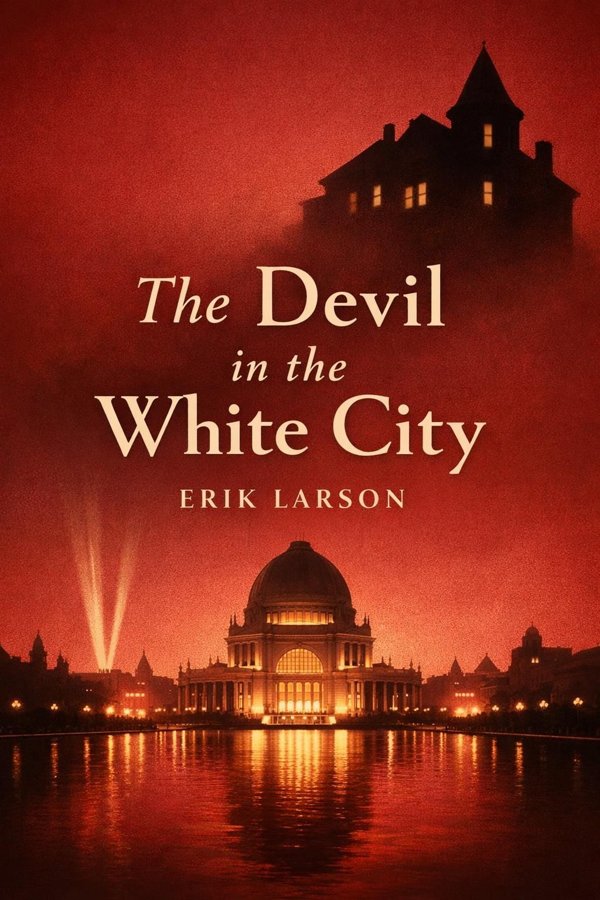
The Devil in the White City: Murder, Magic, and Madness at the Fair That Changed America: Summary & Key Insights
by Erik Larson
 10 min4 chaptersAudio available
What Is The Devil in the White City: Murder, Magic, and Madness at the Fair That Changed America About?
The Devil in the White City: Murder, Magic, and Madness at the Fair That Changed America by Erik Larson is a world_history book spanning 4 pages. Set against the backdrop of the 1893 Chicago World's Fair, this nonfiction narrative intertwines the true stories of architect Daniel H. Burnham, who masterminded the fair’s construction, and serial killer H. H. Holmes, who used the event to lure victims to his 'Murder Castle.' Erik Larson vividly reconstructs the era’s ambition, innovation, and darkness, offering a gripping portrait of America’s Gilded Age.
This FizzRead summary covers all 4 key chapters of The Devil in the White City: Murder, Magic, and Madness at the Fair That Changed America in approximately 10 minutes, distilling the most important ideas, arguments, and takeaways from Erik Larson's work. Also available as an audio summary and Key Quotes Podcast.
The Devil in the White City: Murder, Magic, and Madness at the Fair That Changed America
Set against the backdrop of the 1893 Chicago World's Fair, this nonfiction narrative intertwines the true stories of architect Daniel H. Burnham, who masterminded the fair’s construction, and serial killer H. H. Holmes, who used the event to lure victims to his 'Murder Castle.' Erik Larson vividly reconstructs the era’s ambition, innovation, and darkness, offering a gripping portrait of America’s Gilded Age.
Who Should Read The Devil in the White City: Murder, Magic, and Madness at the Fair That Changed America?
This book is perfect for anyone interested in world_history and looking to gain actionable insights in a short read. Whether you're a student, professional, or lifelong learner, the key ideas from The Devil in the White City: Murder, Magic, and Madness at the Fair That Changed America by Erik Larson will help you think differently.
- ✓Readers who enjoy world_history and want practical takeaways
- ✓Professionals looking to apply new ideas to their work and life
- ✓Anyone who wants the core insights of The Devil in the White City: Murder, Magic, and Madness at the Fair That Changed America in just 10 minutes
Want the full summary?
Get instant access to this book summary and 100K+ more with Fizz Moment.
Get Free SummaryAvailable on App Store • Free to download
Key Chapters
Daniel Burnham was already a man of renown when the contest to design the World’s Columbian Exposition began, but his selection as chief architect of the Fair marked the pinnacle of his career. From the beginning, Burnham’s challenge was monumental. He had to embody America’s progress—four hundred years after Columbus’s voyage—with a spectacle that would rival Paris’s recent Exposition Universelle and its Eiffel Tower. The Board of Directors placed impossible demands on him: to conceive an entire city of beauty and innovation, and to do it under an unforgiving deadline and amid Chicago’s harsh climate.
As Burnham assembled a dream team of architects and landscape designers—men like Frederick Law Olmsted, Louis Sullivan, and Charles McKim—he became the field marshal of an operation that tested every human limit. His belief that ‘make no little plans’ guided their work, though his subordinates often buckled under pressure. Labor strikes, fierce rivalries, and constant design disputes haunted the project. Construction delays mounted, storms tore down half-built pavilions, and winter froze the effort to a crawl. Still, Burnham’s will held. He imposed order where chaos reigned, bringing together craftsmen, engineers, and visionaries under the banner of civic glory.
The transformation was profound. From muddy, swamp-ridden Jackson Park rose a Renaissance dream—a city gleaming in white plaster, inspired by classical architecture and arranged along lagoons and boulevards. It was a fragile illusion of perfection, maintained by men who barely slept and suffered continual setbacks. But Burnham believed that beauty could elevate a nation’s spirit. His Fair would be a statement against mediocrity, a declaration that the United States had arrived as a global power of art and industry.
Through Burnham’s perspective, the building of the Fair was less a feat of architecture than of faith. Every decision, every delay, every burst of creative temper revealed the tension between vision and practicality. Chicago, with its soot and slaughterhouses, would for one sublime season become the heart of civilization itself.
Even as Burnham’s White City rose toward glory, another structure emerged just blocks away on West 63rd Street—a building that hid its purpose behind elegant façades and businesslike promises. It was known locally as the World’s Fair Hotel, but to history it would become Holmes’s ‘Murder Castle.’ Within its twisting corridors, soundproof rooms, and concealed gas lines, H. H. Holmes turned the age’s fascination with progress and invention into instruments of death.
Holmes was a master manipulator—handsome, articulate, and endlessly deceptive. He arrived in Chicago with the Fair’s anticipation already electrifying the city, sensing opportunity amid chaos. His charisma opened doors to partnerships and credit accounts; his lies built foundations as solid as any architectural blueprint. Holmes understood human psychology the way a designer understands materials. He designed his castle with the precision of an engineer, employing workers who were dismissed before they could discern the layout, installing chutes to the basement where acid baths awaited, and creating hidden passages that allowed him to appear or vanish as he pleased.
Holmes’s crimes grew in parallel with the Fair’s magnificence. He swindled businesses, seduced unsuspecting women drawn by the Fair’s promise, and murdered those who threatened exposure or outlived their usefulness. The influx of visitors to Chicago provided endless new faces—ribbons of anonymity that wrapped his deeds in the city’s bustle. Each disappearance might be explained away by the Great Exhibition’s magnetic pull elsewhere.
Through Holmes, we encounter the dark side of progress. The same ingenuity that allowed Burnham to build the White City allowed Holmes to sculpt terror. He exploited the era’s blind faith in innovation and professionalism, showing that darkness can wear the mask of modernity. His story reveals how ambition, untethered from morality, can create monstrosities of intellect and charm—structures as sinister as they are ingenious.
+ 2 more chapters — available in the FizzRead app
All Chapters in The Devil in the White City: Murder, Magic, and Madness at the Fair That Changed America
About the Author
Erik Larson is an American journalist and author known for his meticulously researched historical narratives. His works often blend true crime and history, including 'Dead Wake' and 'In the Garden of Beasts.' He has been a finalist for the National Book Award and his books are international bestsellers.
Get This Summary in Your Preferred Format
Read or listen to the The Devil in the White City: Murder, Magic, and Madness at the Fair That Changed America summary by Erik Larson anytime, anywhere. FizzRead offers multiple formats so you can learn on your terms — all free.
Available formats: App · Audio · PDF · EPUB — All included free with FizzRead
Download The Devil in the White City: Murder, Magic, and Madness at the Fair That Changed America PDF and EPUB Summary
Key Quotes from The Devil in the White City: Murder, Magic, and Madness at the Fair That Changed America
“Daniel Burnham was already a man of renown when the contest to design the World’s Columbian Exposition began, but his selection as chief architect of the Fair marked the pinnacle of his career.”
“Even as Burnham’s White City rose toward glory, another structure emerged just blocks away on West 63rd Street—a building that hid its purpose behind elegant façades and businesslike promises.”
Frequently Asked Questions about The Devil in the White City: Murder, Magic, and Madness at the Fair That Changed America
The Devil in the White City: Murder, Magic, and Madness at the Fair That Changed America by Erik Larson is a world_history book that explores key ideas across 4 chapters. Set against the backdrop of the 1893 Chicago World's Fair, this nonfiction narrative intertwines the true stories of architect Daniel H. Burnham, who masterminded the fair’s construction, and serial killer H. H. Holmes, who used the event to lure victims to his 'Murder Castle.' Erik Larson vividly reconstructs the era’s ambition, innovation, and darkness, offering a gripping portrait of America’s Gilded Age.
More by Erik Larson
In the Garden of Beasts: Love, Terror, and an American Family in Hitler's Berlin
Erik Larson
10 min
The Splendid and the Vile: A Saga of Churchill, Family, and Defiance During the Blitz
Erik Larson
10 min
Thunderstruck
Erik Larson
10 min
Isaac's Storm: A Man, a Time, and the Deadliest Hurricane in History
Erik Larson
10 minYou Might Also Like
The Age of Capital
Eric Hobsbawm
10 min
The Gulag Archipelago
Aleksandr Solzhenitsyn
10 min
Jerusalem: The Biography
Simon Sebag Montefiore
10 min
The Anglo-Saxons
James Campbell
10 min
The Boer War
Thomas Pakenham
10 min
The Industrial Revolutionaries: The Making of the Modern World 1776–1914
Gavin Weightman
10 minBrowse by Category
Ready to read The Devil in the White City: Murder, Magic, and Madness at the Fair That Changed America?
Get the full summary and 100K+ more books with Fizz Moment.