
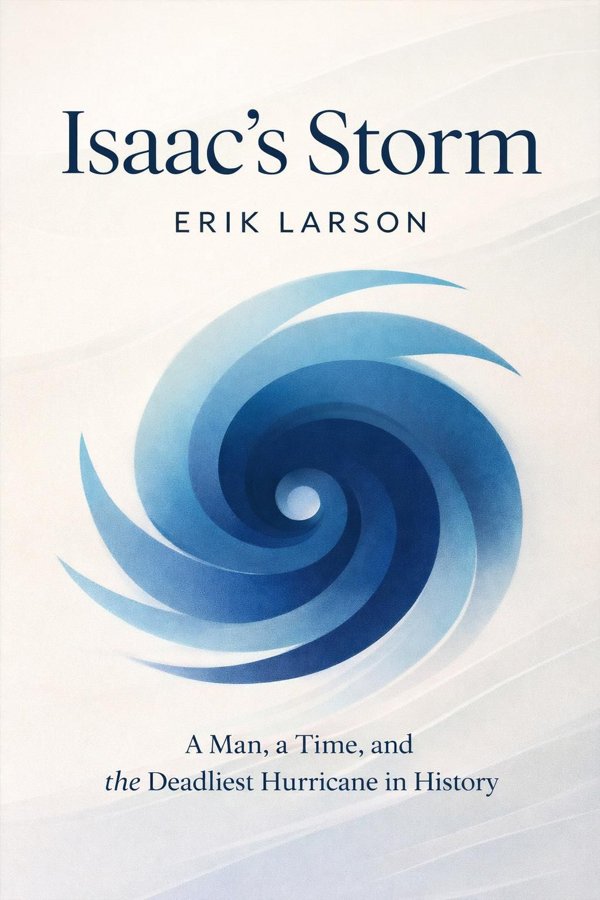
Isaac's Storm: A Man, a Time, and the Deadliest Hurricane in History: Summary & Key Insights
by Erik Larson
 10 min6 chaptersAudio available
What Is Isaac's Storm: A Man, a Time, and the Deadliest Hurricane in History About?
Isaac's Storm: A Man, a Time, and the Deadliest Hurricane in History by Erik Larson is a world_history book spanning 6 pages. Isaac's Storm recounts the true story of the 1900 Galveston hurricane, the deadliest natural disaster in U.S. history, through the experiences of Isaac Cline, a meteorologist for the U.S. Weather Bureau. Drawing on historical records, personal accounts, and scientific analysis, Erik Larson reconstructs the events leading up to the storm, the human errors that magnified its devastation, and the aftermath that reshaped meteorology and disaster preparedness in America.
This FizzRead summary covers all 6 key chapters of Isaac's Storm: A Man, a Time, and the Deadliest Hurricane in History in approximately 10 minutes, distilling the most important ideas, arguments, and takeaways from Erik Larson's work. Also available as an audio summary and Key Quotes Podcast.
Isaac's Storm: A Man, a Time, and the Deadliest Hurricane in History
Isaac's Storm recounts the true story of the 1900 Galveston hurricane, the deadliest natural disaster in U.S. history, through the experiences of Isaac Cline, a meteorologist for the U.S. Weather Bureau. Drawing on historical records, personal accounts, and scientific analysis, Erik Larson reconstructs the events leading up to the storm, the human errors that magnified its devastation, and the aftermath that reshaped meteorology and disaster preparedness in America.
Who Should Read Isaac's Storm: A Man, a Time, and the Deadliest Hurricane in History?
This book is perfect for anyone interested in world_history and looking to gain actionable insights in a short read. Whether you're a student, professional, or lifelong learner, the key ideas from Isaac's Storm: A Man, a Time, and the Deadliest Hurricane in History by Erik Larson will help you think differently.
- ✓Readers who enjoy world_history and want practical takeaways
- ✓Professionals looking to apply new ideas to their work and life
- ✓Anyone who wants the core insights of Isaac's Storm: A Man, a Time, and the Deadliest Hurricane in History in just 10 minutes
Want the full summary?
Get instant access to this book summary and 100K+ more with Fizz Moment.
Get Free SummaryAvailable on App Store • Free to download
Key Chapters
At the turn of the century, meteorology was more hope than exact science. The U.S. Weather Bureau, still young, operated under rigid rules designed less to understand storms than to control information. Forecasts were centralized in Washington, and local stations—like the one where Isaac Cline served in Galveston—were bound by bureaucratic restraint. Warnings about hurricanes were not to be issued lightly; panic was considered a greater danger than the storm itself.
Cline was a product of this system, yet he stood out. A man of precision and ambition, he believed deeply in the predictive potential of scientific observation. His dedication earned him the respect of Galveston’s citizens and the confidence of the Bureau. The city looked to him as a guardian, the man who would read the skies and shield their prosperity from chaos. That was both his privilege and his trap.
Early meteorology relied heavily on pattern recognition, barometric readings, and telegraph reports from distant stations. But communication was slow, data incomplete. In Cuba, meteorologists had long studied tropical systems and warned of their paths with stunning accuracy—but their warnings rarely found receptive ears in Washington. By 1900, nationalist pride and institutional competition largely dismissed their expertise. The Weather Bureau of the United States preferred the comfort of its own theories to the humility of collaboration.
In this world, Isaac functioned both as scientist and symbol. His belief that Galveston’s geography—its gentle slope and surrounding topography—would protect it from major hurricanes reflected both scientific reasoning and civic loyalty. He was not reckless, but confident, embodying the broader American spirit that viewed nature as something to be overcome, not feared. This confidence, as the century’s dawn approached, formed the stage upon which tragedy would unfold.
Before the storm, Galveston was the jewel of the Texas coast. Its harbor bustled with merchants and steamships, and its clean boulevards reflected the city’s wealth and self-assurance. Newspapers called it the New York of the South, and its citizens saw hurricanes as inconveniences of a bygone era. The idea of storm surges and destruction seemed distant, outdated, even absurd.
Under this illusion of safety, Isaac Cline’s presence reinforced their confidence. When he publicly asserted that Galveston could withstand a major hurricane, his words carried the weight of expertise. The city embraced this assurance, choosing comfort over caution. Yet beneath the surface, nature waited. Warm waters of the Gulf, the right temperature gradient, and the invisible weaving of winds in the Atlantic were already giving birth to something vast and unstoppable.
The city’s prosperity had brought vulnerability. Built low to the shore, without seawalls or defensive infrastructure, Galveston was exposed to any surge that might sweep in from the Gulf. Its beauty masked fragility—a truth visible only through hindsight. What makes this portion of the story haunting is how ordinary life continued as disaster approached: children played, ships unloaded cargo, and Isaac’s Weather Bureau station transmitted routine forecasts while, miles away, ocean currents began their slow, fatal choreography.
The belief in safety, that collective certainty, would turn out to be the city’s greatest illusion. The tragedy that followed was not born of ignorance, but of overconfidence—the kind that lulls societies into complacency until nature reminds them of its sovereignty.
+ 4 more chapters — available in the FizzRead app
All Chapters in Isaac's Storm: A Man, a Time, and the Deadliest Hurricane in History
About the Author
Erik Larson is an American journalist and author known for his narrative nonfiction works that blend historical research with storytelling. His books, including 'The Devil in the White City' and 'Dead Wake,' have been bestsellers and critically acclaimed for their vivid portrayal of historical events and figures.
Get This Summary in Your Preferred Format
Read or listen to the Isaac's Storm: A Man, a Time, and the Deadliest Hurricane in History summary by Erik Larson anytime, anywhere. FizzRead offers multiple formats so you can learn on your terms — all free.
Available formats: App · Audio · PDF · EPUB — All included free with FizzRead
Download Isaac's Storm: A Man, a Time, and the Deadliest Hurricane in History PDF and EPUB Summary
Key Quotes from Isaac's Storm: A Man, a Time, and the Deadliest Hurricane in History
“At the turn of the century, meteorology was more hope than exact science.”
“Before the storm, Galveston was the jewel of the Texas coast.”
Frequently Asked Questions about Isaac's Storm: A Man, a Time, and the Deadliest Hurricane in History
Isaac's Storm: A Man, a Time, and the Deadliest Hurricane in History by Erik Larson is a world_history book that explores key ideas across 6 chapters. Isaac's Storm recounts the true story of the 1900 Galveston hurricane, the deadliest natural disaster in U.S. history, through the experiences of Isaac Cline, a meteorologist for the U.S. Weather Bureau. Drawing on historical records, personal accounts, and scientific analysis, Erik Larson reconstructs the events leading up to the storm, the human errors that magnified its devastation, and the aftermath that reshaped meteorology and disaster preparedness in America.
More by Erik Larson
In the Garden of Beasts: Love, Terror, and an American Family in Hitler's Berlin
Erik Larson
10 min
The Splendid and the Vile: A Saga of Churchill, Family, and Defiance During the Blitz
Erik Larson
10 min
The Devil in the White City: Murder, Magic, and Madness at the Fair That Changed America
Erik Larson
10 min
Thunderstruck
Erik Larson
10 minYou Might Also Like
The Age of Capital
Eric Hobsbawm
10 min
The Gulag Archipelago
Aleksandr Solzhenitsyn
10 min
Jerusalem: The Biography
Simon Sebag Montefiore
10 min
The Anglo-Saxons
James Campbell
10 min
The Boer War
Thomas Pakenham
10 min
The Industrial Revolutionaries: The Making of the Modern World 1776–1914
Gavin Weightman
10 minBrowse by Category
Ready to read Isaac's Storm: A Man, a Time, and the Deadliest Hurricane in History?
Get the full summary and 100K+ more books with Fizz Moment.