
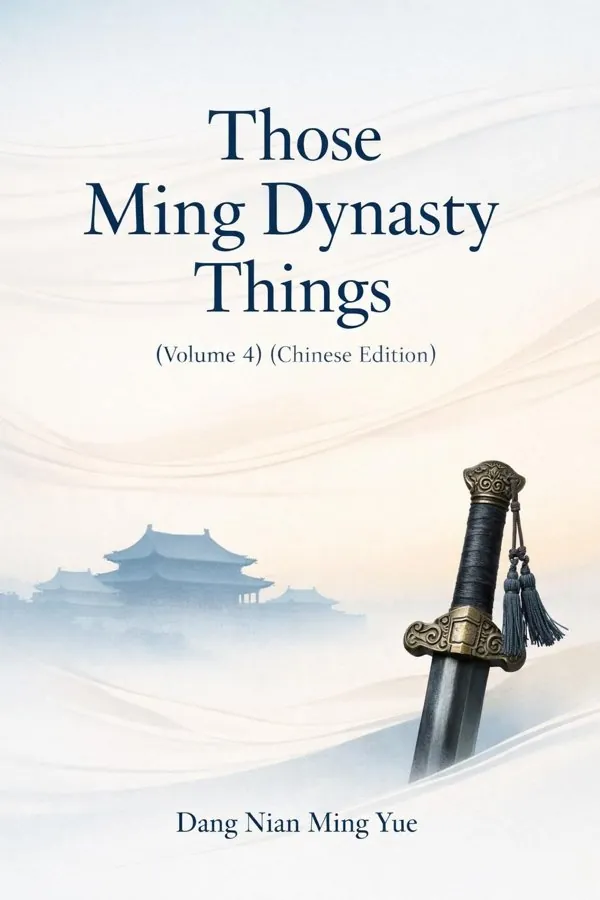
Those Ming Dynasty Things (Volume 4) (Chinese Edition): Summary & Key Insights
 10 min9 chaptersAudio available
Key Takeaways from Those Ming Dynasty Things (Volume 4) (Chinese Edition)
A single military disaster can expose weaknesses that years of peace had concealed.
Emergency rule often begins as necessity and ends in suspicion.
History often remembers emperors, but in moments of collapse it is principled officials who carry the state.
Palace coups rarely look inevitable beforehand, yet in hindsight they reveal years of accumulated resentment and calculation.
Winning back the throne is easier than restoring trust.
What Is Those Ming Dynasty Things (Volume 4) (Chinese Edition) About?
Those Ming Dynasty Things (Volume 4) (Chinese Edition) by Dang Nian Ming Yue is a chinese_history book spanning 7 pages. Those Ming Dynasty Things (Volume 4) continues Dang Nian Ming Yue’s celebrated retelling of Ming history by focusing on one of the dynasty’s most unstable and revealing periods: the aftermath of the Tumu Crisis, the contested rule of the Jingtai Emperor, the restoration of Emperor Yingzong, and the rebuilding era under Emperor Xianzong. Rather than presenting history as a dry list of dates and officials, the book turns political struggle into a vivid human drama filled with fear, ambition, loyalty, calculation, and unintended consequences. At its center is a simple but powerful question: what happens to an empire when the throne itself becomes uncertain? This volume matters because it shows how states are tested less by prosperity than by crisis. Military defeat, hostage emperors, regencies, court intrigue, and factional rivalry all expose the strengths and weaknesses of Ming institutions. Dang Nian Ming Yue writes with the confidence of a serious historical researcher and the energy of a gifted storyteller, blending documented events with sharp interpretation and humor. The result is a book that makes mid-Ming history accessible to general readers while still offering rich insight into political leadership, bureaucratic survival, and the recurring patterns of power.
This FizzRead summary covers all 9 key chapters of Those Ming Dynasty Things (Volume 4) (Chinese Edition) in approximately 10 minutes, distilling the most important ideas, arguments, and takeaways from Dang Nian Ming Yue's work. Also available as an audio summary and Key Quotes Podcast.
Those Ming Dynasty Things (Volume 4) (Chinese Edition)
Those Ming Dynasty Things (Volume 4) continues Dang Nian Ming Yue’s celebrated retelling of Ming history by focusing on one of the dynasty’s most unstable and revealing periods: the aftermath of the Tumu Crisis, the contested rule of the Jingtai Emperor, the restoration of Emperor Yingzong, and the rebuilding era under Emperor Xianzong. Rather than presenting history as a dry list of dates and officials, the book turns political struggle into a vivid human drama filled with fear, ambition, loyalty, calculation, and unintended consequences. At its center is a simple but powerful question: what happens to an empire when the throne itself becomes uncertain?
This volume matters because it shows how states are tested less by prosperity than by crisis. Military defeat, hostage emperors, regencies, court intrigue, and factional rivalry all expose the strengths and weaknesses of Ming institutions. Dang Nian Ming Yue writes with the confidence of a serious historical researcher and the energy of a gifted storyteller, blending documented events with sharp interpretation and humor. The result is a book that makes mid-Ming history accessible to general readers while still offering rich insight into political leadership, bureaucratic survival, and the recurring patterns of power.
Who Should Read Those Ming Dynasty Things (Volume 4) (Chinese Edition)?
This book is perfect for anyone interested in chinese_history and looking to gain actionable insights in a short read. Whether you're a student, professional, or lifelong learner, the key ideas from Those Ming Dynasty Things (Volume 4) (Chinese Edition) by Dang Nian Ming Yue will help you think differently.
- ✓Readers who enjoy chinese_history and want practical takeaways
- ✓Professionals looking to apply new ideas to their work and life
- ✓Anyone who wants the core insights of Those Ming Dynasty Things (Volume 4) (Chinese Edition) in just 10 minutes
Want the full summary?
Get instant access to this book summary and 100K+ more with Fizz Moment.
Get Free SummaryAvailable on App Store • Free to download
Key Chapters
A single military disaster can expose weaknesses that years of peace had concealed. In this volume, the Tumu Crisis is not treated as just a battlefield defeat but as a political earthquake that shook the Ming dynasty from its foundations. Emperor Yingzong’s capture by the Mongols was almost unimaginable for a ruling house that depended on imperial dignity and cosmic legitimacy. When the emperor became a prisoner, the court had to confront not only external danger but also a terrifying constitutional question: how does an empire function when the Son of Heaven is alive, absent, and powerless?
Dang Nian Ming Yue shows that the real damage of Tumu was psychological and institutional. The crisis forced officials, generals, and princes to improvise under extreme pressure. It revealed how fragile military command had become, how dependent the system was on palace influence, and how quickly court politics could shift from routine rivalry to existential struggle. The event also changed the relationship between the throne and the bureaucracy. Ministers who had once served the emperor had to decide whether preserving the state required acting beyond normal expectations of obedience.
This makes the episode deeply relevant beyond its historical setting. Modern organizations also face moments when a symbolic leader fails, disappears, or loses credibility. In such times, institutions survive only if competent people can distinguish loyalty to an individual from loyalty to the system itself. The Tumu Crisis teaches that real resilience is tested in uncertainty, not in ceremonial stability.
Actionable takeaway: when evaluating any institution, ask not how it performs in normal times, but how it responds when its central authority suddenly collapses.
Emergency rule often begins as necessity and ends in suspicion. After Yingzong’s capture, his brother Zhu Qiyu took the throne as the Jingtai Emperor to preserve the dynasty and maintain continuity. On paper, this solved the immediate crisis. In practice, it created a problem that would haunt the court for years: if Jingtai was meant to safeguard the state, was he still a caretaker once his brother returned alive? And if he intended to remain emperor, where did duty end and usurpation begin?
Dang Nian Ming Yue brings this tension to life by showing how legitimacy in imperial politics was never just legal. It was emotional, symbolic, and personal. Jingtai had to govern effectively while managing the presence of a living former emperor. Every policy, appointment, and family decision could be interpreted politically. His supporters argued that he had saved the realm. His critics worried that emergency authority had turned into dynastic ambition. The result was not stable government but a court thick with distrust.
The book also illustrates an enduring political lesson: succession ambiguity poisons institutions. Whether in states, corporations, or family businesses, temporary leaders often face a dangerous transition. If they cling too tightly to power, they lose moral standing. If they remain too tentative, they invite instability. Jingtai’s reign shows how difficult it is to rule decisively while appearing disinterested.
Readers can apply this insight to leadership transitions today. Interim leaders need transparent roles, clear timelines, and visible principles; otherwise, every necessary action becomes suspect. Legitimacy requires more than competence.
Actionable takeaway: in any succession crisis, define authority clearly and early, because unclear mandates turn allies into rivals and necessity into mistrust.
History often remembers emperors, but in moments of collapse it is principled officials who carry the state. One of the most important figures in this volume is Yu Qian, the minister whose resolve helped stabilize the Ming after the Tumu disaster. Dang Nian Ming Yue presents him not as a flawless saint but as a rare public servant who understood the difference between serving a ruler and defending the realm. When panic spread through the court, Yu Qian advocated resistance instead of retreat and helped organize Beijing’s defense at a moment when fear could easily have destroyed the dynasty.
What makes Yu Qian compelling is the tragic cost of integrity in political systems dominated by insecurity. His achievements were substantial, yet success did not protect him. As court factions shifted and power changed hands, the same independence that once made him indispensable also made him vulnerable. The book uses his fate to show that moral courage does not guarantee political survival. In fact, it often creates enemies among those who benefit from confusion, flattery, or revenge.
This idea has practical value far beyond imperial history. In any organization, competent truth-tellers are often appreciated in crisis but sidelined in recovery, especially when their clarity exposes others’ failures. Leaders who genuinely value institutions must protect principled dissent before, during, and after emergencies.
Yu Qian’s story is ultimately about the loneliness of public duty. He acted because the state needed him, not because the outcome would favor him personally. That is why he remains memorable while many of his rivals do not.
Actionable takeaway: if you lead a team or institution, identify and protect people who speak hard truths in crisis, because they are often your most valuable defenders of long-term stability.
Palace coups rarely look inevitable beforehand, yet in hindsight they reveal years of accumulated resentment and calculation. The famous Seizing of the Gate incident, in which Emperor Yingzong returned to power, is one of the most dramatic episodes in the book. Dang Nian Ming Yue narrates it as both a thrilling political reversal and a cautionary case study in how unresolved legitimacy disputes eventually explode. Jingtai’s weakening health, factional maneuvering, and lingering loyalty to the former emperor created the conditions for a sudden shift that changed the court overnight.
The restoration of Yingzong was not merely a family matter between brothers. It represented the triumph of one political interpretation over another. Supporters of the coup framed it as the correction of an abnormal arrangement; opponents saw it as a dangerous overthrow. Either way, the event demonstrated that formal power is never enough when informal networks, symbolic loyalty, and strategic timing align against a regime.
The episode also shows how quickly political narratives are rewritten. Yesterday’s necessity becomes today’s crime. Yesterday’s exile becomes today’s rightful ruler. Dang Nian Ming Yue highlights the speed with which officials adjusted, reminding readers that survival often drives behavior as much as conviction. That uncomfortable truth makes the history feel real.
For modern readers, the lesson is that unresolved internal conflicts do not disappear simply because they are suppressed. They harden beneath the surface until a moment of weakness invites decisive action. In institutions, neglected grievances and ambiguous settlements often produce abrupt realignments later.
Actionable takeaway: do not mistake temporary silence for real resolution; if a leadership conflict remains fundamentally unsettled, address it openly before crisis turns it into a dramatic rupture.
Winning back the throne is easier than restoring trust. After Yingzong returned to power, the Ming court faced the difficult work of reorganization. A restored ruler had to reward allies, punish enemies, and reestablish authority, but each of those moves risked deepening division. Dang Nian Ming Yue shows that political restoration is never a simple reset. Institutions remember. Officials remember. Families of the condemned remember. The state may regain continuity on paper while becoming more brittle in spirit.
One of the volume’s strengths is its attention to aftermath rather than just spectacle. The restoration did not solve the problems exposed by the Tumu Crisis and Jingtai’s reign; it rearranged them. Questions of loyalty became more dangerous. A man’s past decisions, once made under emergency conditions, could now be judged under a different political morality. This made service riskier and encouraged caution, conformity, and retrospective blame.
The treatment of figures such as Yu Qian underscores a broader point: restored regimes often seek legitimacy through punishment. By condemning selected individuals, they dramatize the return of order. But this strategy can distort justice and weaken confidence in the fairness of government. A state that governs by settling old scores may recover authority while damaging institutional trust.
Readers can apply this to any post-crisis environment. After a merger, leadership shake-up, or political transition, the urge to identify villains is powerful. Yet excessive retribution can prevent durable recovery. Institutions need accountability, but they also need a path forward that reduces fear.
Actionable takeaway: after a major transition, prioritize fair process over emotional revenge, because durable authority depends on trust as much as victory.
The most important form of power is often not conquest but repair. Under Emperor Xianzong, the Ming dynasty entered a period that Dang Nian Ming Yue presents as one of reconstruction rather than dramatic upheaval. After the volatility of previous reigns, the value of relative stability became newly visible. Xianzong inherited not a collapsed state but a scarred one, and his era shows how dynasties recover through administrative normalization, political recalibration, and the gradual return of confidence.
This reconstruction was not glamorous. It depended on restoring routine governance, balancing court factions, and reducing the temperature of succession-centered politics. Dang Nian Ming Yue captures the subtlety of this process well. States are not saved only by battlefield victories or coups; they are also sustained by tax collection, appointments, border management, and daily bureaucratic competence. In this sense, the book argues indirectly for the historical importance of the ordinary. Stability is made from repeated acts of administration.
At the same time, Xianzong’s reign was no utopia. Court influence, palace relationships, and structural weaknesses remained. Yet compared with the chaos that preceded him, his era demonstrates how systems regain strength when leaders stop turning every issue into a struggle for survival. Recovery requires predictability.
This lesson resonates in modern leadership. Teams exhausted by turmoil often do not need grand visions first; they need competent routines, credible rules, and fewer shocks. The rebuilding phase can feel less exciting than the crisis phase, but it is where durable strength returns.
Actionable takeaway: when inheriting a damaged organization, focus first on restoring dependable processes, because sustainable renewal begins with consistency, not spectacle.
Large historical events often grow out of small rooms filled with anxious people. One of the recurring insights in this volume is that imperial court politics was not a separate world from national governance; it was the mechanism through which military, fiscal, and administrative decisions were filtered. Palace influence, eunuch activity, ministerial rivalry, and personal favor all mattered because the emperor stood at the center of the system. When access to him became contested, the state itself became unstable.
Dang Nian Ming Yue is especially effective at showing how personality and structure interact. Individual ambition mattered, but ambition became dangerous because institutions lacked clean boundaries. A palace favorite could influence appointments. A factional accusation could derail policy. A succession dispute could distort military planning. This is why the book reads as more than biography or anecdote. It demonstrates that governance quality depends on whether institutions can restrain personal insecurity.
There is a modern application here that readers will recognize immediately. Organizations often assume that internal politics is merely annoying background noise. In reality, internal politics can become a strategic liability when it interferes with decision-making, information flow, or talent retention. The Ming court’s struggles remind us that systems break down when loyalty to camps overrides loyalty to purpose.
The book also encourages readers to look beyond official titles. Who has access? Who controls information? Who shapes perceptions? These questions often reveal more than formal charts of authority. Court politics is really about the hidden architecture of power.
Actionable takeaway: if you want to understand any institution, look past formal hierarchy and map the informal networks that influence decisions, because those networks often determine outcomes.
History becomes richer when it remembers that empires were inhabited, not just administered. Beyond coups and emperors, this volume pays attention to commerce, urban life, culture, and the rhythms of ordinary society in the mid-Ming era. Dang Nian Ming Yue uses these details to remind readers that even during political instability, daily life continued. Markets operated, families adapted, scholars pursued advancement, and local society sustained the larger state. This broader perspective prevents history from becoming trapped inside the palace walls.
The value of this approach is significant. Political crises can dominate the historical record, but a dynasty’s true condition is also reflected in social vitality. Commercial growth, cultural production, and local resilience reveal whether the state still possessed underlying strength. Mid-Ming society was not simply waiting for court outcomes; it had its own momentum. In fact, the durability of ordinary life often helped absorb the shocks created by elite conflict.
For readers, this offers a practical way to understand history more intelligently. When evaluating any period, ask not only who ruled but how people lived. Were trade networks functioning? Was cultural life active? Did social institutions remain coherent? These questions produce a fuller picture than political narrative alone.
The same principle applies now. Headlines focus on leaders and crises, yet the health of a society also depends on everyday systems: families, local economies, schools, trust, and cultural confidence. Dang Nian Ming Yue’s storytelling succeeds because it keeps both levels in view.
Actionable takeaway: whenever you study history or current affairs, pair top-level political analysis with attention to ordinary social life, because real resilience is often found below the level of power.
The most unsettling lesson of history is not that people change, but that certain behaviors barely do. As this volume moves through defeat, regency, restoration, and reconstruction, a larger pattern emerges: power repeatedly attracts fear, flattery, opportunism, and self-justification. Dang Nian Ming Yue does not present these as uniquely Ming flaws. Instead, he uses the period to expose recurring human tendencies. Leaders confuse position with security. Courtiers mistake proximity for wisdom. Rivals call ambition principle and principle ambition.
This cyclical view gives the book much of its philosophical depth. The events are specific to the Ming dynasty, but the underlying logic feels universal. Institutions are strongest when rules are clear, talent is respected, and personal insecurity is constrained. They decline when symbolism outruns competence, when access matters more than merit, and when crises are used to rewrite morality after the fact. The reader comes away with more than historical knowledge; they gain a framework for recognizing patterns in politics, business, and public life.
The practical value of this idea lies in pattern recognition. Historical literacy is useful not only because it informs us about the past, but because it trains us to spot familiar structures in the present: succession fights disguised as legal debates, purges disguised as reforms, and loyalty tests disguised as morality.
Dang Nian Ming Yue’s great achievement is making this insight entertaining without making it shallow. He invites readers to enjoy the story while quietly teaching them how power behaves.
Actionable takeaway: study historical episodes not as isolated curiosities but as pattern libraries, and use them to identify recurring risks whenever leadership, legitimacy, and fear collide.
All Chapters in Those Ming Dynasty Things (Volume 4) (Chinese Edition)
About the Author
Dang Nian Ming Yue is the pen name of Shi Yue, a Chinese author best known for the hugely influential Those Ming Dynasty Things series. He gained a wide readership by doing something rare: turning serious dynastic history into lively, witty, highly readable narrative nonfiction. His work focuses especially on the Ming dynasty, but its appeal goes beyond historical facts. By emphasizing personality, motive, irony, and political tension, he helps modern readers see history as a world of real human choices rather than distant names and dates. Although he writes for a broad audience rather than a strictly academic one, his books are respected for their strong grounding in historical material. His storytelling style has played a major role in popularizing Chinese history for contemporary readers.
Get This Summary in Your Preferred Format
Read or listen to the Those Ming Dynasty Things (Volume 4) (Chinese Edition) summary by Dang Nian Ming Yue anytime, anywhere. FizzRead offers multiple formats so you can learn on your terms — all free.
Available formats: App · Audio · PDF · EPUB — All included free with FizzRead
Download Those Ming Dynasty Things (Volume 4) (Chinese Edition) PDF and EPUB Summary
Key Quotes from Those Ming Dynasty Things (Volume 4) (Chinese Edition)
“A single military disaster can expose weaknesses that years of peace had concealed.”
“Emergency rule often begins as necessity and ends in suspicion.”
“History often remembers emperors, but in moments of collapse it is principled officials who carry the state.”
“Palace coups rarely look inevitable beforehand, yet in hindsight they reveal years of accumulated resentment and calculation.”
“Winning back the throne is easier than restoring trust.”
Frequently Asked Questions about Those Ming Dynasty Things (Volume 4) (Chinese Edition)
Those Ming Dynasty Things (Volume 4) (Chinese Edition) by Dang Nian Ming Yue is a chinese_history book that explores key ideas across 9 chapters. Those Ming Dynasty Things (Volume 4) continues Dang Nian Ming Yue’s celebrated retelling of Ming history by focusing on one of the dynasty’s most unstable and revealing periods: the aftermath of the Tumu Crisis, the contested rule of the Jingtai Emperor, the restoration of Emperor Yingzong, and the rebuilding era under Emperor Xianzong. Rather than presenting history as a dry list of dates and officials, the book turns political struggle into a vivid human drama filled with fear, ambition, loyalty, calculation, and unintended consequences. At its center is a simple but powerful question: what happens to an empire when the throne itself becomes uncertain? This volume matters because it shows how states are tested less by prosperity than by crisis. Military defeat, hostage emperors, regencies, court intrigue, and factional rivalry all expose the strengths and weaknesses of Ming institutions. Dang Nian Ming Yue writes with the confidence of a serious historical researcher and the energy of a gifted storyteller, blending documented events with sharp interpretation and humor. The result is a book that makes mid-Ming history accessible to general readers while still offering rich insight into political leadership, bureaucratic survival, and the recurring patterns of power.
More by Dang Nian Ming Yue
You Might Also Like
1587, A Year of No Significance
Ray Huang
10 min
A Brief History of the Song Dynasty (Chinese Edition)
Chen Zhen
10 min
Comprehensive Mirror to Aid in Government (Zizhi Tongjian)
Sima Guang
10 min
General History of China (Chinese Edition)
Lü Simian
10 min
Modern History of China (Chinese Edition)
Li Kan
10 min
Records of the Grand Historian (Chinese Edition)
Sima Qian
10 minBrowse by Category
Ready to read Those Ming Dynasty Things (Volume 4) (Chinese Edition)?
Get the full summary and 100K+ more books with Fizz Moment.