
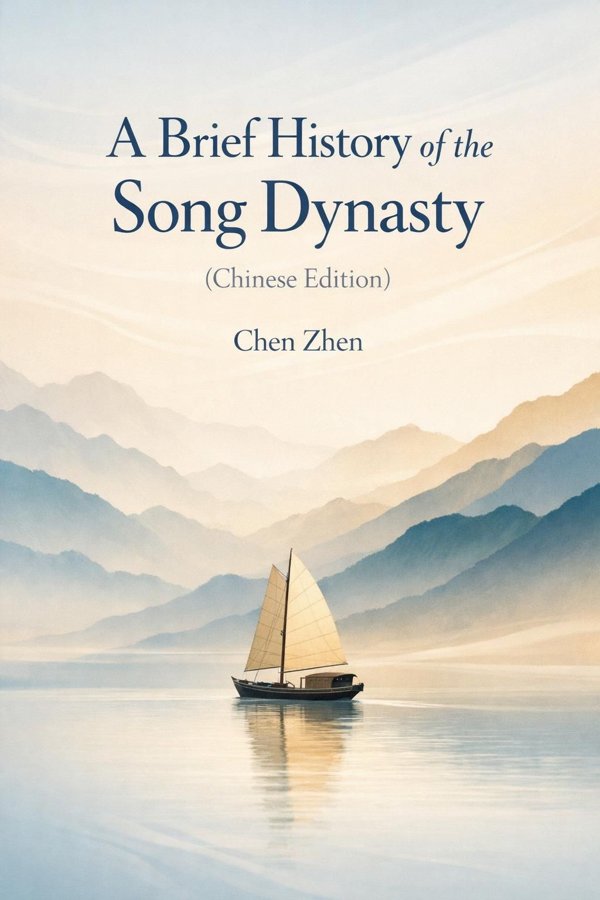
A Brief History of the Song Dynasty (Chinese Edition): Summary & Key Insights
by Chen Zhen
 10 min5 chaptersAudio available
What Is A Brief History of the Song Dynasty (Chinese Edition) About?
A Brief History of the Song Dynasty (Chinese Edition) by Chen Zhen is a chinese_history book spanning 5 pages. This book provides a concise introduction to the history of the Song Dynasty, covering its founding, development, and eventual fall. It explores political, economic, cultural, and military aspects of the era. Author Chen Zhen presents key events and figures in an accessible way, helping readers quickly grasp the significance of this important Chinese dynasty.
This FizzRead summary covers all 5 key chapters of A Brief History of the Song Dynasty (Chinese Edition) in approximately 10 minutes, distilling the most important ideas, arguments, and takeaways from Chen Zhen's work. Also available as an audio summary and Key Quotes Podcast.
A Brief History of the Song Dynasty (Chinese Edition)
This book provides a concise introduction to the history of the Song Dynasty, covering its founding, development, and eventual fall. It explores political, economic, cultural, and military aspects of the era. Author Chen Zhen presents key events and figures in an accessible way, helping readers quickly grasp the significance of this important Chinese dynasty.
Who Should Read A Brief History of the Song Dynasty (Chinese Edition)?
This book is perfect for anyone interested in chinese_history and looking to gain actionable insights in a short read. Whether you're a student, professional, or lifelong learner, the key ideas from A Brief History of the Song Dynasty (Chinese Edition) by Chen Zhen will help you think differently.
- ✓Readers who enjoy chinese_history and want practical takeaways
- ✓Professionals looking to apply new ideas to their work and life
- ✓Anyone who wants the core insights of A Brief History of the Song Dynasty (Chinese Edition) in just 10 minutes
Want the full summary?
Get instant access to this book summary and 100K+ more with Fizz Moment.
Get Free SummaryAvailable on App Store • Free to download
Key Chapters
When I describe the beginning of the Song Dynasty, I start with Zhao Kuangyin, later Emperor Taizu of Song, whose story exemplifies determination and the longing for unity. In the aftermath of the Five Dynasties and Ten Kingdoms—a time of fragmentation and chaos—Zhao seized the opportunity to end an age of warlord rule. His founding act in 960 CE, the Chenqiao Mutiny, was not merely a military coup; it was a reassertion of stability through the idea that order must be grounded in merit and bureaucracy, not aristocratic lineage.
From the outset, Taizu envisioned a state where civilian administration triumphed over military dominance. He famously disarmed powerful generals, reshaping command structures so that provincial militaries could not challenge the throne. This was the birth of the Song’s distinctive character: centralized governance through the scholar-official system. I emphasize in the book how this move established a long-lasting peace internally, but also sowed the seeds of military vulnerability later.
Under Taizu and his successor Taizong, the capital Kaifeng blossomed into a hub of organization. Taxes and rituals were standardized, bureaucrats were carefully ranked, and civil examinations expanded to select talented individuals based on learning rather than heritage. For me, this moment marked the victory of intellect over muscle—a triumph of the pen. It also illustrated the beginning of the Song’s enduring contradiction: its brilliance in administration and weakness in defense.
As a historian, I see Zhao Kuangyin’s achievement as enormously transformative. He gave China one of its most enduring ideals: that knowledge and governance must align. The structure he established became the institutional backbone that supported centuries of cultural prosperity. Yet, as we shall see later, stability built upon bureaucratic supervision also limited the dynasty’s military responsiveness—a flaw that history would expose.
Few periods in world history witnessed economic dynamics as sophisticated as those of the Song. In my narrative, I highlight that the Song era was not simply a time of expansion—it was an age of economic consciousness. Agricultural innovation spearheaded this growth: the introduction of new rice strains from Champa transformed southern China into a fertile heartland. These advances doubled yields, freed labor for commercial pursuits, and powered urbanization.
The rise of cities was unprecedented. Kaifeng and Hangzhou teemed with markets and artisans; they embodied what scholars later called the world’s first urban consumer economy. You could walk down a street where a scholar copied books for money, a merchant offered foreign spices, and craftsmen sold bamboo goods—all receiving payment in a common currency of paper money, the world’s earliest experiment with fiat exchange.
Trade networks grew beyond imagination. The Grand Canal transported grain and silk; ships from Quanzhou and Guangzhou carried Chinese porcelain and tea to Southeast Asia and beyond. The Song maritime horizon widened until China became a major participant in international trade. In this book, I argue that it was in the Song that China first saw the integration of markets, technology, and bureaucracy into one cohesive system that sustained both wealth and learning.
Economic prosperity nurtured social fluidity. Merchants gained new respect, and scholars interacted with commerce more directly than ever before. The empire’s prosperity also spurred financial innovation—state-operated monopolies on salt and tea, expansive tax systems, and official coinage reforms. These achievements made the Song one of history’s most advanced economies.
But prosperity carried risks. Land concentration and fiscal strain grew; military expenditure against northern enemies drained resources. Still, when we speak of Song economy, we speak of vitality and modernity—a phase where China reimagined prosperity not as tribute-based wealth but as a circulation of goods, ideas, and ambitions.
+ 3 more chapters — available in the FizzRead app
All Chapters in A Brief History of the Song Dynasty (Chinese Edition)
About the Author
Get This Summary in Your Preferred Format
Read or listen to the A Brief History of the Song Dynasty (Chinese Edition) summary by Chen Zhen anytime, anywhere. FizzRead offers multiple formats so you can learn on your terms — all free.
Available formats: App · Audio · PDF · EPUB — All included free with FizzRead
Download A Brief History of the Song Dynasty (Chinese Edition) PDF and EPUB Summary
Key Quotes from A Brief History of the Song Dynasty (Chinese Edition)
“When I describe the beginning of the Song Dynasty, I start with Zhao Kuangyin, later Emperor Taizu of Song, whose story exemplifies determination and the longing for unity.”
“Few periods in world history witnessed economic dynamics as sophisticated as those of the Song.”
Frequently Asked Questions about A Brief History of the Song Dynasty (Chinese Edition)
A Brief History of the Song Dynasty (Chinese Edition) by Chen Zhen is a chinese_history book that explores key ideas across 5 chapters. This book provides a concise introduction to the history of the Song Dynasty, covering its founding, development, and eventual fall. It explores political, economic, cultural, and military aspects of the era. Author Chen Zhen presents key events and figures in an accessible way, helping readers quickly grasp the significance of this important Chinese dynasty.
You Might Also Like
1587, A Year of No Significance
Ray Huang
10 min
Comprehensive Mirror to Aid in Government (Zizhi Tongjian)
Sima Guang
10 min
General History of China (Chinese Edition)
Lü Simian
10 min
Modern History of China (Chinese Edition)
Li Kan
10 min
Records of the Grand Historian (Chinese Edition)
Sima Qian
10 min
Romance of the Three Kingdoms
Luo Guanzhong
10 minBrowse by Category
Ready to read A Brief History of the Song Dynasty (Chinese Edition)?
Get the full summary and 100K+ more books with Fizz Moment.