
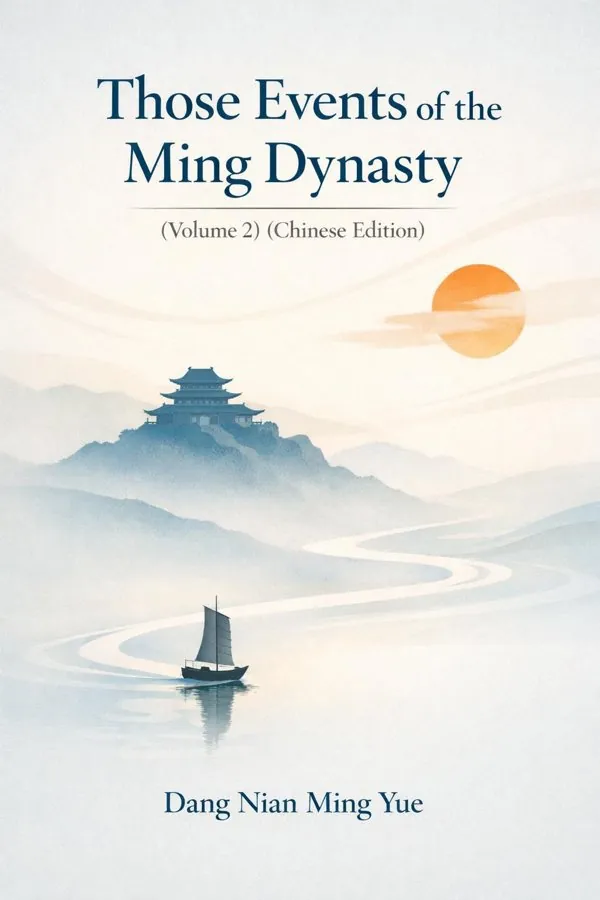
Those Events of the Ming Dynasty (Volume 2) (Chinese Edition): Summary & Key Insights
 10 min9 chaptersAudio available
What Is Those Events of the Ming Dynasty (Volume 2) (Chinese Edition) About?
Those Events of the Ming Dynasty (Volume 2) (Chinese Edition) by Dang Nian Ming Yue is a chinese_history book spanning 9 pages. This second volume continues the engaging narrative style of the first, using accessible and humorous language to recount the Ming dynasty’s history from the Yongle prosperity to the Renxuan era. Based on historical facts, the author combines vivid storytelling and character portrayal to help readers understand the political, military, cultural, and social transformations of the Ming dynasty.
This FizzRead summary covers all 9 key chapters of Those Events of the Ming Dynasty (Volume 2) (Chinese Edition) in approximately 10 minutes, distilling the most important ideas, arguments, and takeaways from Dang Nian Ming Yue's work. Also available as an audio summary and Key Quotes Podcast.
Those Events of the Ming Dynasty (Volume 2) (Chinese Edition)
This second volume continues the engaging narrative style of the first, using accessible and humorous language to recount the Ming dynasty’s history from the Yongle prosperity to the Renxuan era. Based on historical facts, the author combines vivid storytelling and character portrayal to help readers understand the political, military, cultural, and social transformations of the Ming dynasty.
Who Should Read Those Events of the Ming Dynasty (Volume 2) (Chinese Edition)?
This book is perfect for anyone interested in chinese_history and looking to gain actionable insights in a short read. Whether you're a student, professional, or lifelong learner, the key ideas from Those Events of the Ming Dynasty (Volume 2) (Chinese Edition) by Dang Nian Ming Yue will help you think differently.
- ✓Readers who enjoy chinese_history and want practical takeaways
- ✓Professionals looking to apply new ideas to their work and life
- ✓Anyone who wants the core insights of Those Events of the Ming Dynasty (Volume 2) (Chinese Edition) in just 10 minutes
Want the full summary?
Get instant access to this book summary and 100K+ more with Fizz Moment.
Get Free SummaryAvailable on App Store • Free to download
Key Chapters
When Zhu Di seized the throne and declared himself the Yongle Emperor, the Ming was a nation still recovering from internal fissures. The scars of the Jingnan Campaign cut deep. His first challenge wasn’t building new glory — it was convincing the empire to believe in him. As I narrate, Yongle did this not through hesitation but through sheer, commanding will.
He reestablished imperial authority by reorganizing the court, enforcing strict central control, and rewarding loyalty. Unlike his father Zhu Yuanzhang’s rule, which was marked by suspicion and harsh punishments, Yongle’s regime refined the mechanisms of authority into something more efficient — paradoxically both absolutist and rational. He knew the danger of fragmentation and repeatedly emphasized unity under heaven. His reign was about more than personal ambition; it was about securing the legitimacy of a dynasty that had almost torn itself apart.
During this stage, the tone of the narrative in the book becomes both grand and personal. Yongle is portrayed as a ruler of immense energy, often rising before dawn to review memorials, then directly overseeing large-scale construction and military affairs. Yet his determination often bordered on obsession. I tell his story as a man trying to erase the stigma of rebellion by building monuments that would last a thousand years.
The decision to move the capital northward to Beijing was the Yongle Emperor’s most daring and symbolically charged project. In the book, I describe it as a convergence of imperial will and cultural identity. Beijing was not chosen simply for strategic defense against the Mongols, though that was important. It was chosen because it was the stage upon which the grandeur of the Ming could be permanently inscribed.
Imagine, as I portray it, the massive scale of construction: artisans summoned from across the empire, timbers hauled from the southern forests, and endless caravans of laborers paving the selfsame roads that still traverse the city today. The Forbidden City was more than architecture; it was imperial propaganda cast in wood and stone. Every hall spoke of power, symmetry, and cosmic order.
In writing this chapter, my intention was to let the readers feel both the awe and the cost. The glory of the Forbidden City rose on the backs of countless common folk. Yet in that image — the emperor standing atop the newly completed ramparts — we see both the peak of human ambition and the inevitability of its price.
+ 7 more chapters — available in the FizzRead app
All Chapters in Those Events of the Ming Dynasty (Volume 2) (Chinese Edition)
About the Author
Dang Nian Ming Yue, whose real name is Shi Yue, was born in 1979 in Guangdong, China. He gained fame through his online serialized work 'Those Events of the Ming Dynasty,' later officially published. His writing is known for its humorous and approachable style, making history enjoyable for a wide readership.
Get This Summary in Your Preferred Format
Read or listen to the Those Events of the Ming Dynasty (Volume 2) (Chinese Edition) summary by Dang Nian Ming Yue anytime, anywhere. FizzRead offers multiple formats so you can learn on your terms — all free.
Available formats: App · Audio · PDF · EPUB — All included free with FizzRead
Download Those Events of the Ming Dynasty (Volume 2) (Chinese Edition) PDF and EPUB Summary
Key Quotes from Those Events of the Ming Dynasty (Volume 2) (Chinese Edition)
“When Zhu Di seized the throne and declared himself the Yongle Emperor, the Ming was a nation still recovering from internal fissures.”
“The decision to move the capital northward to Beijing was the Yongle Emperor’s most daring and symbolically charged project.”
Frequently Asked Questions about Those Events of the Ming Dynasty (Volume 2) (Chinese Edition)
Those Events of the Ming Dynasty (Volume 2) (Chinese Edition) by Dang Nian Ming Yue is a chinese_history book that explores key ideas across 9 chapters. This second volume continues the engaging narrative style of the first, using accessible and humorous language to recount the Ming dynasty’s history from the Yongle prosperity to the Renxuan era. Based on historical facts, the author combines vivid storytelling and character portrayal to help readers understand the political, military, cultural, and social transformations of the Ming dynasty.
More by Dang Nian Ming Yue
You Might Also Like
1587, A Year of No Significance
Ray Huang
10 min
A Brief History of the Song Dynasty (Chinese Edition)
Chen Zhen
10 min
Comprehensive Mirror to Aid in Government (Zizhi Tongjian)
Sima Guang
10 min
General History of China (Chinese Edition)
Lü Simian
10 min
Modern History of China (Chinese Edition)
Li Kan
10 min
Records of the Grand Historian (Chinese Edition)
Sima Qian
10 minBrowse by Category
Ready to read Those Events of the Ming Dynasty (Volume 2) (Chinese Edition)?
Get the full summary and 100K+ more books with Fizz Moment.