
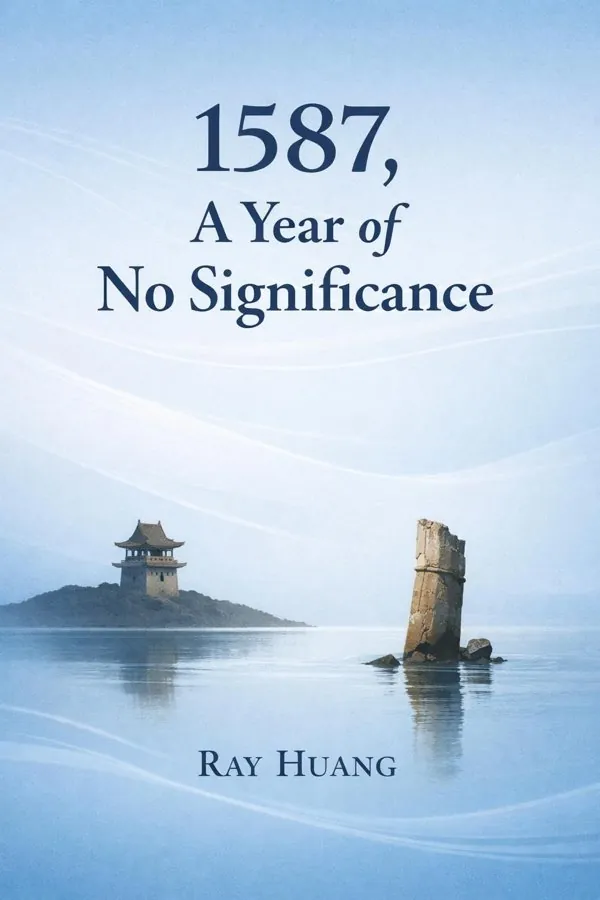
1587, A Year of No Significance: Summary & Key Insights
by Ray Huang
 10 min9 chaptersAudio available
Key Takeaways from 1587, A Year of No Significance
Sometimes the most damaging political decision is not a reckless action but a long withdrawal.
A brilliant reformer can strengthen a state, but if reform depends too heavily on one extraordinary person, it may collapse as soon as he is gone.
Integrity is admirable, but Huang asks a disturbing question: what happens when moral purity cannot be translated into effective governance?
States often fail when they celebrate civil virtue while neglecting the practical foundations of security.
In rigid systems, moderation can look like weakness even when it is the last available form of governance.
What Is 1587, A Year of No Significance About?
1587, A Year of No Significance by Ray Huang is a chinese_history book spanning 9 pages. Ray Huang’s 1587, A Year of No Significance is one of the most influential works of modern Chinese history because it turns an apparently uneventful year into a lens for understanding the long decline of the Ming dynasty. Rather than recounting wars, rebellions, or dramatic turning points, Huang asks a more difficult question: what if empires often decay not through sudden catastrophe, but through administrative paralysis, moral rigidity, and institutional fatigue? By focusing on several emblematic figures in and around the year 1587—the Wanli Emperor, reformer Zhang Juzheng, the upright official Hai Rui, the general Qi Jiguang, the cautious statesman Shen Shixing, and the iconoclastic thinker Li Zhi—he reveals a political order unable to adapt to changing realities. Huang’s great strength lies in his “macro-history” approach, which connects personal careers to deeper structural forces such as bureaucracy, Confucian ideology, fiscal weakness, and the mismatch between moral ideals and practical governance. The result is a brilliant, accessible study that explains not only late Ming stagnation, but also how large institutions can fail while appearing outwardly stable.
This FizzRead summary covers all 9 key chapters of 1587, A Year of No Significance in approximately 10 minutes, distilling the most important ideas, arguments, and takeaways from Ray Huang's work. Also available as an audio summary and Key Quotes Podcast.
1587, A Year of No Significance
Ray Huang’s 1587, A Year of No Significance is one of the most influential works of modern Chinese history because it turns an apparently uneventful year into a lens for understanding the long decline of the Ming dynasty. Rather than recounting wars, rebellions, or dramatic turning points, Huang asks a more difficult question: what if empires often decay not through sudden catastrophe, but through administrative paralysis, moral rigidity, and institutional fatigue? By focusing on several emblematic figures in and around the year 1587—the Wanli Emperor, reformer Zhang Juzheng, the upright official Hai Rui, the general Qi Jiguang, the cautious statesman Shen Shixing, and the iconoclastic thinker Li Zhi—he reveals a political order unable to adapt to changing realities. Huang’s great strength lies in his “macro-history” approach, which connects personal careers to deeper structural forces such as bureaucracy, Confucian ideology, fiscal weakness, and the mismatch between moral ideals and practical governance. The result is a brilliant, accessible study that explains not only late Ming stagnation, but also how large institutions can fail while appearing outwardly stable.
Who Should Read 1587, A Year of No Significance?
This book is perfect for anyone interested in chinese_history and looking to gain actionable insights in a short read. Whether you're a student, professional, or lifelong learner, the key ideas from 1587, A Year of No Significance by Ray Huang will help you think differently.
- ✓Readers who enjoy chinese_history and want practical takeaways
- ✓Professionals looking to apply new ideas to their work and life
- ✓Anyone who wants the core insights of 1587, A Year of No Significance in just 10 minutes
Want the full summary?
Get instant access to this book summary and 100K+ more with Fizz Moment.
Get Free SummaryAvailable on App Store • Free to download
Key Chapters
Sometimes the most damaging political decision is not a reckless action but a long withdrawal. In Huang’s account, the Wanli Emperor illustrates how an empire can be undermined when its ruler stops actively participating in governance, even while remaining formally supreme. Early in his reign, Wanli benefited from capable guidance and appeared positioned to become an effective monarch. Yet over time, he grew frustrated with the moralizing pressures of the bureaucracy, especially the constant memorials and ritual disputes that constrained his freedom. Instead of confronting the system directly, he increasingly disengaged.
This withdrawal did not abolish the Ming state. Officials still filed reports, institutions still functioned, ceremonies still occurred, and taxes were still collected. But the center of decision-making became hollow. Critical appointments were delayed, policy drifted, and bureaucratic routine replaced strategic direction. Huang’s point is subtle: the emperor’s inactivity was not merely a personal flaw; it exposed a system so dependent on symbolic authority and ritual consensus that it could not function well when that authority became passive.
The Wanli Emperor also shows the limits of a political order built more on moral expectations than on clear mechanisms for resolving deadlock. When emperor and officials no longer trusted one another, the system produced paralysis instead of adaptation. In modern terms, this resembles organizations where a CEO stops making decisions, yet no one has legitimate authority to move major initiatives forward.
A practical application is to look beyond whether institutions appear stable on paper. Ask whether decisions are actually being made, whether leadership is engaged, and whether conflict can be resolved constructively. Actionable takeaway: if you lead a team or institution, remember that disengagement creates a vacuum that routine cannot fill.
A brilliant reformer can strengthen a state, but if reform depends too heavily on one extraordinary person, it may collapse as soon as he is gone. Huang presents Grand Secretary Zhang Juzheng as the Ming dynasty’s last serious attempt at disciplined, practical governance. Zhang pushed administrative centralization, fiscal rationalization, and stricter accountability. He sought to make officials actually perform their duties rather than merely speak the language of moral virtue. Under his leadership, the court regained a degree of order and effectiveness.
Yet Zhang’s achievement carried a hidden weakness. His reforms worked partly because of his personal authority, political skill, and ability to compel obedience. They did not fully transform the deeper culture of the bureaucracy, which remained suspicious of concentration of power and attached to idealized Confucian norms. After Zhang’s death, he was attacked, disgraced, and stripped of honor. The speed of this reversal reveals how fragile reform becomes when institutions have not internalized its logic.
Huang is not portraying Zhang as a flawless hero. His severity, centralization, and use of power created enemies. But that is precisely the point: in a system that rewarded moral posturing more than measurable administrative success, even effective reform could be condemned as illegitimate. This tension between practical statecraft and moral orthodoxy runs throughout the book.
The lesson applies broadly. Companies, governments, and nonprofits often praise innovation while quietly resisting structural change. A charismatic reformer may temporarily improve performance, but unless incentives, processes, and culture also change, the old habits return. Think of a school improved by one exceptional principal, only to decline after that person leaves.
Actionable takeaway: when implementing reform, build durable systems, not just personal authority—otherwise success will vanish with the reformer.
Integrity is admirable, but Huang asks a disturbing question: what happens when moral purity cannot be translated into effective governance? Hai Rui, one of late imperial China’s most celebrated upright officials, stands for incorruptibility, courage, and devotion to principle. He criticized abuses, defended the common people, and became a lasting symbol of honest administration. Yet in Huang’s treatment, Hai Rui is not simply praised. He is used to explore the gap between moral heroism and institutional problem-solving.
Hai Rui’s style embodied the Confucian ideal of the official who remonstrates against injustice regardless of personal cost. Such figures were morally powerful because they held rulers and colleagues accountable. But they were often less successful at designing durable solutions to structural problems like taxation, military financing, bureaucratic incentives, and administrative overload. An official might expose wrongdoing and still leave the machinery of government fundamentally unchanged.
This does not diminish Hai Rui’s importance. Rather, it shows the limitations of a political culture that elevated virtue above technique. In a complex empire, good intentions and incorruptible character were not enough. The state needed systems, metrics, legal clarity, and operational flexibility. Huang’s insight is that late Ming institutions often confused ethical posture with practical capacity.
Modern readers can recognize this pattern in public life and workplaces. An employee may be respected for honesty and courage while lacking the managerial tools to fix deep-rooted dysfunction. A politician may campaign on integrity but struggle to implement policy. Character matters immensely, but administration requires more than character alone.
A useful application is to pair ethics with competence. When evaluating leaders, ask not only whether they are principled, but whether they can design institutions that work under pressure. Actionable takeaway: admire moral courage, but do not mistake moral symbolism for an adequate solution to structural problems.
States often fail when they celebrate civil virtue while neglecting the practical foundations of security. General Qi Jiguang, famous for his military effectiveness, represents in Huang’s narrative a world of competence that the Ming political culture never fully knew how to honor. Qi achieved results through discipline, training, organization, and realism. He understood that military strength is not produced by slogans or ritual hierarchy, but by logistics, leadership, and adaptable methods.
Yet the late Ming order was deeply uncomfortable with giving sustained prestige to military professionalism. Civil officials and Confucian orthodoxy occupied the moral high ground, while military affairs were often treated as secondary, even suspect. This imbalance mattered enormously. An empire facing internal weakness and external pressure could not afford to underinvest in defense or to treat military administration as an inferior domain.
Qi’s career also reveals the dependence of practical success on political sponsorship. His effectiveness was tied to support from figures like Zhang Juzheng. Once that support weakened, his position became more vulnerable. This demonstrates a recurring theme in the book: talent could exist within the system, but the system lacked reliable ways to protect and reproduce it.
The broader lesson applies to any organization that prizes abstract values while overlooking operational competence. A hospital may emphasize mission statements while underfunding staffing systems. A business may celebrate vision while neglecting supply chains and frontline training. Symbolic prestige often goes to visible or intellectually fashionable roles, while essential but less glamorous functions are ignored.
Huang invites readers to take practical capacity seriously. Security, whether military, financial, or organizational, depends on institutions that support expertise over image. Actionable takeaway: identify the unglamorous capabilities your organization relies on, and strengthen them before a crisis exposes their neglect.
In rigid systems, moderation can look like weakness even when it is the last available form of governance. Scholar-official Shen Shixing appears in Huang’s book as a careful, conciliatory statesman trying to preserve workable politics in an environment dominated by faction, ritual disputes, and moral absolutism. He was not a dramatic reformer or a heroic dissenter. Instead, he tried to keep the machinery of government moving by balancing interests and softening conflicts.
This made him both necessary and vulnerable. In an idealized political culture, compromise is easily portrayed as opportunism. Yet Huang shows that late Ming governance increasingly depended on exactly this sort of quiet mediation because the system lacked more robust mechanisms for negotiation and coordination. Shen’s career reveals how officials who pursued practical accommodation could be undermined by those who claimed superior moral clarity.
The tragedy is that compromise without institutional reform rarely solves underlying problems. It postpones breakdown rather than preventing it. Shen could ease tensions, but he could not transform the basic mismatch between the empire’s ceremonial-political framework and the administrative demands of a vast, changing society. His moderation kept the state afloat, but only temporarily.
This pattern remains familiar. In companies, universities, and governments, some leaders serve mainly as stabilizers. They reduce conflict, maintain coalitions, and prevent small disputes from becoming disasters. Their work is often invisible because success looks like the absence of crisis. But when compromise becomes a substitute for structural change, deeper weaknesses continue to accumulate.
A practical application is to respect the value of political and organizational mediation while recognizing its limits. Consensus is useful, but not if it merely papers over dysfunction. Actionable takeaway: use compromise to create space for reform, not to avoid reform indefinitely.
When a society cannot question its dominant ideas, intellectual dissent becomes a warning sign of deeper institutional strain. Philosopher Li Zhi occupies a special place in Huang’s narrative because he embodied criticism of rigid orthodoxy at a time when official ideology still claimed unquestioned legitimacy. Li challenged conventional moral assumptions, resisted empty formalism, and emphasized authenticity over conformity. His life and thought suggest that late Ming culture contained growing tensions between lived reality and sanctioned doctrine.
Huang does not treat Li Zhi merely as an eccentric thinker. He represents a larger problem: the moral language of the state had become increasingly disconnected from the complexities of social and political life. Confucian ideals remained powerful, but their institutional use often encouraged performance rather than honest engagement with reality. In such a climate, dissent could appear scandalous not because it was false, but because it threatened the forms that sustained elite legitimacy.
Li Zhi’s importance extends beyond intellectual history. He helps explain why the Ming system struggled to adapt. If innovation is filtered through rigid orthodoxy, unconventional insight is easily marginalized. The culture becomes better at preserving approved language than at solving emerging problems. This is as true in modern organizations as in imperial courts. Teams that punish candid criticism often become trapped in self-deception.
A practical example is workplace culture. If employees feel safer repeating approved narratives than reporting what is actually failing, leaders lose access to reality. Innovation declines, and small problems become structural threats. Healthy institutions need room for respectful dissent, uncomfortable questions, and nonconforming perspectives.
Actionable takeaway: build environments where truth matters more than ideological or cultural performance; dissent, when thoughtful, is often a form of institutional self-preservation.
A sophisticated bureaucracy can create order, but it can also become so governed by procedure and moral language that it loses the ability to resolve real problems. Huang’s examination of the Ming administrative system is one of the book’s central achievements. The empire had an elaborate structure of offices, memorials, examinations, censorship, and hierarchical reporting. On the surface, this looked like an impressive mechanism for governing a vast realm. In practice, however, the system often encouraged caution, formalism, and symbolic correctness over timely decision-making.
Officials were trained to master classical learning and moral reasoning. Those skills gave the state a shared elite culture, but they did not automatically produce administrative flexibility. Many questions became trapped in ritualized argument. The emperor could not easily ignore the bureaucracy without undermining legitimacy, while officials could criticize policy without assuming clear responsibility for outcomes. This led to deadlock, delay, and fragmentation.
Huang’s larger point is that institutions can fail not because they lack rules, but because they have too many rules disconnected from operational reality. Bureaucracy becomes especially brittle when procedure substitutes for strategy. Modern readers will recognize the pattern in organizations where approvals multiply, accountability diffuses, and everyone follows process while obvious problems remain unsolved.
Consider a public agency that requires endless sign-offs, making urgent action nearly impossible, or a corporation where meetings and reporting dashboards proliferate while frontline issues worsen. The appearance of order masks a loss of responsiveness.
The practical lesson is not that bureaucracy is bad; large systems need procedures. The lesson is that procedure must serve outcomes, not replace them. Actionable takeaway: regularly audit your processes and ask a hard question—does this rule help us solve problems, or merely help us appear responsible?
Empires rarely decline from politics alone; beneath institutional tensions lie material pressures that make adaptation urgent. Huang places the Ming state within a wider economic and social context marked by commercialization, population growth, changing local power structures, and fiscal strain. The world of late sixteenth-century China was not static. Markets were expanding, silver was reshaping monetary life, and society was becoming more complex than the administrative assumptions inherited from earlier periods.
The problem was that the political system did not adjust smoothly to these transformations. Tax structures, administrative habits, and elite expectations remained tied to older frameworks. Local society became more dynamic, but central institutions remained morally conservative and organizationally rigid. This mismatch increased pressure on officials and widened the gap between formal governance and lived realities.
Huang’s analysis helps explain why seemingly minor political disputes mattered so much. A fiscally stretched and administratively overloaded state has less margin for indecision. Ritual conflict, personnel delays, and bureaucratic caution become more dangerous when the social and economic environment is already changing rapidly. What looks like drift at the top can translate into fragility across the whole system.
This insight is highly relevant today. Institutions often fail to update their rules when external conditions shift. A business may keep a pricing model suited to an old market. A government may use outdated regulations in a transformed economy. The result is not immediate collapse, but mounting friction, inefficiency, and resentment.
The practical application is to connect policy and administration to real material conditions. Ideals matter, but they must be tested against changing environments. Actionable takeaway: whenever a system seems stuck, examine whether its rules still fit the social and economic world it is trying to govern.
The deepest insight of Huang’s book is that history is not made only by dramatic events; sometimes the most revealing year is one in which almost nothing obvious happens. The title 1587, A Year of No Significance is deliberately ironic. Huang uses this seemingly ordinary year to show that decline often appears first as stagnation, contradiction, and inability to act. By focusing on representative individuals and recurring institutional patterns, he develops what he calls a macro-historical interpretation: the idea that personal stories make sense only when placed within larger structures of culture, administration, and historical development.
This method is what makes the book so enduring. Instead of treating history as a sequence of isolated episodes, Huang asks readers to look for long-term patterns. Why did capable people fail? Why did reform not endure? Why did a morally sophisticated bureaucracy struggle to govern effectively? Why could an apparently stable order not adapt? The answers lie not in villainy or accident alone, but in systemic design.
Macro-history also gives readers a tool for interpreting the present. In modern life, we often overreact to headlines while ignoring slow-moving structural problems: institutional mistrust, incentive misalignment, demographic change, technological disruption, or cultural rigidity. Huang teaches us to read surface calm more critically. A quiet year may conceal an exhausted system.
As a practical habit, this means asking bigger questions whenever a problem appears recurring or strangely resistant to solution. Instead of blaming a single leader or event, examine incentives, norms, and organizational structure. Actionable takeaway: learn to see “insignificant” moments as clues to deeper patterns—small symptoms often reveal the true condition of a system.
All Chapters in 1587, A Year of No Significance
About the Author
Ray Huang (1918–2000) was a Chinese-American historian whose work reshaped how many readers understand imperial China. Born in Changsha, Hunan, he lived through war and political upheaval before eventually pursuing historical scholarship in the United States. He later taught at the State University of New York and became known for his “macro-history” approach, which emphasized long-term institutional patterns over isolated events. Rather than treating history as a chain of personalities and dates, Huang examined administration, finance, social change, and political culture as interconnected systems. His most famous books include 1587, A Year of No Significance and China: A Macro History. Clear, analytical, and ambitious, his writing helped bring Chinese history to a broad English-speaking audience while offering fresh insight into how states function and decline.
Get This Summary in Your Preferred Format
Read or listen to the 1587, A Year of No Significance summary by Ray Huang anytime, anywhere. FizzRead offers multiple formats so you can learn on your terms — all free.
Available formats: App · Audio · PDF · EPUB — All included free with FizzRead
Download 1587, A Year of No Significance PDF and EPUB Summary
Key Quotes from 1587, A Year of No Significance
“Sometimes the most damaging political decision is not a reckless action but a long withdrawal.”
“A brilliant reformer can strengthen a state, but if reform depends too heavily on one extraordinary person, it may collapse as soon as he is gone.”
“Integrity is admirable, but Huang asks a disturbing question: what happens when moral purity cannot be translated into effective governance?”
“States often fail when they celebrate civil virtue while neglecting the practical foundations of security.”
“In rigid systems, moderation can look like weakness even when it is the last available form of governance.”
Frequently Asked Questions about 1587, A Year of No Significance
1587, A Year of No Significance by Ray Huang is a chinese_history book that explores key ideas across 9 chapters. Ray Huang’s 1587, A Year of No Significance is one of the most influential works of modern Chinese history because it turns an apparently uneventful year into a lens for understanding the long decline of the Ming dynasty. Rather than recounting wars, rebellions, or dramatic turning points, Huang asks a more difficult question: what if empires often decay not through sudden catastrophe, but through administrative paralysis, moral rigidity, and institutional fatigue? By focusing on several emblematic figures in and around the year 1587—the Wanli Emperor, reformer Zhang Juzheng, the upright official Hai Rui, the general Qi Jiguang, the cautious statesman Shen Shixing, and the iconoclastic thinker Li Zhi—he reveals a political order unable to adapt to changing realities. Huang’s great strength lies in his “macro-history” approach, which connects personal careers to deeper structural forces such as bureaucracy, Confucian ideology, fiscal weakness, and the mismatch between moral ideals and practical governance. The result is a brilliant, accessible study that explains not only late Ming stagnation, but also how large institutions can fail while appearing outwardly stable.
You Might Also Like
A Brief History of the Song Dynasty (Chinese Edition)
Chen Zhen
10 min
Comprehensive Mirror to Aid in Government (Zizhi Tongjian)
Sima Guang
10 min
General History of China (Chinese Edition)
Lü Simian
10 min
Modern History of China (Chinese Edition)
Li Kan
10 min
Records of the Grand Historian (Chinese Edition)
Sima Qian
10 min
Romance of the Three Kingdoms
Luo Guanzhong
10 minBrowse by Category
Ready to read 1587, A Year of No Significance?
Get the full summary and 100K+ more books with Fizz Moment.