
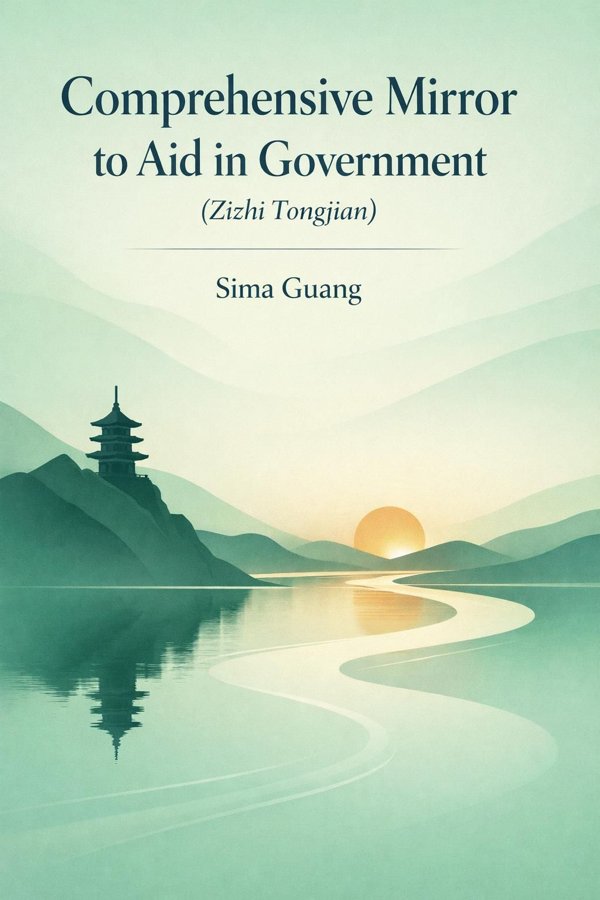
Comprehensive Mirror to Aid in Government (Zizhi Tongjian): Summary & Key Insights
by Sima Guang
 10 min8 chaptersAudio available
Key Takeaways from Comprehensive Mirror to Aid in Government (Zizhi Tongjian)
The most powerful use of history is not to admire the dead, but to warn the living.
How a story is arranged determines what we learn from it.
Institutions matter, but the character of those who occupy them matters just as much.
A ruler’s greatest danger is not ignorance, but isolation from truth.
Battles may be fought on frontiers, but their outcomes are often decided in the capital long before armies move.
What Is Comprehensive Mirror to Aid in Government (Zizhi Tongjian) About?
Comprehensive Mirror to Aid in Government (Zizhi Tongjian) by Sima Guang is a chinese_history book spanning 7 pages. Some histories preserve the past; others are written to shape the future. Comprehensive Mirror to Aid in Government (Zizhi Tongjian) belongs firmly to the second kind. Compiled by the Northern Song statesman and historian Sima Guang, this vast chronicle recounts 1,362 years of Chinese history, from 403 BCE to 959 CE, in strict chronological order. Rather than celebrating dynasties in isolation, it follows the flow of events across centuries, showing how ambition, reform, war, taxation, succession, and court intrigue repeatedly determined the fate of states. Sima Guang’s purpose was practical. He believed rulers and officials could govern better by studying how earlier leaders succeeded or failed. The book therefore functions as both historical record and political manual. It reveals patterns: strong institutions outlast charismatic individuals, moral decay weakens even wealthy regimes, and poor judgment at the top quickly spreads disaster below. Sima Guang wrote with unusual authority. He was not only a scholar but also a senior Song official deeply involved in public affairs. His combination of political experience, moral seriousness, and mastery of historical sources made Zizhi Tongjian one of the most influential works in Chinese historiography—and an enduring guide to leadership, statecraft, and human nature.
This FizzRead summary covers all 8 key chapters of Comprehensive Mirror to Aid in Government (Zizhi Tongjian) in approximately 10 minutes, distilling the most important ideas, arguments, and takeaways from Sima Guang's work. Also available as an audio summary and Key Quotes Podcast.
Comprehensive Mirror to Aid in Government (Zizhi Tongjian)
Some histories preserve the past; others are written to shape the future. Comprehensive Mirror to Aid in Government (Zizhi Tongjian) belongs firmly to the second kind. Compiled by the Northern Song statesman and historian Sima Guang, this vast chronicle recounts 1,362 years of Chinese history, from 403 BCE to 959 CE, in strict chronological order. Rather than celebrating dynasties in isolation, it follows the flow of events across centuries, showing how ambition, reform, war, taxation, succession, and court intrigue repeatedly determined the fate of states.
Sima Guang’s purpose was practical. He believed rulers and officials could govern better by studying how earlier leaders succeeded or failed. The book therefore functions as both historical record and political manual. It reveals patterns: strong institutions outlast charismatic individuals, moral decay weakens even wealthy regimes, and poor judgment at the top quickly spreads disaster below.
Sima Guang wrote with unusual authority. He was not only a scholar but also a senior Song official deeply involved in public affairs. His combination of political experience, moral seriousness, and mastery of historical sources made Zizhi Tongjian one of the most influential works in Chinese historiography—and an enduring guide to leadership, statecraft, and human nature.
Who Should Read Comprehensive Mirror to Aid in Government (Zizhi Tongjian)?
This book is perfect for anyone interested in chinese_history and looking to gain actionable insights in a short read. Whether you're a student, professional, or lifelong learner, the key ideas from Comprehensive Mirror to Aid in Government (Zizhi Tongjian) by Sima Guang will help you think differently.
- ✓Readers who enjoy chinese_history and want practical takeaways
- ✓Professionals looking to apply new ideas to their work and life
- ✓Anyone who wants the core insights of Comprehensive Mirror to Aid in Government (Zizhi Tongjian) in just 10 minutes
Want the full summary?
Get instant access to this book summary and 100K+ more with Fizz Moment.
Get Free SummaryAvailable on App Store • Free to download
Key Chapters
The most powerful use of history is not to admire the dead, but to warn the living. That conviction lies at the heart of Zizhi Tongjian. Sima Guang did not compile this enormous work simply to preserve facts or entertain curious readers. He assembled it as a “mirror” for rulers, ministers, and officials—something they could look into and see the likely consequences of their own choices.
The central idea is straightforward: governance follows patterns. When rulers ignore competent advice, indulge favorites, overtax the people, mishandle succession, or pursue reckless wars, decline follows. When they appoint capable ministers, discipline the court, preserve fiscal balance, and act with restraint, stability becomes possible. Sima Guang’s chronicle demonstrates these patterns repeatedly across more than a millennium, making history function like a long-range laboratory of political cause and effect.
This concept remains practical today. Modern leaders in business, government, and institutions also face recurring problems: how to choose trustworthy deputies, when to reform too quickly or too slowly, how to balance idealism with realism, and how to distinguish short-term success from long-term strength. A manager studying failed dynasties may recognize the danger of promoting loyal flatterers over competent critics. A public servant may see how disorder often begins with small compromises in procedure and accountability.
Sima Guang’s great insight is that hindsight can become foresight if one studies seriously enough. The book teaches readers to ask not only, “What happened?” but also, “What chain of decisions made it happen?”
Actionable takeaway: When making an important decision, identify a historical or past example with similar pressures, then ask what early choices led to success or failure before choosing your next step.
How a story is arranged determines what we learn from it. One of Sima Guang’s boldest decisions was to organize history chronologically rather than by separate dynastic biographies. This matters enormously. By placing events in sequence year by year, Zizhi Tongjian allows readers to see how one action triggers another across regions, courts, and generations.
In traditional annals or biographical histories, a reader may understand a person or reign in isolation. In Sima Guang’s structure, the interconnectedness of events becomes clearer. A frontier revolt affects tax collection. Fiscal strain weakens military supply. Military weakness emboldens rivals. Court panic encourages factional struggle. A succession dispute then turns a temporary crisis into dynastic collapse. Chronology turns history from a collection of episodes into a visible chain of causation.
This method is useful far beyond ancient China. In modern organizations, problems also look isolated until arranged in sequence. A drop in morale may appear sudden, but a chronological review might reveal a hiring freeze, poor communication, delayed promotions, and leadership inconsistency leading up to it. In public policy, inflation, unrest, or institutional distrust rarely emerge from a single cause. They develop through linked decisions over time.
Sima Guang’s arrangement also disciplines the reader. It discourages simplistic moralizing by showing that outcomes usually emerge from cumulative pressures, not one dramatic turning point alone. Leaders fail gradually before they fail spectacularly.
The book’s chronology teaches a habit of mind: map events in order before judging them. This reduces emotional reactions and sharpens strategic understanding.
Actionable takeaway: When analyzing any major problem, build a timeline first. List the critical decisions, warnings, delays, and turning points in sequence before trying to assign blame or design a solution.
Institutions matter, but the character of those who occupy them matters just as much. Across Zizhi Tongjian, Sima Guang repeatedly shows that the personal qualities of rulers and ministers—self-restraint, greed, courage, vanity, diligence, or paranoia—can determine whether a state remains stable or drifts toward ruin.
A talented but impulsive ruler may win battles and still destroy long-term order. A cautious and morally serious minister may avert disaster simply by speaking honestly at the right moment. Court politics in the chronicle often hinge less on formal law than on temperament: whether an emperor can accept criticism, whether a general can resist ambition, whether a minister values the state above faction, whether a regent can govern without clinging to private power.
This is one reason the book endures. It understands politics as human drama rather than abstract administration. The same office produces different results depending on the person holding it. Sima Guang never suggests that virtue alone guarantees success, but he does insist that vice, especially when combined with power, magnifies risk. Moral weakness at the top spreads confusion below.
Readers today can apply this lesson in hiring, promotion, and trust. Resume strength and technical ability matter, but so do judgment, emotional discipline, and receptiveness to dissent. A brilliant executive who cannot hear unwelcome truths may damage an organization more than a less gifted but steadier leader. Families, companies, and governments all suffer when character is treated as secondary.
Sima Guang’s subtle point is that leadership failure often begins in private habits before becoming public catastrophe. Arrogance precedes isolation; isolation precedes bad decisions.
Actionable takeaway: Evaluate leaders not only by results, but by patterns of behavior—how they handle criticism, temptation, pressure, and responsibility when no immediate reward is at stake.
A ruler’s greatest danger is not ignorance, but isolation from truth. Again and again, Zizhi Tongjian shows that states decline when leaders surround themselves with agreeable voices and punish frank advice. By contrast, periods of strength often depend on ministers willing to speak plainly, even at personal risk.
Sima Guang pays close attention to remonstrance—the practice of advising, correcting, or warning a ruler. In his historical world, honest counsel is not a decorative moral ideal; it is a survival mechanism. Courts become unstable when sovereigns promote flatterers, eunuchs, favorites, or factional allies over competent officials. Bad news is delayed, distortions multiply, and policy becomes detached from reality. Once that happens, even intelligent rulers may act blindly because the information reaching them has already been filtered by fear and ambition.
This insight has modern relevance. In companies, boards, universities, and governments, senior decision-makers often receive polished reports rather than inconvenient truths. Teams learn quickly whether honesty is rewarded or punished. If dissent carries career risk, people become silent, and silence creates strategic blindness. Many institutional crises are not caused by a total lack of knowledge, but by a culture that prevents knowledge from traveling upward.
Sima Guang also suggests that hearing criticism is a discipline, not a talent. Leaders must actively create channels for objection, protect candid advisers, and distinguish loyalty from flattery. The strongest rulers in his chronicle are rarely those who never err; they are those who can still correct course because someone dares to tell them the truth.
Actionable takeaway: Build one formal habit for honest feedback—such as a designated critic in meetings or anonymous reporting—and reward useful dissent before a crisis tests whether truth can still reach leadership.
Battles may be fought on frontiers, but their outcomes are often decided in the capital long before armies move. One of the recurring lessons of Zizhi Tongjian is that military success depends on political coherence, logistical preparation, fiscal stability, and credible leadership. War is never just about generals and weapons; it is a test of the entire governing system.
Sima Guang records campaigns, rebellions, and interstate struggles in detail, yet he consistently ties battlefield outcomes to prior administrative conditions. Armies collapse when supply systems fail, when commanders are chosen for favoritism rather than competence, when exhausted populations resent the state, or when courts interfere impulsively from afar. Conversely, even weaker states can survive when leadership is disciplined, goals are realistic, and resources are managed carefully.
The chronicle also warns against aggression driven by vanity. Rulers often launch ambitious campaigns to display glory, distract from domestic problems, or imitate past conquerors. Such wars may produce early victories but strain treasuries, deepen unrest, and expose institutional weakness. Sima Guang treats reckless militarism as a form of political delusion: the desire to appear strong can become the fastest route to becoming weak.
Modern leaders can apply this lesson beyond literal warfare. A major corporate acquisition, legal showdown, or rapid expansion resembles a campaign. Success depends not on bravado but on supply lines, team alignment, morale, realistic timelines, and fallback plans. Dramatic moves reveal whether the organization beneath them is sound.
The deeper message is that crisis does not create character; it reveals existing strengths and weaknesses. By the time a state is at war, many decisive errors have already been made.
Actionable takeaway: Before pursuing any high-risk initiative, test your logistical foundation—resources, chain of command, information flow, and public or team support—rather than relying on ambition alone.
Most regimes do not fall in a single day; they decay through tolerated patterns. Zizhi Tongjian is especially valuable because it shows decline as a process rather than a surprise. Corruption, tax burdens, palace intrigue, succession disputes, military overreach, and local disaffection often accumulate for years before the final collapse makes them visible to everyone.
Sima Guang’s long historical canvas allows readers to watch this slow erosion. A court grows indulgent. Talented ministers withdraw or are pushed aside. Fiscal mismanagement intensifies. Regional commanders gain autonomous power. The central government responds too late, and what once looked like isolated weakness reveals itself as systemic fragility. The end, when it comes, seems sudden only to those who ignored the signs.
This way of reading history is highly practical. Organizations rarely disintegrate from one bad quarter or one failed project alone. Instead, warning indicators appear early: declining standards, political infighting, blurred accountability, delayed decisions, and rising cynicism among capable people. Families, institutions, and governments all share this vulnerability. Small tolerated disorders become normal, then structural.
Sima Guang’s achievement is to train the reader’s eye for early signals. He teaches that the health of a state can often be judged before obvious disaster appears. A stable regime is not simply one that has not yet fallen; it is one whose institutions still correct errors faster than they produce them.
The lesson also encourages humility. Wealth, prestige, and long tradition cannot save a system that has stopped governing itself well. Past greatness often delays reform because it creates complacency.
Actionable takeaway: Identify three “small” recurring dysfunctions in your organization or personal system and treat them as strategic warnings, not minor annoyances, before they harden into permanent decline.
Force can seize a throne, but it cannot by itself secure durable rule. Throughout Zizhi Tongjian, Sima Guang distinguishes between bare possession of power and genuine political legitimacy. A regime survives not only by defeating rivals, but by convincing officials, soldiers, and ordinary people that its authority is justified, orderly, and preferable to chaos.
Legitimacy in the chronicle is built from several elements: proper succession, ritual propriety, just administration, competent governance, and the ability to maintain social order without constant coercion. Usurpers, regents, and military strongmen may control armies, but if they cannot stabilize institutions or command broad confidence, their victories remain fragile. Even successful founders must transform force into recognized rule.
This theme helps explain why Sima Guang pays close attention to ceremony, titles, decrees, and political symbolism. These are not empty formalities. They help define who has the right to command and under what principles. When norms are repeatedly broken, even capable rulers invite suspicion and resistance. Political order depends partly on shared belief.
Modern readers can interpret legitimacy in broader terms. In a workplace, a leader may have formal authority but lose legitimacy if promotions seem unfair, rules apply selectively, or decisions lack transparency. In public life, institutions weaken when people no longer believe procedures are trustworthy. Compliance then requires more force, and force further erodes trust.
Sima Guang’s realism is sharp here: morality and effectiveness are intertwined. Stable authority requires both competence and recognized fairness. Power without legitimacy becomes expensive to maintain and easy to challenge.
Actionable takeaway: If you lead others, strengthen legitimacy by making decisions through visible, consistent principles rather than relying only on rank, urgency, or personal influence.
Not every reform is wise simply because change is needed. One of the subtler lessons readers can draw from Zizhi Tongjian is that policies succeed only when they fit the conditions of the time: administrative capacity, political support, economic realities, and social tolerance. Sima Guang respected order and continuity, and his historical writing repeatedly suggests caution toward abrupt or poorly grounded transformation.
Across the centuries he narrates, states often attempt reform under pressure—tax changes, military reorganization, centralization, anti-corruption drives, or legal restructuring. Some measures are necessary, but reforms frequently fail when leaders overestimate what institutions can absorb. Ambitious policies imposed too quickly may provoke factional resistance, implementation errors, and unintended instability. A theoretically sound plan can become disastrous if timing, communication, and local execution are neglected.
This does not mean Sima Guang opposes all change. Rather, he asks whether reform strengthens governance or merely disrupts it. Effective change requires clear priorities, trustworthy administrators, and a realistic understanding of human incentives. It must also preserve enough continuity that the system does not break while being repaired.
This lesson applies directly today. Companies often announce sweeping transformations—new software, reporting structures, incentive systems, or cultural initiatives—without training managers or adjusting workload. Governments pass bold laws without funding enforcement. Schools redesign curricula without teacher support. The result is frustration, cynicism, and backlash.
Sima Guang reminds us that reform is not judged by intention alone, but by durable outcomes. The true reformer is not the loudest innovator, but the one who changes what can be sustained.
Actionable takeaway: Before launching reform, ask three questions: Do we have the capacity to implement it, the support to maintain it, and the patience to adjust it when reality resists the plan?
All Chapters in Comprehensive Mirror to Aid in Government (Zizhi Tongjian)
About the Author
Sima Guang (1019–1086) was one of the most respected historians and statesmen of the Northern Song dynasty. Born into a scholarly family, he rose through the civil service and became a senior official known for his seriousness, integrity, and conservative political outlook. He is especially remembered for opposing Wang Anshi’s reform program, arguing that government change should be cautious, disciplined, and grounded in historical understanding. His greatest achievement was the compilation of Comprehensive Mirror to Aid in Government (Zizhi Tongjian), a vast chronological history completed after roughly nineteen years of labor with a team of assistants. Sima Guang’s blend of political experience and historical scholarship gave his writing unusual authority. He remains a central figure in Chinese historiography, admired for treating history as a practical guide to moral and effective governance.
Get This Summary in Your Preferred Format
Read or listen to the Comprehensive Mirror to Aid in Government (Zizhi Tongjian) summary by Sima Guang anytime, anywhere. FizzRead offers multiple formats so you can learn on your terms — all free.
Available formats: App · Audio · PDF · EPUB — All included free with FizzRead
Download Comprehensive Mirror to Aid in Government (Zizhi Tongjian) PDF and EPUB Summary
Key Quotes from Comprehensive Mirror to Aid in Government (Zizhi Tongjian)
“The most powerful use of history is not to admire the dead, but to warn the living.”
“How a story is arranged determines what we learn from it.”
“Institutions matter, but the character of those who occupy them matters just as much.”
“A ruler’s greatest danger is not ignorance, but isolation from truth.”
“Battles may be fought on frontiers, but their outcomes are often decided in the capital long before armies move.”
Frequently Asked Questions about Comprehensive Mirror to Aid in Government (Zizhi Tongjian)
Comprehensive Mirror to Aid in Government (Zizhi Tongjian) by Sima Guang is a chinese_history book that explores key ideas across 8 chapters. Some histories preserve the past; others are written to shape the future. Comprehensive Mirror to Aid in Government (Zizhi Tongjian) belongs firmly to the second kind. Compiled by the Northern Song statesman and historian Sima Guang, this vast chronicle recounts 1,362 years of Chinese history, from 403 BCE to 959 CE, in strict chronological order. Rather than celebrating dynasties in isolation, it follows the flow of events across centuries, showing how ambition, reform, war, taxation, succession, and court intrigue repeatedly determined the fate of states. Sima Guang’s purpose was practical. He believed rulers and officials could govern better by studying how earlier leaders succeeded or failed. The book therefore functions as both historical record and political manual. It reveals patterns: strong institutions outlast charismatic individuals, moral decay weakens even wealthy regimes, and poor judgment at the top quickly spreads disaster below. Sima Guang wrote with unusual authority. He was not only a scholar but also a senior Song official deeply involved in public affairs. His combination of political experience, moral seriousness, and mastery of historical sources made Zizhi Tongjian one of the most influential works in Chinese historiography—and an enduring guide to leadership, statecraft, and human nature.
You Might Also Like
1587, A Year of No Significance
Ray Huang
10 min
A Brief History of the Song Dynasty (Chinese Edition)
Chen Zhen
10 min
General History of China (Chinese Edition)
Lü Simian
10 min
Modern History of China (Chinese Edition)
Li Kan
10 min
Records of the Grand Historian (Chinese Edition)
Sima Qian
10 min
Romance of the Three Kingdoms
Luo Guanzhong
10 minBrowse by Category
Ready to read Comprehensive Mirror to Aid in Government (Zizhi Tongjian)?
Get the full summary and 100K+ more books with Fizz Moment.