
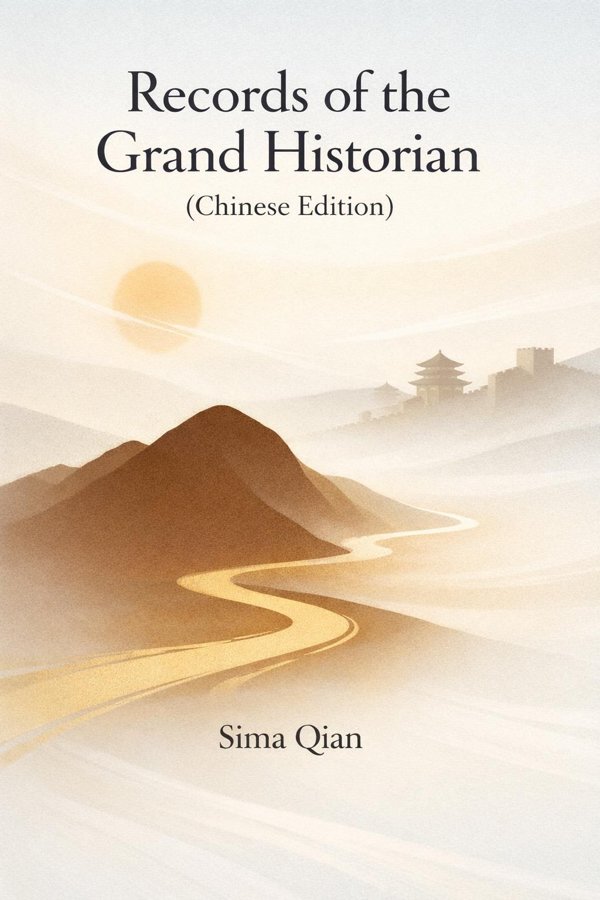
Records of the Grand Historian (Chinese Edition): Summary & Key Insights
by Sima Qian
 10 min9 chaptersAudio available
Key Takeaways from Records of the Grand Historian (Chinese Edition)
A civilization is not explained by dates alone; it is revealed through the motives of the people who shaped it.
The way history is organized shapes what readers are able to understand.
Every ancient civilization begins with memory before it reaches documentation.
Empires do not decline in a single day; they decay through patterns of conduct.
Sometimes the best way to understand an era is through the life of one unforgettable person.
What Is Records of the Grand Historian (Chinese Edition) About?
Records of the Grand Historian (Chinese Edition) by Sima Qian is a chinese_history book spanning 7 pages. Few books have shaped a civilization’s memory as deeply as Records of the Grand Historian. Written by Sima Qian during the Western Han dynasty, this monumental work traces roughly three thousand years of Chinese history, from the legendary Yellow Emperor to the reign of Emperor Wu. Yet it is far more than a list of rulers and events. Across 130 chapters, Sima Qian examines how states rise, how leaders fail, how institutions endure, and how individuals—scholars, generals, merchants, rebels, and courtiers—leave their mark on history. What makes this classic extraordinary is its structure and voice. Sima Qian combines annals, chronological tables, thematic treatises, hereditary houses, and vivid biographies to create a sweeping but human-centered portrait of the past. He writes with moral seriousness, literary power, and unusual psychological depth, showing that history is driven not only by policy and war, but also by ambition, fear, loyalty, and chance. Sima Qian’s authority is inseparable from his life. As Grand Historian of Han, and as a man who endured humiliation to complete his father’s mission, he wrote with urgency, courage, and a profound commitment to truth. This is why his masterpiece remains essential reading for anyone seeking to understand China, power, and the meaning of history itself.
This FizzRead summary covers all 9 key chapters of Records of the Grand Historian (Chinese Edition) in approximately 10 minutes, distilling the most important ideas, arguments, and takeaways from Sima Qian's work. Also available as an audio summary and Key Quotes Podcast.
Records of the Grand Historian (Chinese Edition)
Few books have shaped a civilization’s memory as deeply as Records of the Grand Historian. Written by Sima Qian during the Western Han dynasty, this monumental work traces roughly three thousand years of Chinese history, from the legendary Yellow Emperor to the reign of Emperor Wu. Yet it is far more than a list of rulers and events. Across 130 chapters, Sima Qian examines how states rise, how leaders fail, how institutions endure, and how individuals—scholars, generals, merchants, rebels, and courtiers—leave their mark on history.
What makes this classic extraordinary is its structure and voice. Sima Qian combines annals, chronological tables, thematic treatises, hereditary houses, and vivid biographies to create a sweeping but human-centered portrait of the past. He writes with moral seriousness, literary power, and unusual psychological depth, showing that history is driven not only by policy and war, but also by ambition, fear, loyalty, and chance.
Sima Qian’s authority is inseparable from his life. As Grand Historian of Han, and as a man who endured humiliation to complete his father’s mission, he wrote with urgency, courage, and a profound commitment to truth. This is why his masterpiece remains essential reading for anyone seeking to understand China, power, and the meaning of history itself.
Who Should Read Records of the Grand Historian (Chinese Edition)?
This book is perfect for anyone interested in chinese_history and looking to gain actionable insights in a short read. Whether you're a student, professional, or lifelong learner, the key ideas from Records of the Grand Historian (Chinese Edition) by Sima Qian will help you think differently.
- ✓Readers who enjoy chinese_history and want practical takeaways
- ✓Professionals looking to apply new ideas to their work and life
- ✓Anyone who wants the core insights of Records of the Grand Historian (Chinese Edition) in just 10 minutes
Want the full summary?
Get instant access to this book summary and 100K+ more with Fizz Moment.
Get Free SummaryAvailable on App Store • Free to download
Key Chapters
A civilization is not explained by dates alone; it is revealed through the motives of the people who shaped it. One of the greatest strengths of Records of the Grand Historian is that Sima Qian refuses to reduce history to a dry sequence of reigns, battles, and decrees. Again and again, he asks what rulers desired, what ministers feared, what generals misunderstood, and what common people endured. In his hands, history becomes an inquiry into character.
This approach gives the book unusual depth. A military defeat is not only a tactical event; it may stem from arrogance, bad counsel, or political jealousy. A successful reign is not merely the result of strong laws; it may depend on restraint, timing, and the ability to recognize talent. Sima Qian pays close attention to the inner lives of figures across social classes, reminding readers that historical outcomes often begin as personal choices.
This is one reason the work remains fresh. Modern readers can apply its lessons to organizations, governments, and even family life. When a team fails, the problem may not be external pressure alone, but hidden rivalry or poor judgment. When a leader succeeds, it may be because they understood people, not just procedure. Sima Qian teaches that institutions matter, but human motives animate them.
His biographical method also invites readers to resist simplistic moral labeling. A person may be brave yet vain, loyal yet politically naive, ruthless yet effective. Such complexity makes better historians and wiser citizens because it pushes us to look beneath surfaces.
Actionable takeaway: when evaluating any major event—past or present—ask not only what happened, but what motives, fears, ambitions, and misread incentives drove the people involved.
The way history is organized shapes what readers are able to understand. Sima Qian’s great innovation was not only what he recorded, but how he arranged it. Records of the Grand Historian is divided into five major sections: basic annals, chronological tables, treatises, hereditary houses, and biographies. This structure allows readers to see the past from multiple angles instead of through a single royal narrative.
The annals provide a political backbone through the reigns of rulers. The chronological tables help readers compare events across states and periods, making simultaneous developments visible. The treatises explore major institutions and systems, such as ritual, music, economy, astronomy, and waterways. The hereditary houses show the role of powerful regional lineages and feudal states. The biographies bring the story down to the level of individual lives, often becoming the most memorable part of the work.
This design matters because history is rarely one-dimensional. If we rely only on kings, we miss the role of ministers and social systems. If we focus only on biographies, we lose the broader political framework. Sima Qian creates a layered map of the past, where structure, chronology, ideas, and personalities illuminate one another.
Modern readers can learn from this method in practical ways. A business case study, for example, becomes clearer when examined through timelines, system-level analysis, key actors, and institutional context. A nation’s crisis is better understood when we combine leadership decisions with economic and cultural forces.
Sima Qian’s architecture became the model for later official histories, and for good reason: it respects complexity without surrendering coherence.
Actionable takeaway: when studying any complex subject, organize your understanding through multiple lenses—timeline, systems, institutions, and individual actors—rather than relying on a single narrative.
Every ancient civilization begins with memory before it reaches documentation. One of the fascinating features of Records of the Grand Historian is the way Sima Qian handles the earliest periods of Chinese history, including legendary rulers such as the Yellow Emperor. Rather than dismissing foundational traditions, he preserves them as part of the civilizational story. At the same time, he writes with a historian’s awareness that early materials are fragmentary, inherited, and sometimes uncertain.
This balance is one of the book’s deepest achievements. Founding legends matter because they carry values, identity, and political meaning. They tell later generations what kind of order they believe they come from. Yet Sima Qian also shows that the historian’s task is not blind repetition. His selection, comparison, and arrangement of sources suggest an ongoing effort to discriminate between inherited prestige and plausible record.
For readers today, this approach offers an important lesson. Societies are always built from a mixture of fact, interpretation, and symbolic memory. National stories, family stories, and corporate origin stories all contain elements that are emotionally true, politically useful, or historically uncertain. Wisdom lies in understanding the role each element plays.
In practical terms, this means learning to read foundational narratives with both respect and scrutiny. We do not have to choose between cynicism and credulity. Instead, we can ask: What function does this story serve? What evidence supports it? Why has it endured? Sima Qian models this stance long before modern historiography gave it formal language.
By beginning with legendary antiquity and moving toward documented history, he also shows how civilizations construct continuity across immense stretches of time.
Actionable takeaway: treat origin stories—whether national, organizational, or personal—as meaningful sources of identity, but test them carefully against evidence and context.
Empires do not decline in a single day; they decay through patterns of conduct. Throughout Records of the Grand Historian, Sima Qian repeatedly shows that political success is rarely permanent. Dynasties rise through discipline, strategic intelligence, and moral legitimacy, then weaken through excess, complacency, cruelty, or the inability to hear honest counsel. History in this book is neither random nor mechanically determined. It is shaped by character under pressure.
The transitions between major houses and states are especially revealing. Strong founders often emerge from disorder by combining force with vision. But later generations, inheriting stability they did not create, may become indulgent or detached. Court politics harden. Advisors compete. Rulers confuse fear with authority. Military campaigns become overextended. Public trust erodes. Sima Qian does not preach a simplistic formula, but he makes one principle clear: conduct at the top has consequences far beyond the palace.
This insight remains intensely relevant. In governments, corporations, and institutions, periods of success can hide growing weaknesses. A company that dominates its market may stop listening to criticism. A political movement may mistake loyalty for competence. A family business may decline when heirs inherit status without discipline. Sima Qian’s histories remind us that durability depends on self-correction.
He also illustrates that moral legitimacy and practical effectiveness are linked more often than cynical observers admit. A ruler who punishes arbitrarily may win obedience for a time, but not trust. A leader who rewards talent and restrains ego builds deeper strength.
Actionable takeaway: if you lead any group, regularly ask which habits created your success and which new behaviors might quietly be undermining it before decline becomes visible.
Sometimes the best way to understand an era is through the life of one unforgettable person. The biographical chapters in Records of the Grand Historian are among the most influential in world literature because Sima Qian uses individual stories to reveal entire political and moral worlds. Through generals, assassins, philosophers, ministers, diplomats, wanderers, and merchants, readers encounter history as lived experience rather than abstract chronology.
These biographies are not decorative additions to the main narrative. They are central to Sima Qian’s method. A single life can show how talent is rewarded or wasted, how loyalty collides with survival, how ambition turns destructive, or how integrity can endure humiliation. In many cases, the biography illuminates tensions that official court-centered history would hide. We see how large systems affect real people and how individuals maneuver within constraints.
This makes the book especially powerful for modern readers. We remember a principle more clearly when we see it embodied. A discussion of political centralization becomes vivid when attached to a minister navigating court suspicion. The cost of war becomes real when told through a commander’s fate. Ethical conflict becomes memorable through a man forced to choose between duty and self-preservation.
There is also a practical lesson in how Sima Qian selects details. He understands that revealing moments—a conversation, a refusal, a strategic decision, an act of endurance—often tell us more than official titles. Anyone trying to understand people, from managers to teachers to historians, can benefit from looking for such moments.
Actionable takeaway: when trying to understand a system, study representative lives within it; biographies often expose truths that broad summaries leave invisible.
Great individuals may attract attention, but durable history is built through institutions. One of the reasons Records of the Grand Historian has such lasting value is that it does not focus only on rulers and dramatic personalities. Through its treatises and broader narrative method, it shows how rituals, economic arrangements, calendar systems, waterways, and administrative structures shape the possibilities of political life.
This is a crucial corrective to hero-centered history. A capable ruler may launch reforms, but if taxation is chaotic, transport is inefficient, records are unreliable, or ceremonial order is broken, the state remains fragile. Sima Qian understands that governance depends on invisible frameworks. Music and ritual, for example, are not treated as superficial ornaments; they are part of the moral and social order that stabilizes relations. Economic systems are not background details; they influence military capacity, public welfare, and state resilience.
Readers today can apply this insight directly. When an organization struggles, it is tempting to blame one leader or celebrate one charismatic problem-solver. But many failures are structural: unclear incentives, poor information flow, weak succession planning, or neglected processes. In the same way, many successes owe less to brilliance than to sound systems.
Sima Qian’s work encourages a broader historical literacy: ask not only who held power, but what mechanisms supported or constrained them. This perspective is especially useful for students, policymakers, and business leaders who want to understand why some reforms last and others vanish.
By combining personal narrative with institutional analysis, the book offers a richer explanation of how societies function.
Actionable takeaway: when assessing success or failure, identify the underlying systems—finance, communication, rules, and culture—rather than focusing only on visible personalities.
It is easy to judge the past; it is harder to understand the pressure under which choices were made. One of Sima Qian’s most remarkable qualities is his moral seriousness combined with sympathy. He does not abandon judgment—treachery, vanity, cruelty, and incompetence are clearly visible in his pages—but neither does he flatten historical actors into simple heroes and villains. He often shows how circumstance, status, fear, and conflicting obligations complicate action.
This humane complexity is especially striking in his treatment of disgraced or controversial figures. Rather than repeating official condemnation, he frequently reopens the question: what options did this person truly have? Were they undone by poor judgment, by impossible conditions, by court intrigue, or by the limits of their own character? Such inquiry does not excuse wrongdoing, but it deepens explanation.
For modern readers, this approach has practical ethical value. In workplaces, politics, and public debate, people often rush toward outrage without context. Sima Qian reminds us that wise judgment requires reconstructing constraints. A subordinate may appear disloyal but may have faced contradictory commands. A leader may seem weak but may have inherited impossible circumstances. Understanding context does not erase responsibility; it clarifies it.
This method also helps prevent self-righteousness. By seeing how intelligent, capable, or well-intentioned people became trapped by ambition, fear, or loyalty, we learn humility about our own vulnerability to flawed choices.
Sima Qian’s historical sympathy is one reason his work feels deeply modern. He seeks not merely to condemn or praise, but to understand the human condition in political life.
Actionable takeaway: before passing judgment on a person’s decisions, reconstruct the pressures, incentives, and limits they faced; fair evaluation begins with context.
History is never written in a vacuum; it is written by people who risk something in telling it. The life of Sima Qian gives Records of the Grand Historian unusual moral force. Serving as Grand Historian of Han, he defended General Li Ling after a military disaster and incurred the wrath of Emperor Wu. Rather than choose death, he endured imprisonment and castration, then continued writing in order to complete the historical work inherited from his father and entrusted to his own conscience.
This personal ordeal matters because it illuminates the book’s ethical core. Sima Qian knew that power influences memory. Official narratives can reward obedience, erase complexity, and punish inconvenient truth. His determination to complete the work despite humiliation shows that for him, history was not merely scholarship. It was a form of moral responsibility to the dead, the living, and the future.
Readers today can draw a broader lesson from this. Whether in journalism, academia, public service, or ordinary professional life, truth often carries a cost. People may stay silent to protect status, avoid conflict, or preserve access. Sima Qian’s example does not demand reckless defiance in every situation, but it does ask a hard question: what responsibilities do we owe truth when convenience points elsewhere?
His courage also helps explain the emotional intensity of many biographies in the book. He writes not as a detached compiler, but as someone who understood disgrace, political violence, and the fragile dignity of human reputation.
Actionable takeaway: in your own work, identify one area where honesty is being softened by fear or convenience, and take one concrete step toward a more truthful record.
A people without historical memory becomes vulnerable to manipulation, amnesia, and repetition. Records of the Grand Historian demonstrates that writing history is not only about preserving facts; it is about constructing a durable memory for civilization. By gathering legends, documents, court records, speeches, traditions, and biographies into a coherent narrative, Sima Qian ensured that early China would be remembered as an interconnected historical world rather than a scattered accumulation of local stories.
This achievement has cultural and political significance. Shared memory helps define identity, continuity, and legitimacy. It gives later generations a language for discussing virtue, disorder, reform, and decline. The book became foundational not simply because it recorded events, but because it provided a framework through which Chinese readers could interpret the past and orient themselves in the present.
Modern societies face similar challenges in new forms. Information is abundant, but memory is fragmented. People consume headlines without context, commentary without chronology, and opinion without archival depth. The result can be a shallow public understanding in which every crisis appears unprecedented and every debate lacks historical perspective. Sima Qian’s work is a reminder that memory must be curated, organized, and transmitted if it is to remain meaningful.
This applies on a smaller scale too. Families, institutions, and communities become wiser when they preserve their own histories accurately. Documented memory improves decision-making because it reveals patterns, recurring mistakes, and inherited strengths.
Sima Qian shows that to write history is to protect continuity against oblivion.
Actionable takeaway: begin preserving the memory of your own community or field—through notes, archives, interviews, or timelines—so that future decisions are grounded in remembered experience rather than guesswork.
All Chapters in Records of the Grand Historian (Chinese Edition)
About the Author
Sima Qian (c. 145–86 BCE) was the greatest historian of the Western Han dynasty and one of the most influential writers in Chinese history. The son of Sima Tan, he inherited a scholarly mission to record the past in a comprehensive and meaningful way. As Grand Historian, he worked with court archives, calendrical systems, and state records, giving him exceptional access to historical materials. His life changed dramatically after he defended General Li Ling and was punished by Emperor Wu with imprisonment and castration. Rather than end his life, he chose to endure disgrace so he could complete his masterpiece, Records of the Grand Historian. That work established the model for later dynastic histories and earned him lasting recognition as the Father of Chinese Historiography.
Get This Summary in Your Preferred Format
Read or listen to the Records of the Grand Historian (Chinese Edition) summary by Sima Qian anytime, anywhere. FizzRead offers multiple formats so you can learn on your terms — all free.
Available formats: App · Audio · PDF · EPUB — All included free with FizzRead
Download Records of the Grand Historian (Chinese Edition) PDF and EPUB Summary
Key Quotes from Records of the Grand Historian (Chinese Edition)
“A civilization is not explained by dates alone; it is revealed through the motives of the people who shaped it.”
“The way history is organized shapes what readers are able to understand.”
“Every ancient civilization begins with memory before it reaches documentation.”
“Empires do not decline in a single day; they decay through patterns of conduct.”
“Sometimes the best way to understand an era is through the life of one unforgettable person.”
Frequently Asked Questions about Records of the Grand Historian (Chinese Edition)
Records of the Grand Historian (Chinese Edition) by Sima Qian is a chinese_history book that explores key ideas across 9 chapters. Few books have shaped a civilization’s memory as deeply as Records of the Grand Historian. Written by Sima Qian during the Western Han dynasty, this monumental work traces roughly three thousand years of Chinese history, from the legendary Yellow Emperor to the reign of Emperor Wu. Yet it is far more than a list of rulers and events. Across 130 chapters, Sima Qian examines how states rise, how leaders fail, how institutions endure, and how individuals—scholars, generals, merchants, rebels, and courtiers—leave their mark on history. What makes this classic extraordinary is its structure and voice. Sima Qian combines annals, chronological tables, thematic treatises, hereditary houses, and vivid biographies to create a sweeping but human-centered portrait of the past. He writes with moral seriousness, literary power, and unusual psychological depth, showing that history is driven not only by policy and war, but also by ambition, fear, loyalty, and chance. Sima Qian’s authority is inseparable from his life. As Grand Historian of Han, and as a man who endured humiliation to complete his father’s mission, he wrote with urgency, courage, and a profound commitment to truth. This is why his masterpiece remains essential reading for anyone seeking to understand China, power, and the meaning of history itself.
You Might Also Like
1587, A Year of No Significance
Ray Huang
10 min
A Brief History of the Song Dynasty (Chinese Edition)
Chen Zhen
10 min
Comprehensive Mirror to Aid in Government (Zizhi Tongjian)
Sima Guang
10 min
General History of China (Chinese Edition)
Lü Simian
10 min
Modern History of China (Chinese Edition)
Li Kan
10 min
Romance of the Three Kingdoms
Luo Guanzhong
10 minBrowse by Category
Ready to read Records of the Grand Historian (Chinese Edition)?
Get the full summary and 100K+ more books with Fizz Moment.