
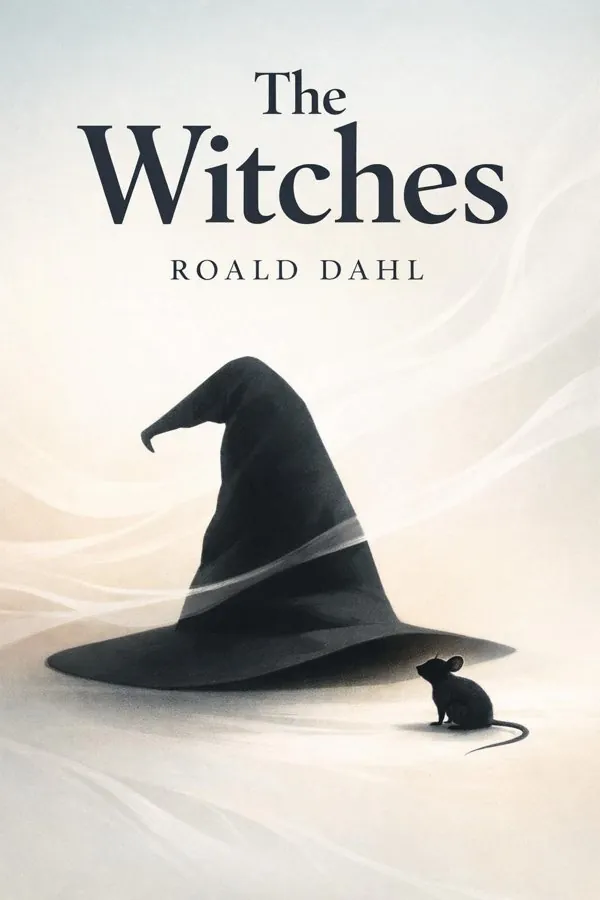
The Witches: Summary & Key Insights
by Roald Dahl
 10 min8 chaptersAudio available
Key Takeaways from The Witches
Fear becomes more manageable when it is given a shape, and that is exactly how The Witches begins.
Some of the strongest stories begin not with adventure, but with grief.
One of the most unsettling ideas in The Witches is that evil does not always announce itself.
True courage often begins by accident, then becomes a choice.
Some stories treat transformation as a loss of self, but The Witches offers a more complex view.
What Is The Witches About?
The Witches by Roald Dahl is a bestsellers book spanning 6 pages. Roald Dahl’s The Witches is a children’s classic that combines fairy-tale imagination with genuine menace, creating a story that is funny, frightening, and deeply memorable. It follows a young boy and his wise, cigar-smoking grandmother as they uncover the existence of real witches—ordinary-looking women who secretly despise children and are plotting to destroy them. What begins as a collection of eerie warnings soon turns into a high-stakes battle against the Grand High Witch herself. Beneath the novel’s playful absurdity lies a powerful story about grief, courage, resourcefulness, and the comfort of unconditional love. Dahl understands better than most writers that children are drawn not only to wonder, but also to danger, and he uses that tension brilliantly. His authority comes from his unmatched ability to speak in a child’s voice while exposing the strange cruelties and comic horrors of the adult world. The Witches endures because it respects young readers enough to scare them, amuse them, and remind them that bravery does not depend on size, strength, or even remaining human.
This FizzRead summary covers all 8 key chapters of The Witches in approximately 10 minutes, distilling the most important ideas, arguments, and takeaways from Roald Dahl's work. Also available as an audio summary and Key Quotes Podcast.
The Witches
Roald Dahl’s The Witches is a children’s classic that combines fairy-tale imagination with genuine menace, creating a story that is funny, frightening, and deeply memorable. It follows a young boy and his wise, cigar-smoking grandmother as they uncover the existence of real witches—ordinary-looking women who secretly despise children and are plotting to destroy them. What begins as a collection of eerie warnings soon turns into a high-stakes battle against the Grand High Witch herself. Beneath the novel’s playful absurdity lies a powerful story about grief, courage, resourcefulness, and the comfort of unconditional love. Dahl understands better than most writers that children are drawn not only to wonder, but also to danger, and he uses that tension brilliantly. His authority comes from his unmatched ability to speak in a child’s voice while exposing the strange cruelties and comic horrors of the adult world. The Witches endures because it respects young readers enough to scare them, amuse them, and remind them that bravery does not depend on size, strength, or even remaining human.
Who Should Read The Witches?
This book is perfect for anyone interested in bestsellers and looking to gain actionable insights in a short read. Whether you're a student, professional, or lifelong learner, the key ideas from The Witches by Roald Dahl will help you think differently.
- ✓Readers who enjoy bestsellers and want practical takeaways
- ✓Professionals looking to apply new ideas to their work and life
- ✓Anyone who wants the core insights of The Witches in just 10 minutes
Want the full summary?
Get instant access to this book summary and 100K+ more with Fizz Moment.
Get Free SummaryAvailable on App Store • Free to download
Key Chapters
Fear becomes more manageable when it is given a shape, and that is exactly how The Witches begins. The boy’s grandmother does not dismiss danger with comforting lies; instead, she teaches him how real witches operate. These are not storybook figures with green faces and broomsticks. They are hidden in plain sight, looking like ordinary women while secretly hating children with obsessive intensity. Her detailed explanations—gloves to hide claws, wigs to cover bald heads, strange noses that detect children by smell—turn vague childhood fear into specific knowledge.
This opening matters because it establishes one of the book’s deepest lessons: understanding a threat is the first step toward surviving it. The grandmother’s stories are terrifying, but they are also practical. She treats the boy as someone capable of learning, not merely someone who must be protected. That respect strengthens their bond and prepares him for what is to come.
In everyday life, the same principle applies. Children and adults alike cope better when they are taught to recognize risk rather than ignore it. Whether the danger is bullying, manipulation, dishonesty, or unhealthy environments, naming what is real helps reduce helplessness. Dahl transforms this idea into fantasy, but the emotional truth is highly recognizable.
The grandmother’s warnings also introduce the novel’s dark humor. Her descriptions are grotesque and vivid, yet they carry warmth because they come from love, not paranoia. She wants the boy to be alert, not afraid of life itself.
Actionable takeaway: when something feels threatening or confusing, do not rely on denial. Learn its signs, understand how it works, and prepare yourself with knowledge instead of panic.
Some of the strongest stories begin not with adventure, but with grief. Early in The Witches, the boy loses both parents in a car accident, a devastating event that changes the course of his life. He goes to live permanently with his grandmother in Norway, and this shift gives the novel emotional depth beneath its fantasy plot. Dahl does not linger sentimentally, but he makes clear that the child’s world has been broken. The grandmother becomes his shelter, guide, and emotional anchor.
What makes this section powerful is its honesty about recovery. The boy is not “fixed” by one comforting moment. Instead, healing takes place through routines, companionship, stories, and the grandmother’s fierce devotion. She is eccentric and tough, but also profoundly nurturing. Her presence shows that love after loss may not erase sorrow, yet it can create enough safety for life to continue.
This idea extends beyond the novel. Many readers, especially younger ones, encounter change they did not choose: bereavement, divorce, moving homes, new schools, or sudden instability. The boy’s experience suggests that resilience often begins with one dependable relationship. You may not control what has been taken away, but support, honesty, and affection can help rebuild a sense of meaning.
Dahl also avoids portraying adults as automatically trustworthy or wise. The grandmother earns trust through action. She is attentive, protective, and truthful, making her one of the book’s great moral centers.
Actionable takeaway: in moments of loss or upheaval, focus first on creating a steady base—through caring relationships, daily habits, and honest conversation. Stability is often the first form healing takes.
One of the most unsettling ideas in The Witches is that evil does not always announce itself. Dahl’s witches are dangerous precisely because they look respectable. They are polished, well-dressed, and socially invisible in the most sinister way: no one notices them because they appear normal. This overturns the familiar fantasy idea that monsters are easy to identify. In Dahl’s world, appearances deceive, manners conceal cruelty, and danger often arrives smiling.
This concept gives the novel much of its lasting power. Children naturally depend on adults to interpret the world, yet The Witches introduces the disturbing possibility that some authority figures are not what they seem. The grandmother helps the boy navigate this by teaching him to notice patterns rather than surfaces. A glove in summer, a constantly itchy scalp under a wig, an unnatural interest in children—these details matter more than a pleasant appearance.
In practical terms, this idea can be read as a lesson in critical thinking. We are often encouraged to trust polished presentation, confidence, or status. But healthy judgment requires paying attention to behavior, motives, and consistency. A charming person can still be harmful; a respectable institution can still be unfair. The novel invites readers to become more observant without becoming cynical about everyone.
Dahl keeps this lesson vivid by filtering it through a child’s perspective. The world becomes thrilling and suspicious at once. Readers are not simply told to be careful; they are trained, alongside the boy, to notice what others miss.
Actionable takeaway: do not judge character by surface impressions alone. Watch how people behave, how they treat the vulnerable, and whether their actions match their image.
True courage often begins by accident, then becomes a choice. While staying with his grandmother at a hotel in England, the boy stumbles into a convention that turns out to be a gathering of all the witches in England. Hidden in the meeting room, he overhears the Grand High Witch unveil a horrifying plan: use a magical formula to turn children into mice so they can be exterminated easily. This chapter is one of the novel’s great set pieces—comic, suspenseful, grotesque, and brilliantly paced.
What makes the scene so effective is the collision between childish vulnerability and monstrous ambition. The boy has no special powers, no weapons, and no adult army behind him. He survives initially by staying still and observing. His hidden position makes him a witness, and witnessing becomes the foundation of resistance. He learns the enemy’s strategy, hierarchy, and weaknesses simply by listening.
There is a broader lesson here about the value of information. Many threats become more dangerous when they remain secret and unchallenged. The boy’s accidental discovery gives him and his grandmother a chance to act. In life, being informed—about harmful policies, unfair behavior, manipulative tactics, or looming problems—can make the difference between passivity and effective response.
The Grand High Witch herself represents concentrated tyranny: theatrical, vain, cruel, and obsessed with control. Her speech reveals how evil often disguises hatred as efficiency. Children are not merely disliked; they are treated as obstacles to be eliminated.
Actionable takeaway: when you uncover important information about a danger or injustice, do not dismiss it. Observe carefully, remember details, and share what matters with someone trustworthy so action becomes possible.
Some stories treat transformation as a loss of self, but The Witches offers a more complex view. After being discovered at the meeting, the boy is turned into a mouse by the witches’ Formula 86 Delayed Action Mouse-Maker. It is a shocking and grotesque moment, yet Dahl refuses to make it the end of the protagonist’s agency. The boy remains himself—his thoughts, feelings, memories, and loyalties are unchanged. His body is altered, but his essential identity survives.
This matters because the transformation could easily have become pure tragedy. Instead, the novel turns it into a test of adaptability. As a mouse, the boy must quickly learn new limitations and new advantages. He can move unnoticed, slip through small spaces, and become a better spy than ever before. What initially appears to be total defeat becomes an unexpected shift in perspective.
Readers can apply this idea beyond fantasy. Major life changes—illness, disability, relocation, aging, social upheaval, or personal disappointment—can feel like unwanted transformations. Dahl’s story suggests that while circumstances may radically change how life looks, they do not automatically erase inner worth or capability. Identity is more durable than appearance.
The grandmother’s reaction is equally important. She does not recoil from the mouse-boy or treat him as less lovable. Her acceptance reinforces the book’s quiet emotional message: love recognizes the person beneath external change.
Actionable takeaway: when life changes you in ways you did not choose, do not assume you have lost yourself. Ask instead: what remains true about me, and how can I use my new reality in unexpected ways?
Power is not always beaten by force; often it is undone by imagination. Once the boy becomes a mouse, he and his grandmother devise a plan to steal the witches’ own mouse-making formula and pour it into the soup prepared for the witches at the hotel. The strategy is daring, risky, and entirely dependent on precision rather than strength. Their enemies are richer, more numerous, and more powerful, but they are not more intelligent or more disciplined.
This is one of the book’s most satisfying ideas. The novel does not celebrate brute heroism. Instead, it rewards observation, timing, collaboration, and nerve. The grandmother provides wisdom and planning; the boy provides stealth and bravery. Together they make a formidable team. Their success comes not from becoming stronger than evil, but from understanding it well enough to exploit its weaknesses.
This principle has broad value. In real life, many problems seem overwhelming because they involve institutions, personalities, or situations larger than we are. Yet resourcefulness can shift the balance. A thoughtful strategy can outperform raw authority. This may mean preparing carefully before a difficult conversation, finding an alternative route around an obstacle, using evidence rather than outrage, or cooperating with others instead of acting alone.
Dahl also slips in a warning: the witches are undone partly because they underestimate a child. Arrogance blinds them. That too is true beyond fiction. People who assume others are powerless often fail to see the danger of being outthought.
Actionable takeaway: when facing a powerful obstacle, do not ask only, “How do I fight it?” Ask, “What does it overlook, where is it vulnerable, and who can help me build a smarter plan?”
Children’s books often divide adults into villains, fools, or distant authority figures. The Witches does something richer through the grandmother: it presents an adult who takes a child seriously. She never talks down to the boy, and she does not hide the truth merely because it is frightening. Even after he becomes a mouse, she includes him in planning, listens to him, and treats him as a capable partner in a dangerous mission.
This relationship is central to the novel’s emotional force. The boy is brave, but his bravery grows because someone believes in him. The grandmother offers what many children need most: respect combined with protection. She is not overprotective in a way that breeds helplessness, nor reckless in a way that ignores danger. Instead, she models trust, competence, and shared purpose.
The practical relevance is clear. Children gain confidence when adults involve them appropriately in problem-solving, teach them real skills, and acknowledge their perceptions. Likewise, adults benefit when they do not underestimate younger people’s emotional intelligence. Families, schools, and communities are stronger when authority is paired with listening rather than control alone.
Dahl’s portrayal also broadens the idea of heroism. The grandmother is not glamorous or physically powerful, yet she is the novel’s steadiest source of courage. Her love is active, strategic, and unsentimental. She reminds readers that care itself can be a form of strength.
Actionable takeaway: if you are responsible for someone younger or more vulnerable, empower them with truthful guidance and trust. If you are the younger person, value the adults who respect your mind as much as they protect your safety.
Many children’s stories restore everything at the end, but The Witches chooses a braver and stranger path. The boy remains a mouse. There is no magical cure, no return to ordinary human life, and no promise that everything will be fine in the conventional sense. Instead, he and his grandmother decide to continue hunting witches around the world. The ending is bittersweet, practical, and oddly uplifting. It accepts loss while still making room for purpose and joy.
This is one of the book’s most remarkable qualities. Dahl refuses a sentimental resolution, yet the ending is not bleak. The boy and his grandmother focus on what can still be done rather than what cannot be restored. They turn a personal misfortune into a mission. Even more moving, the boy is comforted by the knowledge that as a mouse he will not outlive his grandmother by very long. For him, love matters more than normalcy.
This conclusion offers a powerful lesson about acceptance. Real healing does not always mean reversing damage. Sometimes it means building a meaningful future within changed circumstances. The novel suggests that happiness can coexist with limitation, and that purpose can emerge from hardship.
In everyday life, this perspective can help when closure is incomplete. Not every injury heals perfectly. Not every dream returns. But people can still make plans, pursue worthwhile goals, and remain deeply connected to those they love.
Actionable takeaway: when life does not offer a neat resolution, do not wait endlessly for perfect restoration. Ask what meaningful life is still possible now, and commit yourself to that path.
All Chapters in The Witches
About the Author
Roald Dahl (1916–1990) was a British novelist, short story writer, and screenwriter whose work transformed children’s literature. Born in Wales to Norwegian parents, he drew on a vivid imagination, dark humor, and a sharp understanding of childhood fears and desires to create unforgettable books. Before becoming a full-time author, he worked for Shell and served as a Royal Air Force pilot during World War II. Dahl went on to write classics including Charlie and the Chocolate Factory, Matilda, The BFG, James and the Giant Peach, and The Witches. His stories are known for their eccentric heroes, grotesque villains, inventive language, and rebellious spirit. Though sometimes controversial, Dahl remains one of the most widely read and influential children’s authors in the world.
Get This Summary in Your Preferred Format
Read or listen to the The Witches summary by Roald Dahl anytime, anywhere. FizzRead offers multiple formats so you can learn on your terms — all free.
Available formats: App · Audio · PDF · EPUB — All included free with FizzRead
Download The Witches PDF and EPUB Summary
Key Quotes from The Witches
“Fear becomes more manageable when it is given a shape, and that is exactly how The Witches begins.”
“Some of the strongest stories begin not with adventure, but with grief.”
“One of the most unsettling ideas in The Witches is that evil does not always announce itself.”
“True courage often begins by accident, then becomes a choice.”
“Some stories treat transformation as a loss of self, but The Witches offers a more complex view.”
Frequently Asked Questions about The Witches
The Witches by Roald Dahl is a bestsellers book that explores key ideas across 8 chapters. Roald Dahl’s The Witches is a children’s classic that combines fairy-tale imagination with genuine menace, creating a story that is funny, frightening, and deeply memorable. It follows a young boy and his wise, cigar-smoking grandmother as they uncover the existence of real witches—ordinary-looking women who secretly despise children and are plotting to destroy them. What begins as a collection of eerie warnings soon turns into a high-stakes battle against the Grand High Witch herself. Beneath the novel’s playful absurdity lies a powerful story about grief, courage, resourcefulness, and the comfort of unconditional love. Dahl understands better than most writers that children are drawn not only to wonder, but also to danger, and he uses that tension brilliantly. His authority comes from his unmatched ability to speak in a child’s voice while exposing the strange cruelties and comic horrors of the adult world. The Witches endures because it respects young readers enough to scare them, amuse them, and remind them that bravery does not depend on size, strength, or even remaining human.
More by Roald Dahl

You Might Also Like
The Godfather
Mario Puzo
10 min
The Handmaid's Tale
Margaret Atwood
10 min
The Hunger Games
Suzanne Collins
10 min
The Nightingale
Kristin Hannah
10 min
The Seven Husbands of Evelyn Hugo
Taylor Jenkins Reid
10 min
Backwater Justice
Fern Michaels
10 minBrowse by Category
Ready to read The Witches?
Get the full summary and 100K+ more books with Fizz Moment.