
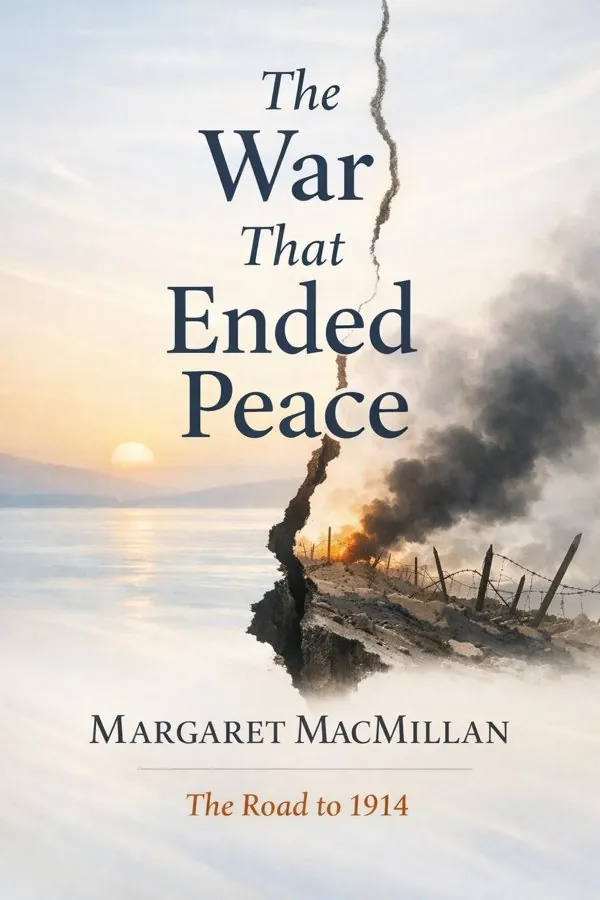
The War That Ended Peace: The Road to 1914: Summary & Key Insights
 10 min9 chaptersAudio available
Key Takeaways from The War That Ended Peace: The Road to 1914
Peace often survives not because conflict disappears, but because leaders build rules strong enough to contain it.
Ideas that inspire unity at home can fuel aggression abroad.
Societies are most vulnerable to war when they begin to treat military power as reassuring rather than terrifying.
History is not only driven by structures; it is also steered by the temperaments of the people in charge.
The arrangements designed to keep nations safe can sometimes make whole systems more brittle.
What Is The War That Ended Peace: The Road to 1914 About?
The War That Ended Peace: The Road to 1914 by Margaret MacMillan is a world_history book spanning 5 pages. Why do stable, prosperous societies still drift into catastrophe? In The War That Ended Peace, historian Margaret MacMillan answers that question by tracing how Europe, after nearly a century without a major continental war, stumbled into World War I. Rather than treating 1914 as an unavoidable explosion, she shows how peace was gradually undermined by nationalism, imperial rivalry, military planning, domestic political pressures, and the flawed judgments of powerful individuals. The result is not just a diplomatic history but a vivid portrait of a civilization confident in its progress yet blind to its own dangers. What makes this book so compelling is MacMillan’s ability to connect grand historical forces with human personality. Kings, ministers, generals, and diplomats do not appear as abstract actors but as proud, anxious, ambitious people making choices under pressure. Her command of international history, sharpened by her acclaimed work on twentieth-century diplomacy, gives the narrative both authority and urgency. This book matters because it reveals how peace can unravel not only through hatred or madness, but through complacency, miscalculation, and the failure to imagine the true cost of war.
This FizzRead summary covers all 9 key chapters of The War That Ended Peace: The Road to 1914 in approximately 10 minutes, distilling the most important ideas, arguments, and takeaways from Margaret MacMillan's work. Also available as an audio summary and Key Quotes Podcast.
The War That Ended Peace: The Road to 1914
Why do stable, prosperous societies still drift into catastrophe? In The War That Ended Peace, historian Margaret MacMillan answers that question by tracing how Europe, after nearly a century without a major continental war, stumbled into World War I. Rather than treating 1914 as an unavoidable explosion, she shows how peace was gradually undermined by nationalism, imperial rivalry, military planning, domestic political pressures, and the flawed judgments of powerful individuals. The result is not just a diplomatic history but a vivid portrait of a civilization confident in its progress yet blind to its own dangers.
What makes this book so compelling is MacMillan’s ability to connect grand historical forces with human personality. Kings, ministers, generals, and diplomats do not appear as abstract actors but as proud, anxious, ambitious people making choices under pressure. Her command of international history, sharpened by her acclaimed work on twentieth-century diplomacy, gives the narrative both authority and urgency. This book matters because it reveals how peace can unravel not only through hatred or madness, but through complacency, miscalculation, and the failure to imagine the true cost of war.
Who Should Read The War That Ended Peace: The Road to 1914?
This book is perfect for anyone interested in world_history and looking to gain actionable insights in a short read. Whether you're a student, professional, or lifelong learner, the key ideas from The War That Ended Peace: The Road to 1914 by Margaret MacMillan will help you think differently.
- ✓Readers who enjoy world_history and want practical takeaways
- ✓Professionals looking to apply new ideas to their work and life
- ✓Anyone who wants the core insights of The War That Ended Peace: The Road to 1914 in just 10 minutes
Want the full summary?
Get instant access to this book summary and 100K+ more with Fizz Moment.
Get Free SummaryAvailable on App Store • Free to download
Key Chapters
Peace often survives not because conflict disappears, but because leaders build rules strong enough to contain it. MacMillan begins with the Congress of Vienna in 1815, where Europe’s major powers tried to prevent another Napoleonic upheaval. Statesmen such as Metternich and Castlereagh did not create a utopia, but they did establish a balance-of-power system, habits of consultation, and a diplomatic culture designed to manage rivalry before it became war. For decades, this order helped Europe avoid the kind of continent-wide conflict that had devastated it earlier.
Yet the peace of the nineteenth century was more fragile than it looked. The system depended heavily on elite cooperation, dynastic legitimacy, and a shared fear of revolution. Over time, those foundations weakened. Liberalism, nationalism, industrialization, and democratic pressures transformed society faster than old diplomatic structures could adapt. Europe looked stable on the surface, but underneath, the assumptions that had sustained order were eroding.
MacMillan’s point is highly practical: institutions can preserve peace only if they evolve with changing realities. A framework that works in one era may become dangerously outdated in another. Modern organizations, alliances, and even companies face the same challenge. Rules established after a crisis can create stability, but if leaders confuse temporary success with permanent security, they may fail to notice emerging threats.
A useful example is any institution that relies on old habits while its environment changes rapidly. A business with strong legacy processes may seem secure until technology or public expectations shift. Likewise, nineteenth-century Europe trusted a diplomatic architecture that no longer matched its political and social conditions.
Actionable takeaway: when a system appears stable, ask what hidden assumptions support it and whether those assumptions still hold.
Ideas that inspire unity at home can fuel aggression abroad. One of MacMillan’s central themes is that nationalism, so powerful in the nineteenth century, was both creative and destructive. It helped forge new states, mobilize citizens, and give populations a sense of common belonging. But it also encouraged peoples and governments to view honor, prestige, and historical grievance as matters worth fighting over. National identity became emotionally charged, and politics became harder to moderate when compromise could be portrayed as betrayal.
At the same time, imperial competition extended these tensions beyond Europe. Britain, France, Germany, Russia, and Austria-Hungary pursued influence across Africa, Asia, and the Balkans. Colonial disputes, naval expansion, and strategic anxieties fed mutual suspicion. Even when crises were resolved, they often left behind resentment and a stronger belief that rival powers were fundamentally hostile.
MacMillan shows that nationalism was especially dangerous when combined with insecurity. Germany wanted recognition and place; France wanted recovery and status; Russia saw itself as protector of Slavs; Austria-Hungary feared dissolution; Britain worried about naval supremacy. Each power told itself a story of legitimate defense. Together, those stories made Europe more combustible.
This dynamic remains relevant. In modern politics, leaders often frame complex economic or strategic problems as moral contests between “us” and “them.” That language can energize supporters, but it narrows room for negotiation. Teams, companies, and nations all become more reckless when identity becomes more important than outcomes.
A practical application is to watch how institutions define pride. Healthy patriotism or group identity can motivate service and resilience; unhealthy nationalism treats every disagreement as an existential struggle.
Actionable takeaway: whenever leaders appeal to honor, destiny, or historical grievance, ask whether they are solving a problem or intensifying it.
Societies are most vulnerable to war when they begin to treat military power as reassuring rather than terrifying. MacMillan explores how Europe’s great powers increasingly glorified armies, admired uniforms, and invested faith in military planning. Generals gained prestige, conscription deepened the relationship between citizens and armies, and war was often discussed as a test of national vitality rather than a human disaster. This did not mean leaders wanted war at all times, but it did mean many of them viewed it as a usable instrument.
Industrialization intensified this mindset. Railways allowed faster mobilization. Advanced artillery, machine guns, and larger reserves made war planning more technical and rigid. Military timetables acquired an aura of necessity: once one state began to mobilize, others felt compelled to follow. The result was a dangerous paradox. The more states prepared to deter war through speed and readiness, the more likely they were to accelerate a crisis toward war.
MacMillan shows that militarism was also cultural. Popular literature, youth movements, public ceremonies, and elite conversation often romanticized struggle. Even those who feared conflict could be seduced by the belief that a short, decisive war might cleanse divisions or restore national confidence. Few fully grasped the scale of destruction modern war would bring.
This pattern applies beyond military history. In many fields, technical plans can create false confidence. A company with detailed contingency systems may assume it can control a crisis that, in reality, will spiral unpredictably. Preparation is necessary, but overconfidence in tools can reduce caution.
A practical example is escalation in competitive settings. When rivals adopt increasingly aggressive timelines, each side may feel it has no choice but to move faster, even if all would be safer slowing down.
Actionable takeaway: distinguish between prudent preparation and a mindset that makes risky action feel normal, inevitable, or easy to control.
History is not only driven by structures; it is also steered by the temperaments of the people in charge. MacMillan is especially good at showing how the road to 1914 was shaped by leaders whose vanity, insecurity, impulsiveness, and blind spots mattered enormously. Kaiser Wilhelm II sought status and admiration but often behaved erratically. Tsar Nicholas II was personally decent yet weak and indecisive. Austrian, French, British, and Russian leaders carried their own prejudices, fears, and political calculations into every major decision.
The importance of personality did not mean individuals had unlimited freedom. They operated inside systems of alliance, domestic politics, military advice, and public opinion. But personality influenced how they read threats, whom they trusted, how far they pushed crises, and whether they calmed or inflamed their governments. A more disciplined leader might have paused where another postured; a more imaginative statesman might have found compromise where another saw humiliation.
MacMillan’s portraits offer a practical lesson in leadership. Formal authority does not cancel emotional weakness. In fact, large systems may magnify it. Leaders who crave prestige can convert manageable disputes into tests of ego. Leaders who avoid difficult choices can allow momentum to decide for them. Leaders surrounded by flatterers may mistake their assumptions for reality.
This insight applies in boardrooms, governments, and institutions of every kind. When evaluating leadership, it is not enough to ask whether someone is intelligent or experienced. One must ask how they behave under stress, how they handle dissent, and whether they can revise their beliefs.
A practical exercise is to examine decision-makers not just by policy positions but by habits: Are they reflective or reactive? Secure or theatrical? Curious or rigid?
Actionable takeaway: when choosing or trusting leaders, pay close attention to character, because in moments of crisis personality becomes strategy.
The arrangements designed to keep nations safe can sometimes make whole systems more brittle. MacMillan explains how Europe’s alliance networks, especially the Triple Alliance and Triple Entente, emerged from understandable strategic calculations. States sought partners to deter enemies, reduce isolation, and improve bargaining power. In theory, these alliances could preserve stability by discouraging aggression. In practice, they hardened suspicions and divided Europe into increasingly hostile camps.
Alliances were not always rigid legal traps, but they shaped expectations. Governments assumed that future crises would activate obligations, mobilizations, and reputational pressures. Even when specific treaty commitments were ambiguous, the political logic of partnership made disengagement difficult. A local conflict now risked drawing in larger powers because each feared losing credibility or abandoning a crucial friend.
MacMillan shows that the danger lay not just in formal documents but in alliance psychology. Once states divide the world into friends and adversaries, they begin interpreting events through that lens. Defensive measures by one side are seen as offensive preparations by the other. Diplomatic flexibility shrinks. Caution starts to look like weakness.
This is a valuable lesson in networked risk. In business, finance, or geopolitics, interdependence can create resilience, but tightly linked commitments can also transmit shocks rapidly. An organization may enter partnerships for protection, only to discover that those ties expose it to disputes it never intended to join.
A practical example is any team structure where loyalty is prized above judgment. Members may escalate conflicts simply because standing apart appears disloyal. The result is collective entrapment.
Actionable takeaway: build partnerships carefully, but always ask what conflicts, assumptions, and automatic reactions those partnerships may pull you into when pressure rises.
Nations do not make foreign policy in isolation from internal fear, division, and ambition. MacMillan emphasizes that Europe’s leaders were not simply playing an external chess game; they were also managing parliaments, parties, class tensions, labor unrest, nationalist movements, and constitutional struggles at home. Domestic politics often pushed leaders toward tougher postures abroad, either to rally support, distract attention, or avoid appearing weak.
In Germany, elites worried about socialism, democratization, and social change. In Russia, the regime was haunted by revolution and instability after 1905. In Austria-Hungary, ethnic tensions threatened imperial cohesion. In France and Britain, political competition and public opinion shaped what leaders believed they could concede. Foreign crises became entangled with domestic legitimacy.
MacMillan’s analysis is important because it challenges the idea that war results only from international rivalry. Leaders may escalate externally because they feel cornered internally. A government under pressure may prefer a risky show of strength to a politically costly compromise. This does not mean the public always wants war; often it means elites misjudge what toughness requires.
The same mechanism appears in modern institutions. Executives under internal scrutiny may make bold external moves to project control. Political leaders may adopt symbolic confrontations because concession is dangerous in the domestic arena. Even in personal life, people sometimes harden their stance in one area to compensate for insecurity in another.
A practical application is to look behind public decisions. Ask what audience leaders are really addressing. The official opponent may not be the only target; sometimes the real audience is domestic supporters, rivals, or critics.
Actionable takeaway: to understand any hardline decision, examine the internal pressures behind it, not just the external justification offered.
Major wars often begin on the periphery, where local grievances intersect with great-power rivalry. For MacMillan, the Balkans were exactly such a danger zone. As the Ottoman Empire weakened, newly assertive states, nationalist movements, and competing empires rushed to shape the region’s future. Serbia sought greater influence among South Slavs. Austria-Hungary feared nationalist contagion and the loss of authority. Russia backed Slavic causes partly from sentiment, partly from strategy. Every local conflict risked wider consequences.
The Balkan Wars of 1912 and 1913 intensified the instability. They demonstrated both the volatility of the region and the inability of Europe’s powers to create durable settlements. Violence, territorial revision, refugee flows, and wounded prestige left governments more suspicious and more willing to consider force. By 1914, the Balkans were not a random flashpoint but a proven testing ground for competing ambitions.
The assassination of Archduke Franz Ferdinand in Sarajevo mattered because it struck a system already primed for overreaction. Austria-Hungary viewed Serbia not just as a troublesome neighbor but as an existential threat to imperial survival. Russia saw Austria’s pressure on Serbia as a challenge to its influence. The local and the continental became inseparable.
This insight applies broadly: seemingly small arenas can become high-risk when they symbolize larger unresolved struggles. In organizations, a dispute over one department, one client, or one policy can trigger broader conflict if it touches status, precedent, or identity.
A practical question is whether a given conflict is really about the issue at hand or about deeper anxieties attached to it. If leaders misread a symbolic flashpoint as a minor problem, they may underestimate escalation risk.
Actionable takeaway: pay special attention to peripheral disputes that carry outsized emotional or strategic meaning, because those are often where larger systems break.
Catastrophe is often the result not of a single decision, but of many poor decisions made in quick succession. MacMillan’s treatment of the July Crisis of 1914 is one of the book’s most powerful contributions. After the assassination in Sarajevo, Europe’s leaders still had options. War was not automatic. But Austria-Hungary chose a punitive course against Serbia; Germany offered encouragement through the so-called blank cheque; Russia moved toward support for Serbia; France backed Russia; Britain hesitated and signaled ambiguously; mobilization plans narrowed flexibility at every turn.
What stands out is not only aggression, but failure of imagination. Many policymakers believed a firm stance would control events. Others assumed their opponents would back down. Some hoped conflict could remain localized. Few understood how rapidly mobilization, alliance commitments, mistrust, and prestige would combine into a continent-wide war.
MacMillan refuses simplistic blame without abandoning moral seriousness. Some actors behaved more recklessly than others, but the wider lesson is that crises are ecosystems of pressure. Delay, ambiguity, pride, bureaucratic routines, and mutual fear can interact in ways that overwhelm intention.
This is highly relevant in modern decision-making. During emergencies, leaders often rely on partial information, inherited procedures, and assumptions about how others will react. If communication is poor and timelines are compressed, organizations can lurch into outcomes no one explicitly wanted.
A practical method is crisis rehearsal that includes human error, institutional inertia, and worst-case escalation, not just ideal execution. Plans should ask: What if others misread our intent? What if our timetable itself creates panic?
Actionable takeaway: in fast-moving crises, create deliberate pauses for communication and reassessment before procedures lock everyone into irreversible choices.
A society can be advanced, educated, and culturally brilliant while still walking toward disaster. MacMillan paints pre-1914 Europe as a world of scientific innovation, expanding trade, artistic experimentation, urban sophistication, and confidence in progress. Many Europeans believed that economic interdependence, shared civilization, and rational statecraft made a general war unlikely or even impossible. This confidence was one of the era’s most dangerous illusions.
The book challenges a comforting assumption: that modernization naturally produces peace. Europe before 1914 was deeply connected, yet those connections coexisted with arms races, imperial competition, social Darwinist thinking, and widespread acceptance of force. Progress in technology and organization made war more devastating, not less likely. Railways, telegraphs, industry, and bureaucracy gave states greater capacity to mobilize violence efficiently.
MacMillan’s broader message is timeless. Material progress does not automatically bring wisdom, restraint, or empathy. Prosperity can breed complacency. Cultural achievement can coexist with political irresponsibility. Societies often mistake sophistication for maturity.
This insight has obvious contemporary relevance. Globalization, digital connectivity, and technological innovation may create incentives for cooperation, but they do not eliminate rivalry, fear, or miscalculation. A connected world can still fragment if leaders and citizens assume peace is self-sustaining.
A practical application is to resist narratives of inevitability, whether optimistic or pessimistic. Neither “war can’t happen here” nor “conflict is unavoidable” is a safe basis for policy. What matters is active maintenance of trust, norms, and realistic assessment.
Actionable takeaway: never assume that economic development or cultural confidence alone will preserve peace; stability requires conscious political effort and moral discipline.
All Chapters in The War That Ended Peace: The Road to 1914
About the Author
Margaret MacMillan is a Canadian historian, author, and Professor Emeritus of International History at the University of Oxford. She has held prominent academic positions in both Canada and the United Kingdom, including serving as Warden of St Antony’s College, Oxford. MacMillan is widely recognized for her expertise in modern international relations, war, and diplomacy, and for her ability to turn complex geopolitical subjects into vivid, accessible narratives. Her acclaimed works include Paris 1919, Nixon in China, and The War That Ended Peace. Across her writing, she combines rigorous scholarship with sharp insight into the personalities and political cultures that shape world events, making her one of the most respected popular historians of modern global affairs.
Get This Summary in Your Preferred Format
Read or listen to the The War That Ended Peace: The Road to 1914 summary by Margaret MacMillan anytime, anywhere. FizzRead offers multiple formats so you can learn on your terms — all free.
Available formats: App · Audio · PDF · EPUB — All included free with FizzRead
Download The War That Ended Peace: The Road to 1914 PDF and EPUB Summary
Key Quotes from The War That Ended Peace: The Road to 1914
“Peace often survives not because conflict disappears, but because leaders build rules strong enough to contain it.”
“Ideas that inspire unity at home can fuel aggression abroad.”
“Societies are most vulnerable to war when they begin to treat military power as reassuring rather than terrifying.”
“History is not only driven by structures; it is also steered by the temperaments of the people in charge.”
“The arrangements designed to keep nations safe can sometimes make whole systems more brittle.”
Frequently Asked Questions about The War That Ended Peace: The Road to 1914
The War That Ended Peace: The Road to 1914 by Margaret MacMillan is a world_history book that explores key ideas across 9 chapters. Why do stable, prosperous societies still drift into catastrophe? In The War That Ended Peace, historian Margaret MacMillan answers that question by tracing how Europe, after nearly a century without a major continental war, stumbled into World War I. Rather than treating 1914 as an unavoidable explosion, she shows how peace was gradually undermined by nationalism, imperial rivalry, military planning, domestic political pressures, and the flawed judgments of powerful individuals. The result is not just a diplomatic history but a vivid portrait of a civilization confident in its progress yet blind to its own dangers. What makes this book so compelling is MacMillan’s ability to connect grand historical forces with human personality. Kings, ministers, generals, and diplomats do not appear as abstract actors but as proud, anxious, ambitious people making choices under pressure. Her command of international history, sharpened by her acclaimed work on twentieth-century diplomacy, gives the narrative both authority and urgency. This book matters because it reveals how peace can unravel not only through hatred or madness, but through complacency, miscalculation, and the failure to imagine the true cost of war.
More by Margaret MacMillan
You Might Also Like
The Age of Capital
Eric Hobsbawm
10 min
The Gulag Archipelago
Aleksandr Solzhenitsyn
10 min
Jerusalem: The Biography
Simon Sebag Montefiore
10 min
The Anglo-Saxons
James Campbell
10 min
The Boer War
Thomas Pakenham
10 min
The Industrial Revolutionaries: The Making of the Modern World 1776–1914
Gavin Weightman
10 minBrowse by Category
Ready to read The War That Ended Peace: The Road to 1914?
Get the full summary and 100K+ more books with Fizz Moment.