
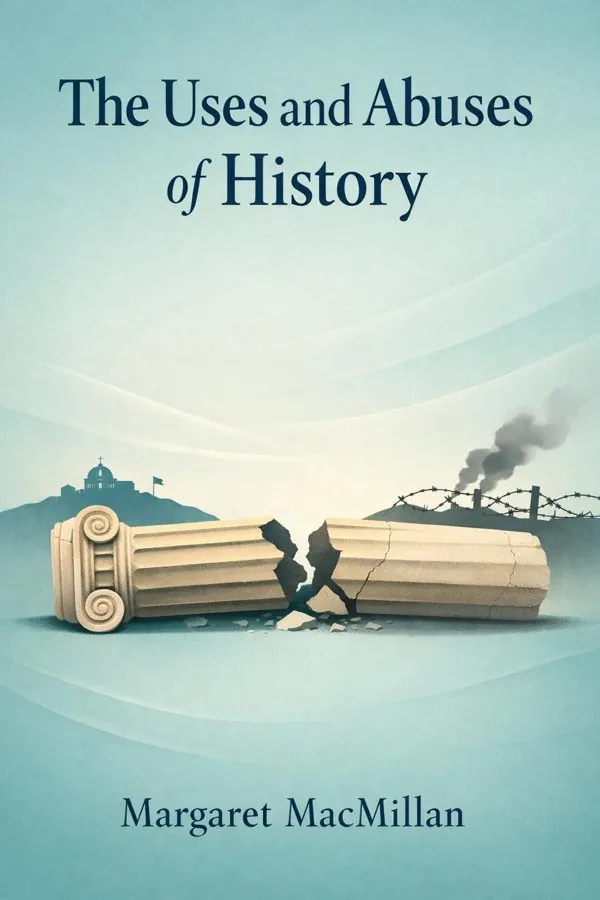
The Uses and Abuses of History: Summary & Key Insights
 10 min10 chaptersAudio available
Key Takeaways from The Uses and Abuses of History
We often speak of history as if it were a stable record waiting to be retrieved, but MacMillan reminds us that history is always an act of interpretation.
Every society tells stories about itself, and those stories help determine what people believe they owe one another.
Few political tools are as effective as a well-timed historical analogy.
History becomes most dangerous when it is converted from inquiry into ammunition.
In moments of crisis, policymakers reach instinctively for history.
What Is The Uses and Abuses of History About?
The Uses and Abuses of History by Margaret MacMillan is a world_history book spanning 10 pages. History is never just about the past. It shapes national myths, justifies political decisions, comforts societies in moments of crisis, and fuels grievances that can last for generations. In The Uses and Abuses of History, Margaret MacMillan examines this power with rare clarity and urgency. She shows that history can be an invaluable guide when used with humility, discipline, and critical thinking—but it becomes dangerous when simplified, cherry-picked, or turned into propaganda. Rather than treating the past as a storehouse of easy lessons, MacMillan urges readers to approach it as a complex field of evidence, interpretation, and debate. What makes this book especially important is its relevance to public life. Leaders often invoke historical analogies to justify war, diplomacy, reform, or nationalism. Citizens rely on inherited stories to understand identity and belonging. MacMillan, one of the world’s most respected historians, brings deep expertise in war, diplomacy, and international relations to show how these narratives work. Her argument is both scholarly and accessible: if we want to make better decisions in the present, we must learn to think about the past more carefully, honestly, and responsibly.
This FizzRead summary covers all 10 key chapters of The Uses and Abuses of History in approximately 10 minutes, distilling the most important ideas, arguments, and takeaways from Margaret MacMillan's work. Also available as an audio summary and Key Quotes Podcast.
The Uses and Abuses of History
History is never just about the past. It shapes national myths, justifies political decisions, comforts societies in moments of crisis, and fuels grievances that can last for generations. In The Uses and Abuses of History, Margaret MacMillan examines this power with rare clarity and urgency. She shows that history can be an invaluable guide when used with humility, discipline, and critical thinking—but it becomes dangerous when simplified, cherry-picked, or turned into propaganda. Rather than treating the past as a storehouse of easy lessons, MacMillan urges readers to approach it as a complex field of evidence, interpretation, and debate.
What makes this book especially important is its relevance to public life. Leaders often invoke historical analogies to justify war, diplomacy, reform, or nationalism. Citizens rely on inherited stories to understand identity and belonging. MacMillan, one of the world’s most respected historians, brings deep expertise in war, diplomacy, and international relations to show how these narratives work. Her argument is both scholarly and accessible: if we want to make better decisions in the present, we must learn to think about the past more carefully, honestly, and responsibly.
Who Should Read The Uses and Abuses of History?
This book is perfect for anyone interested in world_history and looking to gain actionable insights in a short read. Whether you're a student, professional, or lifelong learner, the key ideas from The Uses and Abuses of History by Margaret MacMillan will help you think differently.
- ✓Readers who enjoy world_history and want practical takeaways
- ✓Professionals looking to apply new ideas to their work and life
- ✓Anyone who wants the core insights of The Uses and Abuses of History in just 10 minutes
Want the full summary?
Get instant access to this book summary and 100K+ more with Fizz Moment.
Get Free SummaryAvailable on App Store • Free to download
Key Chapters
We often speak of history as if it were a stable record waiting to be retrieved, but MacMillan reminds us that history is always an act of interpretation. The past itself is gone; what remains are traces—documents, letters, artifacts, testimonies, monuments, and institutions. Historians do not simply uncover truth like archaeologists lifting a perfect statue from the earth. They select evidence, weigh conflicting sources, decide what matters, and shape narratives from incomplete fragments. That process does not make history fictional, but it does make it contingent, revisable, and deeply human.
This insight matters because many political arguments pretend historical claims are obvious and unquestionable. A leader may say, “History proves this nation was always unified,” or “The lesson of the past is clear.” MacMillan warns that such certainty is usually false. Different historians can study the same event and reach different conclusions because they ask different questions, use new evidence, or challenge inherited assumptions. Even the choice of where a story begins can change its meaning.
In practical terms, this means readers should ask better questions when history is invoked. What sources support the claim? Whose voices are missing? What assumptions shape the story? When a public debate relies on a simplified version of the past—about empire, revolution, religion, or national destiny—critical historical awareness can prevent manipulation.
The takeaway is simple: treat historical narratives with respect, but not with blind trust. Ask how the story was built before accepting the lesson it claims to teach.
Every society tells stories about itself, and those stories help determine what people believe they owe one another. MacMillan shows that history is central to collective identity because nations are not held together by geography alone; they are held together by memory, symbols, victories, losses, and shared myths. Britain remembers wartime resilience, the United States celebrates founding ideals and frontier expansion, and many postcolonial nations build identity around liberation struggles. These narratives create cohesion, pride, and purpose.
Yet identity-building through history carries risks. Nations rarely remember everything equally. They may celebrate military triumphs while forgetting atrocities, praise founding fathers while minimizing exclusion, or emphasize victimhood while ignoring their own aggression. Such selectivity can strengthen solidarity, but it can also foster resentment, self-righteousness, and historical blindness. MacMillan does not argue that national stories should disappear; rather, she urges us to make them more honest and capacious.
This has practical implications for education, public monuments, museums, and civic debate. A mature society can commemorate heroism without denying injustice. It can teach patriotism without demanding myth. For example, a school curriculum that includes both democratic achievements and episodes of slavery, imperialism, or civil conflict creates citizens who are more informed and less vulnerable to propaganda.
The actionable lesson is to examine the stories your society repeats most often. Ask what they include, what they omit, and how they shape current politics. Strong identity is healthiest when it rests on truthfulness rather than flattering simplification.
Few political tools are as effective as a well-timed historical analogy. MacMillan explains that leaders regularly appeal to the past to gain legitimacy, rally support, and frame present choices as morally necessary. By comparing an opponent to a past tyrant, invoking a golden age, or presenting a policy as the completion of a national mission, politicians turn history into a language of persuasion. These references feel powerful because they make current events seem familiar and emotionally charged.
But analogies can clarify or distort. A statesman who sees every negotiation as another Munich may become recklessly confrontational. A movement that treats all foreign interventions as repeats of colonial domination may miss important differences between cases. MacMillan’s point is not that historical comparison is always wrong—indeed, decision-makers need analogies to think—but that careless analogies simplify complexity and can produce disastrous judgments.
We can see this in debates over war, secession, migration, and economic crisis. History becomes a script through which leaders cast heroes, villains, and victims. Once that script hardens, nuance becomes politically inconvenient. Citizens stop asking whether the comparison actually fits.
A practical response is to slow down whenever public figures invoke the past. What exactly is being compared? Are the conditions truly similar? What key differences are being ignored? Historical analogies should open inquiry, not close it.
Takeaway: when leaders use history to justify action, test the analogy before you trust the conclusion. Good politics learns from the past; bad politics hides behind it.
History becomes most dangerous when it is converted from inquiry into ammunition. MacMillan argues that distorted memories of past humiliation, betrayal, conquest, or victimhood can be used to inflame hatred and justify conflict. Political entrepreneurs often revive old grievances because they provide ready-made emotional energy. A selective memory of past suffering can persuade people that revenge, expansion, exclusion, or repression is not aggression at all, but justice delayed.
The abuse usually follows a familiar pattern. Complex events are reduced to moral fables. One group is portrayed as innocent across time, another as permanently guilty. Ambiguities disappear. Historical defeats become sacred wounds; ancient claims become nonnegotiable rights. In such climates, compromise starts to look like betrayal because the past has been made absolute.
MacMillan is especially alert to the way nationalism and ethnic politics exploit these narratives. Conflicts in many regions have been intensified by competing historical myths, each side teaching a version of the past that confirms its own righteousness. Once people are taught that they are reliving an old struggle, present realities become harder to see clearly.
The practical lesson applies not just to governments but to media, schools, and ordinary citizens. Be wary of rhetoric that insists an entire people has always been victim or villain. Seek out multiple accounts, especially from those outside your own community. Historical pain deserves recognition, but weaponized memory is a threat to peace.
The takeaway: when history is used to assign eternal innocence or guilt, pause immediately. That is often the moment when remembrance stops being education and starts becoming incitement.
In moments of crisis, policymakers reach instinctively for history. MacMillan shows that this can be helpful, but in war and diplomacy it is often perilous. Under pressure, leaders search for precedents that make uncertainty manageable. They ask whether a dictator resembles Hitler, whether a military intervention will become another Vietnam, or whether concessions will invite aggression. These analogies help organize complex situations quickly—but they can also mislead because no two historical moments are identical.
The danger is not merely intellectual; it is practical and immediate. If leaders choose the wrong analogy, they may escalate when caution is needed or hesitate when firmness is required. Historical episodes become shortcuts, and shortcuts in foreign policy can cost lives. MacMillan’s broader argument is that history should illuminate patterns, constraints, and human behavior, not provide automatic formulas.
This idea matters well beyond high diplomacy. Businesses, activists, and institutions also fall into analogy traps. A company may treat every disruption like a past recession; a social movement may assume prior strategies will work unchanged today. The comfort of familiarity can block fresh thinking.
A more disciplined use of history asks: What conditions are similar? What institutions differ? What technologies, cultures, or power balances have changed? Good historical thinking combines comparison with context. It resists the temptation to say, “This is just like before.”
Actionable takeaway: use history as a map of possibilities, not a script. In any high-stakes decision, compare the past carefully, then identify what is genuinely new before acting.
A good historian does not merely preserve facts; a good historian challenges lazy certainty. MacMillan defends the historian’s public role as one of testing evidence, uncovering forgotten perspectives, and resisting oversimplified stories. In a culture that often rewards speed, outrage, and ideological clarity, historians offer something less immediately gratifying but far more valuable: complexity grounded in proof.
This does not mean historians are neutral machines. They have viewpoints, interests, and limitations like everyone else. But their discipline requires habits that public life desperately needs—source criticism, contextual thinking, openness to revision, and awareness of contingency. Historians remind us that people in the past did not know how things would turn out, that choices were constrained, and that events rarely have single causes. These habits make simplistic blame and grandiose myth harder to sustain.
MacMillan also suggests that historians have a civic responsibility. If they retreat entirely into specialist language and academic isolation, public memory will be shaped instead by propagandists, demagogues, and entertainers. Historians must therefore communicate clearly, intervene when history is abused, and help wider audiences distinguish evidence-based interpretation from political storytelling.
For readers, this means valuing experts who show their workings rather than merely asserting conclusions. Read historians who acknowledge uncertainty, engage opposing views, and cite evidence rather than relying on rhetorical force alone.
The takeaway is practical: seek out historical voices that deepen understanding rather than flatter assumptions. The historian’s most important service is not giving us comforting answers, but making us harder to deceive.
What societies choose to commemorate reveals what they believe about themselves. MacMillan explores public memory through monuments, anniversaries, museums, memorial services, and national rituals. These practices are not passive reflections of history; they actively shape how future generations understand sacrifice, guilt, achievement, and belonging. Public memory teaches citizens what deserves honor, grief, gratitude, or silence.
Because commemoration is selective, it is always political. A war memorial may emphasize heroism while omitting the causes of the war. A national holiday may celebrate liberation while overlooking those excluded from its promises. A statue may honor greatness in one era and provoke moral outrage in another. MacMillan’s key point is not that commemoration is inherently deceptive, but that it should be examined critically. Memory is not the same as history, and public rituals often simplify what historical scholarship complicates.
This matters today as communities debate monuments, school names, reparations, and historical apologies. Removing a statue does not erase history; nor does preserving it automatically educate. The harder task is creating public memory that informs rather than indoctrinates. That may involve adding context, building new memorials, broadening museum narratives, or redesigning rituals to include previously marginalized voices.
On a personal level, citizens can ask why certain dates are remembered and others neglected. What emotions are being cultivated? Pride, mourning, unity, grievance?
Actionable takeaway: engage commemoration as a civic practice, not background scenery. When you encounter a monument, holiday, or memorial, ask what version of the past it teaches—and what a fuller version would require.
The past cannot be undone, but it can be confronted in ways that reduce its power to poison the present. MacMillan shows that history plays a crucial role in reconciliation after civil war, dictatorship, colonization, or communal violence. Communities emerging from trauma often need more than silence or slogans; they need truthful acknowledgment. Without that, grievances harden and myths proliferate.
Reconciliation, however, does not mean producing a single agreed story that erases disagreement. MacMillan recognizes that different groups remember the same events differently, and some conflicts leave wounds too deep for easy consensus. Still, a society can move forward if it establishes a shared commitment to evidence, admits suffering on multiple sides, and resists the temptation to sanctify one narrative as untouchable.
Examples include truth commissions, public apologies, revised textbooks, and joint historical projects between former enemies. None of these guarantees harmony. In some cases they reopen pain. Yet avoiding difficult history altogether often leaves space for denial, conspiracy, and political exploitation. Responsible remembrance can make coexistence more possible by replacing mythic accusation with documented understanding.
This lesson also applies in families, organizations, and communities. Repair becomes possible when people acknowledge what happened without immediately turning acknowledgment into self-justification.
The takeaway: reconciliation begins not with forgetting, but with disciplined honesty. If a community wants a less violent future, it must create ways of remembering that recognize pain without turning it into permanent warfare.
One of MacMillan’s most important contributions is her insistence that history must be wider than the nation-state. National histories often imply that a country developed largely through its own internal virtues, struggles, and decisions. But a global perspective reveals constant entanglement—through empire, trade, migration, war, disease, technology, and ideas. No nation’s story is self-contained.
This broader view helps correct distortions. A country may celebrate industrial growth without considering colonial extraction that helped finance it. Another may define itself through anti-imperial struggle while overlooking how global ideologies and rival powers shaped that struggle. By placing national experiences in world context, historians can challenge self-flattering narratives and illuminate connections that domestic stories miss.
A global perspective is also practical. Many contemporary problems—climate change, borders, inequality, conflict, pandemics—cannot be understood through narrow patriotic lenses. Historical awareness of interdependence makes simplistic blame less plausible. It also expands empathy by showing how different societies have faced related pressures in different ways.
For readers, this means seeking histories that cross borders rather than simply affirm inherited national memory. Compare accounts from different countries. Notice how the same event—a war, treaty, revolution, or migration wave—looks different depending on where one stands.
Actionable takeaway: whenever you encounter a national story that seems complete on its own, ask what international forces shaped it. History becomes more truthful, and more useful, when it is read across borders rather than trapped within them.
The ultimate value of history, for MacMillan, is not that it offers neat lessons, but that it cultivates judgment. Historical awareness teaches citizens to live with complexity, question certainty, and recognize that present arrangements are neither inevitable nor permanent. That is a democratic virtue. Societies function better when people understand how institutions developed, how rights were won, how injustices were rationalized, and how easily fear can narrow moral vision.
MacMillan does not claim history predicts the future. Instead, she argues that it trains the mind. It reveals recurring patterns in ambition, pride, self-interest, hope, and folly. It helps people see that progress can be reversed, that bad ideas can return in new forms, and that moral confidence should be tempered by awareness of past mistakes. Citizens who think historically are less likely to be seduced by utopian promises or apocalyptic rhetoric.
This has direct applications in everyday life. Voters can assess campaign claims more skeptically. Professionals can understand how their institutions inherited biases or strengths. Communities can debate reform with a clearer sense of what has been tried before and why previous efforts succeeded or failed. Historical thinking does not remove disagreement, but it can make disagreement more informed and less hysterical.
The actionable lesson is to build historical habits into civic life: read beyond headlines, compare present arguments with past precedents, and remain alert to what is forgotten as well as what is remembered.
Takeaway: history is most useful when it makes us more thoughtful citizens—harder to manipulate, slower to moralize, and better prepared to act with perspective.
All Chapters in The Uses and Abuses of History
About the Author
Margaret MacMillan is a distinguished Canadian historian and one of the leading public interpreters of modern international history. She has taught at major institutions in Canada, the United States, and the United Kingdom, and is especially associated with the University of Oxford, where she served as Warden of St Antony’s College and Professor of International History. MacMillan is known for making complex historical events accessible without sacrificing nuance or rigor. Her acclaimed books include Paris 1919, which examines the peace settlement after World War I, and The War That Ended Peace, on the origins of World War I. Across her work, she explores diplomacy, war, political leadership, and the uses of memory. Her writing is respected for its clarity, balance, and relevance to contemporary public life.
Get This Summary in Your Preferred Format
Read or listen to the The Uses and Abuses of History summary by Margaret MacMillan anytime, anywhere. FizzRead offers multiple formats so you can learn on your terms — all free.
Available formats: App · Audio · PDF · EPUB — All included free with FizzRead
Download The Uses and Abuses of History PDF and EPUB Summary
Key Quotes from The Uses and Abuses of History
“We often speak of history as if it were a stable record waiting to be retrieved, but MacMillan reminds us that history is always an act of interpretation.”
“Every society tells stories about itself, and those stories help determine what people believe they owe one another.”
“Few political tools are as effective as a well-timed historical analogy.”
“History becomes most dangerous when it is converted from inquiry into ammunition.”
“In moments of crisis, policymakers reach instinctively for history.”
Frequently Asked Questions about The Uses and Abuses of History
The Uses and Abuses of History by Margaret MacMillan is a world_history book that explores key ideas across 10 chapters. History is never just about the past. It shapes national myths, justifies political decisions, comforts societies in moments of crisis, and fuels grievances that can last for generations. In The Uses and Abuses of History, Margaret MacMillan examines this power with rare clarity and urgency. She shows that history can be an invaluable guide when used with humility, discipline, and critical thinking—but it becomes dangerous when simplified, cherry-picked, or turned into propaganda. Rather than treating the past as a storehouse of easy lessons, MacMillan urges readers to approach it as a complex field of evidence, interpretation, and debate. What makes this book especially important is its relevance to public life. Leaders often invoke historical analogies to justify war, diplomacy, reform, or nationalism. Citizens rely on inherited stories to understand identity and belonging. MacMillan, one of the world’s most respected historians, brings deep expertise in war, diplomacy, and international relations to show how these narratives work. Her argument is both scholarly and accessible: if we want to make better decisions in the present, we must learn to think about the past more carefully, honestly, and responsibly.
More by Margaret MacMillan
You Might Also Like
The Age of Capital
Eric Hobsbawm
10 min
The Gulag Archipelago
Aleksandr Solzhenitsyn
10 min
Jerusalem: The Biography
Simon Sebag Montefiore
10 min
The Anglo-Saxons
James Campbell
10 min
The Boer War
Thomas Pakenham
10 min
The Industrial Revolutionaries: The Making of the Modern World 1776–1914
Gavin Weightman
10 minBrowse by Category
Ready to read The Uses and Abuses of History?
Get the full summary and 100K+ more books with Fizz Moment.