
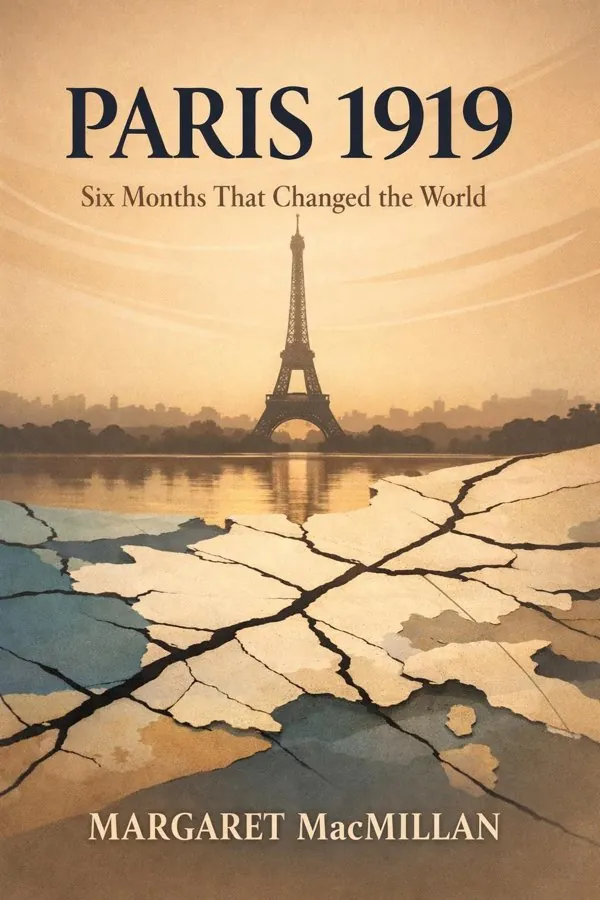
Paris 1919: Six Months That Changed the World: Summary & Key Insights
 10 min9 chaptersAudio available
Key Takeaways from Paris 1919: Six Months That Changed the World
Peace is often imagined as relief, but in 1919 it felt more like collapse.
History often turns less on abstract principles than on the people asked to apply them.
Ideas can change the world, but they rarely survive unchanged once they meet power.
Borders are often treated as natural facts, but in 1919 they were arguments waiting to explode.
Few regions demonstrate the long shadow of 1919 more clearly than the Middle East.
What Is Paris 1919: Six Months That Changed the World About?
Paris 1919: Six Months That Changed the World by Margaret MacMillan is a world_history book spanning 9 pages. What happens when a handful of exhausted leaders try to redesign the world after the greatest war humanity had yet seen? In Paris 1919, Margaret MacMillan reconstructs the Paris Peace Conference with clarity, drama, and analytical precision, showing how six months of negotiation shaped the twentieth century. The book follows the statesmen, diplomats, lobbyists, nationalists, and activists who crowded into Paris after World War I, all hoping to secure justice, territory, security, or recognition. At the center were Woodrow Wilson, David Lloyd George, and Georges Clemenceau, whose competing visions helped determine the fate of Europe, the Middle East, Asia, and the colonial world. MacMillan’s achievement lies in revealing both the grand strategy and the human detail: vanity, fear, idealism, revenge, improvisation, and political pressure all mattered. This is not merely a story about treaties. It is an explanation of how borders were drawn, promises made, grievances deepened, and institutions like the League of Nations imagined. Written by one of the foremost historians of diplomacy and modern international relations, the book remains essential for understanding how peace settlements can stabilize the world—or sow the seeds of future crises.
This FizzRead summary covers all 9 key chapters of Paris 1919: Six Months That Changed the World in approximately 10 minutes, distilling the most important ideas, arguments, and takeaways from Margaret MacMillan's work. Also available as an audio summary and Key Quotes Podcast.
Paris 1919: Six Months That Changed the World
What happens when a handful of exhausted leaders try to redesign the world after the greatest war humanity had yet seen? In Paris 1919, Margaret MacMillan reconstructs the Paris Peace Conference with clarity, drama, and analytical precision, showing how six months of negotiation shaped the twentieth century. The book follows the statesmen, diplomats, lobbyists, nationalists, and activists who crowded into Paris after World War I, all hoping to secure justice, territory, security, or recognition. At the center were Woodrow Wilson, David Lloyd George, and Georges Clemenceau, whose competing visions helped determine the fate of Europe, the Middle East, Asia, and the colonial world. MacMillan’s achievement lies in revealing both the grand strategy and the human detail: vanity, fear, idealism, revenge, improvisation, and political pressure all mattered. This is not merely a story about treaties. It is an explanation of how borders were drawn, promises made, grievances deepened, and institutions like the League of Nations imagined. Written by one of the foremost historians of diplomacy and modern international relations, the book remains essential for understanding how peace settlements can stabilize the world—or sow the seeds of future crises.
Who Should Read Paris 1919: Six Months That Changed the World?
This book is perfect for anyone interested in world_history and looking to gain actionable insights in a short read. Whether you're a student, professional, or lifelong learner, the key ideas from Paris 1919: Six Months That Changed the World by Margaret MacMillan will help you think differently.
- ✓Readers who enjoy world_history and want practical takeaways
- ✓Professionals looking to apply new ideas to their work and life
- ✓Anyone who wants the core insights of Paris 1919: Six Months That Changed the World in just 10 minutes
Want the full summary?
Get instant access to this book summary and 100K+ more with Fizz Moment.
Get Free SummaryAvailable on App Store • Free to download
Key Chapters
Peace is often imagined as relief, but in 1919 it felt more like collapse. When the First World War ended, Europe was physically devastated, financially crippled, and psychologically shattered. Empires that had dominated the continent for centuries—the German, Austro-Hungarian, Ottoman, and Russian—had either fallen or were falling apart. Millions were dead, millions more were wounded or displaced, and revolution seemed possible in multiple countries. Into this unstable environment came a sweeping expectation: the peacemakers in Paris would not simply end the war on paper, but rebuild civilization itself.
MacMillan shows that the conference began under crushing pressure. Citizens wanted punishment for Germany, but also lasting peace. Small nations demanded self-determination, while larger powers wanted strategic advantage. Colonized peoples hoped wartime rhetoric about liberty would apply to them too. Economic recovery required cooperation, yet political leaders were constrained by domestic anger, electoral promises, and fear of unrest. This gap between public hope and political reality is one of the book’s central themes.
A practical lesson emerges here for modern readers. Whenever institutions confront a crisis—whether in geopolitics, business, or public policy—leaders are often asked to deliver justice, stability, reform, and reconciliation all at once. Those goals may be individually reasonable but collectively contradictory. Paris in 1919 became a case study in the danger of overloading a negotiation with impossible expectations.
The actionable takeaway: when evaluating any major settlement, ask not only what leaders promised, but what conditions made those promises achievable or impossible.
History often turns less on abstract principles than on the people asked to apply them. At the Paris Peace Conference, three leaders dominated the proceedings: Woodrow Wilson of the United States, David Lloyd George of Britain, and Georges Clemenceau of France. MacMillan portrays them not as symbols, but as complicated political operators shaped by temperament, national interest, and personal conviction.
Wilson arrived as the prophet of a new world order. He believed peace could rest on open diplomacy, national self-determination, and a League of Nations that would prevent future wars. Lloyd George was more agile and ambiguous. He had to satisfy British voters who wanted Germany punished, while also preserving European stability and British imperial interests. Clemenceau, older and hardened by decades of French vulnerability to Germany, cared above all about security. France had suffered immensely on its own soil, and he wanted guarantees that Germany could never again invade.
Their interactions mattered enormously. Wilson supplied ideals, Clemenceau demanded realism, and Lloyd George navigated between the two. None fully got what he wanted, but each shaped the outcome. MacMillan’s insight is that diplomacy is rarely a contest between right and wrong; it is usually a collision of legitimate but incompatible priorities.
This dynamic has modern applications. In any complex negotiation—international, corporate, or organizational—the key players may agree on the need for a solution while disagreeing on what problem matters most. One side seeks principle, another protection, another flexibility.
The actionable takeaway: before entering any negotiation, identify each major actor’s deepest fear and highest priority, because agreements are often decided there rather than in official rhetoric.
Ideas can change the world, but they rarely survive unchanged once they meet power. Woodrow Wilson embodied the moral ambition of the peace conference. His Fourteen Points had inspired millions by promising a more open and just international order. He argued that peace should not be based on vengeance or secret bargains, but on fairness, consent, and collective security. For populations exhausted by war, Wilson seemed to offer a new diplomatic language.
Yet MacMillan carefully demonstrates the limits of idealism in practice. Wilson’s principle of self-determination sounded universal, but it was difficult to apply in ethnically mixed territories where no neat national boundaries existed. His commitment to justice collided with French demands for security and British concerns about empire and naval power. He also underestimated the resilience of old diplomacy and overestimated both his leverage and the willingness of others to subordinate national interests to abstract ideals.
The League of Nations was Wilson’s great project, and its inclusion in the settlement was a major achievement. But even that success contained irony: he won the League’s covenant in Paris only to lose support for it at home in the United States. MacMillan’s portrait of Wilson is neither dismissive nor reverential. She shows that principles matter enormously, but they cannot substitute for political coalition-building, institutional design, and realistic enforcement.
This insight travels well beyond history. Organizations frequently adopt noble mission statements that falter when budgets, competing stakeholders, and operational constraints appear. A vision can inspire, but implementation determines impact.
The actionable takeaway: hold onto principles, but translate them early into workable structures, measurable commitments, and political support—or they may remain inspiring but ineffective.
Borders are often treated as natural facts, but in 1919 they were arguments waiting to explode. With old empires collapsing, the conference had to decide where new states would begin and end. Poland was restored, Czechoslovakia and Yugoslavia emerged, and the map of Central and Eastern Europe was redrawn. The challenge was not merely cartographic. It involved history, language, economics, ethnicity, religion, transportation networks, and military strategy, all layered on top of one another.
MacMillan shows how difficult these decisions were. National self-determination seemed attractive in theory, yet populations were deeply mixed. A town might contain several languages, competing historical memories, and communities with different loyalties. Strategic rail lines or access to the sea could matter as much as ethnic majority. As a result, peacemakers often had to choose between imperfect options. Any border that protected one population could trap another as a minority.
The settlements produced both liberation and resentment. Some peoples gained statehood for the first time in generations; others felt abandoned or divided. These unresolved tensions helped destabilize the region in the interwar years and beyond. MacMillan’s key contribution is to show that even well-intended border-making can create long-term fragility when demographic and strategic realities are too complex for clean solutions.
There is a contemporary lesson here. Political restructuring—whether of nations, institutions, or markets—works best when decision-makers account for local complexity rather than forcing elegant but unrealistic schemes onto messy realities.
The actionable takeaway: when solving structural problems, distrust overly simple maps of human identity and ask who will become vulnerable under the proposed arrangement.
Few regions demonstrate the long shadow of 1919 more clearly than the Middle East. As the Ottoman Empire collapsed, the peacemakers faced the task of deciding who would govern Arab lands and under what terms. But they were not starting from a blank slate. During the war, Britain and France had made overlapping commitments: to Arab leaders seeking independence, to each other in secret arrangements such as Sykes-Picot, and to Zionists through the Balfour Declaration. Paris became the place where these incompatible promises collided.
MacMillan reveals how strategic interests often outran principle. The victorious powers spoke of mandates and tutelage, framing imperial control as preparation for self-government. In practice, these arrangements often extended European influence under a new vocabulary. Local voices were heard unevenly, and decisions were filtered through great-power priorities such as oil, trade routes, security, and imperial prestige.
The consequences were profound. Artificial borders, contested legitimacy, and unmet expectations fed future instability. Communities that had expected independence encountered foreign administration instead. Competing national projects, especially in places like Palestine, were pushed into frameworks that would prove deeply contentious.
This chapter matters because it helps explain why modern conflicts cannot be understood without reference to postwar diplomacy. It also offers a wider lesson: when leaders make promises to different audiences without reconciling them, later negotiations inherit confusion and mistrust.
The actionable takeaway: in any strategy process, list every commitment already made to stakeholders and resolve contradictions early, because unresolved promises become tomorrow’s conflicts.
The Paris Peace Conference was global, but not equally global in its moral reach. MacMillan pays important attention to Asian and colonial questions, showing that the conference was not only about Europe. Japan attended as a victorious great power and sought recognition of its regional interests as well as a racial equality clause for the League of Nations covenant. China hoped for justice over Shandong, a province previously under German control but transferred instead to Japanese influence. Anticolonial activists from India, Egypt, Korea, Vietnam, and elsewhere watched closely, wondering whether Wilsonian language about self-determination might apply beyond Europe.
For many of them, Paris was a bitter education. The conference exposed a hierarchy built into the international order. Great-power politics and imperial interests consistently overrode universal claims. The rejection of racial equality and the handling of China’s case were especially revealing. These outcomes intensified disillusionment with liberal internationalism and energized nationalist and anti-colonial movements across Asia.
MacMillan’s insight is crucial: the peace settlement did not merely disappoint Europe’s losers; it also disappointed many non-European observers who realized that the new order was less universal than advertised. Paris thus became a turning point not only for interwar diplomacy but for the global history of decolonization.
The practical application is broad. Institutions lose legitimacy when they proclaim fairness while preserving unequal rules. Over time, those excluded from full participation stop seeking inclusion on existing terms and begin building alternative political movements.
The actionable takeaway: if you want a system to endure, test whether its stated principles apply equally to outsiders, not just to those already powerful within it.
Wars do not end when armies stop fighting; they continue through bills, shortages, and financial blame. One of the most contentious issues in Paris was reparations. The victors, especially France and Britain, wanted Germany to pay for the enormous destruction caused by the war. This demand had a powerful moral and political logic. Entire regions had been devastated, and taxpayers in the winning countries expected compensation. Yet the question was never simply whether Germany should pay, but how much, in what form, and with what consequences for Europe’s economic recovery.
MacMillan presents the reparations issue as both necessary and hazardous. Too little compensation would seem unjust and politically impossible for the victors. Too much could cripple Germany, poison relations, and destabilize the entire European economy. At the same time, the Allies themselves were entangled in inter-Allied debts, reconstruction needs, inflation, and trade disruption. Economic questions were inseparable from political ones.
The settlement left many of these problems only partially resolved, creating uncertainty that fed resentment in Germany and frustration among the victors. Later political actors would weaponize the reparations issue, often exaggerating or simplifying it, but MacMillan shows that the deeper problem was the inability to build a coherent recovery framework for a deeply interdependent continent.
This has striking relevance today. Punitive financial measures may satisfy public anger, but if they ignore systemic interdependence, they can damage everyone involved. Sustainable settlements require balancing accountability with recovery.
The actionable takeaway: when assigning financial responsibility after a crisis, design terms that punish wrongdoing without undermining the broader system needed for future stability.
Lasting peace requires more than a treaty; it requires mechanisms to manage future conflict. That conviction drove the creation of the League of Nations, the most ambitious institutional innovation to emerge from Paris. Wilson viewed it as the foundation of a new world order in which aggression could be deterred through collective security, dialogue, and shared norms. MacMillan treats the League as both a genuine breakthrough and a reminder that institutions are only as strong as the states behind them.
The League mattered because it represented a shift in political imagination. International relations need not rely only on secret alliances, shifting balances of power, and improvisation after catastrophe. There could be a standing body, however imperfect, dedicated to preventing disputes from escalating. Yet from the start, the League was burdened by contradictions. The United States never joined. Major powers supported it unevenly. Its authority depended on cooperation among states that remained deeply suspicious of one another.
MacMillan also connects the League to the Treaty of Versailles more broadly. Critics often treat the treaty as purely punitive, but the reality was more complicated: it combined coercive elements with efforts to build a rules-based peace. The tragedy was not simply that the settlement was flawed, but that its more constructive parts lacked the political support needed to succeed.
For modern readers, the lesson is clear. Institutions cannot substitute for political will, but without institutions, political will has no durable framework. Building peace requires both rules and commitment.
The actionable takeaway: judge any institution not only by its charter, but by whether its most powerful members are willing to accept constraints and responsibilities when they become inconvenient.
One of the most valuable lessons of Paris 1919 is that outcomes can be consequential without being fully intentional. The conference has often been remembered as the event that set the stage for the Second World War. MacMillan resists simplistic blame while acknowledging that many decisions made in 1919 had dangerous afterlives. Some settlements produced legitimate gains for vulnerable nations; others created minorities, grievances, and weak states. Germany was neither crushed beyond recovery nor reconciled into a stable order. Colonial subjects heard promises of justice that were not fulfilled. The League embodied hope but lacked enforcement.
MacMillan’s broader argument is that historical actors operate under severe limits: bad information, domestic pressure, urgency, ego, prejudice, and institutional weakness. The peacemakers were neither omnipotent villains nor wise architects. They were fallible leaders trying to manage a crisis larger than their tools. That recognition matters because it encourages a more mature view of responsibility. Poor outcomes can emerge not only from malice, but from partial solutions, neglected side effects, and failures of imagination.
This insight is practical in every field. Leaders are often judged by the visible intentions of a plan while ignoring second-order consequences. Yet durable strategy requires asking what a decision will incentivize, distort, or destabilize over time.
The actionable takeaway: whenever you assess a major policy or agreement, look beyond immediate wins and ask what resentments, exclusions, or structural weaknesses it may be planting for the future.
All Chapters in Paris 1919: Six Months That Changed the World
About the Author
Margaret MacMillan is a Canadian historian and public intellectual specializing in international history, diplomacy, and war. She has taught at leading institutions in Canada and Britain and served as Warden of St Antony’s College, Oxford, one of the world’s major centers for the study of international affairs. MacMillan is especially admired for making complex geopolitical history readable, vivid, and analytically sharp. Her work often explores how leaders, ideas, and institutions shape global events, particularly in the years surrounding the two world wars. In addition to Paris 1919, she is the author of acclaimed books such as The War That Ended Peace and Nixon and Mao. Her scholarship combines narrative power with deep archival knowledge, making her one of the most trusted interpreters of modern diplomatic history.
Get This Summary in Your Preferred Format
Read or listen to the Paris 1919: Six Months That Changed the World summary by Margaret MacMillan anytime, anywhere. FizzRead offers multiple formats so you can learn on your terms — all free.
Available formats: App · Audio · PDF · EPUB — All included free with FizzRead
Download Paris 1919: Six Months That Changed the World PDF and EPUB Summary
Key Quotes from Paris 1919: Six Months That Changed the World
“Peace is often imagined as relief, but in 1919 it felt more like collapse.”
“History often turns less on abstract principles than on the people asked to apply them.”
“Ideas can change the world, but they rarely survive unchanged once they meet power.”
“Borders are often treated as natural facts, but in 1919 they were arguments waiting to explode.”
“Few regions demonstrate the long shadow of 1919 more clearly than the Middle East.”
Frequently Asked Questions about Paris 1919: Six Months That Changed the World
Paris 1919: Six Months That Changed the World by Margaret MacMillan is a world_history book that explores key ideas across 9 chapters. What happens when a handful of exhausted leaders try to redesign the world after the greatest war humanity had yet seen? In Paris 1919, Margaret MacMillan reconstructs the Paris Peace Conference with clarity, drama, and analytical precision, showing how six months of negotiation shaped the twentieth century. The book follows the statesmen, diplomats, lobbyists, nationalists, and activists who crowded into Paris after World War I, all hoping to secure justice, territory, security, or recognition. At the center were Woodrow Wilson, David Lloyd George, and Georges Clemenceau, whose competing visions helped determine the fate of Europe, the Middle East, Asia, and the colonial world. MacMillan’s achievement lies in revealing both the grand strategy and the human detail: vanity, fear, idealism, revenge, improvisation, and political pressure all mattered. This is not merely a story about treaties. It is an explanation of how borders were drawn, promises made, grievances deepened, and institutions like the League of Nations imagined. Written by one of the foremost historians of diplomacy and modern international relations, the book remains essential for understanding how peace settlements can stabilize the world—or sow the seeds of future crises.
More by Margaret MacMillan
You Might Also Like
The Age of Capital
Eric Hobsbawm
10 min
The Gulag Archipelago
Aleksandr Solzhenitsyn
10 min
Jerusalem: The Biography
Simon Sebag Montefiore
10 min
The Anglo-Saxons
James Campbell
10 min
The Boer War
Thomas Pakenham
10 min
The Industrial Revolutionaries: The Making of the Modern World 1776–1914
Gavin Weightman
10 minBrowse by Category
Ready to read Paris 1919: Six Months That Changed the World?
Get the full summary and 100K+ more books with Fizz Moment.