
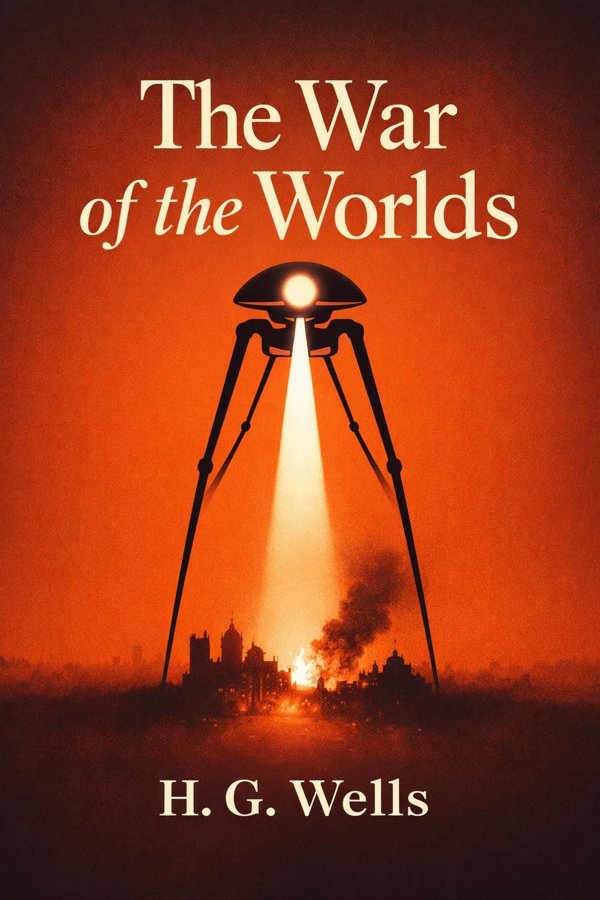
The War of the Worlds: Summary & Key Insights
by H. G. Wells
 10 min10 chaptersAudio available
Key Takeaways from The War of the Worlds
History often begins not with a dramatic proclamation but with a misunderstood event.
Nothing unsettles people more than discovering they are no longer at the center of the story.
Institutions look strongest right before they confront a challenge they were never designed to meet.
Order is often less permanent than it appears.
The most unsettling invasions are often those that reflect what the invaded have done to others.
What Is The War of the Worlds About?
The War of the Worlds by H. G. Wells is a scifi_fantasy book spanning 11 pages. The War of the Worlds is one of the defining works of science fiction: a gripping invasion story, a survival narrative, and a sharp critique of human arrogance all at once. First published in 1898, H. G. Wells imagines what happens when Earth experiences what imperial powers had long inflicted on others: conquest by a technologically superior force. The novel follows an unnamed narrator as Martians land in England, unleash devastating machines and heat-rays, and reduce the confidence of Victorian civilization to panic, ruin, and fear. What begins as scientific curiosity quickly becomes a portrait of social collapse, moral testing, and the fragility of everything people assume is permanent. The book still matters because it speaks to modern anxieties about war, empire, technology, mass destruction, and humanity’s place in the universe. Wells was uniquely qualified to write such a story. A brilliant social critic as well as a novelist, he used speculative fiction not merely to entertain but to expose the weaknesses of society. In The War of the Worlds, he created a timeless warning disguised as an unforgettable adventure.
This FizzRead summary covers all 10 key chapters of The War of the Worlds in approximately 10 minutes, distilling the most important ideas, arguments, and takeaways from H. G. Wells's work. Also available as an audio summary and Key Quotes Podcast.
The War of the Worlds
The War of the Worlds is one of the defining works of science fiction: a gripping invasion story, a survival narrative, and a sharp critique of human arrogance all at once. First published in 1898, H. G. Wells imagines what happens when Earth experiences what imperial powers had long inflicted on others: conquest by a technologically superior force. The novel follows an unnamed narrator as Martians land in England, unleash devastating machines and heat-rays, and reduce the confidence of Victorian civilization to panic, ruin, and fear. What begins as scientific curiosity quickly becomes a portrait of social collapse, moral testing, and the fragility of everything people assume is permanent. The book still matters because it speaks to modern anxieties about war, empire, technology, mass destruction, and humanity’s place in the universe. Wells was uniquely qualified to write such a story. A brilliant social critic as well as a novelist, he used speculative fiction not merely to entertain but to expose the weaknesses of society. In The War of the Worlds, he created a timeless warning disguised as an unforgettable adventure.
Who Should Read The War of the Worlds?
This book is perfect for anyone interested in scifi_fantasy and looking to gain actionable insights in a short read. Whether you're a student, professional, or lifelong learner, the key ideas from The War of the Worlds by H. G. Wells will help you think differently.
- ✓Readers who enjoy scifi_fantasy and want practical takeaways
- ✓Professionals looking to apply new ideas to their work and life
- ✓Anyone who wants the core insights of The War of the Worlds in just 10 minutes
Want the full summary?
Get instant access to this book summary and 100K+ more with Fizz Moment.
Get Free SummaryAvailable on App Store • Free to download
Key Chapters
History often begins not with a dramatic proclamation but with a misunderstood event. In The War of the Worlds, the crisis starts when astronomers observe strange eruptions on Mars and then a metal cylinder crashes onto the English countryside. At first, the incident feels almost manageable. Crowds gather with curiosity rather than fear, reporters seek a story, and local authorities assume the situation can be contained. This opening matters because Wells shows how human beings interpret the unknown through the comforting habits of ordinary life. People expect novelty, not catastrophe.
The cylinder represents more than an alien object. It is the arrival of a reality that does not fit human assumptions. The Victorians believe they live in a stable, rational, well-ordered world, yet the object in the pit instantly exposes how fragile that confidence is. Wells deliberately stages the invasion as a slow awakening. The danger is visible, but most people lack the imagination to recognize it. That pattern is strikingly modern. Societies often ignore warning signs, whether involving new technologies, environmental threats, pandemics, or political extremism, because familiar routines feel safer than hard truths.
The first cylinder also introduces one of the novel’s central themes: superior intelligence does not guarantee moral superiority. Humanity often viewed itself as the pinnacle of creation, but the Martians arrive as a more advanced species with no regard for human life. Wells turns the telescope around and asks readers to imagine what it feels like to be the weaker civilization.
Practical lesson: when a disruptive event appears, the greatest danger may be underestimating it because it does not fit existing expectations. Actionable takeaway: train yourself to question first impressions and take anomalies seriously before they become disasters.
Nothing unsettles people more than discovering they are no longer at the center of the story. When the Martians emerge from the cylinder, they are grotesque, vulnerable-looking, and yet terrifyingly alien. They do not resemble heroic conquerors or familiar monsters; instead, they are products of a completely different evolutionary path. Their huge brains, tentacled bodies, and dependence on machinery signal a civilization shaped by intelligence, adaptation, and ruthless efficiency rather than human values.
Wells uses their appearance to challenge comforting assumptions about life, progress, and destiny. The Martians are physically weak in Earth’s atmosphere, yet they compensate through technology. Their tripods and heat-rays make them overwhelmingly powerful despite their frailty. This contrast is essential. It suggests that dominance in nature does not come from nobility or physical strength alone, but from the ability to innovate, coordinate, and exploit. Humans have often treated animals and colonized peoples as inferior because they lacked military or industrial power. Wells asks readers to confront what happens when humanity occupies that lower position.
The Martians also disturb because they show intelligence without empathy. Their existence forces readers to separate civilization from morality. A species can master science and still remain indifferent to suffering. That idea remains relevant today in discussions about artificial intelligence, biotechnology, and military innovation. Progress without ethics can become a machine of destruction.
In everyday life, this theme encourages humility. We often assume our way of living is natural, final, or superior. Wells reminds us that intelligence can take many forms and that power alone cannot justify domination.
Actionable takeaway: pair curiosity about innovation with moral scrutiny. Whenever you admire an advance in knowledge or technology, ask not only what it can do, but whom it serves and what human cost it may ignore.
Institutions look strongest right before they confront a challenge they were never designed to meet. As more cylinders land and the British military mobilizes, Wells stages a devastating collision between old confidence and new forms of warfare. Artillery is assembled, roads fill with troops, and officials attempt to respond with discipline and procedure. Yet the Martians possess heat-rays, black smoke, and towering fighting machines that make traditional defenses seem painfully obsolete.
This section of the novel is not just exciting; it is diagnostic. Wells exposes the limits of established systems when faced with unprecedented threats. The army is brave, but bravery alone cannot overcome a technological mismatch. Soldiers act according to the logic of conventional war, while the Martians rewrite the rules entirely. Wells understood that modernity was changing combat, and his fictional invasion anticipates the industrialized slaughter of the twentieth century. More broadly, the novel suggests that institutions often mistake organization for preparedness.
The military response also reveals a psychological pattern. People derive comfort from uniforms, command structures, and official announcements. These symbols suggest order. But Wells strips away that illusion, showing that authority can be sincere and still powerless. In business, politics, or public health, organizations often fail not because they lack effort but because they are fighting the last crisis instead of the current one.
A practical application is clear: resilience depends on adaptability, not tradition. Teams that rely only on past success are vulnerable to disruption. Whether facing cyberattacks, market shifts, or social change, leaders must imagine threats beyond familiar models.
Actionable takeaway: regularly test your assumptions against emerging realities. Ask where your plans are built for yesterday’s problems, and update them before disruption exposes their weakness.
Order is often less permanent than it appears. As the Martians advance through Surrey and beyond, the narrator’s desperate journey turns the novel into a study of panic. Roads clog, families separate, rumors spread faster than facts, and the routines of daily life collapse almost overnight. Wells shows that civilization depends not only on laws and infrastructure but also on a shared belief that tomorrow will resemble today. Once that belief breaks, even ordinary people become disoriented, fearful, and unpredictable.
The flight from the invasion is one of the novel’s most powerful sequences because it captures crisis from the ground level. This is not an abstract war map; it is confusion experienced by individuals trying to protect loved ones, find transport, secure food, or simply survive the next hour. Wells pays attention to practical details: jammed roads, social friction, class habits under stress, and the collapse of communication. Through these scenes, he demonstrates that catastrophe is not only about explosions. It is also about uncertainty, scarcity, and the breakdown of mutual trust.
The narrator’s brother’s experiences in London broaden this perspective. The capital, symbol of imperial stability, becomes vulnerable to the same forces of fear and displacement. Wells emphasizes that no center is secure when a society’s basic systems fail.
The modern relevance is obvious. Natural disasters, wars, economic crashes, and public emergencies often reveal how quickly comfort can vanish. The novel encourages readers to think about preparedness in human terms: mobility, communication, calm decision-making, and responsibility to others.
Actionable takeaway: build personal resilience before crisis strikes. Keep practical plans for communication, transport, and essentials, but also cultivate emotional steadiness, because clear thinking is one of the first casualties of panic.
The most unsettling invasions are often those that reflect what the invaded have done to others. As the Martians expand their control, destroying towns and treating humans as expendable creatures, Wells quietly reverses the logic of empire. Victorian Britain ruled vast territories and often justified domination through claims of civilization, progress, and racial superiority. In The War of the Worlds, those arguments become grotesque when humans themselves are reduced to the status of animals before a stronger power.
This is one of the novel’s most important contributions. Wells does not merely imagine aliens attacking Earth for spectacle; he forces his readers to feel the helplessness that colonized peoples had long endured. The Martians seize land, use overwhelming force, and exploit bodies as resources. Their conquest strips away moral self-justification and exposes imperialism as brutality backed by superior technology. The famous comparison to the extermination of indigenous peoples is not incidental. It is Wells’s ethical lens.
The Martian advance also reveals how quickly people retreat into narrow self-interest when systems fail. Some act courageously, but many respond with selfishness, denial, or fantasy. Wells avoids idealizing humanity even as he condemns the invaders. This complexity strengthens the novel’s moral force. Human beings are not innocent simply because they are victims.
This theme remains relevant wherever powerful nations, corporations, or institutions dominate weaker groups while disguising control as benevolence. Reading the novel today encourages readers to examine the narratives that justify inequality and coercion.
Actionable takeaway: whenever a system claims superiority as a license to control others, pause and interrogate it. Ask who benefits, who is dehumanized, and what the situation looks like from the perspective of the powerless.
Crisis does not create character from nothing; it reveals what was hidden beneath comfort. In the middle section of the novel, the narrator becomes trapped with a curate, a clergyman whose mind unravels under pressure. The curate talks compulsively, swings between religious panic and helplessness, and ultimately becomes dangerous because he cannot regulate his fear. Wells uses this painful relationship to explore how terror affects moral judgment, self-control, and social responsibility.
The curate is not simply a weak man placed beside a stronger one. He represents a broader failure of inherited authority. Religion, like government and military power elsewhere in the novel, proves unable to provide stability when reality exceeds old frameworks. The curate cannot interpret the catastrophe in a way that helps survival. His language offers noise rather than clarity. That makes him both tragic and threatening.
By contrast, the narrator survives not through heroism in the conventional sense, but through observation, restraint, and practical adaptation. Wells suggests that in extreme conditions, emotional discipline matters more than rhetoric. The ability to stay quiet, conserve resources, read the environment, and delay impulsive reactions can become the difference between life and death.
This dynamic has obvious modern applications. In emergencies, teams often suffer not only from external danger but from internal emotional contagion. Panic spreads quickly. A single person who cannot manage fear can destabilize everyone else. The lesson is not to suppress emotion completely, but to avoid letting it dictate decisions.
Actionable takeaway: develop habits of calm under pressure. When facing uncertainty, slow your reactions, focus on immediate facts, and choose the next workable step rather than feeding fear with speculation.
When the world collapses, fantasy can feel more comforting than truth. The artilleryman, one of the novel’s most memorable figures, survives the invasion and speaks passionately about rebuilding humanity underground. He imagines a disciplined, hidden civilization that will preserve knowledge, train future generations, and eventually reclaim the Earth from the Martians. On the surface, his vision sounds bold and strategic. For a moment, it even offers hope.
But Wells carefully undermines this dream. The artilleryman talks grandly, yet his actual behavior reveals laziness, self-indulgence, and a lack of commitment. He prefers the romance of a plan to the labor it would require. This makes him more than a colorful side character. He embodies a recurring human temptation: replacing action with imagination, especially when reality is painful.
The artilleryman’s vision matters because it addresses a question central to every disaster: how should humanity respond after systems fail? Wells’s answer is not cynicism but sobriety. Survival and reconstruction demand discipline, honesty, and sustained effort, not theatrical speeches. Grand ideas can inspire, but they become dangerous when they distract from immediate responsibilities.
In modern life, this theme appears whenever leaders offer sweeping solutions without execution, or individuals hide from difficult work inside elaborate future fantasies. Whether in business strategy, politics, personal reinvention, or social reform, compelling rhetoric is easy; consistent implementation is rare.
The lesson is practical: hope must be tied to realism. It is useful to imagine a better future, but only if that vision leads to concrete steps rather than self-deception.
Actionable takeaway: whenever you feel inspired by a big plan, ask what measurable action should happen today. If there is no disciplined next step, the vision may be an escape rather than a solution.
Civilizations appear immortal until one decisive moment proves otherwise. The fall of London is the emotional and symbolic climax of The War of the Worlds. As the Martians close in and black smoke spreads, the imperial capital becomes a city of abandonment, confusion, and death. Wells’s achievement here lies in scale. He does not describe the destruction of an isolated village but the humiliation of one of the most powerful urban centers in the world. The message is unmistakable: no society is too advanced, too wealthy, or too proud to collapse.
London’s downfall also intensifies the novel’s critique of modern confidence. Victorian Britain saw itself as a global center of commerce, governance, science, and empire. By bringing terror to its streets, Wells attacks the illusion that technological and political dominance guarantees safety. The very structures that symbolize strength become irrelevant against a force that does not respect familiar boundaries.
Yet the scenes are not only political; they are deeply human. Refugees wander, social distinctions blur, and survival replaces status. Under extreme pressure, prestige loses value. What matters becomes movement, shelter, water, and chance. Wells shows that crises can strip life down to essentials with startling speed.
This remains one of the novel’s enduring warnings. Complex societies are interdependent, and their confidence can mask hidden fragility. Financial systems, supply chains, communications networks, and public trust can fail faster than people expect.
Actionable takeaway: do not confuse sophistication with invulnerability. In your own life and work, identify the basic dependencies beneath apparent stability, and strengthen them before stress reveals how much rests on assumptions rather than true resilience.
The greatest powers may still be undone by what they fail to understand. After defeating armies, terrorizing cities, and appearing unstoppable, the Martians die not by human triumph in battle but because they lack immunity to Earth’s microscopic life. Bacteria, invisible and ordinary, accomplish what organized resistance could not. This ending is one of the most brilliant reversals in literature. Wells shifts the scale from giant machines and imperial destruction to the smallest forms of life, reminding readers that power is always relative.
The defeat of the Martians does not flatter humanity. In fact, it humbles us further. Humans are saved not by superior wisdom or force, but by ecological belonging. Life on Earth has evolved in relationship with countless organisms, many of them unnoticed. The Martians, despite all their intelligence, stand outside that network and are destroyed by it. Wells therefore challenges the fantasy that mastery means independence. No being, however advanced, exists beyond biology.
This idea has become even more relevant in the modern world. Public health, environmental science, and climate awareness all reinforce Wells’s insight that human plans operate within larger natural systems. The novel warns against technological arrogance and reminds us that overlooked forces can shape history more decisively than weapons or institutions.
On a personal level, the ending encourages intellectual humility. We often focus on dramatic threats while ignoring subtle conditions that make survival possible: healthy ecosystems, immune systems, infrastructure, trust, and care.
Actionable takeaway: respect the invisible systems that sustain life. Whether thinking about health, the environment, or social stability, pay attention to foundational conditions, because the smallest neglected factors can become the most decisive.
Survival is not the same as restoration. After the Martians perish, the world does not simply return to normal. The narrator reunites with his wife, but the emotional and philosophical consequences of the invasion remain. Wells closes the novel not with uncomplicated relief, but with reflection. Humanity has been spared, yet its illusions have been shattered. People now know that Earth is not secure, that civilization can be overwhelmed, and that the universe may contain intelligences indifferent to human hopes.
This aftermath is crucial because it transforms the story from adventure into lasting meditation. The invasion forces a new perspective on human life. Daily routines, national pride, and social hierarchies all appear smaller when viewed against cosmic possibility. Wells does not encourage despair, however. Instead, he offers a more mature awareness: humility can deepen seriousness, sharpen gratitude, and provoke wiser forms of inquiry.
The aftermath also highlights the psychological burden of catastrophe. Survivors carry memory. They struggle to reconcile familiar places with what they witnessed there. This gives the novel unusual emotional depth for an early science fiction work. Wells understands that disaster changes perception permanently.
For modern readers, the lesson is powerful. Major disruptions, whether personal or collective, often leave us with a choice: cling to old illusions or build a more honest worldview. Growth begins when we accept vulnerability without surrendering meaning.
Actionable takeaway: after any major setback or upheaval, take time to reflect on what assumptions were broken. Use the experience not merely to recover the old normal, but to rebuild your perspective on a firmer, more realistic foundation.
All Chapters in The War of the Worlds
About the Author
H. G. Wells, born Herbert George Wells in 1866, was an English novelist, essayist, journalist, and social critic whose work helped shape modern science fiction. Raised in modest circumstances, he studied biology under T. H. Huxley, an experience that deeply influenced his interest in evolution, science, and social change. Wells became famous through a series of groundbreaking novels, including The Time Machine, The Invisible Man, The Island of Doctor Moreau, and The War of the Worlds. His fiction combined imagination with serious reflection on class, empire, technology, and the future of humanity. Beyond novels, he wrote extensively on politics, education, and history. Wells died in 1946, but his influence remains immense. He is still regarded as one of the most important speculative writers ever to put scientific ideas into unforgettable narrative form.
Get This Summary in Your Preferred Format
Read or listen to the The War of the Worlds summary by H. G. Wells anytime, anywhere. FizzRead offers multiple formats so you can learn on your terms — all free.
Available formats: App · Audio · PDF · EPUB — All included free with FizzRead
Download The War of the Worlds PDF and EPUB Summary
Key Quotes from The War of the Worlds
“History often begins not with a dramatic proclamation but with a misunderstood event.”
“Nothing unsettles people more than discovering they are no longer at the center of the story.”
“Institutions look strongest right before they confront a challenge they were never designed to meet.”
“Order is often less permanent than it appears.”
“The most unsettling invasions are often those that reflect what the invaded have done to others.”
Frequently Asked Questions about The War of the Worlds
The War of the Worlds by H. G. Wells is a scifi_fantasy book that explores key ideas across 10 chapters. The War of the Worlds is one of the defining works of science fiction: a gripping invasion story, a survival narrative, and a sharp critique of human arrogance all at once. First published in 1898, H. G. Wells imagines what happens when Earth experiences what imperial powers had long inflicted on others: conquest by a technologically superior force. The novel follows an unnamed narrator as Martians land in England, unleash devastating machines and heat-rays, and reduce the confidence of Victorian civilization to panic, ruin, and fear. What begins as scientific curiosity quickly becomes a portrait of social collapse, moral testing, and the fragility of everything people assume is permanent. The book still matters because it speaks to modern anxieties about war, empire, technology, mass destruction, and humanity’s place in the universe. Wells was uniquely qualified to write such a story. A brilliant social critic as well as a novelist, he used speculative fiction not merely to entertain but to expose the weaknesses of society. In The War of the Worlds, he created a timeless warning disguised as an unforgettable adventure.
More by H. G. Wells
You Might Also Like
Red Rising
Pierce Brown
10 min
Stranger in a Strange Land
Robert A. Heinlein
10 min
AI Valley
Chen Qiufan
10 min
Bloodchild
Octavia E. Butler
10 min
Do Androids Dream of Electric Sheep?
Philip K. Dick
10 min
Jujutsu Kaisen, Vol. 24
Gege Akutami
10 minBrowse by Category
Ready to read The War of the Worlds?
Get the full summary and 100K+ more books with Fizz Moment.