
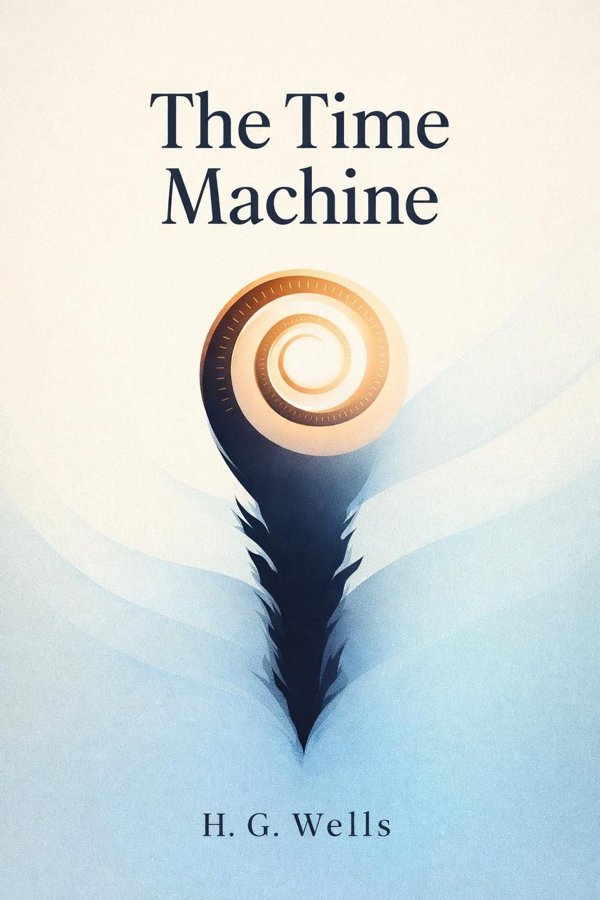
The Time Machine: Summary & Key Insights
by H. G. Wells
 10 min9 chaptersAudio available
What Is The Time Machine About?
The Time Machine by H. G. Wells is a scifi_fantasy book spanning 9 pages. The Time Machine is a science fiction novella by H. G. Wells, first published in 1895. It tells the story of an English scientist known as the Time Traveller who invents a machine that allows him to travel through time. Journeying to the distant future, he discovers a world inhabited by two evolved human species—the gentle Eloi and the subterranean Morlocks—revealing a haunting vision of humanity’s fate shaped by class division and evolution.
This FizzRead summary covers all 9 key chapters of The Time Machine in approximately 10 minutes, distilling the most important ideas, arguments, and takeaways from H. G. Wells's work. Also available as an audio summary and Key Quotes Podcast.
The Time Machine
The Time Machine is a science fiction novella by H. G. Wells, first published in 1895. It tells the story of an English scientist known as the Time Traveller who invents a machine that allows him to travel through time. Journeying to the distant future, he discovers a world inhabited by two evolved human species—the gentle Eloi and the subterranean Morlocks—revealing a haunting vision of humanity’s fate shaped by class division and evolution.
Who Should Read The Time Machine?
This book is perfect for anyone interested in scifi_fantasy and looking to gain actionable insights in a short read. Whether you're a student, professional, or lifelong learner, the key ideas from The Time Machine by H. G. Wells will help you think differently.
- ✓Readers who enjoy scifi_fantasy and want practical takeaways
- ✓Professionals looking to apply new ideas to their work and life
- ✓Anyone who wants the core insights of The Time Machine in just 10 minutes
Want the full summary?
Get instant access to this book summary and 100K+ more with Fizz Moment.
Get Free SummaryAvailable on App Store • Free to download
Key Chapters
After the dinner that introduced the astonishing concept of time travel, the Time Traveller dedicates himself wholly to the task of translating theory into reality. His laboratory becomes a sanctuary of pursuit, filled with shining metal, intricate dials, and delicate levers—symbols of human ingenuity reaching for the infinite. Through his own words, I wanted to convey the feverish devotion that marks every true advance in science. Each bolt tightened is a declaration of faith in reason; each experiment an act of rebellion against the limits imposed by mortality.
The Time Traveller’s construction is not portrayed as effortless triumph. Just as the great explorers faced storms and skepticism, he encounters doubt, even ridicule. Yet the vision of transcending time itself sustains him. In the rhythm of his work, there beats the heart of every scientific pioneer—from Galileo observing the heavens to Darwin pondering extinction. He embodies the same audacity: the belief that knowledge can pierce through the veils of mystery.
When the machine finally stands complete, it gleams like a sculpture forged from purpose. Its tiny model had promised possibility; the full-scale version promises revelation. At that moment, the divide between theory and action dissolves. The Time Traveller prepares to step not into another country but another epoch, reminding us that invention without courage is merely decoration. The creation of the time machine thus becomes an allegory of the human condition: we construct bridges to the unknown, trusting that discovery will bring enlightenment, even if it may also bring despair.
The activation of the machine marks one of the most electrifying transitions in all imaginative literature. As the Time Traveller grips the levers, space itself trembles and the familiar world dissolves. Time elongates and contracts before his eyes—the sun streaking across the sky, days flashing into nights like the beat of a pulse. Civilization itself, that mighty edifice built upon generations of labor, flickers and fades into dust.
In writing this sequence, I sought to convey both the exhilaration and terror of temporal travel. The sensation is not flight but a fall through history, each century peeling away the veneer of stability we assume surrounds us. The Traveller feels the rush of centuries as wind; he sees the landscape transform, cities crumble, vegetation reclaim the earth. The experience is less a journey than an awakening—a brutal realization that permanence is the illusion of the present moment.
Here, science becomes metaphor. The speeding machine may be the instrument of discovery, but its motion symbolizes the unstoppable progress of time itself. It is a reminder that even as we innovate, we cannot escape decay. When the dizziness subsides and silence reigns again, he finds himself in a strange serenity—the year 802,701 A.D.—a world that seems peaceful, luminous, and yet chillingly alien.
+ 7 more chapters — available in the FizzRead app
All Chapters in The Time Machine
About the Author
Herbert George Wells (1866–1946) was an English writer best known for his pioneering works of science fiction, including The War of the Worlds, The Invisible Man, and The Time Machine. Often called the 'father of science fiction,' Wells also wrote extensively on social commentary, history, and politics, influencing both literature and modern thought.
Get This Summary in Your Preferred Format
Read or listen to the The Time Machine summary by H. G. Wells anytime, anywhere. FizzRead offers multiple formats so you can learn on your terms — all free.
Available formats: App · Audio · PDF · EPUB — All included free with FizzRead
Download The Time Machine PDF and EPUB Summary
Key Quotes from The Time Machine
“After the dinner that introduced the astonishing concept of time travel, the Time Traveller dedicates himself wholly to the task of translating theory into reality.”
“The activation of the machine marks one of the most electrifying transitions in all imaginative literature.”
Frequently Asked Questions about The Time Machine
The Time Machine by H. G. Wells is a scifi_fantasy book that explores key ideas across 9 chapters. The Time Machine is a science fiction novella by H. G. Wells, first published in 1895. It tells the story of an English scientist known as the Time Traveller who invents a machine that allows him to travel through time. Journeying to the distant future, he discovers a world inhabited by two evolved human species—the gentle Eloi and the subterranean Morlocks—revealing a haunting vision of humanity’s fate shaped by class division and evolution.
More by H. G. Wells
You Might Also Like

Red Rising
Pierce Brown
10 min
Stranger in a Strange Land
Robert A. Heinlein
10 min
AI Valley
Chen Qiufan
10 min
Bloodchild
Octavia E. Butler
10 min
Do Androids Dream of Electric Sheep?
Philip K. Dick
10 min
Jujutsu Kaisen, Vol. 24
Gege Akutami
10 minBrowse by Category
Ready to read The Time Machine?
Get the full summary and 100K+ more books with Fizz Moment.