
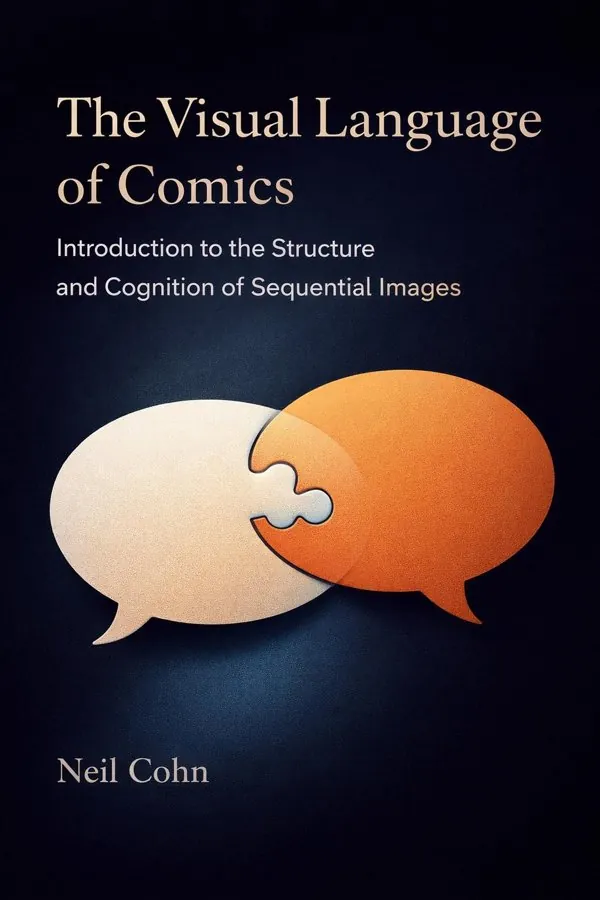
The Visual Language of Comics: Introduction to the Structure and Cognition of Sequential Images: Summary & Key Insights
by Neil Cohn
 10 min8 chaptersAudio available
Key Takeaways from The Visual Language of Comics: Introduction to the Structure and Cognition of Sequential Images
The most provocative idea in this book is also its central claim: comics are not simply a mixture of art and text, but a structured visual language.
What seems visually obvious is often carefully constructed from smaller parts.
Stories in comics do not unfold randomly from panel to panel.
One of the most important corrections Cohn makes is to the myth that images are universal.
It is easy to underestimate comics because they can be read quickly.
What Is The Visual Language of Comics: Introduction to the Structure and Cognition of Sequential Images About?
The Visual Language of Comics: Introduction to the Structure and Cognition of Sequential Images by Neil Cohn is a cognition book spanning 7 pages. Comics may look effortless on the page, but Neil Cohn argues that their meaning is anything but accidental. In The Visual Language of Comics, he makes a bold and intellectually rich case: sequential images are not merely illustrations arranged in order, but a genuine visual language with its own structure, conventions, and grammar. Just as spoken and written language rely on learned systems of meaning, comics depend on shared visual patterns that readers must acquire and interpret. What makes this book especially important is the way it bridges fields that are often kept apart. Cohn draws from linguistics, cognitive psychology, comics studies, and visual communication to explain how people understand panels, transitions, narrative roles, and graphic symbols. He shows that reading comics is an active cognitive achievement, not a passive act of looking. Cohn is uniquely qualified to make this argument. As a cognitive scientist and linguist focused on visual narratives, he has spent years studying how the mind processes sequential images across cultures. The result is a foundational book for anyone who wants to understand not only how comics work, but what they reveal about language, learning, and human thought.
This FizzRead summary covers all 8 key chapters of The Visual Language of Comics: Introduction to the Structure and Cognition of Sequential Images in approximately 10 minutes, distilling the most important ideas, arguments, and takeaways from Neil Cohn's work. Also available as an audio summary and Key Quotes Podcast.
The Visual Language of Comics: Introduction to the Structure and Cognition of Sequential Images
Comics may look effortless on the page, but Neil Cohn argues that their meaning is anything but accidental. In The Visual Language of Comics, he makes a bold and intellectually rich case: sequential images are not merely illustrations arranged in order, but a genuine visual language with its own structure, conventions, and grammar. Just as spoken and written language rely on learned systems of meaning, comics depend on shared visual patterns that readers must acquire and interpret.
What makes this book especially important is the way it bridges fields that are often kept apart. Cohn draws from linguistics, cognitive psychology, comics studies, and visual communication to explain how people understand panels, transitions, narrative roles, and graphic symbols. He shows that reading comics is an active cognitive achievement, not a passive act of looking.
Cohn is uniquely qualified to make this argument. As a cognitive scientist and linguist focused on visual narratives, he has spent years studying how the mind processes sequential images across cultures. The result is a foundational book for anyone who wants to understand not only how comics work, but what they reveal about language, learning, and human thought.
Who Should Read The Visual Language of Comics: Introduction to the Structure and Cognition of Sequential Images?
This book is perfect for anyone interested in cognition and looking to gain actionable insights in a short read. Whether you're a student, professional, or lifelong learner, the key ideas from The Visual Language of Comics: Introduction to the Structure and Cognition of Sequential Images by Neil Cohn will help you think differently.
- ✓Readers who enjoy cognition and want practical takeaways
- ✓Professionals looking to apply new ideas to their work and life
- ✓Anyone who wants the core insights of The Visual Language of Comics: Introduction to the Structure and Cognition of Sequential Images in just 10 minutes
Want the full summary?
Get instant access to this book summary and 100K+ more with Fizz Moment.
Get Free SummaryAvailable on App Store • Free to download
Key Chapters
The most provocative idea in this book is also its central claim: comics are not simply a mixture of art and text, but a structured visual language. That statement challenges a common assumption that images are universally understood and require no special learning. Cohn argues the opposite. Like speech or writing, comics rely on organized systems of signs, conventions, and combinations that users must internalize in order to understand them fluently.
In spoken language, we combine sounds into words and words into sentences. In comics, readers combine visual units into panels and panels into sequences that communicate actions, emotions, events, and narrative relationships. A jagged speech balloon may indicate shouting. Motion lines may suggest speed. A sequence of panels may imply causality, time, or emotional change. None of these meanings emerge from raw perception alone; they depend on learned visual conventions.
This linguistic perspective matters because it changes how we think about reading comics. If comics are a language, then readers can become more or less fluent, creators can manipulate grammar for effect, and cultural traditions can develop distinct visual dialects. Japanese manga, American superhero comics, and European bandes dessinées may all share broad principles while differing in style and narrative conventions.
The idea also has practical implications. Teachers can treat comics literacy as a skill worth developing rather than as a trivial byproduct of looking at pictures. Creators can study visual grammar as seriously as writers study syntax. Researchers can compare comics comprehension to language processing in the brain.
Actionable takeaway: stop thinking of comics as “just pictures,” and start reading them as a learned communication system with rules, expectations, and expressive possibilities.
What seems visually obvious is often carefully constructed from smaller parts. Cohn shows that visual language begins with basic graphic units that carry conventional meaning, much like morphemes or words in verbal language. These include lines, shapes, icons, facial expressions, body postures, framing devices, and recurring symbols such as light bulbs for ideas or stars for pain.
These elements do not function in isolation. A single curved line may mean little on its own, but when attached to a face it can become a smile, and when multiplied near a moving arm it can imply motion. Panels then package these visual units into meaningful moments, while sequences connect moments into unfolding narratives. In other words, graphic marks become signs, signs become scenes, and scenes become stories.
This layered structure explains why skilled comics artists can communicate so much with economical drawing. Consider a simple three-panel strip: in the first panel, a character looks at a cake; in the second, a hand reaches forward; in the third, the cake is gone and the character smiles. Even with minimal detail, readers infer desire, action, and outcome because they understand the building blocks and how they combine.
For readers, awareness of these units improves comprehension. For creators, it improves control. A crowded panel with too many competing symbols may confuse the reader, while a clear arrangement of gaze, gesture, and framing can guide attention naturally. Designers of educational graphics and storyboards can use the same principle by reducing complexity and making each visual component purposeful.
Actionable takeaway: when reading or creating comics, pay attention to the smallest visual cues—lines, symbols, framing, and posture—because these are the foundational units from which larger narrative meaning is built.
Stories in comics do not unfold randomly from panel to panel. Cohn’s concept of visual narrative grammar argues that sequences have an underlying syntax, a patterned organization that helps readers understand what role each panel plays in the larger event. This is one of the book’s most powerful contributions because it moves discussion of comics beyond style into structure.
Just as sentences often contain subjects, verbs, and objects arranged in predictable relations, comics sequences contain panels that serve different narrative functions. Some panels establish context, some build tension, some show the peak action, and others provide aftermath or resolution. Readers often understand these roles intuitively, but Cohn shows that intuition reflects tacit knowledge of visual grammar.
Imagine a four-panel sequence: a character notices a banana peel, steps forward, slips, and lies on the ground. If the order is rearranged, comprehension becomes awkward. The humor weakens because the narrative syntax has been disrupted. Likewise, inserting an establishing panel before the slip can improve clarity, while removing the final reaction panel may make the event feel unfinished. Structure shapes meaning.
This insight is practical for artists, editors, and educators. Creators can diagnose why a sequence feels confusing by asking whether the narrative roles are clear. Teachers can help students analyze comics not just by discussing content, but by identifying setup, progression, climax, and release. Filmmakers and storyboard artists can also benefit, since visual sequencing affects pacing across media.
Actionable takeaway: when a comic sequence feels smooth or confusing, examine the function of each panel—what sets up the action, what develops it, and what resolves it—to understand the hidden syntax guiding the reader.
One of the most important corrections Cohn makes is to the myth that images are universal. While people everywhere can perceive shapes and faces, the conventions used in comics are not the same across cultures. Visual languages are shaped by shared traditions, publication histories, artistic norms, and reader experience. This means that fluency in one comics tradition does not automatically transfer perfectly to another.
For example, manga may use symbolic backgrounds, decompressed pacing, and highly codified emotional icons in ways that differ from mainstream American comics. European comics may handle page layout, panel density, and visual emphasis differently again. A reader unfamiliar with these traditions may still follow the broad plot, but subtler cues about tone, pacing, or emotional intensity may be missed.
This cross-cultural variation strengthens rather than weakens Cohn’s argument. Spoken languages differ, yet no one concludes that language does not exist. In the same way, the existence of different visual systems suggests that comics rely on learned conventions, not purely universal perception. Some graphic devices may travel widely, but their use and interpretation remain culturally shaped.
This has practical value for global creators and readers. Translating a comic is not only about converting words in speech balloons. It may also require sensitivity to layout, symbols, timing, and reader expectations. Teachers using comics in multicultural classrooms should not assume that every student interprets the same image sequence identically.
Actionable takeaway: approach comics from other cultures with curiosity rather than assumption, and recognize that visual fluency—like verbal fluency—depends on exposure to specific conventions and traditions.
It is easy to underestimate comics because they can be read quickly. But speed should not be confused with simplicity. Cohn demonstrates that understanding sequential images requires sophisticated cognitive processing. Readers must perceive visual forms, recognize symbolic conventions, infer actions between panels, track characters across changing views, and build a coherent mental model of the unfolding story.
A key challenge in comics is closure: the reader must connect separate images into continuous events. If one panel shows a raised fist and the next shows a broken vase, the impact is often not drawn directly. The mind fills in the missing action. This act of inference resembles how we process language, where listeners infer implied meaning beyond literal words. Comics reading is therefore dynamic and participatory.
Attention, memory, and expectation all play roles. Readers store prior panels in working memory, compare new information with earlier events, and use narrative expectations to predict what comes next. This is why a confusing page layout or ambiguous transition can slow comprehension. It is also why experienced comics readers often navigate complex sequences more easily than beginners.
The implications go beyond comics studies. Understanding how people process sequential images can inform educational design, interface design, visual instructions, and even clinical research into cognition. For example, visual narratives may offer alternative pathways for communication when verbal processing is limited, though they still require learned competence.
Actionable takeaway: treat comics reading as an active interpretive skill, and improve comprehension by slowing down, tracking panel-to-panel inferences, and noticing how your mind fills the gaps between images.
People are not born knowing how to read comics any more than they are born reading text. Cohn emphasizes that visual language is learned, and proficiency develops gradually through exposure, practice, and cultural participation. This idea has major consequences for how we think about education, literacy, and artistic training.
Children may enjoy pictures early, but enjoying pictures is not the same as understanding sequential visual grammar. Young readers often need time to grasp panel order, causal transitions, symbolic marks, and narrative pacing. Likewise, adults unfamiliar with comics may misread layouts or overlook conventions that experienced readers process effortlessly. Fluency is built through repeated contact with visual narrative systems.
This developmental perspective helps explain differences in reader experience. A seasoned manga reader may instantly understand an exaggerated sweat drop as embarrassment, while a newcomer may treat it as decorative. An experienced comics artist intuitively knows how to guide the eye across a page, while a novice may create layouts that look exciting but disrupt comprehension.
The same principle applies to learning environments. If educators use comics for teaching, they should not assume all students are equally visually literate. Instruction may need to include how to read panels, interpret symbols, and understand sequencing. Artists, too, can improve by studying how readers learn conventions and by testing their work with different audiences.
Actionable takeaway: build visual fluency deliberately—read across styles, study page flow and symbolism, and remember that better comprehension of comics comes from practice, not just from having eyesight.
Comics are often treated either as entertainment or as an artistic medium, but Cohn shows they are also a powerful scientific window into human cognition. Because comics combine perception, symbolic interpretation, sequencing, and narrative inference, they allow researchers to study how the mind coordinates multiple systems at once. In this sense, comics are not a niche curiosity; they are a valuable laboratory for understanding thought.
The book highlights how visual narratives intersect with linguistics, psychology, neuroscience, and communication theory. If readers process panel sequences using expectations similar to syntactic structures in language, then comics can help test broader theories about how humans organize meaning. If different cultural traditions produce different visual grammars, they can reveal how learning shapes perception and interpretation.
There are practical implications beyond academia. Designers of manuals, infographics, educational media, and digital interfaces all rely on sequential visuals. A poor instruction diagram can fail for the same reasons a poor comic fails: unclear visual units, weak sequencing, or broken narrative expectations. Conversely, well-designed visuals can improve learning, memory, and engagement.
For artists, this perspective is empowering. Studying cognition does not reduce art to mechanics; it provides insight into why certain techniques work. Timing, framing, and symbolic shorthand are not arbitrary tricks but tools that engage predictable mental processes. Knowing this can make creative choices more intentional.
Actionable takeaway: use comics as a model for effective communication—whether in art, teaching, or design—by aligning visual choices with how people actually perceive, infer, and remember meaning.
A common mistake is to think of comics as pictures first and words second, as if text merely labels what the eye already sees. Cohn’s framework encourages a more integrated view. In many comics, verbal and visual information work together as interdependent systems. Meaning emerges not from one channel alone, but from their coordination.
A panel may show a character smiling while the caption reveals bitter sarcasm. An image may depict a city street, while dialogue specifies danger that is not yet visible. Sound effects can function visually and verbally at once, shaping rhythm, emphasis, and emotional force. In these cases, readers do not separately process words and pictures and then compare them; they construct a unified interpretation from both.
This matters because it explains why adaptations between media are difficult. A comic page may rely on the tension between sparse text and expressive imagery, or between narration and panel sequencing. Simply extracting the words or reproducing the pictures does not preserve the full communicative structure. It also matters for creators, who need to know when to let the image carry the meaning and when text should redirect, deepen, or complicate it.
In education and communication design, this principle warns against redundancy. If text merely repeats what the image already says, attention may be wasted. But if text complements the image by adding context, timing, or interpretation, learning can improve. The most effective comics often achieve this balance elegantly.
Actionable takeaway: evaluate every word and image in a comic by asking how they work together, and aim for complementarity rather than simple repetition.
All Chapters in The Visual Language of Comics: Introduction to the Structure and Cognition of Sequential Images
About the Author
Neil Cohn is a cognitive scientist and linguist whose work focuses on the structure and comprehension of visual language, especially comics and sequential images. He is widely recognized for developing theories that connect comics studies with linguistics, psychology, and cognitive science. His research explores how readers understand visual narratives, how graphic conventions are learned, and how different cultures develop distinct visual systems. Cohn has published extensively on comics grammar, drawing, and the mental processes behind visual communication. He has also taught and conducted research at universities including Tilburg University in the Netherlands. What makes his work especially influential is his ability to treat comics not merely as entertainment or art, but as a serious communicative system that reveals important truths about language, learning, and the human mind.
Get This Summary in Your Preferred Format
Read or listen to the The Visual Language of Comics: Introduction to the Structure and Cognition of Sequential Images summary by Neil Cohn anytime, anywhere. FizzRead offers multiple formats so you can learn on your terms — all free.
Available formats: App · Audio · PDF · EPUB — All included free with FizzRead
Download The Visual Language of Comics: Introduction to the Structure and Cognition of Sequential Images PDF and EPUB Summary
Key Quotes from The Visual Language of Comics: Introduction to the Structure and Cognition of Sequential Images
“The most provocative idea in this book is also its central claim: comics are not simply a mixture of art and text, but a structured visual language.”
“What seems visually obvious is often carefully constructed from smaller parts.”
“Stories in comics do not unfold randomly from panel to panel.”
“One of the most important corrections Cohn makes is to the myth that images are universal.”
“It is easy to underestimate comics because they can be read quickly.”
Frequently Asked Questions about The Visual Language of Comics: Introduction to the Structure and Cognition of Sequential Images
The Visual Language of Comics: Introduction to the Structure and Cognition of Sequential Images by Neil Cohn is a cognition book that explores key ideas across 8 chapters. Comics may look effortless on the page, but Neil Cohn argues that their meaning is anything but accidental. In The Visual Language of Comics, he makes a bold and intellectually rich case: sequential images are not merely illustrations arranged in order, but a genuine visual language with its own structure, conventions, and grammar. Just as spoken and written language rely on learned systems of meaning, comics depend on shared visual patterns that readers must acquire and interpret. What makes this book especially important is the way it bridges fields that are often kept apart. Cohn draws from linguistics, cognitive psychology, comics studies, and visual communication to explain how people understand panels, transitions, narrative roles, and graphic symbols. He shows that reading comics is an active cognitive achievement, not a passive act of looking. Cohn is uniquely qualified to make this argument. As a cognitive scientist and linguist focused on visual narratives, he has spent years studying how the mind processes sequential images across cultures. The result is a foundational book for anyone who wants to understand not only how comics work, but what they reveal about language, learning, and human thought.
You Might Also Like
A Field Guide to Lies: Critical Thinking in the Information Age
Daniel J. Levitin
10 min
A Theory of Cognitive Dissonance
Leon Festinger
10 min
Black-And-White Thinking: The Burden of a Binary Brain in a Complex World
Kevin Dutton
10 min
Born Liars: Why We Can’t Live Without Deceit
Ian Leslie
10 min
Collective Illusions: Conformity, Complicity, and the Science of Why We Make Bad Decisions
Todd Rose
10 min
Concrete Mathematics: A Foundation for Computer Science
Ronald L. Graham, Donald E. Knuth, Oren Patashnik
10 minBrowse by Category
Ready to read The Visual Language of Comics: Introduction to the Structure and Cognition of Sequential Images?
Get the full summary and 100K+ more books with Fizz Moment.