
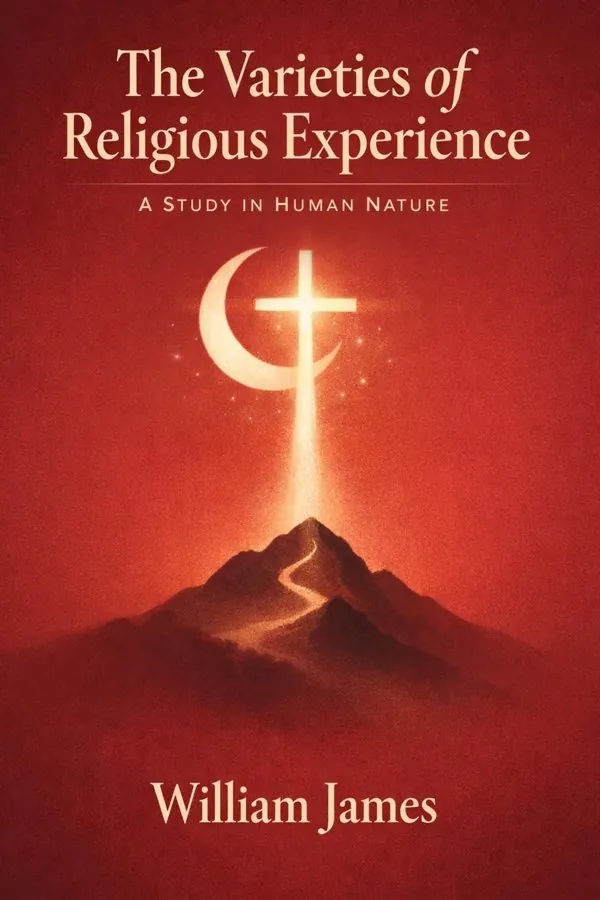
The Varieties of Religious Experience: A Study in Human Nature: Summary & Key Insights
 10 min9 chaptersAudio available
Key Takeaways from The Varieties of Religious Experience: A Study in Human Nature
The most important facts about religion may happen far from temples, rituals, and official doctrines.
Some people seem naturally oriented toward trust, gratitude, and the bright side of existence.
Some truths can only be seen by those who have suffered enough to lose their illusions.
A human being can live for years in conflict and then change all at once.
The deepest beliefs are eventually revealed not in speech, but in temperament and conduct.
What Is The Varieties of Religious Experience: A Study in Human Nature About?
The Varieties of Religious Experience: A Study in Human Nature by William James is a psychology book spanning 9 pages. What if religion were studied not as a system of doctrines, but as a lived reality inside the human mind? In The Varieties of Religious Experience, William James approaches faith from exactly that angle. First delivered as the famous Gifford Lectures in 1901–1902, this classic work examines conversion, mysticism, saintliness, despair, and spiritual renewal as deeply personal psychological events rather than merely theological claims. James is less interested in churches, institutions, and creeds than in what happens to individuals when they feel themselves in contact with something greater than their ordinary selves. What makes the book enduring is its combination of intellectual rigor, empathy, and openness. James neither dismisses religion as illusion nor accepts every spiritual claim uncritically. Instead, he asks what religious experiences do in people’s lives: how they change behavior, relieve suffering, inspire moral energy, and reshape identity. As one of the founders of modern psychology and a major philosopher of pragmatism, James brought exceptional authority to this inquiry. The result is a landmark study of belief, emotion, and consciousness that still speaks powerfully to readers interested in psychology, spirituality, and the complexity of human nature.
This FizzRead summary covers all 9 key chapters of The Varieties of Religious Experience: A Study in Human Nature in approximately 10 minutes, distilling the most important ideas, arguments, and takeaways from William James's work. Also available as an audio summary and Key Quotes Podcast.
The Varieties of Religious Experience: A Study in Human Nature
What if religion were studied not as a system of doctrines, but as a lived reality inside the human mind? In The Varieties of Religious Experience, William James approaches faith from exactly that angle. First delivered as the famous Gifford Lectures in 1901–1902, this classic work examines conversion, mysticism, saintliness, despair, and spiritual renewal as deeply personal psychological events rather than merely theological claims. James is less interested in churches, institutions, and creeds than in what happens to individuals when they feel themselves in contact with something greater than their ordinary selves.
What makes the book enduring is its combination of intellectual rigor, empathy, and openness. James neither dismisses religion as illusion nor accepts every spiritual claim uncritically. Instead, he asks what religious experiences do in people’s lives: how they change behavior, relieve suffering, inspire moral energy, and reshape identity. As one of the founders of modern psychology and a major philosopher of pragmatism, James brought exceptional authority to this inquiry. The result is a landmark study of belief, emotion, and consciousness that still speaks powerfully to readers interested in psychology, spirituality, and the complexity of human nature.
Who Should Read The Varieties of Religious Experience: A Study in Human Nature?
This book is perfect for anyone interested in psychology and looking to gain actionable insights in a short read. Whether you're a student, professional, or lifelong learner, the key ideas from The Varieties of Religious Experience: A Study in Human Nature by William James will help you think differently.
- ✓Readers who enjoy psychology and want practical takeaways
- ✓Professionals looking to apply new ideas to their work and life
- ✓Anyone who wants the core insights of The Varieties of Religious Experience: A Study in Human Nature in just 10 minutes
Want the full summary?
Get instant access to this book summary and 100K+ more with Fizz Moment.
Get Free SummaryAvailable on App Store • Free to download
Key Chapters
The most important facts about religion may happen far from temples, rituals, and official doctrines. William James begins by narrowing his focus deliberately: he is not primarily studying organized religion, ecclesiastical power, or formal theology. Instead, he investigates the inner life of individuals and the moments in which they feel connected to an unseen order. For James, religion in its most vital form is what people experience in solitude, in crisis, in prayer, in awe, and in the sense that life has a deeper meaning than appearances suggest.
This distinction matters because public religion can be inherited, imitated, or socially enforced, while personal religion must be lived. A creed may be memorized, but an experience of surrender, rebirth, forgiveness, or transcendence leaves psychological traces. James treats these experiences as data. He collects testimonies, autobiographical reports, and case studies to understand what religion does to consciousness and conduct.
In modern terms, this approach remains useful even for nonreligious readers. We can ask similar questions about meditation, therapy, peak performance, grief, or moral awakening. What changes a person at the deepest level? What experiences reorganize motivation and identity? James shows that if we want to understand belief, we should look less at abstract statements and more at transformed lives.
A practical application is to examine your own convictions through lived evidence rather than labels. Instead of asking only, “What do I say I believe?” ask, “What experiences actually shape how I live, suffer, hope, and decide?” Actionable takeaway: pay attention to the private experiences that most deeply influence your character, because they reveal more about your worldview than any formal creed.
Some people seem naturally oriented toward trust, gratitude, and the bright side of existence. James calls this disposition “healthy-mindedness,” a religious or psychological outlook that emphasizes goodness, harmony, and the possibility of happiness. Healthy-minded individuals do not deny life’s difficulties so much as they refuse to grant darkness the final word. They are drawn to affirmative spiritual visions that highlight divine benevolence, moral progress, and the healing power of faith.
James sees strength in this posture. It can generate resilience, confidence, and emotional vitality. People who sincerely believe that reality is fundamentally meaningful often endure hardship with less bitterness. In everyday life, healthy-mindedness appears in people who recover from setbacks quickly, practice gratitude, seek constructive interpretations, and surround themselves with uplifting habits.
But James is also alert to its limits. Optimism can become superficial if it merely suppresses pain. A person who insists that everything is fine may avoid confronting injustice, guilt, grief, or depression. Positive thinking becomes psychologically thin when it cannot reckon with tragedy. James therefore admires healthy-mindedness without treating it as the whole truth.
This insight remains highly relevant today. Much of modern self-help celebrates optimism, reframing, and emotional regulation. These can be powerful tools, but James reminds us they work best when they are honest rather than forced. Healthy-mindedness is not pretending evil does not exist; it is choosing not to let evil define reality.
Actionable takeaway: cultivate gratitude and hope as real practices, but test your optimism by asking whether it helps you engage hardship more courageously rather than simply avoid it.
Some truths can only be seen by those who have suffered enough to lose their illusions. In contrast to the healthy-minded temperament, James examines what he calls the “sick soul,” the person who feels deeply the reality of evil, guilt, loss, and inner division. For such individuals, cheerful philosophies are inadequate. They do not merely encounter hardship; they become haunted by life’s brokenness and by the instability of the self.
James treats this condition with seriousness and respect. He does not pathologize spiritual struggle as mere weakness. Instead, he argues that the sick soul may perceive dimensions of existence that optimists overlook. Awareness of mortality, moral failure, emptiness, or despair can become the starting point for a more profound form of religion. Many intense spiritual transformations begin not in comfort, but in crisis.
This insight has broad psychological value. People experiencing burnout, grief, anxiety, or existential confusion often feel alienated in cultures obsessed with positivity. James offers a language for understanding darker states not as failures of character, but as encounters with difficult realities. The “sick soul” asks harder questions: What if life is not safe? What if I cannot save myself by willpower alone? What if meaning must be rediscovered at a deeper level?
In practical life, this means not every low period should be rushed away. Reflection, therapy, spiritual practice, and honest conversation can transform despair into insight. The goal is not to glorify suffering, but to recognize that deep unrest can open the door to deep change.
Actionable takeaway: when you experience inner darkness, resist the urge to dismiss it as useless; instead, ask what truth about your life, values, or unmet needs it may be revealing.
A human being can live for years in conflict and then change all at once. James’s account of conversion is one of the book’s most influential contributions. He describes conversion as the process by which a divided, troubled, or morally inconsistent self becomes unified around a new center of energy. Sometimes this happens gradually through reflection and habit. Sometimes it arrives suddenly, with overwhelming force, as if a new life has broken in from beyond ordinary consciousness.
James is fascinated by both forms. He refuses to reduce conversion to mere emotional excess, yet he also avoids explaining it solely in supernatural terms. Instead, he studies its psychology. The unconscious mind, he suggests, may continue working on unresolved tensions until a breakthrough occurs. What appears sudden may have been forming beneath awareness for a long time.
The idea extends beyond religion. People experience secular conversions when they recover from addiction, leave destructive relationships, discover a vocation, commit to a moral cause, or radically change their priorities after illness or loss. In each case, the scattered self becomes reorganized. Energy that was once consumed by conflict becomes available for action.
James also recognizes that conversion is often judged by results. Does it produce steadiness, compassion, courage, and practical improvement? That pragmatic question remains useful. Grand declarations matter less than transformed conduct.
A practical application is to notice where your life is internally split: values versus behavior, longing versus habit, image versus reality. Sustainable change often requires more than discipline; it requires a new organizing commitment.
Actionable takeaway: identify one area where your life feels divided and ask what deeper belief, purpose, or practice could unify your actions instead of leaving them at war with one another.
The deepest beliefs are eventually revealed not in speech, but in temperament and conduct. James explores saintliness as the practical expression of religious life. Saints, in his broad sense, are individuals whose consciousness has been transformed by a sense of higher reality, producing qualities such as charity, purity, humility, patience, and spiritual joy. They live as though self-centeredness has loosened its grip.
For James, saintliness is not mere moral respectability. It often includes unusual intensity: extraordinary self-sacrifice, forgiveness under pressure, detachment from material rewards, and unwavering devotion to ideals. These traits can seem impractical in a competitive world, yet they reveal the power of spiritual conviction to reshape human motivation.
At the same time, James is too nuanced to romanticize all saintly behavior. Virtues can become distorted. Humility may slide into passivity, purity into repression, charity into poor judgment, and asceticism into hostility toward ordinary human goods. Saintliness must therefore be evaluated by its fruits, not by its pious appearance.
In contemporary life, saintliness can be understood less as heroic perfection and more as disciplined moral orientation. A person who responds to criticism without cruelty, gives generously without performance, or remains grounded in service rather than ego displays a secular version of what James admired. The point is not sainthood as status, but character shaped by devotion to something higher than immediate self-interest.
This idea invites us to ask whether our beliefs actually improve our behavior. Do they make us kinder, steadier, less vain, and more useful to others? If not, their practical value is doubtful.
Actionable takeaway: choose one trait associated with spiritual maturity—such as patience, generosity, or humility—and practice it consistently for a week as a test of what you truly serve.
Some of the most decisive human experiences are the hardest to put into words. James’s discussion of mysticism is famous because he treats mystical states as serious psychological phenomena rather than irrational curiosities. He identifies several common features: they are often ineffable, meaning difficult to describe; noetic, meaning they carry a sense of deep insight or revelation; transient, meaning they do not last; and passive, meaning they seem to happen to the person rather than being fully controlled.
James does not insist that mystical experiences prove any particular theology. Instead, he argues that they reveal the mind’s capacity for forms of awareness beyond ordinary waking consciousness. These states may occur in prayer, meditation, nature, artistic absorption, near-death experiences, or sudden moments of unity and awe. For those who have them, they can feel more real than everyday life.
The significance of mysticism lies partly in its effects. A brief experience of profound interconnectedness may alter values for years. Someone who once felt trapped in narrow self-concern may emerge with increased compassion, less fear of death, or stronger trust in meaning. Even if others cannot verify the experience directly, its transformative consequences deserve attention.
In modern settings, we can approach this insight with both openness and discernment. Not every intense feeling is wisdom, but neither should extraordinary states be dismissed simply because they resist measurement. Journaling, meditation, contemplative walks, and careful self-observation can help individuals recognize when expanded states of consciousness carry lasting value.
Actionable takeaway: create regular quiet space—through meditation, solitude, or reflective practice—to notice experiences of awe or depth, and evaluate them by the clarity, humility, and compassion they leave behind.
James asks a bold question: how should we judge religious beliefs if we cannot settle them by pure logic alone? His answer reflects his pragmatic philosophy. The value of a religious experience or belief should be assessed, at least in part, by its consequences in life. Does it energize action, heal division, produce courage, deepen morality, and help a person face suffering? If so, it has a kind of truth in use, even if its metaphysical status remains debated.
This does not mean every comforting belief is automatically valid. James is not saying usefulness replaces truth. Rather, in matters where objective proof is limited, lived results become an essential part of evaluation. Religious ideas are not just propositions; they are working hypotheses for life. Their significance appears in how they function within human experience.
This framework remains powerful far beyond religion. People constantly live by assumptions they cannot fully prove: that life is worth committing to, that love matters, that forgiveness heals, that effort is meaningful. We test such beliefs through action and consequence. A person who adopts a disciplined spiritual practice may find greater peace and moral steadiness. Another may discover that a rigid belief system increases fear and narrowness. The fruits matter.
James’s approach also encourages humility. Since different temperaments may need different forms of faith, no single formula should be forced on all. What matters is whether a belief enlarges life rather than diminishing it.
Actionable takeaway: when evaluating a major belief, ask not only whether it sounds convincing in theory, but also what kind of person it is making you in practice.
Even the noblest virtues can become harmful when they lose proportion. In examining the value of saintliness, James offers one of the book’s most balanced arguments. He deeply respects saintly lives for their moral beauty, emotional intensity, and capacity to inspire reform. Yet he also insists that spiritual virtues must be judged within the full context of human flourishing. Self-denial can become self-erasure. Obedience can weaken independence. Purity can become contempt for the body or suspicion of joy.
This is a crucial correction to romantic views of holiness. James refuses to equate extremity with excellence. A person who fasts excessively, rejects all pleasure, or submits blindly to authority may look impressive from a distance, but the real question is whether such practices enrich life or impoverish it. The best spiritual ideals elevate character without crushing vitality.
This insight applies strongly today, especially in environments where moral seriousness can slide into burnout, perfectionism, or ideological rigidity. People devoted to service, activism, religion, or self-improvement often assume that more sacrifice is always better. James suggests a more intelligent standard: virtues must be life-giving, not merely dramatic. They should produce steadiness, usefulness, and humane breadth.
In practical terms, this means examining whether your highest ideals are integrated with wisdom. Are you helping others while secretly neglecting your own health? Are you calling your fear “humility”? Are you mistaking exhaustion for devotion? James invites self-scrutiny without cynicism.
Actionable takeaway: review one virtue you strongly value—such as discipline, service, or purity—and ask how it might become distorted if pushed without balance, then set one boundary that protects its healthier form.
Human life becomes poorer when science explains mechanisms but ignores meaning, or when religion offers meaning while refusing facts. James argues that religion and science need not be enemies because they address different dimensions of experience. Science investigates observable processes, causal laws, and measurable phenomena. Religion speaks to value, purpose, inward transformation, and the sense that human beings stand in relation to something more than material survival.
James does not try to force religion into scientific proof, nor does he allow science to dismiss all inner experience as insignificant simply because it is subjective. For him, subjective life is still part of reality and therefore worthy of disciplined study. Feelings, moral struggles, mystical states, and conversion experiences are genuine human events, even if they cannot be captured as neatly as physical data.
This perspective remains especially relevant in modern discussions of psychology, neuroscience, and spirituality. Brain scans may correlate with meditation or prayer, but they do not exhaust the meaning of those experiences. Likewise, spiritual claims should not ignore scientific knowledge about mental health, cognition, and behavior. The most mature view allows both kinds of inquiry to inform one another.
In everyday life, this union means we can seek therapy and pray, study biology and contemplate transcendence, value empirical evidence and still ask existential questions. James models an intellectually honest spirituality: one that respects facts without reducing the human person to facts alone.
Actionable takeaway: when facing a major life question, consult both empirical understanding and inner meaning—ask what the evidence shows, but also what kind of life, value, or purpose the situation is calling you toward.
All Chapters in The Varieties of Religious Experience: A Study in Human Nature
About the Author
William James (1842–1910) was an American philosopher, psychologist, and one of the most influential intellectual figures of the modern era. A professor at Harvard, he played a foundational role in establishing psychology as a scientific discipline in the United States while also shaping the philosophical movement known as pragmatism. His work explored consciousness, emotion, will, belief, and the practical consequences of ideas in lived experience. James was known for combining rigorous analysis with deep interest in the richness of human inner life, including religion, mysticism, and moral struggle. His major books include The Principles of Psychology, The Will to Believe, Pragmatism, and The Varieties of Religious Experience. He remains widely read for his humane, open-minded, and psychologically penetrating approach to questions of mind, meaning, and human nature.
Get This Summary in Your Preferred Format
Read or listen to the The Varieties of Religious Experience: A Study in Human Nature summary by William James anytime, anywhere. FizzRead offers multiple formats so you can learn on your terms — all free.
Available formats: App · Audio · PDF · EPUB — All included free with FizzRead
Download The Varieties of Religious Experience: A Study in Human Nature PDF and EPUB Summary
Key Quotes from The Varieties of Religious Experience: A Study in Human Nature
“The most important facts about religion may happen far from temples, rituals, and official doctrines.”
“Some people seem naturally oriented toward trust, gratitude, and the bright side of existence.”
“Some truths can only be seen by those who have suffered enough to lose their illusions.”
“A human being can live for years in conflict and then change all at once.”
“The deepest beliefs are eventually revealed not in speech, but in temperament and conduct.”
Frequently Asked Questions about The Varieties of Religious Experience: A Study in Human Nature
The Varieties of Religious Experience: A Study in Human Nature by William James is a psychology book that explores key ideas across 9 chapters. What if religion were studied not as a system of doctrines, but as a lived reality inside the human mind? In The Varieties of Religious Experience, William James approaches faith from exactly that angle. First delivered as the famous Gifford Lectures in 1901–1902, this classic work examines conversion, mysticism, saintliness, despair, and spiritual renewal as deeply personal psychological events rather than merely theological claims. James is less interested in churches, institutions, and creeds than in what happens to individuals when they feel themselves in contact with something greater than their ordinary selves. What makes the book enduring is its combination of intellectual rigor, empathy, and openness. James neither dismisses religion as illusion nor accepts every spiritual claim uncritically. Instead, he asks what religious experiences do in people’s lives: how they change behavior, relieve suffering, inspire moral energy, and reshape identity. As one of the founders of modern psychology and a major philosopher of pragmatism, James brought exceptional authority to this inquiry. The result is a landmark study of belief, emotion, and consciousness that still speaks powerfully to readers interested in psychology, spirituality, and the complexity of human nature.
More by William James


You Might Also Like
The Body Keeps the Score
Bessel van der Kolk
10 min
Surrounded by Idiots
Thomas Erikson
10 min
Emotional Intelligence
Daniel Goleman
10 min
Attached
Amir Levine
10 min
Why Does He Do That
Lundy Bancroft
10 min
Women Who Run with the Wolves
Clarissa Pinkola Estés
10 minBrowse by Category
Ready to read The Varieties of Religious Experience: A Study in Human Nature?
Get the full summary and 100K+ more books with Fizz Moment.