
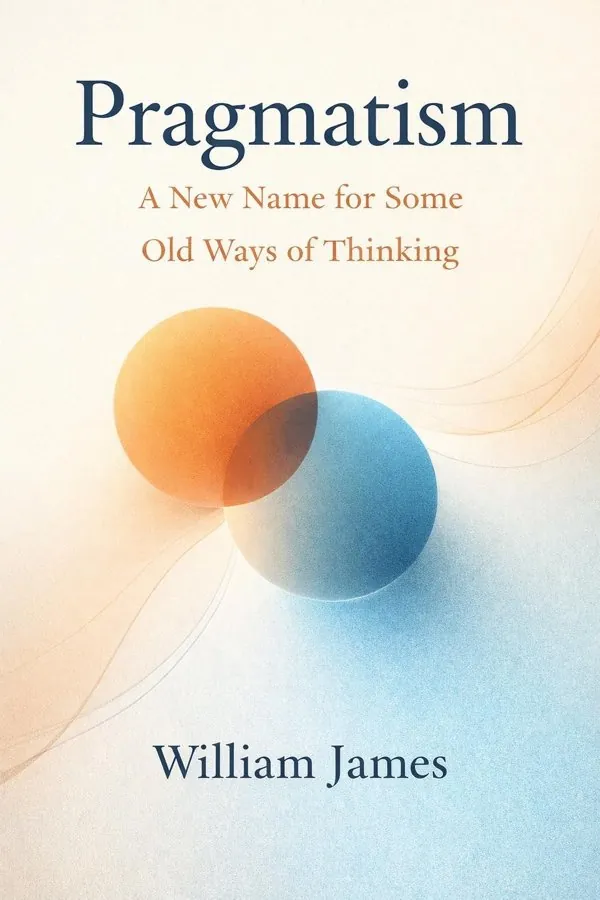
Pragmatism: A New Name for Some Old Ways of Thinking: Summary & Key Insights
 10 min8 chaptersAudio available
Key Takeaways from Pragmatism: A New Name for Some Old Ways of Thinking
Behind every philosophical system stands a human mood.
An idea is not fully understood until we know what difference it makes.
Many metaphysical arguments seem profound only because they float above life.
Reality may be unified, but it is not flattened into simplicity.
Truth is not a static property waiting in heaven; it becomes true as it proves itself in experience.
What Is Pragmatism: A New Name for Some Old Ways of Thinking About?
Pragmatism: A New Name for Some Old Ways of Thinking by William James is a western_phil book spanning 7 pages. William James’s Pragmatism: A New Name for Some Old Ways of Thinking is one of the most influential works in American philosophy because it asks a disarmingly simple question: what difference does an idea make in lived experience? Based on a series of public lectures delivered in 1906 and 1907, the book presents pragmatism not as a rigid doctrine but as a method for testing philosophical claims by their practical consequences. Instead of treating philosophy as an abstract contest between systems, James brings it back to life, action, belief, choice, and the realities of human experience. The book matters because it offers a way through stale intellectual disputes. James argues that many debates become clearer when we ask how competing views actually change the world we inhabit, the decisions we make, and the hopes we sustain. This approach reshaped discussions of truth, religion, metaphysics, and knowledge. James was uniquely equipped to make this case: a pioneering psychologist, a major Harvard thinker, and one of the founders of pragmatism. His writing combines philosophical depth with unusual warmth, clarity, and relevance, making this classic still feel urgent today.
This FizzRead summary covers all 8 key chapters of Pragmatism: A New Name for Some Old Ways of Thinking in approximately 10 minutes, distilling the most important ideas, arguments, and takeaways from William James's work. Also available as an audio summary and Key Quotes Podcast.
Pragmatism: A New Name for Some Old Ways of Thinking
William James’s Pragmatism: A New Name for Some Old Ways of Thinking is one of the most influential works in American philosophy because it asks a disarmingly simple question: what difference does an idea make in lived experience? Based on a series of public lectures delivered in 1906 and 1907, the book presents pragmatism not as a rigid doctrine but as a method for testing philosophical claims by their practical consequences. Instead of treating philosophy as an abstract contest between systems, James brings it back to life, action, belief, choice, and the realities of human experience.
The book matters because it offers a way through stale intellectual disputes. James argues that many debates become clearer when we ask how competing views actually change the world we inhabit, the decisions we make, and the hopes we sustain. This approach reshaped discussions of truth, religion, metaphysics, and knowledge. James was uniquely equipped to make this case: a pioneering psychologist, a major Harvard thinker, and one of the founders of pragmatism. His writing combines philosophical depth with unusual warmth, clarity, and relevance, making this classic still feel urgent today.
Who Should Read Pragmatism: A New Name for Some Old Ways of Thinking?
This book is perfect for anyone interested in western_phil and looking to gain actionable insights in a short read. Whether you're a student, professional, or lifelong learner, the key ideas from Pragmatism: A New Name for Some Old Ways of Thinking by William James will help you think differently.
- ✓Readers who enjoy western_phil and want practical takeaways
- ✓Professionals looking to apply new ideas to their work and life
- ✓Anyone who wants the core insights of Pragmatism: A New Name for Some Old Ways of Thinking in just 10 minutes
Want the full summary?
Get instant access to this book summary and 100K+ more with Fizz Moment.
Get Free SummaryAvailable on App Store • Free to download
Key Chapters
Behind every philosophical system stands a human mood. James opens the book by arguing that the history of philosophy is not driven by logic alone, but by temperament: our emotional and intellectual inclinations quietly shape the views we find convincing. He famously contrasts two broad styles of mind. The “tender-minded” are rationalistic, idealistic, religious, and attracted to principles, order, and certainty. The “tough-minded” are empiricist, materialistic, skeptical, and loyal to facts, variety, and hard evidence. Most philosophical conflict, he suggests, is really a conflict between these psychological types.
This insight is powerful because it reframes philosophical disagreement. Instead of assuming one side is simply irrational, James shows that each camp is responding to genuine human needs. Some people crave moral meaning and unity; others demand honesty about complexity and uncertainty. The problem is that traditional philosophies often satisfy only one side at the expense of the other. Rationalism can become detached from experience, while empiricism can leave us with a fragmented and spiritually thin picture of reality.
In practical life, this tension appears everywhere. In politics, some favor elegant principles while others trust incremental experiments. In personal growth, some want timeless rules while others prefer trial and error. James’s pragmatism tries to honor both needs by asking which ideas preserve intellectual seriousness without losing contact with life.
The actionable takeaway is this: when you encounter a deep disagreement, look beneath the arguments to the human needs and temperaments involved. That shift can turn debate into understanding and help you search for solutions that are both truthful and livable.
An idea is not fully understood until we know what difference it makes. This is James’s most famous pragmatic principle: to grasp the meaning of a concept, we should ask what practical consequences would follow if it were true. If two theories produce no different experience, no different expectation, and no different course of action, then the dispute between them may be verbal rather than substantial.
James does not reduce meaning to crude usefulness or immediate cash value. He means something broader and deeper: the experiential bearings of an idea. What habits of action does it encourage? What expectations does it create? What problems does it solve? A concept gains significance through its effects in life.
This method is especially helpful in cutting through inflated abstraction. Suppose two colleagues argue endlessly about whether leadership is an innate trait or a learned skill. A pragmatic approach asks: what changes if we adopt one view rather than the other? If believing leadership can be developed leads to better training, more mentorship, and stronger organizations, that practical difference matters. Or imagine someone debating whether mindfulness is “really spiritual” or “just psychological.” James would ask what concrete consequences each framing has for practice, motivation, and results.
Pragmatism does not tell us to ignore theory; it tells us to test theory by life. It asks us to move from slogans to outcomes, from verbal prestige to experienced reality. That is why James presents pragmatism as a method more than a final system.
The actionable takeaway is simple: when faced with a difficult concept, ask, “If this were true, what would change in action, expectation, or experience?” The answer often reveals the real meaning of the idea.
Many metaphysical arguments seem profound only because they float above life. James insists that even the most abstract claims about reality should be judged by the practical difference they make. Questions about free will, substance, design, causation, or the absolute are not meaningless, but they become meaningful only when linked to lived consequences.
His point is not that metaphysics is useless. On the contrary, James takes metaphysical questions seriously because they shape our moral energy, our sense of possibility, and our orientation to the world. Consider the difference between determinism and free will. If all action is fixed in advance, then responsibility, regret, resolve, and hope may be understood one way. If genuine choice exists, they are understood another way. Likewise, belief in a universe guided by purpose can nourish resilience and trust, while a purely accidental cosmos may encourage a different emotional posture.
James’s genius is to make metaphysics answerable to human stakes without making it merely subjective. He asks us to compare what each view licenses in practice. Does one perspective deepen courage, seriousness, and coherence? Does another undermine effort or render experience unintelligible? The point is not to choose comforting fantasies, but to see that abstract theories are never as detached from life as they pretend to be.
Today, this applies to debates about artificial intelligence, human nature, or consciousness. Whether we see humans as machines, as creative agents, or as meaning-making beings changes how we educate, govern, and judge one another.
The actionable takeaway: when considering an abstract worldview, do not ask only whether it sounds elegant. Ask how it reshapes responsibility, hope, decision-making, and the way people actually live.
Reality may be unified, but it is not flattened into simplicity. In discussing “the one and the many,” James challenges philosophies that force experience into an all-encompassing system. He resists the temptation to dissolve the world’s richness into a single absolute order in which every conflict, difference, and unfinished process is already reconciled. For James, experience suggests a pluralistic universe: connected, yes, but also open, diverse, and not fully complete.
This idea matters because monistic systems often purchase unity at too high a cost. If everything is already harmonized in some ultimate whole, then genuine struggle can appear illusory, evil can be minimized, and human effort can seem secondary. James wants a philosophy that takes contingency seriously. The world, as we encounter it, contains many centers of activity, many partial truths, and many unfinished possibilities. Unity exists, but it is built, discovered, and negotiated within a field of plurality.
In practical terms, pluralism fosters intellectual humility. It reminds us that no single institution, ideology, or person has exhausted reality. In organizations, it supports diverse perspectives rather than one totalizing vision. In personal relationships, it encourages us to honor difference without assuming difference means chaos. In politics, it suggests that social order may emerge from ongoing cooperation rather than from a perfect blueprint.
James’s pluralism is hopeful because it leaves room for novelty. The future is not completely predetermined by a closed system. Human action can genuinely contribute to what the world becomes.
The actionable takeaway is to resist all-or-nothing thinking. Seek forms of unity that do not erase complexity, and treat diversity of experience as a resource for discovering reality rather than a threat to truth.
Truth is not a static property waiting in heaven; it becomes true as it proves itself in experience. This is one of James’s boldest and most controversial claims. He argues that ideas are true insofar as they help us successfully navigate reality, connect with experience, and lead us into reliable relations with the world. Truth, in this sense, is not arbitrary opinion. It is what gets verified, confirmed, and made good through the ongoing test of life.
James does not mean that whatever feels useful is true. He explicitly resists that caricature. A belief must fit with experience, cohere with other established truths, and continue to work under scrutiny. Truth is not invented out of convenience; it is validated through consequences. Scientific theories, moral principles, and ordinary beliefs all earn their status by guiding us effectively and withstanding correction.
Think about a map. A map is true not because it resembles reality in every detail, but because it reliably gets you where you need to go. If a medical theory predicts outcomes, guides treatment, and survives testing, it counts as true in a meaningful sense. If a personal belief—such as “I can improve through disciplined practice”—helps structure effort and is borne out by growth, it has pragmatic truth-value in lived experience.
James’s account makes truth dynamic, social, and fallible. It grows as inquiry grows. That does not weaken truth; it shows why truth matters: it is what helps us orient ourselves successfully in a changing world.
The actionable takeaway is to evaluate beliefs by asking whether they can be tested, whether they fit experience, and whether they continue to guide action successfully over time.
We do not approach reality as disembodied spectators. James argues that human interests, purposes, and needs play a role in what we notice, how we interpret it, and which truths become important to us. This is the humanistic side of pragmatism. Knowledge is not produced by a mind floating outside life; it emerges from beings trying to cope, act, and make sense of the world.
This does not mean truth is merely subjective or that facts bend to preference. Rather, James insists that inquiry is always situated. Scientists ask certain questions because those questions matter. Citizens debate institutions because justice matters. Individuals seek meaning because life demands orientation. Human concerns help select the paths along which truth is pursued and articulated.
This insight is liberating because it exposes the false ideal of a completely interest-free standpoint. In real life, we choose between research programs, educational priorities, and moral frameworks based partly on what we care about. A doctor focuses on symptoms relevant to healing, not on every detail of a patient’s existence. A company tracks metrics tied to its mission, not every possible data point. Human purposes are not impurities added to knowledge; they are conditions of directed inquiry.
At the same time, James warns us not to confuse our interests with reality itself. Our purposes guide investigation, but the world answers back. That is why pragmatism combines human involvement with experiential testing.
The actionable takeaway is this: be explicit about the purposes shaping your thinking. Ask not only “Is this claim factual?” but also “What human need is directing my attention here?” That clarity can make your judgments more honest and more effective.
Some of life’s most important decisions must be made before certainty arrives. James extends pragmatism into the religious domain by arguing that, in certain genuine options, our “passional nature” may rightly decide. When a choice is living, forced, and momentous—and when evidence cannot settle it in advance—refusing to choose is itself a choice. In such cases, belief may help create the very conditions under which truth becomes accessible.
This argument is especially important in religion, but it reaches beyond religion. Trust, commitment, love, moral courage, and collective action often require a leap before full proof is available. You cannot fully verify friendship without first acting as a friend. You cannot test whether a team can achieve something bold if no one is willing to believe in the effort enough to begin. Likewise, religious faith may shape a person’s experience, discipline, and sensibility in ways that open possibilities invisible from the outside.
James is careful here. He is not saying that any comforting belief is justified. He is speaking about cases where evidence is incomplete, the stakes are high, and action cannot wait. In these contexts, demanding absolute proof can close off goods that only committed participation can reveal.
Modern examples include starting a meaningful career change, joining a social movement, or choosing to trust a partner after honest reflection. In all such cases, waiting for mathematical certainty may guarantee paralysis.
The actionable takeaway: when confronting a live, unavoidable, high-stakes decision under uncertainty, recognize that committed action can be rational. Ask whether belief is opening a real path to evidence rather than merely shielding you from reality.
The irony of many philosophies is that they begin by attacking rigidity and end by becoming rigid themselves. James repeatedly stresses that pragmatism should not be treated as a closed creed with fixed answers to every question. It is best understood as a method of clarification: a way to interpret concepts by tracing their practical bearings and to evaluate beliefs by their experiential consequences.
This matters because it preserves flexibility. Pragmatism does not require one political ideology, one scientific theory, or one theology. Instead, it asks every view to show its cash value in experience. What can this belief do? What confusion does it remove? What practices does it encourage? What evidence can test it? In this sense, pragmatism is less a destination than a disciplined habit of inquiry.
That habit is deeply useful today. In workplaces, teams often argue at the level of labels—innovation, accountability, culture—without defining what those terms would look like in daily behavior. A pragmatic method pushes the conversation toward observable consequences. In education, it shifts focus from rhetoric about learning to whether students can actually think, apply, and grow. In personal development, it helps distinguish ideas that sound impressive from habits that genuinely transform life.
James’s anti-dogmatic stance also explains the enduring appeal of the book. He gives readers a philosophical toolkit rather than demanding submission to a system. That makes pragmatism adaptable without making it shallow.
The actionable takeaway is to turn big claims into testable implications. Whenever a theory sounds persuasive, ask: “What would count as this idea working in real life?” If no answer appears, the theory may be less meaningful than it seems.
All Chapters in Pragmatism: A New Name for Some Old Ways of Thinking
About the Author
William James (1842–1910) was an American philosopher, psychologist, and one of the most important intellectual figures of the modern era. Born into a prominent family that included novelist Henry James, he studied medicine before turning toward psychology and philosophy. At Harvard, he became a pioneering teacher and scholar, helping establish psychology as a scientific discipline in the United States. His major works include The Principles of Psychology, The Will to Believe, The Varieties of Religious Experience, and Pragmatism. James is best known for developing pragmatism, a philosophical approach that evaluates ideas by their practical consequences, and for exploring the roles of belief, emotion, habit, and religious experience in human life. His writing remains influential for its clarity, humanity, and deep engagement with lived experience.
Get This Summary in Your Preferred Format
Read or listen to the Pragmatism: A New Name for Some Old Ways of Thinking summary by William James anytime, anywhere. FizzRead offers multiple formats so you can learn on your terms — all free.
Available formats: App · Audio · PDF · EPUB — All included free with FizzRead
Download Pragmatism: A New Name for Some Old Ways of Thinking PDF and EPUB Summary
Key Quotes from Pragmatism: A New Name for Some Old Ways of Thinking
“Behind every philosophical system stands a human mood.”
“An idea is not fully understood until we know what difference it makes.”
“Many metaphysical arguments seem profound only because they float above life.”
“Reality may be unified, but it is not flattened into simplicity.”
“Truth is not a static property waiting in heaven; it becomes true as it proves itself in experience.”
Frequently Asked Questions about Pragmatism: A New Name for Some Old Ways of Thinking
Pragmatism: A New Name for Some Old Ways of Thinking by William James is a western_phil book that explores key ideas across 8 chapters. William James’s Pragmatism: A New Name for Some Old Ways of Thinking is one of the most influential works in American philosophy because it asks a disarmingly simple question: what difference does an idea make in lived experience? Based on a series of public lectures delivered in 1906 and 1907, the book presents pragmatism not as a rigid doctrine but as a method for testing philosophical claims by their practical consequences. Instead of treating philosophy as an abstract contest between systems, James brings it back to life, action, belief, choice, and the realities of human experience. The book matters because it offers a way through stale intellectual disputes. James argues that many debates become clearer when we ask how competing views actually change the world we inhabit, the decisions we make, and the hopes we sustain. This approach reshaped discussions of truth, religion, metaphysics, and knowledge. James was uniquely equipped to make this case: a pioneering psychologist, a major Harvard thinker, and one of the founders of pragmatism. His writing combines philosophical depth with unusual warmth, clarity, and relevance, making this classic still feel urgent today.
More by William James
You Might Also Like
A Little History of Philosophy
Nigel Warburton
10 min
Areopagitica
John Milton
10 min
How To Think Like A Philosopher: Essential Principles For Clear Thinking
Peter Cave
10 min
Language, Truth and Logic
A. J. Ayer
10 min
The Age of Reason
Thomas Paine
10 min
The Essays
Michel De Montaigne
10 minBrowse by Category
Ready to read Pragmatism: A New Name for Some Old Ways of Thinking?
Get the full summary and 100K+ more books with Fizz Moment.