
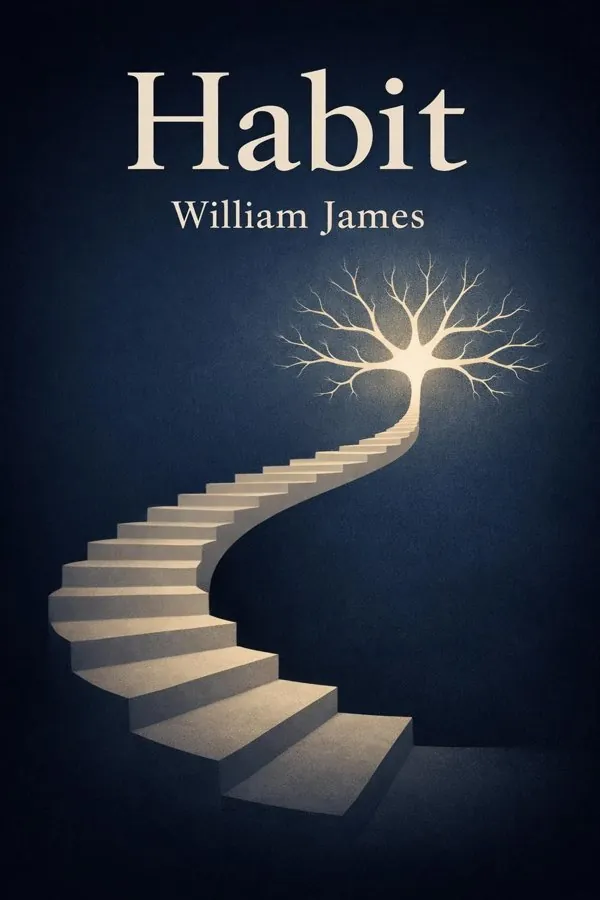
Habit: Summary & Key Insights
 10 min9 chaptersAudio available
Key Takeaways from Habit
A powerful truth lies at the center of James's argument: habit is not just a matter of mindset, but of bodily structure.
What we do often enough stops feeling like choice and starts functioning like machinery.
James's most memorable claim is also his most unsettling: character is largely a bundle of habits.
There is a fragile period at the beginning of every habit when success or failure has outsized consequences.
A bad habit is easiest to break when it still feels minor.
What Is Habit About?
Habit by William James is a psychology book spanning 8 pages. Why do some actions feel effortless while others demand constant willpower? In "Habit," William James offers a powerful answer: much of human life is shaped not by dramatic decisions but by repeated behaviors that gradually become automatic. Drawn from his larger psychological work, this classic essay examines habit as both a mental and physical phenomenon. James argues that every repeated action leaves a trace in the nervous system, making future repetitions easier, until conduct hardens into routine and routine hardens into character. What makes this essay enduring is its blend of scientific observation, philosophical depth, and practical wisdom. Long before modern neuroscience popularized ideas about neural pathways, James explained how repetition reshapes behavior and why early training matters so much. He also recognized that habit is morally significant: good habits can free us for higher aims, while bad ones can quietly imprison us. William James, one of the founders of modern psychology and a major American philosopher, writes with unusual clarity and urgency. "Habit" remains essential reading for anyone interested in self-discipline, education, character formation, productivity, or the hidden forces that govern everyday life.
This FizzRead summary covers all 9 key chapters of Habit in approximately 10 minutes, distilling the most important ideas, arguments, and takeaways from William James's work. Also available as an audio summary and Key Quotes Podcast.
Habit
Why do some actions feel effortless while others demand constant willpower? In "Habit," William James offers a powerful answer: much of human life is shaped not by dramatic decisions but by repeated behaviors that gradually become automatic. Drawn from his larger psychological work, this classic essay examines habit as both a mental and physical phenomenon. James argues that every repeated action leaves a trace in the nervous system, making future repetitions easier, until conduct hardens into routine and routine hardens into character.
What makes this essay enduring is its blend of scientific observation, philosophical depth, and practical wisdom. Long before modern neuroscience popularized ideas about neural pathways, James explained how repetition reshapes behavior and why early training matters so much. He also recognized that habit is morally significant: good habits can free us for higher aims, while bad ones can quietly imprison us.
William James, one of the founders of modern psychology and a major American philosopher, writes with unusual clarity and urgency. "Habit" remains essential reading for anyone interested in self-discipline, education, character formation, productivity, or the hidden forces that govern everyday life.
Who Should Read Habit?
This book is perfect for anyone interested in psychology and looking to gain actionable insights in a short read. Whether you're a student, professional, or lifelong learner, the key ideas from Habit by William James will help you think differently.
- ✓Readers who enjoy psychology and want practical takeaways
- ✓Professionals looking to apply new ideas to their work and life
- ✓Anyone who wants the core insights of Habit in just 10 minutes
Want the full summary?
Get instant access to this book summary and 100K+ more with Fizz Moment.
Get Free SummaryAvailable on App Store • Free to download
Key Chapters
A powerful truth lies at the center of James's argument: habit is not just a matter of mindset, but of bodily structure. He insists that repeated actions physically affect the nervous system, making certain responses easier over time. In other words, habit is not merely something we "have" psychologically; it is something our organism gradually becomes prepared to do. This was a remarkably forward-looking insight, anticipating later ideas about neural plasticity.
James compares the nervous system to a material that can be shaped by use. Just as a path forms where many feet repeatedly tread, a mental or physical action becomes easier when it has been performed many times before. The first attempt may feel awkward, effortful, or even unnatural. But repetition lowers resistance. What once demanded attention begins to happen with less strain.
This idea helps explain why learning a language, driving a car, playing an instrument, or exercising regularly feels difficult at first and easier later. It also explains why harmful patterns become stubborn. Complaining, procrastinating, doom-scrolling, and impulsive anger may begin as occasional acts, but repetition gives them a kind of bodily momentum.
James's point is practical as well as theoretical. If behavior leaves physical traces, then every repetition matters. Small actions are not trivial because they help build the channels through which future conduct will flow. This shifts self-improvement away from vague intention and toward concrete practice.
Actionable takeaway: Treat each repetition as a vote for the kind of nervous system and character you are building, and practice desired behaviors consistently while they are still small.
What we do often enough stops feeling like choice and starts functioning like machinery. James does not say this to diminish human freedom, but to show how efficiency becomes possible. Habit mechanizes behavior. By turning repeated actions into automatic routines, it saves effort, reduces decision fatigue, and allows the mind to focus on higher tasks.
This mechanical side of habit is one of civilization's hidden supports. Daily life would be exhausting if every simple act required fresh deliberation. Dressing, writing, reading familiar words, commuting, and basic social courtesies all depend on habits that operate with little conscious strain. The more of life that can be organized into useful routine, the more mental energy remains for creativity, judgment, and moral choice.
James sees great value in this automation. A pianist can perform fluidly because scales became habitual. A skilled teacher manages a classroom smoothly because many responses have been practiced into readiness. An athlete reacts quickly because training has made movement nearly automatic. In each case, mechanism is not the enemy of excellence; it is the foundation of reliable performance.
Yet the same principle can work against us. If distraction becomes habitual, our attention fragments automatically. If we answer stress with avoidance, that too becomes mechanical. Habit is efficient whether it serves wisdom or folly.
The lesson is not to reject routine but to design it. Since repeated actions become self-executing, we should be deliberate about what we allow to become automatic. Good systems reduce reliance on mood; bad systems trap us inside our own repeated errors.
Actionable takeaway: Identify one daily behavior that should become automatic, and repeat it at the same time and in the same context until it requires little conscious effort.
James's most memorable claim is also his most unsettling: character is largely a bundle of habits. We like to imagine character as something deep, noble, and separate from routine. James brings it down to earth. The kind of person we become is shaped by the things we repeatedly do, especially in ordinary moments. Virtue is not secured by admiring ideals but by enacting them until they become customary.
This view makes character more practical and less mysterious. Courage is strengthened by repeated acts of facing difficulty. Honesty is built by consistently telling the truth, especially when it is inconvenient. Kindness grows when we repeatedly respond with patience instead of irritation. Over time, these actions stop being isolated performances and become part of the self.
The reverse is equally true. Cowardice, laziness, vanity, and selfishness can be strengthened by rehearsal. A person who regularly cuts corners may eventually cease to feel the moral weight of doing so. A person who habitually avoids discomfort may find even small challenges overwhelming. Character drifts toward whatever behavior is practiced most often.
James's insight is liberating because it means transformation does not require waiting for a grand inner revolution. One can begin with behavior. The disciplined person is often the one who has arranged life so that good conduct is repeated before it is fully desired. This is why routines matter so deeply in moral life.
For parents, teachers, leaders, and individuals, the implication is huge: the everyday atmosphere of action matters more than occasional speeches about values. We become what we rehearse.
Actionable takeaway: Choose one virtue you want to strengthen, then define a small daily act that expresses it and repeat that act until it becomes part of your identity.
There is a fragile period at the beginning of every habit when success or failure has outsized consequences. James stresses that habits are formed most effectively through strong starts and early consistency. When a pattern is new, the pathway is still shallow. That makes it both easier to create and easier to lose. A hesitant beginning invites collapse; a decisive beginning gives momentum.
He therefore recommends launching good habits with as much energy and determination as possible. The start should not be casual. If you want to wake early, begin immediately and do so firmly. If you want to read every evening, establish the routine without endless negotiation. Early repetitions have a formative power because they set expectations for both mind and body.
Modern experience confirms this. Someone starting exercise often benefits more from a clear, fixed plan than from vague aspirations. A student who commits to studying at a particular hour every day creates stability faster than one who studies only when motivation appears. Even simple rituals—placing a book on the pillow, setting out running shoes, turning off notifications before work—help the new pattern take hold.
James also warns against exceptions in the vulnerable early stage. Every indulgence weakens the new pathway and strengthens the old one. This may sound severe, but his point is psychological realism: habits become easier when they are not constantly renegotiated.
Strong beginnings matter because they reduce ambiguity. They tell the self, in action rather than theory, what kind of conduct is now expected. The opening phase of change is not everything, but it often determines everything that follows.
Actionable takeaway: When starting a new habit, commit to a clear trigger and follow it without exception for the first two weeks.
A bad habit is easiest to break when it still feels minor. James understands that harmful behaviors gain power through repetition, and the longer they continue, the more deeply they shape conduct. The danger is that people often wait for a problem to become serious before acting. By then, the pathway is reinforced, the cues are familiar, and the response feels natural.
James's advice is direct: attack undesirable habits early and decisively. Do not merely condemn them in theory while permitting them in practice. If a pattern is harmful, interrupt it before it hardens. This may mean removing temptations, changing environments, avoiding occasions that trigger the behavior, or replacing the bad act with a different one at once.
Consider a person who checks social media every few minutes. At first it appears harmless, but repeated often enough, it fragments attention and makes sustained focus feel uncomfortable. Or think of habitual sarcasm in relationships. What begins as a style can gradually erode trust. In both cases, delay strengthens the pattern.
James is not naïve about difficulty. Breaking habits can feel like struggling against one's own prior training. But he believes reform requires action, not merely regret. One must create a break in the chain. The interruption may be external—blocking an app, changing a route, clearing junk food from the house—or internal—making a public commitment, using a replacement behavior, or inserting a pause before acting.
The broader point is moral urgency. Every tolerated repetition is practice. If we keep practicing what weakens us, we should not be surprised when weakness becomes easier.
Actionable takeaway: Identify one bad habit that is still manageable, remove its main trigger today, and replace the behavior with a specific alternative response.
James sees education as far more than the transfer of information. A central task of education, in his view, is the formation of good habits. Schools and training institutions succeed not only when they teach ideas, but when they establish patterns of attention, effort, punctuality, self-control, and intellectual honesty. Knowledge matters, but the capacity to use oneself well matters just as much.
This gives habit a profound educational role. A student who has learned to sit down and work steadily possesses an advantage beyond raw intelligence. A child trained to complete tasks, listen carefully, and persist through frustration acquires habits that support future learning across every subject. James therefore treats habit as the basis of practical efficiency.
This does not mean education should become robotic. Rather, useful automatism creates freedom. When foundational behaviors are trained into readiness, the mind can attend to higher questions. A musician who has practiced technique can interpret. A writer who has habitual discipline can revise thoughtfully. A scientist who has learned careful observation and note-taking is better equipped for discovery.
James's insight also challenges modern educational habits that overvalue inspiration and undervalue discipline. Students often believe they need to feel interested before they can work. James reverses this assumption: disciplined action can come first, and sustained engagement often follows.
For parents and teachers, this means designing environments where good routines are normal and reinforced. Consistent schedules, orderly expectations, repeated practice, and visible models of conduct shape students more powerfully than occasional speeches about excellence.
Actionable takeaway: Build one educational routine—such as a fixed study hour, distraction-free reading block, or daily review practice—that trains consistency as much as content mastery.
Habit is not only personal; it is social. James recognizes that customs, institutions, and moral expectations are built from repeated behaviors shared by groups. A society functions because people internalize countless habits: how to greet others, respect rules, perform work, handle conflict, fulfill roles, and respond to obligations. Social order depends less on constant enforcement than on ingrained patterns.
This gives habit a moral dimension. Good societies are sustained by citizens whose conduct is reliable. Honoring commitments, showing restraint, keeping public spaces orderly, and treating others with basic respect all depend on repetition becoming second nature. When these habits weaken, institutions become strained because they must rely more heavily on surveillance, punishment, or crisis management.
James also suggests that our moral possibilities are shaped by the routines we inhabit. A workplace where cynicism, blame, and shortcut-taking are habitual will produce different people than one where care, preparation, and fairness are expected. Families are the same. Repeated patterns of speech and response become a moral climate. Over time, they feel normal, even inevitable.
This insight is useful for leaders. Culture is not created mainly through slogans; it is built through repeated practices. A team becomes collaborative when meetings reward listening, information is shared habitually, and credit is regularly distributed fairly. A community becomes generous when service is made ordinary rather than exceptional.
James's view reminds us that ethics is lived in routines. The moral life is not only about heroic decisions but about the small, repeated forms of conduct that prepare or undermine those decisions.
Actionable takeaway: Examine one group you belong to and strengthen a repeated practice—such as punctuality, honest feedback, or gratitude—that would improve its moral culture over time.
One of James's most practical insights is that willpower is most useful at the beginning of action, not as a permanent fuel source. People often imagine self-improvement as a long struggle of sheer effort. James offers a more intelligent model: use conscious effort to establish a pattern, then let habit take over. The goal is not endless exertion but durable automaticity.
This matters because willpower is unstable. It varies with mood, fatigue, stress, and environment. Habits are more reliable. A person who exercises only when inspired will be inconsistent. A person who always goes after work on Monday, Wednesday, and Friday has shifted the burden from emotion to routine. The same is true for writing, saving money, preparing healthy meals, or sleeping on time.
James does not dismiss effort. In fact, he values moments of decisive action intensely. He believes that energetic acts of will can create the turning point from which a new habit grows. But he wants that effort invested wisely. Rather than repeatedly debating whether to act, remove the debate. Create triggers, reduce friction, and standardize the behavior.
For example, someone trying to journal can keep the notebook on the pillow and write before bed. A person trying to spend less can automate savings at payday. Someone trying to be kinder can create a pause rule before responding in conflict. In each case, structure supports intention.
The deepest wisdom here is that discipline matures into design. We begin by pushing ourselves, but we improve most when life is arranged so the right thing becomes the easy thing.
Actionable takeaway: Use willpower once to build a system—calendar block, alarm, automation, or environmental cue—that makes your desired behavior more likely every day.
James repeatedly points us away from dramatic resolutions and toward ordinary repetition. People are often impressed by intense moments of conviction: a bold promise, a burst of enthusiasm, a temporary makeover. But character and conduct are usually shaped elsewhere, in the unnoticed actions of daily life. The future belongs less to what we feel strongly once than to what we do regularly.
This is why James treats habits as the practical engine of change. A person may deeply value health, wisdom, generosity, or excellence, but unless those values are translated into recurrent behaviors, they remain unrealized ideals. The body and mind are trained by action, not admiration. Reading ten pages a day can matter more than buying ambitious books. Saving a small amount monthly can matter more than talking about financial responsibility. Making one sincere apology can matter more than thinking of oneself as compassionate.
The beauty of this view is that it democratizes improvement. Progress does not require extraordinary talent or constant inspiration. It requires repetition. Tiny acts gain force when they are stable. Over months and years, they accumulate into competence, trustworthiness, and identity.
James also implies that neglect works the same way. Small failures to act, repeated often enough, become a way of life. The cost of inaction compounds quietly. This is why he urges seriousness about the everyday. Seemingly trivial choices are the raw material of destiny.
For modern readers surrounded by motivational noise, this message is refreshing. Grand visions have value, but they are fulfilled through mundane faithfulness. The habit you practice on an average Tuesday may shape your life more than the goals you announce on New Year's Day.
Actionable takeaway: Reduce one important goal to a behavior so small you can repeat it daily, then track consistency rather than intensity.
All Chapters in Habit
About the Author
William James (1842-1910) was an American philosopher, psychologist, and teacher whose work helped establish psychology as a modern scientific discipline in the United States. Born into an intellectually prominent family, he studied medicine at Harvard before turning toward philosophy and psychology. James became one of the key founders of functional psychology, which examines how mental processes help people adapt to life, and he was also a leading voice in pragmatism, a philosophy that evaluates ideas by their practical effects. His major books include "The Principles of Psychology," "Pragmatism," and "The Varieties of Religious Experience." Known for combining scientific observation with philosophical insight, James remains one of the most widely read and influential thinkers in psychology, education, religion, and moral philosophy.
Get This Summary in Your Preferred Format
Read or listen to the Habit summary by William James anytime, anywhere. FizzRead offers multiple formats so you can learn on your terms — all free.
Available formats: App · Audio · PDF · EPUB — All included free with FizzRead
Download Habit PDF and EPUB Summary
Key Quotes from Habit
“A powerful truth lies at the center of James's argument: habit is not just a matter of mindset, but of bodily structure.”
“What we do often enough stops feeling like choice and starts functioning like machinery.”
“James's most memorable claim is also his most unsettling: character is largely a bundle of habits.”
“There is a fragile period at the beginning of every habit when success or failure has outsized consequences.”
“A bad habit is easiest to break when it still feels minor.”
Frequently Asked Questions about Habit
Habit by William James is a psychology book that explores key ideas across 9 chapters. Why do some actions feel effortless while others demand constant willpower? In "Habit," William James offers a powerful answer: much of human life is shaped not by dramatic decisions but by repeated behaviors that gradually become automatic. Drawn from his larger psychological work, this classic essay examines habit as both a mental and physical phenomenon. James argues that every repeated action leaves a trace in the nervous system, making future repetitions easier, until conduct hardens into routine and routine hardens into character. What makes this essay enduring is its blend of scientific observation, philosophical depth, and practical wisdom. Long before modern neuroscience popularized ideas about neural pathways, James explained how repetition reshapes behavior and why early training matters so much. He also recognized that habit is morally significant: good habits can free us for higher aims, while bad ones can quietly imprison us. William James, one of the founders of modern psychology and a major American philosopher, writes with unusual clarity and urgency. "Habit" remains essential reading for anyone interested in self-discipline, education, character formation, productivity, or the hidden forces that govern everyday life.
More by William James
Pragmatism: A New Name for Some Old Ways of Thinking
William James
10 min
The Principles of Psychology
William James
10 min
The Will to Believe, and Other Essays in Popular Philosophy
William James
10 min
The Varieties of Religious Experience: A Study in Human Nature
William James
10 minYou Might Also Like
The Body Keeps the Score
Bessel van der Kolk
10 min
Surrounded by Idiots
Thomas Erikson
10 min
Emotional Intelligence
Daniel Goleman
10 min
Attached
Amir Levine
10 min
Why Does He Do That
Lundy Bancroft
10 min
Women Who Run with the Wolves
Clarissa Pinkola Estés
10 minBrowse by Category
Ready to read Habit?
Get the full summary and 100K+ more books with Fizz Moment.