
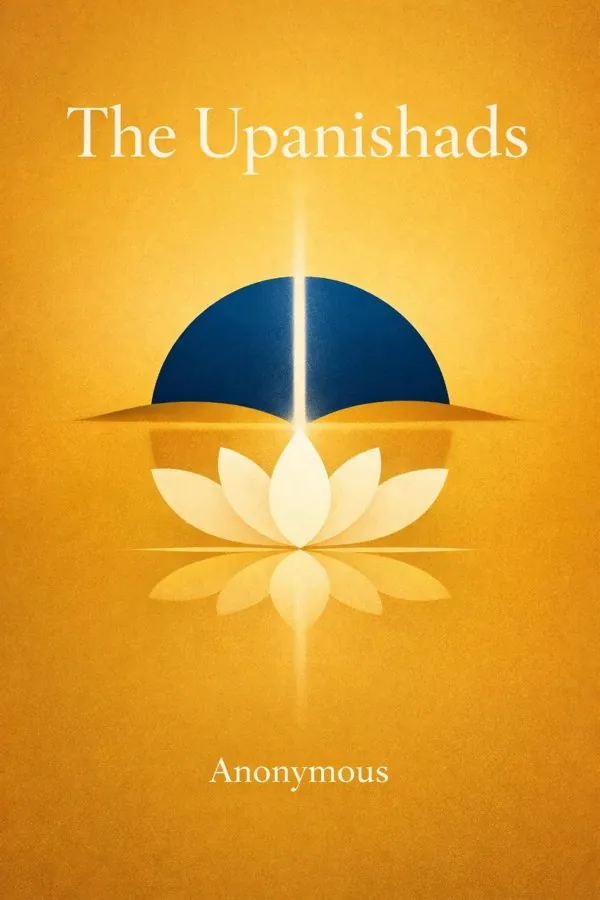
The Upanishads: Summary & Key Insights
by Anonymous
 10 min8 chaptersAudio available
Key Takeaways from The Upanishads
A civilization changes when it stops asking only what must be done and begins asking what is ultimately true.
What if everything changing around you rests on something that never changes?
The most important mystery in life may not be the universe outside you, but the one who says “I.
Few spiritual declarations are as bold as this: the deepest self and ultimate reality are not-two.
The Upanishads teach that bondage is not fundamentally imposed from outside; it is sustained by misperception.
What Is The Upanishads About?
The Upanishads by Anonymous is a eastern_wisdom book spanning 12 pages. The Upanishads are among humanity’s most profound explorations of consciousness, reality, and freedom. Composed in ancient India as the culminating portion of the Vedas, these texts mark a decisive shift from outward ritual to inward inquiry. Instead of asking only how to worship the divine, they ask what the divine truly is, what the self really is, and whether the deepest self and ultimate reality might actually be one. From these questions emerge some of the central ideas of Indian philosophy: Brahman, the absolute; Atman, the innermost self; karma, rebirth, meditation, and liberation from suffering. Their influence stretches across Vedanta, yoga, Hindu spirituality, and global philosophy. Though attributed to no single author, the Upanishads carry the authority of generations of seers who pursued insight through disciplined reflection and direct spiritual experience. What makes them endure is not merely their antiquity, but their relevance. They speak to anyone who has wondered whether identity is deeper than personality, whether fulfillment lies beyond possessions, and whether lasting peace can be discovered not by acquiring more, but by awakening to what has always been present.
This FizzRead summary covers all 8 key chapters of The Upanishads in approximately 10 minutes, distilling the most important ideas, arguments, and takeaways from Anonymous's work. Also available as an audio summary and Key Quotes Podcast.
The Upanishads
The Upanishads are among humanity’s most profound explorations of consciousness, reality, and freedom. Composed in ancient India as the culminating portion of the Vedas, these texts mark a decisive shift from outward ritual to inward inquiry. Instead of asking only how to worship the divine, they ask what the divine truly is, what the self really is, and whether the deepest self and ultimate reality might actually be one. From these questions emerge some of the central ideas of Indian philosophy: Brahman, the absolute; Atman, the innermost self; karma, rebirth, meditation, and liberation from suffering. Their influence stretches across Vedanta, yoga, Hindu spirituality, and global philosophy. Though attributed to no single author, the Upanishads carry the authority of generations of seers who pursued insight through disciplined reflection and direct spiritual experience. What makes them endure is not merely their antiquity, but their relevance. They speak to anyone who has wondered whether identity is deeper than personality, whether fulfillment lies beyond possessions, and whether lasting peace can be discovered not by acquiring more, but by awakening to what has always been present.
Who Should Read The Upanishads?
This book is perfect for anyone interested in eastern_wisdom and looking to gain actionable insights in a short read. Whether you're a student, professional, or lifelong learner, the key ideas from The Upanishads by Anonymous will help you think differently.
- ✓Readers who enjoy eastern_wisdom and want practical takeaways
- ✓Professionals looking to apply new ideas to their work and life
- ✓Anyone who wants the core insights of The Upanishads in just 10 minutes
Want the full summary?
Get instant access to this book summary and 100K+ more with Fizz Moment.
Get Free SummaryAvailable on App Store • Free to download
Key Chapters
A civilization changes when it stops asking only what must be done and begins asking what is ultimately true. The Upanishads emerge from the Vedic world of sacrifice, chant, and sacred ceremony, yet they redirect attention from external ritual toward inner knowledge. This does not mean they reject ritual outright. Rather, they reinterpret it. Fire offerings, recitations, and sacred acts become symbols of deeper processes taking place within consciousness. The real altar is the mind, the real offering is ignorance, and the real reward is insight.
This transition matters because it introduces a new spiritual emphasis: liberation is not secured merely by correct performance, social status, or inherited tradition. It depends on understanding reality directly. The sages invite the seeker to move from doing to seeing, from habit to inquiry, from outer religious conformity to inner awakening. In this sense, the Upanishads revolutionize spiritual life by making self-knowledge the highest path.
In modern terms, this shift resembles moving from checking off wellness routines to asking whether your life is actually aligned with truth. You can meditate, attend services, read sacred books, and still remain inwardly restless. The Upanishadic question is sharper: Who is the one performing all these acts? What are you seeking beneath all striving?
This teaching has practical force. It asks us to examine whether our spiritual or personal routines are mechanical. Are we acting from fear, habit, or social expectation? Or are we using practices to cultivate understanding? The Upanishads suggest that practices are valuable when they point beyond themselves to direct recognition of what is real.
Actionable takeaway: Choose one daily habit you consider meaningful and ask what inner truth it is meant to serve. Refocus the practice so it becomes a doorway to awareness rather than a ritual performed on autopilot.
What if everything changing around you rests on something that never changes? The Upanishads call that unconditioned reality Brahman. Brahman is not simply a deity among other deities, nor merely a creator standing apart from the world. It is the absolute reality underlying all appearances: limitless, eternal, beyond description, yet somehow nearer than anything we can perceive. It is the source from which all beings arise, the essence by which they live, and the reality into which they return.
Because Brahman transcends ordinary language, the Upanishads often describe it through paradox. It is smaller than the smallest and greater than the greatest. It moves and does not move. It is known by the one who realizes that it cannot be grasped as an object. These formulations are not evasions; they are attempts to loosen the mind from rigid categories. Brahman cannot be reduced to any image, concept, or form, because all forms depend on it.
This idea can reshape daily life. Much of human anxiety comes from identifying reality with the unstable: possessions, roles, moods, and outcomes. The Upanishads remind us that the visible world is real at one level but not ultimate. There is a deeper continuity beneath flux. To live with awareness of Brahman is to become less shaken by gain and loss, praise and blame, success and failure.
Practically, this can mean creating moments in the day to step back from the surface drama of events. In a conflict at work, for instance, instead of reacting from ego, you can remember that the changing scene is not the whole of reality. This perspective does not make you passive; it makes you less captive to agitation.
Actionable takeaway: When you feel overwhelmed, pause and ask, “What here is changing, and what in awareness remains unchanged?” Let that question ground you in a wider sense of reality.
The most important mystery in life may not be the universe outside you, but the one who says “I.” The Upanishads use the word Atman to point to the innermost self: not the personality, not the body, not passing thoughts, but the deepest principle of conscious being. Atman is what remains when the layers of identity are stripped away. It is not your résumé, your memories, your social mask, or your emotional weather. It is the witness of all these.
The sages repeatedly urge seekers to discriminate between the changing and the unchanging. The body ages, sensations fluctuate, beliefs evolve, and moods come and go. Yet something in us is aware of all these changes. That witnessing presence is closer to Atman than the shifting story we usually call ourselves. This insight has both philosophical and existential consequences. If you are not reducible to your changing experiences, then suffering linked to ego-identity begins to loosen.
In ordinary life, many forms of distress come from mistaken identification. A person loses a job and feels, “I am worthless.” Another is criticized and feels, “I am destroyed.” The Upanishadic response is not denial but discernment: you have had an experience, but you are not identical with it. Atman is deeper than success, failure, status, or circumstance.
This is especially practical in moments of emotional turbulence. If anger arises, you can observe, “Anger is present,” rather than “I am anger.” That small shift creates space, dignity, and freedom. Over time, it transforms how one relates to fear, desire, and pain.
Actionable takeaway: Spend five minutes each day quietly noticing thoughts, sensations, and emotions as objects in awareness. Repeatedly ask, “Who is aware of this?” Use the question not to force an answer, but to deepen contact with the witnessing self.
Few spiritual declarations are as bold as this: the deepest self and ultimate reality are not-two. The Upanishads express this in mahavakyas, or great sayings, most famously “Tat Tvam Asi” — “That Thou Art.” The claim is astonishing. It means that the Atman within is not separate from Brahman, the absolute ground of reality. The seeker is not merely trying to reach the divine as something distant; the seeker’s deepest being is already rooted in it.
This teaching must be understood carefully. It does not mean the ego, with all its preferences and insecurities, is all-powerful or divine in a narcissistic sense. The false self is not being glorified. Instead, the Upanishads dismantle the ego by revealing that our true nature is far greater than the small, grasping identity we defend. The sense of separateness that structures ordinary life is, in this view, a form of ignorance.
The practical significance is immense. If the same essential reality lives in all beings, then compassion is not merely a moral duty; it is a response to truth. Harm done to others is rooted in misperception. Likewise, loneliness and alienation soften when one sees life as expressions of a shared essence rather than isolated units competing for survival.
In daily interactions, this insight can change how we approach conflict. Instead of seeing another person as an enemy to defeat, we may ask what fear, pain, or confusion is clouding our common humanity. This does not erase boundaries or justice, but it introduces depth and humility.
Actionable takeaway: In one difficult interaction this week, silently remind yourself, “This person and I share the same deepest ground.” Let that remembrance shape your tone, listening, and response.
The Upanishads teach that bondage is not fundamentally imposed from outside; it is sustained by misperception. They call this ignorance avidya: not mere lack of information, but confusion about what is real and who we are. We mistake the temporary for the permanent, the surface self for the true self, and objects of desire for lasting fulfillment. From this confusion arise fear, attachment, envy, pride, and the cycle of dissatisfaction.
Knowledge, or vidya, is therefore not academic accumulation. One may memorize texts and still remain trapped. True knowledge is transformative insight into the nature of Atman and Brahman. It is seeing clearly enough that one’s life is reordered. In the Upanishadic framework, liberation is not created by knowledge in the way a machine is assembled. It is uncovered when ignorance falls away, like the sun appearing when clouds disperse.
This has immediate relevance today. Modern people often confuse being informed with being wise. We consume endless content, yet remain uncertain about meaning, identity, and peace. The Upanishads suggest that wisdom begins not by collecting more concepts, but by examining the assumptions behind our living. What do we believe will complete us? Why do we cling so fiercely to what cannot last?
A practical example: someone may think, “When I achieve this next milestone, I will finally be secure.” After reaching it, insecurity remains. Upanishadic analysis points to the deeper problem: false dependence on impermanent conditions. Knowledge means recognizing this pattern and turning toward what is not contingent.
Actionable takeaway: Identify one belief that governs your striving, such as “I will be enough when…” Write it down and question whether it has ever delivered lasting peace. Use that inquiry to loosen ignorance and redirect attention toward deeper understanding.
Your life is not a series of disconnected moments; it is a field shaped by intention, action, and consequence. The Upanishads deepen the earlier Indian understanding of karma by linking action not only to visible results but to the ongoing formation of the self and the cycle of rebirth. Karma is not cosmic reward and punishment in a simplistic sense. It is the moral and psychological law that actions, desires, and intentions leave traces. These traces shape character, experience, and future becoming.
Rebirth extends this logic beyond a single lifetime. The individual, conditioned by ignorance and desire, continues through repeated embodiments until true knowledge dissolves the basis of bondage. This teaching gives ethical life metaphysical seriousness. Every act matters because every act participates in the structure of becoming.
Whether one interprets rebirth literally, symbolically, or philosophically, the practical lesson remains compelling. Habits create futures. What you repeatedly think, choose, and do becomes the person you inhabit. A resentful mind lives in one world; a disciplined and generous mind in another. Karma is visible even now, in the way repeated actions harden into tendencies.
This encourages responsibility without fatalism. The Upanishads do not say everything is rigidly predetermined. Rather, they show that the present contains both inherited momentum and the possibility of conscious redirection. A person shaped by anger can cultivate restraint. One governed by greed can train in generosity. Freedom grows when awareness interrupts automatic patterns.
Actionable takeaway: Notice one recurring habit that produces suffering for you or others. For seven days, interrupt it with a deliberate opposite action. Treat this as a direct experiment in karma: new intentions create a new inner trajectory.
A single sound can become a map of reality. The Upanishads treat Om not as a mere syllable, but as a sonic symbol of the whole universe and of consciousness itself. In texts such as the Mandukya Upanishad, Om is linked to the waking state, the dreaming state, and deep sleep, as well as a fourth condition beyond them all: turiya, pure consciousness. This teaching is one of the most subtle contributions in world philosophy. It suggests that human experience has layers, and that ordinary waking identity is not the final horizon.
The waking self engages the external world through the senses. The dreaming self inhabits an inner world shaped by impressions and imagination. Deep sleep reveals a state where mental activity subsides, yet being remains. Turiya is not simply another state in sequence; it is the ever-present background of awareness underlying all three. Om becomes a contemplative tool for recognizing this structure.
Practically, this matters because we usually identify only with the waking mind and its concerns. The Upanishads invite us to become curious about consciousness itself. What persists through changing states? Who is present in waking, dreaming, and sleep? Such inquiry can reduce fear, especially the fear that identity is as fragile as passing thoughts.
Meditating on Om can also steady attention. The sound gathers the mind, quiets fragmentation, and points beyond verbal thought. Even for secular readers, it can function as a focal point for inward concentration and a reminder that awareness is deeper than mental noise.
Actionable takeaway: Spend a few minutes each day chanting or silently repeating Om with full attention. Afterward, sit in silence and notice the awareness that remains when the sound fades.
Truth may be universal, but realizing it is rarely effortless. The Upanishads frequently unfold as dialogues between teacher and student, father and son, king and sage, or even Death and a courageous seeker. This form is not incidental. It shows that wisdom is often awakened through relationship, questioning, testing, and disciplined preparation. The guru in the Upanishadic world is not simply a lecturer but one who has seen what the student seeks to understand.
The necessity of guidance arises because the subject matter is subtle. The mind easily turns ultimate teachings into slogans, beliefs, or ego decorations. A teacher helps refine inquiry, challenge self-deception, and adapt teachings to the seeker’s maturity. Yet the Upanishads also insist that the student must be worthy of instruction through sincerity, restraint, concentration, and longing for truth. Initiation is therefore not about exclusivity but readiness.
Ethical and meditative disciplines support this process. Truthfulness, self-control, simplicity, reverence, and contemplation purify the mind so it can perceive more clearly. Liberation, or moksha, is not the result of wishful thinking. It requires a transformed way of being. In this state, the knots of the heart are cut, doubt dissolves, and one is freed from the cycle of ignorance and rebirth.
In contemporary life, the “guru principle” can include wise mentors, trusted traditions, rigorous study, contemplative communities, and practices that keep us honest. The larger lesson is that insight grows through humility and commitment, not just inspiration.
Actionable takeaway: Identify one source of guidance you trust—a teacher, text, community, or disciplined practice—and commit to a regular pattern of study and reflection. Liberation begins when scattered seeking becomes serious training.
All Chapters in The Upanishads
About the Author
The Upanishads were not written by a single author but by generations of ancient Indian sages and seers whose names are often unknown or secondary to the teachings themselves. For this reason, the work is commonly attributed to “Anonymous.” These thinkers belonged to the later Vedic tradition and were less concerned with personal authorship than with transmitting spiritual insight. Their teachings were preserved orally for centuries before being compiled into texts that became central to Hindu philosophy. The anonymity of the Upanishads reflects a worldview in which truth is discovered, contemplated, and passed on through lineage rather than claimed as individual achievement. Their collective voice helped shape Vedanta, yoga, and global spiritual thought for thousands of years.
Get This Summary in Your Preferred Format
Read or listen to the The Upanishads summary by Anonymous anytime, anywhere. FizzRead offers multiple formats so you can learn on your terms — all free.
Available formats: App · Audio · PDF · EPUB — All included free with FizzRead
Download The Upanishads PDF and EPUB Summary
Key Quotes from The Upanishads
“A civilization changes when it stops asking only what must be done and begins asking what is ultimately true.”
“What if everything changing around you rests on something that never changes?”
“The most important mystery in life may not be the universe outside you, but the one who says “I.”
“Few spiritual declarations are as bold as this: the deepest self and ultimate reality are not-two.”
“The Upanishads teach that bondage is not fundamentally imposed from outside; it is sustained by misperception.”
Frequently Asked Questions about The Upanishads
The Upanishads by Anonymous is a eastern_wisdom book that explores key ideas across 8 chapters. The Upanishads are among humanity’s most profound explorations of consciousness, reality, and freedom. Composed in ancient India as the culminating portion of the Vedas, these texts mark a decisive shift from outward ritual to inward inquiry. Instead of asking only how to worship the divine, they ask what the divine truly is, what the self really is, and whether the deepest self and ultimate reality might actually be one. From these questions emerge some of the central ideas of Indian philosophy: Brahman, the absolute; Atman, the innermost self; karma, rebirth, meditation, and liberation from suffering. Their influence stretches across Vedanta, yoga, Hindu spirituality, and global philosophy. Though attributed to no single author, the Upanishads carry the authority of generations of seers who pursued insight through disciplined reflection and direct spiritual experience. What makes them endure is not merely their antiquity, but their relevance. They speak to anyone who has wondered whether identity is deeper than personality, whether fulfillment lies beyond possessions, and whether lasting peace can be discovered not by acquiring more, but by awakening to what has always been present.
More by Anonymous


You Might Also Like
A New Earth
Eckhart Tolle
10 min
The Daily Stoic
Ryan Holiday, Stephen Hanselman
10 min
Buddhism: Plain and Simple
Steve Hagen
10 min
Enchiridion
Epictetus
10 min
The Book of Tea
Kakuzō Okakura
10 min
The Light We Give: How Sikh Wisdom Can Transform Your Life
Simran Jeet Singh
10 minBrowse by Category
Ready to read The Upanishads?
Get the full summary and 100K+ more books with Fizz Moment.