
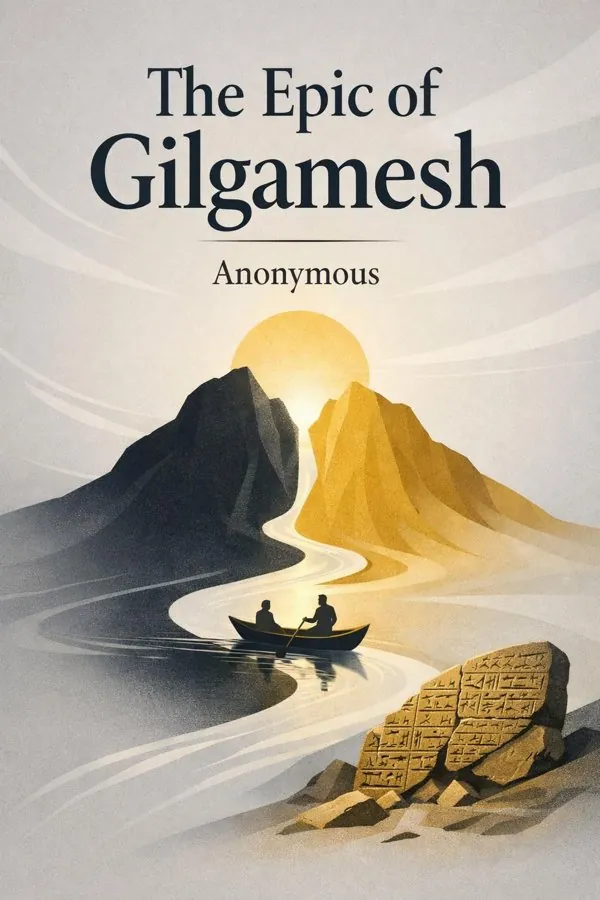
The Epic Of Gilgamesh: Summary & Key Insights
by Anonymous
 10 min9 chaptersAudio available
Key Takeaways from The Epic Of Gilgamesh
A ruler’s greatest danger is often not weakness, but unchecked strength.
Sometimes the person who changes you most is the one strong enough to oppose you.
Human life becomes distorted when it cuts itself off from either wildness or order.
Many heroic ambitions are driven not by confidence, but by dread.
Nothing strips away illusion like the death of someone we love.
What Is The Epic Of Gilgamesh About?
The Epic Of Gilgamesh by Anonymous is a classics book. The Epic Of Gilgamesh is one of humanity’s oldest surviving literary masterpieces, a powerful poem from ancient Mesopotamia that still feels strikingly modern. At its center is Gilgamesh, the mighty king of Uruk, who begins as a proud and overbearing ruler and is gradually transformed by friendship, grief, and a desperate search for immortality. What starts as a tale of heroic strength becomes a profound meditation on mortality, meaning, civilization, and what it means to live well. The epic matters because it asks questions that never go out of date: How should power be used? What do we owe to our friends? How do we face death? And what, if anything, can outlast us? Long before Greek epics and modern novels, this work was exploring the emotional and moral struggles that define human life. Though attributed to Anonymous, the poem comes from a rich scribal tradition, preserved on clay tablets and shaped over centuries by Mesopotamian storytellers and scholars. Their authority lies not in one individual voice, but in a civilization’s memory. Reading Gilgamesh is not just encountering an ancient story; it is listening to one of the earliest great conversations about being human.
This FizzRead summary covers all 9 key chapters of The Epic Of Gilgamesh in approximately 10 minutes, distilling the most important ideas, arguments, and takeaways from Anonymous's work. Also available as an audio summary and Key Quotes Podcast.
The Epic Of Gilgamesh
The Epic Of Gilgamesh is one of humanity’s oldest surviving literary masterpieces, a powerful poem from ancient Mesopotamia that still feels strikingly modern. At its center is Gilgamesh, the mighty king of Uruk, who begins as a proud and overbearing ruler and is gradually transformed by friendship, grief, and a desperate search for immortality. What starts as a tale of heroic strength becomes a profound meditation on mortality, meaning, civilization, and what it means to live well.
The epic matters because it asks questions that never go out of date: How should power be used? What do we owe to our friends? How do we face death? And what, if anything, can outlast us? Long before Greek epics and modern novels, this work was exploring the emotional and moral struggles that define human life.
Though attributed to Anonymous, the poem comes from a rich scribal tradition, preserved on clay tablets and shaped over centuries by Mesopotamian storytellers and scholars. Their authority lies not in one individual voice, but in a civilization’s memory. Reading Gilgamesh is not just encountering an ancient story; it is listening to one of the earliest great conversations about being human.
Who Should Read The Epic Of Gilgamesh?
This book is perfect for anyone interested in classics and looking to gain actionable insights in a short read. Whether you're a student, professional, or lifelong learner, the key ideas from The Epic Of Gilgamesh by Anonymous will help you think differently.
- ✓Readers who enjoy classics and want practical takeaways
- ✓Professionals looking to apply new ideas to their work and life
- ✓Anyone who wants the core insights of The Epic Of Gilgamesh in just 10 minutes
Want the full summary?
Get instant access to this book summary and 100K+ more with Fizz Moment.
Get Free SummaryAvailable on App Store • Free to download
Key Chapters
A ruler’s greatest danger is often not weakness, but unchecked strength. At the beginning of The Epic Of Gilgamesh, Gilgamesh is magnificent, gifted, and nearly unmatched in power, yet he uses that power badly. He dominates his people, acts without restraint, and treats his position as permission rather than responsibility. The citizens of Uruk cry out because they do not lack a strong king; they lack a just one.
This opening matters because the poem refuses to flatter power for its own sake. Gilgamesh is heroic, but he is also oppressive. In modern terms, this insight applies far beyond kingship. A talented executive can bully a team. A brilliant founder can build a toxic company culture. A gifted parent, teacher, or public figure can confuse authority with entitlement. The epic reminds us that competence and character are not the same thing.
The arrival of Enkidu begins to correct Gilgamesh’s imbalance. He meets someone who can challenge him physically and morally, and this friction opens the possibility of growth. The lesson is simple but uncomfortable: people in power rarely reform through praise alone. They need limits, accountability, and relationships that force self-recognition.
In practical life, this means asking whether your strengths are serving others or merely enlarging your ego. If you lead, create systems that invite honest feedback. If you follow, recognize that admiration should not excuse abuse. Greatness without humility quickly becomes destructive.
Actionable takeaway: Identify one area where your authority, talent, or confidence may be going unchecked, and invite specific feedback from someone who is willing to tell you the truth.
Sometimes the person who changes you most is the one strong enough to oppose you. The friendship between Gilgamesh and Enkidu is the emotional center of the epic. Their first encounter is not gentle companionship but fierce confrontation. Enkidu is created as a counterweight to Gilgamesh, and only after struggle do the two become inseparable. This is a crucial insight: meaningful friendship is not always comforting at first. Often, it begins when someone interrupts our self-importance.
Through Enkidu, Gilgamesh becomes less isolated and less cruel. He gains not just a companion for adventure, but a mirror in which to see himself more clearly. Their bond turns raw power into shared purpose. Together they undertake great deeds, but the epic suggests that the greatest achievement is not slaying monsters; it is Gilgamesh’s humanization through love and loyalty.
This idea remains deeply practical. Many people think of friendship as emotional support alone, but the best friendships do more. They challenge bad habits, widen ambition, deepen courage, and make selfishness harder to sustain. A true friend does not merely validate who you already are. A true friend helps you become someone better.
The tragedy of Enkidu’s death reveals how much this bond matters. Gilgamesh’s grief proves that friendship is not a side note to life’s “real” work. It is central to identity, resilience, and meaning. In a world that often prioritizes achievement, the epic argues that companionship is itself a form of transformation.
Actionable takeaway: Strengthen one friendship that makes you wiser, braver, or more honest, and tell that person specifically how they have helped shape your life.
Human life becomes distorted when it cuts itself off from either wildness or order. Enkidu begins the epic as a being of the natural world, living among animals and untouched by urban civilization. Gilgamesh, by contrast, represents the city: walls, kingship, ambition, and human achievement. Their meeting is not just personal. It symbolizes the encounter between nature and culture.
The poem does not simply choose one over the other. Enkidu’s strength and purity come from the wild, but he also lacks language, social bonds, and civic purpose in the human sense. Uruk embodies craft, structure, and collective life, yet it also produces hierarchy and oppression. The epic suggests that flourishing comes from integration rather than extremes. Human beings need instinct and discipline, freedom and responsibility, vitality and structure.
This is easy to apply today. Someone who lives only by impulse may feel authentic but become unstable. Someone who lives only by schedules, metrics, and achievement may become efficient but spiritually numb. Healthy organizations need creativity and process. Healthy families need warmth and boundaries. Healthy individuals need both spontaneity and self-command.
The story of Enkidu’s transition into human society can also be read as a reflection on education and socialization. To become fully human is to gain connection, memory, and obligation, but something is lost too. The poem invites readers to be alert to both sides of progress.
Actionable takeaway: Review your daily life and restore one missing element of balance—more structure if your life feels chaotic, or more play, rest, and contact with the natural world if your life feels overcontrolled.
Many heroic ambitions are driven not by confidence, but by dread. When Gilgamesh sets out to confront Humbaba, the guardian of the Cedar Forest, the quest looks like pure heroism. He seeks fame, danger, and deeds worthy of legend. Yet beneath this pursuit lies a familiar human impulse: the desire to outrun insignificance. Glory promises a kind of permanence, a name that survives when the body does not.
The epic treats this motive with both admiration and suspicion. Courage matters. Great works matter. Human beings are right to want their lives to count. But the poem also shows how easily the search for renown becomes a mask for anxiety. Gilgamesh wants to do something unforgettable because he dimly senses that he himself is not lasting. His quest for reputation is an early answer to mortality.
This dynamic appears everywhere in modern life. People chase titles, online visibility, money, or nonstop productivity not always because those things are meaningful, but because they fear being ordinary or forgotten. Achievement can become a defense against inner emptiness. The result is often exhaustion, not peace.
The epic does not tell us to avoid excellence. It asks us to examine the spirit in which we pursue it. Ambition rooted in service and craftsmanship can enrich life. Ambition rooted in panic becomes restless and destructive. The key question is not only “What am I trying to build?” but also “What am I trying to escape?”
Actionable takeaway: Choose one major goal and write down the deeper reason behind it. If fear of irrelevance is driving the effort, redefine the goal in terms of contribution rather than recognition.
Nothing strips away illusion like the death of someone we love. Enkidu’s death marks the turning point of The Epic Of Gilgamesh. Until then, Gilgamesh acts as though his strength, status, and victories place him above ordinary limits. But grief tears through that fantasy. Looking at Enkidu’s body, he realizes with horror that the same fate awaits him. The death of his friend becomes the death of his assumptions.
This is one of the epic’s deepest truths: grief is not only sorrow for another person. It is often a confrontation with our own fragility. Loss changes time, ambition, and identity. Suddenly, what once seemed urgent can feel trivial, while neglected questions become unavoidable. What matters? What endures? How should one live, knowing everything passes?
In contemporary life, grief is often treated as something to “get through” efficiently. The epic offers a different model. Gilgamesh’s mourning is excessive, raw, and destabilizing. He wanders, laments, and becomes almost unrecognizable to himself. This does not mean endless despair is ideal, but it does mean grief deserves respect. It can become a teacher if we do not rush to silence it.
Practically, this insight encourages emotional honesty. After loss, people may need rituals, memory, conversation, solitude, or professional support. Grief can also reorder priorities in healthy ways, drawing us back to relationships and values we had neglected.
Actionable takeaway: If you are carrying an old or recent loss, create one intentional act of remembrance—write a letter, share a story, visit a meaningful place, or speak openly with someone you trust.
The most human journey may be the one that ends in refusal. After Enkidu dies, Gilgamesh becomes consumed by the need to escape death. He travels beyond the known world seeking Utnapishtim, the figure who survived the great flood and was granted exceptional life. Gilgamesh’s quest is desperate, and that desperation gives the epic its philosophical power. He is no longer chasing adventure; he is trying to solve the unsolvable.
What he learns is devastating and liberating. Immortality, in the literal sense he wants, is not for him. Even when he comes close to a life-restoring plant, it is stolen away. The poem emphasizes this point almost cruelly: there is no secret technique, heroic feat, or special status that can permanently defeat human mortality.
Yet this apparent failure is the beginning of wisdom. Much suffering comes from demanding guarantees life cannot give. We want certainty in love, permanence in success, protection from aging, and control over every outcome. The epic strips away these fantasies. Acceptance is not defeatism; it is clarity.
This lesson matters in everyday decisions. People often postpone living well because they are trying to secure a future that can never be fully secured. They overwork, overplan, or avoid vulnerability in the hope of mastering risk. Gilgamesh’s journey suggests that the attempt to abolish finitude can make us miss life itself.
Actionable takeaway: Notice one place where you are trying to control the uncontrollable, and replace that effort with a concrete practice of presence—attention to today’s work, today’s relationships, and today’s responsibilities.
Peace arrives not when death disappears, but when denial does. One of the lasting achievements of The Epic Of Gilgamesh is that it turns mortality from a terrifying interruption into the central condition of meaningful life. Gilgamesh only begins to understand himself when he stops seeking exemption from the fate shared by all humans.
This acceptance does not make life smaller. It makes it sharper. If our time is limited, then choices matter more, not less. Love becomes precious because it cannot be repeated forever. Work becomes meaningful when it serves a world we will one day leave. Justice matters because suffering is real and time is short. Mortality gives weight to action.
The modern world often swings between two extremes: obsessive self-preservation and numbing avoidance. We either act as though longevity is the ultimate goal or distract ourselves from the fact of death altogether. The epic offers a wiser middle path. Remember death, but do not become paralyzed by it. Let finitude clarify your values.
This can be practiced in ordinary ways. People who accept limits tend to make better commitments. They waste less energy on vanity projects, delay less on important conversations, and appreciate everyday beauty more fully. The awareness that life is brief can deepen gratitude rather than produce despair.
Actionable takeaway: Ask yourself, “If I truly remembered that my time is limited, what would I stop postponing?” Then take one small step this week toward that answer.
We may not live forever, but what we build together can outlast us. At the end of the epic, attention returns to Uruk and its great walls. This is not a random detail. After all his wandering, Gilgamesh is brought back to the city he once ruled poorly and can now see more clearly. The final emphasis on its craftsmanship suggests a mature answer to his earlier obsession with personal immortality.
If the self cannot endure endlessly, human beings can still leave traces through culture, institutions, art, memory, and care. A city wall in the ancient world represented security, cooperation, engineering, and shared identity. Today, our “walls of Uruk” might be books, schools, ethical businesses, public works, families, communities, or acts of mentorship that continue shaping others after we are gone.
The key difference is between legacy as ego and legacy as contribution. Early in the poem, Gilgamesh wants fame attached to his own name. By the end, the more durable vision is collective. Meaning is found not in escaping humanity, but in serving it. This idea is deeply practical for modern readers deciding how to spend their effort. Not every meaningful act is spectacular. Often the most lasting work is patient, local, and shared.
A teacher who changes students’ lives, a parent who creates stability, a craftsperson who works with excellence, or a citizen who improves a neighborhood may never become legendary. Yet these are forms of endurance more real than applause.
Actionable takeaway: Choose one project that contributes to something larger than your personal image, and commit to building it steadily even if recognition is limited.
The oldest stories often survive because they understand us better than we expect. One reason The Epic Of Gilgamesh remains so compelling is that its world is distant but its emotions are immediate. It comes from ancient Mesopotamia, with unfamiliar gods, rituals, and heroic codes, yet its concerns are unmistakably human: friendship, pride, fear, grief, ambition, loss, and the search for meaning.
This is important because modern readers sometimes approach classics as cultural monuments rather than living works. Gilgamesh resists that treatment. It is historically significant, yes, but it is also psychologically perceptive. The poem invites readers to recognize that technology changes quickly while human nature changes slowly. We still struggle with the use of power. We still seek purpose through achievement. We still discover, often painfully, that love and mortality define one another.
Reading such a text can also build intellectual humility. It reminds us that profound reflection did not begin in the modern era. Ancient civilizations were already asking what makes a life worthwhile. That perspective can free us from the assumption that newer automatically means wiser.
Practically, this idea encourages readers to treat classics as tools for self-examination rather than school obligations. Read slowly. Notice what unsettles you. Ask where your own life echoes the story. The value of an ancient epic lies not only in what it teaches about the past, but in what it reveals about the present self.
Actionable takeaway: When reading any classic, write down one emotional reaction and one modern parallel. This habit turns distant literature into a personal source of insight.
All Chapters in The Epic Of Gilgamesh
About the Author
Anonymous is the conventional author name given to The Epic Of Gilgamesh because the work does not come from a single clearly identified writer. Instead, it emerged from the literary traditions of ancient Mesopotamia, especially Sumerian and Akkadian cultures, and was preserved by generations of scribes on clay tablets. Over centuries, stories about the historical king Gilgamesh were expanded, shaped, and compiled into the epic known today. Later tradition associates a standard Babylonian version with the scribe Sin-leqi-unninni, but the poem is best understood as the achievement of a civilization rather than one individual. In that sense, “Anonymous” represents a collective voice from the ancient Near East, carrying forward one of humanity’s earliest and most enduring reflections on power, friendship, and mortality.
Get This Summary in Your Preferred Format
Read or listen to the The Epic Of Gilgamesh summary by Anonymous anytime, anywhere. FizzRead offers multiple formats so you can learn on your terms — all free.
Available formats: App · Audio · PDF · EPUB — All included free with FizzRead
Download The Epic Of Gilgamesh PDF and EPUB Summary
Key Quotes from The Epic Of Gilgamesh
“A ruler’s greatest danger is often not weakness, but unchecked strength.”
“Sometimes the person who changes you most is the one strong enough to oppose you.”
“Human life becomes distorted when it cuts itself off from either wildness or order.”
“Many heroic ambitions are driven not by confidence, but by dread.”
“Nothing strips away illusion like the death of someone we love.”
Frequently Asked Questions about The Epic Of Gilgamesh
The Epic Of Gilgamesh by Anonymous is a classics book that explores key ideas across 9 chapters. The Epic Of Gilgamesh is one of humanity’s oldest surviving literary masterpieces, a powerful poem from ancient Mesopotamia that still feels strikingly modern. At its center is Gilgamesh, the mighty king of Uruk, who begins as a proud and overbearing ruler and is gradually transformed by friendship, grief, and a desperate search for immortality. What starts as a tale of heroic strength becomes a profound meditation on mortality, meaning, civilization, and what it means to live well. The epic matters because it asks questions that never go out of date: How should power be used? What do we owe to our friends? How do we face death? And what, if anything, can outlast us? Long before Greek epics and modern novels, this work was exploring the emotional and moral struggles that define human life. Though attributed to Anonymous, the poem comes from a rich scribal tradition, preserved on clay tablets and shaped over centuries by Mesopotamian storytellers and scholars. Their authority lies not in one individual voice, but in a civilization’s memory. Reading Gilgamesh is not just encountering an ancient story; it is listening to one of the earliest great conversations about being human.
More by Anonymous
You Might Also Like



Browse by Category
Ready to read The Epic Of Gilgamesh?
Get the full summary and 100K+ more books with Fizz Moment.