
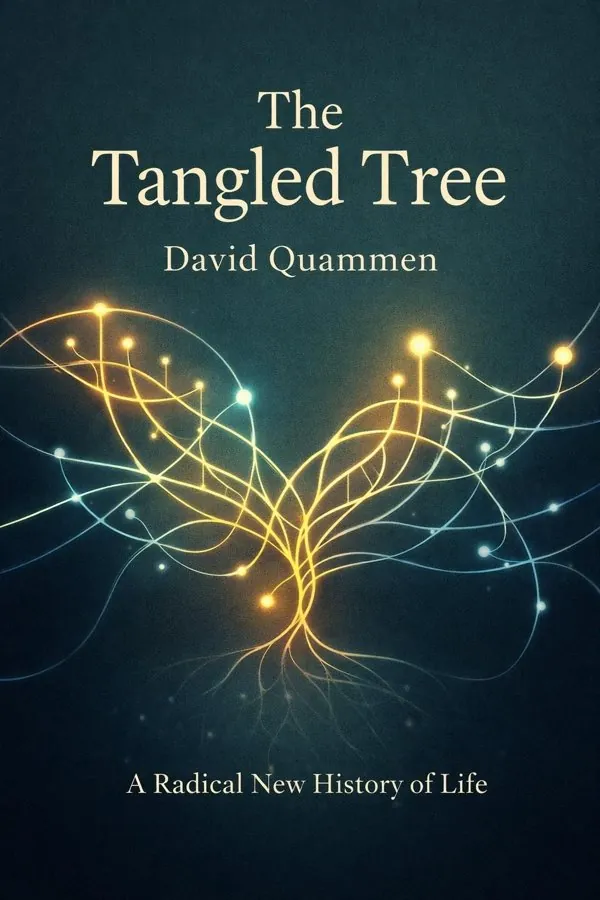
The Tangled Tree: A Radical New History of Life: Summary & Key Insights
 10 min9 chaptersAudio available
Key Takeaways from The Tangled Tree: A Radical New History of Life
A scientific metaphor can guide discovery for generations, but it can also hide what no one expects to see.
Major breakthroughs often begin with someone willing to ask a question that seems obscure to everyone else.
Inheritance is usually imagined as a family story, but genes do not always respect family lines.
Some of the most important evolutionary innovations may have begun not with competition, but with long-term collaboration.
The most important life forms on Earth are often the ones we rarely notice.
What Is The Tangled Tree: A Radical New History of Life About?
The Tangled Tree: A Radical New History of Life by David Quammen is a life_science book spanning 6 pages. What if one of biology’s most powerful images—the Tree of Life—is only partly true? In The Tangled Tree, David Quammen tells the story of a scientific revolution that has reshaped how we understand evolution, ancestry, and the deep history of living things. For generations, Darwin’s tree suggested that life develops through neat, branching lines of descent, with genes passed vertically from parent to offspring. But modern molecular biology has revealed something far messier and more surprising: genes can also move sideways, jumping across species and even across major domains of life. The result is not a tidy tree, but a tangled web. Quammen brings this upheaval to life through vivid portraits of the scientists who drove it, especially Carl Woese, whose work on microbial genetics transformed evolutionary biology. Blending history, biography, and cutting-edge science, Quammen makes a technically demanding subject feel gripping and human. The book matters because it forces us to rethink fundamental assumptions about species, individuality, and our place in nature. It is not just a story about microbes; it is a story about how science changes when reality refuses to fit our metaphors.
This FizzRead summary covers all 9 key chapters of The Tangled Tree: A Radical New History of Life in approximately 10 minutes, distilling the most important ideas, arguments, and takeaways from David Quammen's work. Also available as an audio summary and Key Quotes Podcast.
The Tangled Tree: A Radical New History of Life
What if one of biology’s most powerful images—the Tree of Life—is only partly true? In The Tangled Tree, David Quammen tells the story of a scientific revolution that has reshaped how we understand evolution, ancestry, and the deep history of living things. For generations, Darwin’s tree suggested that life develops through neat, branching lines of descent, with genes passed vertically from parent to offspring. But modern molecular biology has revealed something far messier and more surprising: genes can also move sideways, jumping across species and even across major domains of life. The result is not a tidy tree, but a tangled web.
Quammen brings this upheaval to life through vivid portraits of the scientists who drove it, especially Carl Woese, whose work on microbial genetics transformed evolutionary biology. Blending history, biography, and cutting-edge science, Quammen makes a technically demanding subject feel gripping and human. The book matters because it forces us to rethink fundamental assumptions about species, individuality, and our place in nature. It is not just a story about microbes; it is a story about how science changes when reality refuses to fit our metaphors.
Who Should Read The Tangled Tree: A Radical New History of Life?
This book is perfect for anyone interested in life_science and looking to gain actionable insights in a short read. Whether you're a student, professional, or lifelong learner, the key ideas from The Tangled Tree: A Radical New History of Life by David Quammen will help you think differently.
- ✓Readers who enjoy life_science and want practical takeaways
- ✓Professionals looking to apply new ideas to their work and life
- ✓Anyone who wants the core insights of The Tangled Tree: A Radical New History of Life in just 10 minutes
Want the full summary?
Get instant access to this book summary and 100K+ more with Fizz Moment.
Get Free SummaryAvailable on App Store • Free to download
Key Chapters
A scientific metaphor can guide discovery for generations, but it can also hide what no one expects to see. For more than a century, Darwin’s Tree of Life was biology’s master image: all living things diverge from common ancestors through branching descent. This model captured a profound truth about evolution and still explains much of how organisms inherit traits. Parents pass genes to offspring, lineages split, and over time diversity expands. It was elegant, intuitive, and deeply influential.
But Quammen shows that the rise of molecular biology changed the terms of the conversation. Instead of classifying organisms only by visible traits such as bones, leaves, or body shape, scientists began comparing sequences of DNA and RNA. Molecules allowed them to ask a more precise question: not merely what organisms look like, but how closely related they are at the genetic level. That shift exposed anomalies. Some organisms that seemed closely related looked genetically distant, while others from very different groups shared key genes. The deeper researchers went into microbial life, the stranger the picture became.
This did not mean Darwin was wrong. It meant the tree was incomplete. Vertical inheritance remained central, but it was no longer the whole story. Molecular evidence suggested that life’s history includes mergers, gene swaps, and ancient exchanges that a simple branching diagram cannot fully capture. In practical terms, this matters for everything from disease tracking to agriculture, because genetic relationships influence how traits spread and how organisms adapt.
Actionable takeaway: Treat useful models as tools, not sacred truths; when new evidence appears, update the map rather than defending the old picture.
Major breakthroughs often begin with someone willing to ask a question that seems obscure to everyone else. Carl Woese was one of those scientists. At a time when many biologists focused on familiar plants and animals, Woese turned toward microbes and asked how one might uncover the deepest relationships among all living things. His answer was to compare ribosomal RNA, a molecule present in every organism and fundamental to protein synthesis. Because it changes slowly over evolutionary time, it offered a way to peer far back into life’s history.
Quammen presents Woese as brilliant, difficult, stubborn, and indispensable. Working with limited tools by modern standards, he helped reveal that certain microbes long thought to be ordinary bacteria were in fact something profoundly different. These organisms became known as Archaea, forming a domain of life distinct from Bacteria and Eukarya. That discovery shattered the older two-part division of life and replaced it with a three-domain framework.
The importance of this shift cannot be overstated. It changed textbooks, reorganized evolutionary biology, and highlighted how little humans had understood about the microbial world. It also showed the power of molecular comparison over superficial appearance. Two organisms may look similar under a microscope yet be deeply different in evolutionary origin.
The practical lesson extends beyond biology. In medicine, public health, and environmental science, accurate classification is not just academic. It shapes how researchers study metabolism, extremophiles, antibiotic resistance, and the origins of complex cells. Woese’s work reminds us that reality may be structured in ways our senses alone cannot detect.
Actionable takeaway: Look beneath surface similarities; whether in science or decision-making, deeper structure often matters more than outward form.
Inheritance is usually imagined as a family story, but genes do not always respect family lines. One of Quammen’s central themes is horizontal gene transfer, the movement of genetic material between organisms outside traditional parent-to-offspring reproduction. In microbes especially, genes can travel sideways through mechanisms such as plasmids, viruses, or direct uptake from the environment. This means an organism can acquire useful capabilities not only by slowly mutating over generations, but by borrowing ready-made solutions from others.
This idea was radical because it disrupted the clean logic of the evolutionary tree. If genes can move across branches, then parts of one lineage’s history may be stitched into another. A bacterium can gain antibiotic resistance from a distant relative. Microbial communities can share metabolic tricks that help them survive toxins, heat, or scarcity. Evolution, in these cases, can be collaborative, opportunistic, and networked.
Quammen explains why this matters far beyond microbiology. Antibiotic resistance in hospitals is one vivid example. Bacteria do not need to wait for a lucky mutation if a resistance gene is already circulating nearby. That makes infectious disease harder to control and highlights the importance of careful antibiotic use. In biotechnology, horizontal gene transfer also informs how scientists think about gene editing, microbial engineering, and biosafety.
The broader philosophical shift is equally striking: life is not only a story of divergence but also of exchange. Evolution remains real and natural selection still operates, but the routes through which novelty appears are more varied than biologists once believed.
Actionable takeaway: In any complex system, watch how information moves laterally, not just from top to bottom; sideways transfer can drive change faster than linear inheritance.
Some of the most important evolutionary innovations may have begun not with competition, but with long-term collaboration. Quammen gives significant attention to Lynn Margulis, whose theory of endosymbiosis helped transform biology. Margulis argued that key parts of complex cells—especially mitochondria and chloroplasts—were once free-living bacteria that took up residence inside other cells. Over immense stretches of time, these partnerships became permanent, producing the eukaryotic cells that make up plants, animals, fungi, and humans.
At first, the idea was dismissed or resisted. It challenged conventional assumptions and sounded too strange. Yet accumulating evidence supported it. Mitochondria and chloroplasts carry their own DNA, reproduce in bacterial-like ways, and resemble bacteria in important structural and genetic features. Rather than seeing evolution solely as gradual modification along branches, endosymbiosis revealed a history that included fusion. One organism did not merely descend from another; in a profound sense, one organism incorporated another.
This insight complements horizontal gene transfer by showing that life’s history is shaped not only by branching but by mergers. The cell itself becomes a record of ancient alliance. In practical terms, understanding mitochondria influences research into metabolism, aging, inherited disease, and cellular energy. Chloroplast origins illuminate plant biology and photosynthesis, which in turn matter for agriculture and climate science.
Margulis’s story also illustrates how science advances. Transformative ideas often begin as minority views, and strong evidence may take years to overcome entrenched habits of thought. The lesson is not to believe every unconventional claim, but to remain open when data steadily accumulate.
Actionable takeaway: When solving problems, consider integration as well as competition; durable breakthroughs often come from combining strengths, not just defeating alternatives.
The most important life forms on Earth are often the ones we rarely notice. Quammen repeatedly brings readers back to microbes, not as biological footnotes but as the central actors in life’s history. For much of scientific history, large visible organisms captured attention because they were easier to observe and classify. Yet bacteria and archaea dominated Earth for billions of years before animals appeared, and they still drive planetary processes today.
Microbes shape the chemistry of oceans, soils, and the atmosphere. They recycle nutrients, help produce oxygen, influence climate, and live in intimate partnership with larger organisms. Human beings are ecosystems as much as individuals, carrying vast microbial communities in the gut, on the skin, and throughout the body. These microbes affect digestion, immunity, and even aspects of health that medicine is still learning to understand.
The discovery of horizontal gene transfer made microbes even more consequential. Their genetic flexibility allows them to adapt quickly and share useful traits, making them evolutionary innovators. This helps explain why antibiotic resistance spreads so effectively and why microbial life can thrive in extreme environments once thought impossible. It also underlines why studying only plants and animals gives a distorted picture of biology.
In practical terms, this microbial perspective affects nutrition, public health, wastewater treatment, agriculture, and climate policy. Soil microbes influence crop productivity. Gut microbes affect disease risk. Environmental microbes help clean pollutants or generate industrial products.
Quammen’s deeper point is humbling: humans are not the center of life’s story. We are late arrivals in a microbial world whose foundational systems were built long before us.
Actionable takeaway: Pay attention to hidden systems; whether in health, business, or ecology, the smallest unseen agents often exert the greatest influence.
We like categories because they make the world manageable, but nature is under no obligation to keep them neat. One of the most destabilizing consequences of the science Quammen describes is that the concept of species becomes less straightforward than many people assume. In animals and plants, species are often defined by reproductive boundaries: members of the same species can interbreed, while others cannot. That model works reasonably well in many contexts, but it becomes shaky when applied across all life.
Microbes reproduce differently, exchange genes laterally, and often resist tidy classification. If a bacterium can acquire important genes from unrelated organisms, what exactly defines its lineage? If genomes are mosaics assembled from multiple sources, then evolutionary identity becomes more like a patchwork than a pure bloodline. Even among larger organisms, modern genetics has shown histories of hybridization and gene flow that blur old distinctions.
This is not just a technical problem for specialists. The way we define species affects conservation law, medical research, biodiversity studies, and how we talk about human uniqueness. It also encourages intellectual humility. Categories are useful, but they are approximations built to describe a changing world. Quammen’s account shows that biology advances when scientists remain willing to revise even foundational definitions.
In practical settings, flexible thinking about classification can improve outcomes. Conservationists may need to focus on preserving genetic diversity and ecological function, not only rigid labels. Medical researchers may need to identify pathogens by genome dynamics rather than by older naming conventions.
Actionable takeaway: Use categories pragmatically, not dogmatically; when reality is fluid, definitions should help understanding rather than constrain it.
If life is woven together by exchanges, mergers, and shared ancestry, then human beings are less isolated than we imagine. Quammen uses the revolution in evolutionary biology to challenge comfortable ideas about human exceptionalism. We are not separate from nature, standing at the top of a ladder. We are one recent branch among many, built from ancient cellular mergers, carrying genes inherited through deep time, and living in dependence on microbial partners.
This view does not diminish humanity; it situates us more accurately. Our cells contain mitochondria descended from ancient bacteria. Our bodies function with the help of microbiomes. Our evolutionary history is connected to every other organism through common descent, while the broader history of life includes forms of genetic exchange that make strict boundaries less absolute than once believed. The result is a more relational picture of selfhood.
This matters ethically as well as scientifically. When humans understand themselves as embedded within living systems, issues such as biodiversity loss, antibiotic misuse, habitat destruction, and climate disruption appear in a new light. We are not external managers of a machine called nature. We are participants in a dynamic network whose stability supports our own survival.
On a personal level, this perspective can also influence how people think about health and environment. Diet, antibiotics, sanitation, ecosystems, and biodiversity all affect the web of relationships that sustain life. Recognizing entanglement encourages responsibility over domination.
Quammen’s argument is intellectually bracing because it replaces flattering simplicity with complex belonging. We remain distinctive in many ways, but not disconnected.
Actionable takeaway: Make decisions with interdependence in mind; your health, community, and environment are linked more tightly than isolated thinking suggests.
New truths rarely arrive in a calm, orderly procession; they usually come wrapped in argument, personality, and resistance. One of the pleasures of The Tangled Tree is that Quammen does not present science as a machine that automatically produces facts. He presents it as a human process shaped by obsession, rivalry, ambition, error, and persistence. Carl Woese, Lynn Margulis, and other figures in the book are not saints of pure rationality. They are difficult, gifted, sometimes combative people trying to force the world to yield its secrets.
This matters because readers often encounter science only after disagreements have been smoothed away. Textbooks present conclusions, not the long periods of uncertainty that precede them. Quammen shows how evidence accumulates unevenly, how institutions resist conceptual change, and how a minority view can become mainstream when data become too strong to ignore. He also shows that some challenges to orthodoxy fail, which is why skepticism and standards matter.
The practical application is broad. In business, education, policy, and personal life, people often mistake disagreement for dysfunction. But productive conflict can be a sign that serious inquiry is happening. What matters is whether claims are tested rigorously and whether participants are willing to revise their views in light of evidence.
The book therefore offers a subtle lesson in scientific literacy: trust science not because scientists are infallible, but because the process, at its best, corrects itself over time. The messiness is a feature, not a flaw.
Actionable takeaway: When evaluating new ideas, focus less on confidence and more on evidence, replication, and the willingness to revise conclusions.
Sometimes progress does not destroy an old idea; it transforms it into part of a larger and richer picture. Quammen’s ultimate achievement is to show that the Tree of Life has not simply been overthrown. It has been complicated. Vertical descent still matters enormously, especially in multicellular organisms and across much of evolutionary history. But the more scientists learned about microbes, endosymbiosis, and gene transfer, the more the tree began to look tangled, reticulated, and web-like.
This revised image carries major philosophical weight. It suggests that life’s history cannot always be represented as a single trunk splitting into independent branches. Some branches reconnect. Some borrow pieces from others. Some arise from mergers. Ancestry remains real, but it is not always singular or clean. The metaphor we choose shapes the questions we ask, so replacing a tidy tree with a network changes what biologists look for and how they explain novelty.
There are practical consequences too. Evolutionary research, genome analysis, epidemiology, and biotechnology all benefit from models that account for networked exchange. If pathogens swap genes, if cells arose from symbiosis, and if lineages contain mixed histories, then predictive science must reflect that complexity.
More broadly, the tangled tree becomes a metaphor for knowledge itself. Reality is often less orderly than the categories used to describe it. Mature understanding does not demand simplicity at all costs; it learns to work with complexity without surrendering clarity.
Actionable takeaway: Upgrade your mental models when reality grows more complex; a better framework often explains more, even if it feels less tidy at first.
All Chapters in The Tangled Tree: A Radical New History of Life
About the Author
David Quammen is an American science, nature, and travel writer celebrated for turning complex scientific subjects into vivid, accessible narratives. Trained in literature but deeply immersed in field reporting and scientific research, he has written extensively on evolution, ecology, infectious disease, and biodiversity. His books include The Song of the Dodo, Spillover, Breathless, and The Tangled Tree, many of which have earned wide critical acclaim for their depth, clarity, and storytelling power. Quammen has also been a longtime contributor to National Geographic, where his reporting helped bring cutting-edge science to broad audiences. His writing is distinguished by rigorous research, memorable character portraits, and an ability to connect scientific discovery with urgent human questions.
Get This Summary in Your Preferred Format
Read or listen to the The Tangled Tree: A Radical New History of Life summary by David Quammen anytime, anywhere. FizzRead offers multiple formats so you can learn on your terms — all free.
Available formats: App · Audio · PDF · EPUB — All included free with FizzRead
Download The Tangled Tree: A Radical New History of Life PDF and EPUB Summary
Key Quotes from The Tangled Tree: A Radical New History of Life
“A scientific metaphor can guide discovery for generations, but it can also hide what no one expects to see.”
“Major breakthroughs often begin with someone willing to ask a question that seems obscure to everyone else.”
“Inheritance is usually imagined as a family story, but genes do not always respect family lines.”
“Some of the most important evolutionary innovations may have begun not with competition, but with long-term collaboration.”
“The most important life forms on Earth are often the ones we rarely notice.”
Frequently Asked Questions about The Tangled Tree: A Radical New History of Life
The Tangled Tree: A Radical New History of Life by David Quammen is a life_science book that explores key ideas across 9 chapters. What if one of biology’s most powerful images—the Tree of Life—is only partly true? In The Tangled Tree, David Quammen tells the story of a scientific revolution that has reshaped how we understand evolution, ancestry, and the deep history of living things. For generations, Darwin’s tree suggested that life develops through neat, branching lines of descent, with genes passed vertically from parent to offspring. But modern molecular biology has revealed something far messier and more surprising: genes can also move sideways, jumping across species and even across major domains of life. The result is not a tidy tree, but a tangled web. Quammen brings this upheaval to life through vivid portraits of the scientists who drove it, especially Carl Woese, whose work on microbial genetics transformed evolutionary biology. Blending history, biography, and cutting-edge science, Quammen makes a technically demanding subject feel gripping and human. The book matters because it forces us to rethink fundamental assumptions about species, individuality, and our place in nature. It is not just a story about microbes; it is a story about how science changes when reality refuses to fit our metaphors.
More by David Quammen
The Song of the Dodo: Island Biogeography in an Age of Extinctions
David Quammen
10 min
Spillover: Animal Infections and the Next Human Pandemic
David Quammen
10 min
The Reluctant Mr. Darwin: An Intimate Portrait of Charles Darwin and the Making of His Theory of Evolution
David Quammen
10 minYou Might Also Like
The Selfish Gene
Richard Dawkins
10 min
Awakenings
Oliver Sacks
10 min
Parasite Rex: Inside the Bizarre World of Nature's Most Dangerous Creatures
Carl Zimmer
10 min
The Atlas of Life on Earth
Various
10 min
The Book of Humans: The Story of How We Became Us
Adam Rutherford
10 min
The Horse
Wendy Williams
10 minBrowse by Category
Ready to read The Tangled Tree: A Radical New History of Life?
Get the full summary and 100K+ more books with Fizz Moment.