
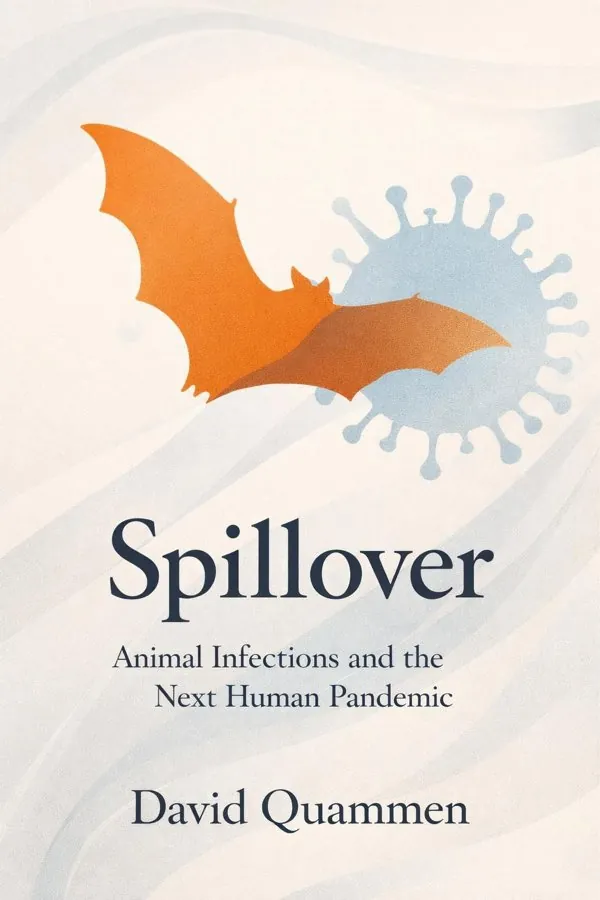
Spillover: Animal Infections and the Next Human Pandemic: Summary & Key Insights
 10 min10 chaptersAudio available
Key Takeaways from Spillover: Animal Infections and the Next Human Pandemic
The most dangerous outbreaks often begin with an invisible mistake of biology: a pathogen finds a way into a new host.
Modern pandemics feel unprecedented, but Quammen reminds us that humanity has been living with zoonotic risk for centuries.
Some of the most consequential disease stories begin not in cities but at the edge of wild habitat.
One of the most frightening aspects of emerging disease is not knowing where it hides between outbreaks.
A virus does not need high lethality to become globally disruptive; it only needs mobility, timing, and access.
What Is Spillover: Animal Infections and the Next Human Pandemic About?
Spillover: Animal Infections and the Next Human Pandemic by David Quammen is a life_science book spanning 11 pages. Spillover is a gripping work of science writing about the most dangerous diseases humans face: the ones that begin somewhere else. David Quammen explores zoonotic infections, pathogens that move from animals into people, and shows how these cross-species jumps are not rare accidents but recurring biological events shaped by ecology, evolution, and human behavior. Moving from remote forests to hospital wards, wet markets, laboratories, and field camps, he follows the trails of Ebola, SARS, Hendra, HIV, influenza, Nipah, and other threats to reveal how pandemics emerge. What makes the book especially powerful is its combination of scientific clarity and on-the-ground reporting. Quammen interviews virologists, epidemiologists, wildlife experts, and outbreak investigators, translating complex ideas into vivid stories without losing rigor. He explains why habitat destruction, global travel, industrial farming, hunting, and urban expansion create ideal conditions for new diseases to spread. Long before the world was transformed by COVID-19, Spillover argued that another pandemic was not a distant possibility but an eventual certainty. The book matters because it reframes public health as inseparable from environmental health, and it gives readers a deeper understanding of the biological and social forces that make modern pandemics possible.
This FizzRead summary covers all 10 key chapters of Spillover: Animal Infections and the Next Human Pandemic in approximately 10 minutes, distilling the most important ideas, arguments, and takeaways from David Quammen's work. Also available as an audio summary and Key Quotes Podcast.
Spillover: Animal Infections and the Next Human Pandemic
Spillover is a gripping work of science writing about the most dangerous diseases humans face: the ones that begin somewhere else. David Quammen explores zoonotic infections, pathogens that move from animals into people, and shows how these cross-species jumps are not rare accidents but recurring biological events shaped by ecology, evolution, and human behavior. Moving from remote forests to hospital wards, wet markets, laboratories, and field camps, he follows the trails of Ebola, SARS, Hendra, HIV, influenza, Nipah, and other threats to reveal how pandemics emerge.
What makes the book especially powerful is its combination of scientific clarity and on-the-ground reporting. Quammen interviews virologists, epidemiologists, wildlife experts, and outbreak investigators, translating complex ideas into vivid stories without losing rigor. He explains why habitat destruction, global travel, industrial farming, hunting, and urban expansion create ideal conditions for new diseases to spread. Long before the world was transformed by COVID-19, Spillover argued that another pandemic was not a distant possibility but an eventual certainty. The book matters because it reframes public health as inseparable from environmental health, and it gives readers a deeper understanding of the biological and social forces that make modern pandemics possible.
Who Should Read Spillover: Animal Infections and the Next Human Pandemic?
This book is perfect for anyone interested in life_science and looking to gain actionable insights in a short read. Whether you're a student, professional, or lifelong learner, the key ideas from Spillover: Animal Infections and the Next Human Pandemic by David Quammen will help you think differently.
- ✓Readers who enjoy life_science and want practical takeaways
- ✓Professionals looking to apply new ideas to their work and life
- ✓Anyone who wants the core insights of Spillover: Animal Infections and the Next Human Pandemic in just 10 minutes
Want the full summary?
Get instant access to this book summary and 100K+ more with Fizz Moment.
Get Free SummaryAvailable on App Store • Free to download
Key Chapters
The most dangerous outbreaks often begin with an invisible mistake of biology: a pathogen finds a way into a new host. Quammen uses the concept of spillover to explain how viruses, bacteria, and other infectious agents cross species lines, often from wild animals into domestic animals and then into humans. This is not science fiction or biological bad luck. It is a normal evolutionary process. Pathogens constantly probe for opportunities, and whenever humans come into close contact with animals, those opportunities increase.
A spillover event does not automatically become an epidemic. Many pathogens enter a human body and go nowhere. Others infect one person but fail to spread further. The truly dangerous cases are those in which a microbe not only enters humans but also adapts well enough to transmit from one person to another. That is the difference between a biological curiosity and a public health disaster. Quammen shows that this process depends on reservoir hosts, transmission routes, mutation, exposure frequency, and the ecological context in which animals and humans interact.
Examples across the book make the concept concrete. Fruit bats may carry viruses harmlessly while shedding them into environments shared with horses or pigs. Primates hunted for bushmeat can expose humans to bloodborne viruses. Live-animal markets can mix species that would rarely meet in nature, allowing pathogens to experiment with new hosts. The lesson is that the species boundary is porous, not fixed.
Actionable takeaway: think of disease prevention upstream. Reducing risky human-animal contact, improving surveillance in wildlife and livestock, and strengthening public health systems matter far more than reacting after a pathogen has already adapted to humans.
Modern pandemics feel unprecedented, but Quammen reminds us that humanity has been living with zoonotic risk for centuries. The story of spillover stretches from ancient domestication to medieval plague, from influenza pandemics to HIV. Looking backward matters because it reveals a pattern: when humans reshape landscapes, concentrate animals, expand trade routes, or change how they live, microbes find new opportunities.
Historical outbreaks show that zoonosis is not a side issue in medical history. It is central to it. The Black Death likely moved through animal reservoirs and flea vectors before devastating human populations. Influenza repeatedly emerged from animal hosts, especially birds and pigs, then spread through increasingly connected human societies. HIV originated from simian viruses crossing into humans, probably through hunting and butchering in Central Africa, before expanding through urbanization, transport networks, and social change.
This historical perspective does two important things. First, it counters the idea that pandemics are freak accidents. They are recurring events that become more likely under certain ecological and social conditions. Second, it shows how technological progress does not eliminate vulnerability. In some cases, it amplifies it. Air travel, industrial farming, dense cities, and global supply chains can move pathogens faster than any caravan, ship, or army in history.
Quammen’s larger point is that the next pandemic will not emerge from nowhere. It will come from the same broad forces that produced previous ones: ecological disruption, animal contact, microbial evolution, and human interconnectedness. History is less a museum of old disasters than a field guide for interpreting the present.
Actionable takeaway: study outbreak history not as a list of past tragedies, but as a practical framework for recognizing recurring risk factors in today’s world.
Some of the most consequential disease stories begin not in cities but at the edge of wild habitat. Quammen’s account of Hendra virus in Australia illustrates how spillover often occurs where ecological systems have been disturbed but not fully replaced. Hendra is carried by fruit bats, also called flying foxes, which appear to host the virus without severe illness. Horses became the intermediate victims, and humans were infected through close contact with sick horses. This chain reveals how pathogens can move through a sequence of hosts rather than jumping directly from wildlife to people.
The Hendra story is also a case study in ecological compression. As forests were altered and food resources changed, bats increasingly fed near farms and suburban areas. Their saliva, urine, or partly eaten fruit likely contaminated environments used by horses. Humans then entered the chain through veterinary care, animal handling, and stable management. No villain is required. Ordinary economic activity and land use created a new interface where species that once remained separate were brought into frequent contact.
Quammen uses Hendra to challenge simplistic assumptions about disease control. Killing bats would be ecologically destructive and scientifically misguided, because reservoir hosts are part of complex systems. The smarter response involves understanding behavior and transmission pathways: vaccinating horses, reducing horse exposure to bat feeding sites, improving animal surveillance, and educating people who work with livestock.
This pattern has broad application beyond Australia. Similar interfaces exist wherever wildlife, livestock, and humans overlap, from pig farms near forest edges to poultry systems along migratory bird routes. Hendra teaches that emerging infections are often symptoms of ecological imbalance, not isolated medical events.
Actionable takeaway: when assessing disease risk, pay close attention to shared spaces between wildlife, domestic animals, and humans, because those interfaces are where prevention is often most effective.
A virus does not need high lethality to become globally disruptive; it only needs mobility, timing, and access. Quammen’s treatment of SARS demonstrates how modern pandemics emerge at the intersection of wildlife trade, urban density, and international travel. SARS likely originated in bats, moved through intermediate hosts such as civets in live-animal market settings, and then found ideal conditions for amplification among humans. Once it entered hospitals and airports, geography stopped being much of a barrier.
What made SARS historically important was not just the disease itself but the speed with which it exposed global vulnerability. A local outbreak became an international crisis through ordinary patterns of commerce and movement. Travelers carried infection across borders before many authorities understood what they were dealing with. Hospitals, instead of serving only as treatment centers, sometimes became transmission hubs. This highlighted the crucial role of infection control, rapid reporting, and transparent communication.
Quammen also emphasizes market ecology: when wild species are captured, transported, confined, stressed, and placed near humans and other animals, pathogens gain repeated opportunities to test new hosts. Such settings are biological mixing chambers. The lesson applies not only to wildlife markets but to any system that compresses diverse species into unnatural proximity.
SARS also offers a rare note of cautious optimism. Strong public health action, international cooperation, contact tracing, and behavioral changes helped stop it before it became permanently entrenched in humans. That success, however, was contingent and difficult, not automatic. It showed what good response can achieve, but also how narrow the window can be.
Actionable takeaway: treat speed and transparency as core outbreak tools. The sooner unusual cases are reported, investigated, and isolated, the better the chance of preventing a local event from becoming a global emergency.
Some spillovers explode visibly; others smolder for years before the world recognizes them. HIV is Quammen’s clearest example of a zoonotic event whose consequences unfolded over decades. The virus originated from simian immunodeficiency viruses in African primates and crossed into humans, likely through blood exposure during hunting and butchering. But the cross-species jump alone did not create a pandemic. What mattered was that the virus found ecological and social conditions in which it could adapt, spread, and persist.
Quammen uses HIV to show evolution in action. Once inside humans, the virus diversified, adapted, and exploited specific transmission routes. Expanding towns, colonial transportation networks, changes in sexual networks, medical reuse of needles, and later international travel all helped transform a local spillover into a global catastrophe. This is a key theme throughout the book: microbes take opportunities, but human systems determine how large those opportunities become.
HIV also teaches humility about timescales. A pathogen may circulate unnoticed long before it is identified. By the time medicine names a new disease, its evolutionary story may already be old. That makes surveillance and retrospective investigation essential. Genetic analysis can reconstruct viral ancestry and spread, revealing where spillover likely happened and how transmission pathways formed.
The practical implication extends beyond HIV itself. Not every emerging pathogen will announce itself with sudden hemorrhagic symptoms or dramatic animal die-offs. Some may establish quiet footholds first. Public health therefore needs tools not only for emergency response but for long, patient detection of unusual patterns.
Actionable takeaway: understand pandemics as both biological and social phenomena. Reducing future risk requires attention to healthcare infrastructure, social behavior, stigma, and early surveillance, not just to the pathogen alone.
If Quammen had to name the pathogen most likely to become the next great pandemic, influenza would remain near the top of the list. Unlike some rare viruses that emerge sporadically, flu is a constant evolutionary machine. It circulates widely in birds, infects other animals such as pigs, and changes rapidly through mutation and reassortment. That genetic flexibility allows it to keep testing new combinations, some of which may spread efficiently among humans.
The danger of influenza lies in its familiarity. Because seasonal flu is common, people can underestimate how different a novel pandemic strain might be. Quammen stresses that wild birds form a major reservoir of influenza diversity. Domestic poultry and pigs can act as bridge hosts or mixing vessels, especially in farming systems where large numbers of animals are kept in close quarters. When multiple strains infect the same host, genes can reshuffle, potentially creating a virus with both novelty and transmissibility.
Historical examples reinforce the warning. The 1918 influenza pandemic killed on a staggering scale, and later pandemics showed that new strains continue to emerge. In a globalized world, a highly transmissible flu virus could spread before vaccines are produced in sufficient quantity. Preparedness therefore depends on surveillance in birds and livestock, flexible vaccine technology, stockpiles, healthcare capacity, and public communication.
Quammen does not present influenza as inevitable doom, but as a standing challenge that rewards constant vigilance. Because the virus evolves quickly and circulates so broadly, complacency is dangerous. The next severe pandemic may not come from the most exotic pathogen. It may come from the one we think we already know.
Actionable takeaway: treat influenza preparedness as year-round pandemic preparedness by supporting vaccination, surveillance, and resilient healthcare systems rather than assuming seasonal familiarity equals safety.
Emerging diseases often look mysterious until their ecological context comes into focus. Quammen’s discussion of Nipah virus reveals how agriculture, deforestation, and animal husbandry can combine to create new transmission pathways. In Malaysia, fruit bats carrying Nipah were drawn to cultivated fruit trees planted near pig farms. Pigs then became amplifying hosts, and the virus spread to humans in close contact with infected swine. What looked at first like a strange outbreak was, on closer examination, a highly intelligible ecological event.
Nipah demonstrates a recurring principle in Spillover: when humans simplify or rearrange landscapes for productivity, they may accidentally increase biological complexity in the most dangerous places. Bats displaced or attracted by altered habitats do not stop carrying viruses simply because farmland has replaced forest. Instead, reservoirs and domestic animals may begin overlapping in new ways. Add dense populations of livestock and high human contact, and the conditions for amplification improve dramatically.
The response to Nipah also shows the economic cost of delayed understanding. Mass culling of pigs was devastating but necessary once the transmission pathway became clear. Had the ecological risk been recognized earlier, some losses might have been reduced through farm design, surveillance, and separation of fruiting trees from livestock areas. Similar lessons apply to other pathogens emerging around intensive farming systems.
Quammen’s broader insight is that disease emergence is often a byproduct of how people engineer landscapes. Public health therefore cannot be separated from land-use planning, agricultural policy, and biodiversity management. Prevention is not just about medicine after infection appears; it is about designing systems that reduce opportunities for cross-species contact.
Actionable takeaway: evaluate farming and development projects not only for economic output, but also for how they alter contact between wildlife, livestock, and humans.
The paradox at the heart of Spillover is simple: we usually cannot predict exactly which pathogen will cause the next pandemic, but we can predict with confidence that one will come. Quammen argues that the next big one is not a matter of if but when. This is not prophecy. It is a conclusion drawn from evolutionary biology, ecological disruption, demographic growth, and globalization. The world has created ideal conditions for disease emergence, and microbes continually exploit those conditions.
Prediction in this context does not mean naming a date or species. It means recognizing structural risk. Expanding human populations push into forests and wildlands. Global travel allows infected people to move between continents within hours. Livestock production concentrates animals by the thousands or millions. Climate shifts alter animal distributions and vector ranges. Weak health systems delay detection. All of these forces increase the probability that a novel pathogen will emerge and spread.
Quammen’s warning is paired with a challenge: preparedness is politically difficult because successful prevention often looks like overreaction. Investments in surveillance, laboratories, rapid diagnostics, protective equipment, and outbreak training may seem excessive until they are suddenly inadequate. Yet waiting for certainty is itself a dangerous choice.
The book therefore pushes readers to think in terms of resilience rather than prediction alone. Since uncertainty is unavoidable, societies need systems that can detect unusual cases early, share information fast, coordinate across borders, and adapt as evidence changes. The exact pathogen may be unknown, but the need for readiness is not.
Actionable takeaway: judge preparedness efforts by whether they build flexible public health capacity, not by whether they correctly guess the identity of the next pandemic microbe.
The deepest argument in Spillover is that pandemics are not merely medical events; they are ecological consequences. Quammen repeatedly shows that pathogens emerge where systems intersect: forest and farm, bat and horse, bird and pig, market and megacity, local outbreak and global network. To understand disease, we must understand relationships, not just microbes. Human health is inseparable from the health of animals, habitats, and the systems through which species interact.
This ecological perspective changes how responsibility is understood. It is tempting to imagine dangerous animals as the source of the problem, but Quammen makes clear that human actions often create the circumstances in which spillover becomes more likely. Logging roads open remote forests to hunting and settlement. Urban demand fuels wildlife trade. Industrial farming creates dense populations of susceptible hosts. Climate and land-use change alter the movements of animals and vectors. In this sense, pandemics are not solely acts of nature. They are partly products of how civilization expands.
This idea has practical implications for policy and everyday thinking. Public health should be integrated with conservation biology, veterinary science, agricultural planning, and environmental governance. The now-common idea of One Health, linking human, animal, and ecosystem health, is embedded throughout Quammen’s reporting even when presented through narrative rather than policy language.
For readers, the book offers a powerful intellectual shift. Instead of seeing outbreaks as isolated emergencies, we begin to see them as warnings from damaged systems. The same behaviors that erode biodiversity can also erode disease safety. That makes prevention broader, harder, and ultimately more realistic.
Actionable takeaway: adopt a One Health mindset by connecting decisions about food, land use, wildlife, travel, and healthcare to their downstream effects on infectious disease risk.
All Chapters in Spillover: Animal Infections and the Next Human Pandemic
About the Author
David Quammen is an American science writer and author celebrated for his ability to turn complex scientific subjects into compelling narrative nonfiction. His work focuses on ecology, evolution, biogeography, conservation, and infectious disease, often highlighting the deep connections between human life and the natural world. Quammen has written extensively for National Geographic and other major publications, earning a reputation for immersive reporting, intellectual rigor, and elegant prose. Among his best-known books are The Song of the Dodo, which explores island biogeography and extinction, and Spillover, his influential study of zoonotic disease and pandemic risk. Drawing on interviews with leading scientists and firsthand reporting from the field, Quammen has become one of the most respected interpreters of science for general readers.
Get This Summary in Your Preferred Format
Read or listen to the Spillover: Animal Infections and the Next Human Pandemic summary by David Quammen anytime, anywhere. FizzRead offers multiple formats so you can learn on your terms — all free.
Available formats: App · Audio · PDF · EPUB — All included free with FizzRead
Download Spillover: Animal Infections and the Next Human Pandemic PDF and EPUB Summary
Key Quotes from Spillover: Animal Infections and the Next Human Pandemic
“The most dangerous outbreaks often begin with an invisible mistake of biology: a pathogen finds a way into a new host.”
“Modern pandemics feel unprecedented, but Quammen reminds us that humanity has been living with zoonotic risk for centuries.”
“Some of the most consequential disease stories begin not in cities but at the edge of wild habitat.”
“One of the most frightening aspects of emerging disease is not knowing where it hides between outbreaks.”
“A virus does not need high lethality to become globally disruptive; it only needs mobility, timing, and access.”
Frequently Asked Questions about Spillover: Animal Infections and the Next Human Pandemic
Spillover: Animal Infections and the Next Human Pandemic by David Quammen is a life_science book that explores key ideas across 10 chapters. Spillover is a gripping work of science writing about the most dangerous diseases humans face: the ones that begin somewhere else. David Quammen explores zoonotic infections, pathogens that move from animals into people, and shows how these cross-species jumps are not rare accidents but recurring biological events shaped by ecology, evolution, and human behavior. Moving from remote forests to hospital wards, wet markets, laboratories, and field camps, he follows the trails of Ebola, SARS, Hendra, HIV, influenza, Nipah, and other threats to reveal how pandemics emerge. What makes the book especially powerful is its combination of scientific clarity and on-the-ground reporting. Quammen interviews virologists, epidemiologists, wildlife experts, and outbreak investigators, translating complex ideas into vivid stories without losing rigor. He explains why habitat destruction, global travel, industrial farming, hunting, and urban expansion create ideal conditions for new diseases to spread. Long before the world was transformed by COVID-19, Spillover argued that another pandemic was not a distant possibility but an eventual certainty. The book matters because it reframes public health as inseparable from environmental health, and it gives readers a deeper understanding of the biological and social forces that make modern pandemics possible.
More by David Quammen

The Song of the Dodo: Island Biogeography in an Age of Extinctions
David Quammen
10 min
The Tangled Tree: A Radical New History of Life
David Quammen
10 min
The Reluctant Mr. Darwin: An Intimate Portrait of Charles Darwin and the Making of His Theory of Evolution
David Quammen
10 minYou Might Also Like
The Selfish Gene
Richard Dawkins
10 min
Awakenings
Oliver Sacks
10 min
Parasite Rex: Inside the Bizarre World of Nature's Most Dangerous Creatures
Carl Zimmer
10 min
The Atlas of Life on Earth
Various
10 min
The Book of Humans: The Story of How We Became Us
Adam Rutherford
10 min
The Horse
Wendy Williams
10 minBrowse by Category
Ready to read Spillover: Animal Infections and the Next Human Pandemic?
Get the full summary and 100K+ more books with Fizz Moment.