
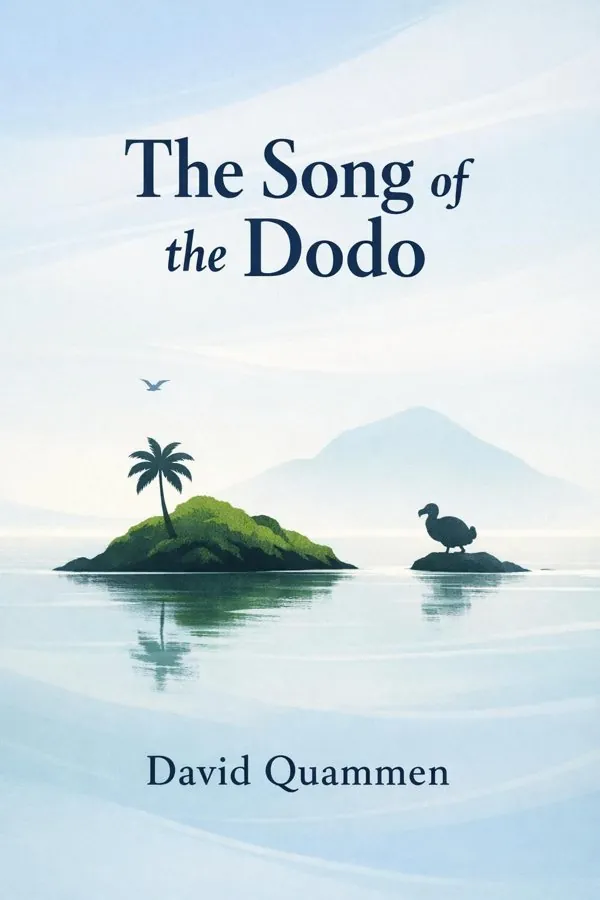
The Song of the Dodo: Island Biogeography in an Age of Extinctions: Summary & Key Insights
 10 min8 chaptersAudio available
Key Takeaways from The Song of the Dodo: Island Biogeography in an Age of Extinctions
Some of the deepest truths in biology become visible only in small, isolated places.
A healthy ecosystem is not a static museum of life; it is a moving balance between arrival and disappearance.
Extinction often looks absurd in hindsight, which is why the dodo has become a cultural joke.
You do not need saltwater to create an island.
Nature is not governed solely by elegant adaptation; chance plays a larger role than people like to admit.
What Is The Song of the Dodo: Island Biogeography in an Age of Extinctions About?
The Song of the Dodo: Island Biogeography in an Age of Extinctions by David Quammen is a life_science book spanning 7 pages. David Quammen’s The Song of the Dodo is one of the great works of modern science writing: a sweeping, intellectually adventurous exploration of why life flourishes in some places, disappears in others, and grows especially fragile when habitats become isolated. At its center is the theory of island biogeography, developed to explain how species colonize islands, persist there, and eventually vanish. But Quammen shows that “islands” are not only oceanic landmasses. They also include mountaintops, forest fragments, parks, and every patch of habitat cut off by roads, farms, or cities. That insight turns a specialized ecological theory into a profound lens for understanding the global extinction crisis. Blending field travel, scientific history, evolutionary theory, and vivid portraits of researchers, Quammen makes complex ideas feel urgent and alive. He moves from Darwin and Wallace to MacArthur and Wilson, from the dodo to endangered species on modern habitat islands, showing how isolation drives both creativity and collapse in nature. The book matters because it explains, with rare clarity, why biodiversity loss is not random but structured by geography, scale, and time. Quammen’s authority comes from years of reporting, deep scientific engagement, and a gift for translating technical ecology into unforgettable narrative.
This FizzRead summary covers all 8 key chapters of The Song of the Dodo: Island Biogeography in an Age of Extinctions in approximately 10 minutes, distilling the most important ideas, arguments, and takeaways from David Quammen's work. Also available as an audio summary and Key Quotes Podcast.
The Song of the Dodo: Island Biogeography in an Age of Extinctions
David Quammen’s The Song of the Dodo is one of the great works of modern science writing: a sweeping, intellectually adventurous exploration of why life flourishes in some places, disappears in others, and grows especially fragile when habitats become isolated. At its center is the theory of island biogeography, developed to explain how species colonize islands, persist there, and eventually vanish. But Quammen shows that “islands” are not only oceanic landmasses. They also include mountaintops, forest fragments, parks, and every patch of habitat cut off by roads, farms, or cities. That insight turns a specialized ecological theory into a profound lens for understanding the global extinction crisis.
Blending field travel, scientific history, evolutionary theory, and vivid portraits of researchers, Quammen makes complex ideas feel urgent and alive. He moves from Darwin and Wallace to MacArthur and Wilson, from the dodo to endangered species on modern habitat islands, showing how isolation drives both creativity and collapse in nature. The book matters because it explains, with rare clarity, why biodiversity loss is not random but structured by geography, scale, and time. Quammen’s authority comes from years of reporting, deep scientific engagement, and a gift for translating technical ecology into unforgettable narrative.
Who Should Read The Song of the Dodo: Island Biogeography in an Age of Extinctions?
This book is perfect for anyone interested in life_science and looking to gain actionable insights in a short read. Whether you're a student, professional, or lifelong learner, the key ideas from The Song of the Dodo: Island Biogeography in an Age of Extinctions by David Quammen will help you think differently.
- ✓Readers who enjoy life_science and want practical takeaways
- ✓Professionals looking to apply new ideas to their work and life
- ✓Anyone who wants the core insights of The Song of the Dodo: Island Biogeography in an Age of Extinctions in just 10 minutes
Want the full summary?
Get instant access to this book summary and 100K+ more with Fizz Moment.
Get Free SummaryAvailable on App Store • Free to download
Key Chapters
A healthy ecosystem is not a static museum of life; it is a moving balance between arrival and disappearance. That is the core insight of the equilibrium theory of island biogeography, developed by Robert MacArthur and E. O. Wilson in the 1960s. Quammen presents their theory not as abstract mathematics for specialists, but as a powerful framework for understanding why species richness varies from island to island.
The idea is elegantly simple. The number of species on an island is shaped by two opposing rates: immigration and extinction. New species arrive from a source area such as a mainland, but species already present also disappear. Large islands tend to support more species because they contain more habitat and larger populations, reducing extinction risk. Islands closer to the mainland tend to receive more colonists, increasing immigration. The “equilibrium” is not a permanent roster of the same species but a shifting total number produced by these interacting rates.
Quammen shows how this theory transformed ecology by giving scientists a predictive model. It explained why small, remote islands usually have fewer species than large, nearby ones. It also suggested that species composition may change even when total richness remains roughly stable.
The theory has practical uses beyond literal islands. Nature reserves, urban green spaces, and isolated wetlands all operate under similar constraints. A tiny park surrounded by highways may lose species faster than a larger connected landscape.
Actionable takeaway: When evaluating any habitat, focus on size and connectivity. Bigger, better-connected areas generally support more resilient biodiversity than small, isolated patches, even if both appear green on a map.
Extinction often looks absurd in hindsight, which is why the dodo has become a cultural joke. Quammen restores its tragedy. The dodo was not simply a clumsy bird that failed to adapt. It was the product of a specific ecological history on Mauritius, an island without mammalian predators where flightlessness had become viable. In other words, the dodo was exquisitely fitted to one world and catastrophically unprepared for another.
This is one of the book’s most important lessons: extinction is rarely about individual weakness and usually about context. The arrival of humans and their commensals, including pigs, rats, dogs, and habitat disturbance, transformed the dodo’s environment faster than its evolutionary inheritance could cope. Species that evolved in isolation often lack defenses against novel predators, diseases, or competitors. Their disappearance is not evidence of inferiority but of mismatch.
Quammen uses the dodo as an emblem of island vulnerability more broadly. Many island birds, reptiles, and mammals were shaped by long periods of ecological simplicity. When new pressures arrive suddenly, these species can collapse with terrifying speed. The same pattern now plays out in fragmented continental habitats, where specialized organisms confront invasive species, edge effects, and human disruption.
A practical application is biosecurity. On many islands today, conservation success depends less on heroic captive breeding than on preventing invasive species from arriving in the first place. Rats on nesting islands, for example, can devastate seabird populations.
Actionable takeaway: See extinction as a systems failure, not a moral flaw in the species that vanished. Support prevention-focused conservation, especially invasive species control and habitat protection before collapse begins.
You do not need saltwater to create an island. Quammen’s most unsettling argument is that modern human landscapes have turned continents into archipelagos. A forest surrounded by farms, a prairie hemmed in by roads, or a wetland isolated by development can function ecologically like an island, even though it sits in the middle of land. This is the bridge between classical island biogeography and the age of extinctions.
Habitat fragmentation reduces continuous ecosystems into smaller patches separated by inhospitable terrain. For species that cannot cross those altered spaces, each patch becomes a biological island. Small populations become trapped, gene flow declines, local extinctions increase, and recolonization becomes less likely. Over time, even if some habitat technically remains, biodiversity erodes.
Quammen emphasizes that fragmentation is not simply habitat loss by another name. Two landscapes may contain the same total acreage of forest, yet the one broken into many small pieces will usually support fewer species than the one left intact. Predators may require large territories, interior forest birds may avoid edges, and pollinators may fail to move effectively among isolated patches.
This concept has direct policy relevance. Conservation cannot focus only on preserving total area; it must also consider shape, arrangement, corridors, and permeability. Wildlife crossings, buffer zones, and connected reserve networks matter because they reduce island-like isolation.
A practical example can be seen in suburban planning. Green belts that connect parks and woodlots often support more movement by birds, mammals, and insects than isolated ornamental spaces.
Actionable takeaway: Whenever you think about conservation or development, ask not only “How much habitat remains?” but also “How broken apart is it?” Fragmentation can quietly empty ecosystems long before the land looks destroyed.
Nature is not governed solely by elegant adaptation; chance plays a larger role than people like to admit. Quammen explores how drift, founder effects, adaptive radiation, and environmental contingency shape island life. A species may arrive by accident, survive because of luck, and then diversify through natural selection into forms no one could have predicted in advance.
On islands, these processes become especially vivid. A small founding population carries only part of the genetic variation of its source population. That limited starting point can send evolution down unusual paths. Random changes in gene frequencies may matter more in small populations. At the same time, open ecological niches can favor adaptive radiation, where one ancestral species gives rise to multiple descendants specialized for different ways of life.
This is why islands generate biological eccentricity. But Quammen also shows the darker side: the very smallness that allows drift and novelty can produce fragility. Random demographic events, storms, disease outbreaks, or a skewed sex ratio can push a tiny population toward extinction.
The broader application is a more realistic understanding of biodiversity. Not every species exists because it is perfectly optimized. Some persist because history happened a certain way; some disappear because random shocks overwhelm them. This matters in conservation, where managers must often protect populations too small to rely on evolutionary resilience alone.
A practical example is genetic rescue, where carefully managed movement of individuals between populations can reduce inbreeding and improve viability.
Actionable takeaway: Respect the role of contingency. In managing species or ecosystems, do not assume that natural selection will automatically solve every problem; small populations often need active support before chance turns against them.
Saving species is not only a moral task; it is a design problem. Quammen devotes substantial attention to the practical implications of island biogeography for conservation, especially the question of how reserves should be created and arranged. If habitat patches behave like islands, then the geometry of preservation matters enormously.
This concern helped fuel debates over reserve design, including the famous question of whether a single large reserve is better than several small ones. Quammen treats such debates with nuance. Larger reserves generally reduce extinction risk because they support bigger populations and more varied habitats. But multiple reserves may sometimes protect different species, spread risk, or fit political realities better. The key is not to force a simplistic formula, but to understand the ecological tradeoffs.
Connectivity emerges as a recurring theme. Corridors, stepping-stone habitats, and landscape permeability can reduce isolation, allowing dispersal and recolonization. Edge effects also matter: a narrow forest strip may technically count as habitat yet be too exposed to support sensitive interior species. Conservation planning must therefore think spatially, not just sentimentally.
This insight has real-world applications in national parks, private land easements, river restoration, and urban biodiversity initiatives. A reserve that exists only on paper, surrounded by hostile land use and too small for key species, may slowly fail even without obvious destruction.
Actionable takeaway: Support conservation strategies that prioritize size, connectivity, and ecological realism. Good intentions are not enough; landscapes must be designed so species can persist, move, and recover over generations.
Species vanish in ecological systems, but the forces behind their disappearance are often social, economic, and moral. Quammen pushes readers beyond biological mechanism into responsibility. Habitat destruction, overhunting, introduced predators, and climate disruption are not natural background events. They emerge from human choices about land, trade, growth, and what kinds of life we value.
This is why the geography of extinction is also a moral geography. Some places hold extraordinary concentrations of endemic species yet face intense pressure from logging, agriculture, mining, or development. In such places, the future of biodiversity depends not only on ecological theory but on governance, local livelihoods, colonial histories, and global consumption patterns.
Quammen does not preach in simplistic terms. Instead, he reveals that extinction is usually incremental, often invisible until too late, and deeply entangled with ordinary human systems. A road opens a forest. Edge habitat expands. Hunters gain access. Invasive species arrive. Populations shrink. What looks like a local event is often the endpoint of wider networks of cause.
For readers, this reframes conservation from a distant concern for rare animals into a broader civic issue. Food systems, tourism, trade in exotic species, and land-use policy all influence the survival of species far from where decisions are made.
A practical example is consumer demand for products linked to deforestation. Markets in one country can drive habitat loss in another, effectively increasing isolation and extinction risk for species no buyer will ever see.
Actionable takeaway: Connect ecological concern with everyday choices and public policy. Biodiversity loss is not just happening “out there”; it is shaped by the economic and political systems we participate in.
Big ecological ideas do not arise from equations alone; they are grounded in mud, travel, frustration, and close attention to real landscapes. One of Quammen’s great strengths is showing science as a lived practice. He follows biologists into island forests, remote archipelagos, and fragmented habitats, revealing how theory is tested against stubborn facts on the ground.
This matters because it prevents readers from imagining ecology as detached from the world it studies. Scientific understanding of biodiversity emerges through observation, sampling, comparison, and repeated encounters with complex places. Field scientists often work with imperfect data, elusive organisms, bad weather, and systems too intricate for neat conclusions. Yet from these constraints they build robust insights.
Quammen’s narrative style also demonstrates why place-based knowledge is indispensable. An island is not just a dot on a map with area and distance values. It has geology, climate, history, human inhabitants, and species interactions that shape outcomes in unique ways. Good science therefore combines general theory with local detail.
The practical application is broader scientific literacy. Readers, policymakers, and donors should understand that protecting biodiversity requires investment not only in reserves but in research, monitoring, and long-term ecological observation. You cannot manage what you do not understand.
For everyday readers, this idea also encourages more attentive engagement with nearby nature. Even local parks or restored habitats can teach lessons about species richness, edge effects, migration, and resilience.
Actionable takeaway: Value field knowledge. Support conservation science, pay attention to local ecosystems, and remember that sound ecological decisions depend on patient observation as much as on grand theory.
All Chapters in The Song of the Dodo: Island Biogeography in an Age of Extinctions
About the Author
David Quammen is an American science writer, essayist, and journalist celebrated for making complex biological ideas accessible to a wide audience. Trained in literature but drawn to natural history, he built his career by combining rigorous reporting with elegant storytelling. His work has appeared in major publications, especially National Geographic, where he wrote extensively on wildlife, evolution, ecology, and global health. Quammen is known for exploring big scientific questions through travel, interviews with researchers, and vivid explanatory narrative. In addition to The Song of the Dodo, he has written influential books on emerging infectious diseases, human origins, and evolutionary theory. His reputation rests on intellectual depth, curiosity, and a rare ability to turn advanced science into engaging, humane nonfiction.
Get This Summary in Your Preferred Format
Read or listen to the The Song of the Dodo: Island Biogeography in an Age of Extinctions summary by David Quammen anytime, anywhere. FizzRead offers multiple formats so you can learn on your terms — all free.
Available formats: App · Audio · PDF · EPUB — All included free with FizzRead
Download The Song of the Dodo: Island Biogeography in an Age of Extinctions PDF and EPUB Summary
Key Quotes from The Song of the Dodo: Island Biogeography in an Age of Extinctions
“Some of the deepest truths in biology become visible only in small, isolated places.”
“A healthy ecosystem is not a static museum of life; it is a moving balance between arrival and disappearance.”
“Extinction often looks absurd in hindsight, which is why the dodo has become a cultural joke.”
“You do not need saltwater to create an island.”
“Nature is not governed solely by elegant adaptation; chance plays a larger role than people like to admit.”
Frequently Asked Questions about The Song of the Dodo: Island Biogeography in an Age of Extinctions
The Song of the Dodo: Island Biogeography in an Age of Extinctions by David Quammen is a life_science book that explores key ideas across 8 chapters. David Quammen’s The Song of the Dodo is one of the great works of modern science writing: a sweeping, intellectually adventurous exploration of why life flourishes in some places, disappears in others, and grows especially fragile when habitats become isolated. At its center is the theory of island biogeography, developed to explain how species colonize islands, persist there, and eventually vanish. But Quammen shows that “islands” are not only oceanic landmasses. They also include mountaintops, forest fragments, parks, and every patch of habitat cut off by roads, farms, or cities. That insight turns a specialized ecological theory into a profound lens for understanding the global extinction crisis. Blending field travel, scientific history, evolutionary theory, and vivid portraits of researchers, Quammen makes complex ideas feel urgent and alive. He moves from Darwin and Wallace to MacArthur and Wilson, from the dodo to endangered species on modern habitat islands, showing how isolation drives both creativity and collapse in nature. The book matters because it explains, with rare clarity, why biodiversity loss is not random but structured by geography, scale, and time. Quammen’s authority comes from years of reporting, deep scientific engagement, and a gift for translating technical ecology into unforgettable narrative.
More by David Quammen

Spillover: Animal Infections and the Next Human Pandemic
David Quammen
10 min
The Tangled Tree: A Radical New History of Life
David Quammen
10 min
The Reluctant Mr. Darwin: An Intimate Portrait of Charles Darwin and the Making of His Theory of Evolution
David Quammen
10 minYou Might Also Like
The Selfish Gene
Richard Dawkins
10 min
Awakenings
Oliver Sacks
10 min
Parasite Rex: Inside the Bizarre World of Nature's Most Dangerous Creatures
Carl Zimmer
10 min
The Atlas of Life on Earth
Various
10 min
The Book of Humans: The Story of How We Became Us
Adam Rutherford
10 min
The Horse
Wendy Williams
10 minBrowse by Category
Ready to read The Song of the Dodo: Island Biogeography in an Age of Extinctions?
Get the full summary and 100K+ more books with Fizz Moment.