
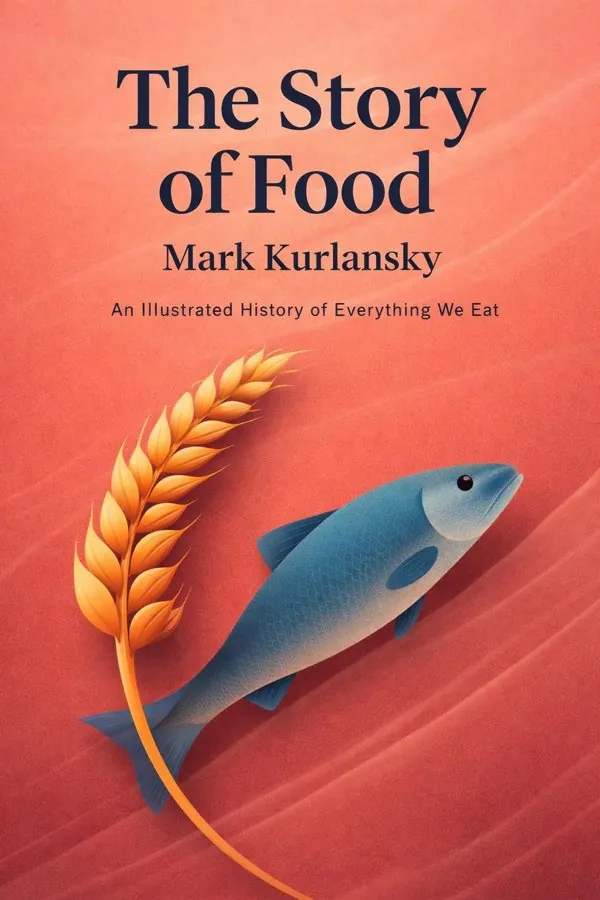
The Story of Food: An Illustrated History of Everything We Eat: Summary & Key Insights
 10 min4 chaptersAudio available
What Is The Story of Food: An Illustrated History of Everything We Eat About?
The Story of Food: An Illustrated History of Everything We Eat by Mark Kurlansky is a civilization book spanning 4 pages. A richly illustrated exploration of the history, culture, and science of food, tracing how ingredients and culinary traditions have shaped human civilization. Mark Kurlansky examines the origins of what we eat, the evolution of cooking, and the global connections that food has created across time and geography.
This FizzRead summary covers all 4 key chapters of The Story of Food: An Illustrated History of Everything We Eat in approximately 10 minutes, distilling the most important ideas, arguments, and takeaways from Mark Kurlansky's work. Also available as an audio summary and Key Quotes Podcast.
The Story of Food: An Illustrated History of Everything We Eat
A richly illustrated exploration of the history, culture, and science of food, tracing how ingredients and culinary traditions have shaped human civilization. Mark Kurlansky examines the origins of what we eat, the evolution of cooking, and the global connections that food has created across time and geography.
Who Should Read The Story of Food: An Illustrated History of Everything We Eat?
This book is perfect for anyone interested in civilization and looking to gain actionable insights in a short read. Whether you're a student, professional, or lifelong learner, the key ideas from The Story of Food: An Illustrated History of Everything We Eat by Mark Kurlansky will help you think differently.
- ✓Readers who enjoy civilization and want practical takeaways
- ✓Professionals looking to apply new ideas to their work and life
- ✓Anyone who wants the core insights of The Story of Food: An Illustrated History of Everything We Eat in just 10 minutes
Want the full summary?
Get instant access to this book summary and 100K+ more with Fizz Moment.
Get Free SummaryAvailable on App Store • Free to download
Key Chapters
In the earliest chapters of human history, eating was not a choice but a constant pursuit for survival. As I explored this era, what struck me most was how our ancestors’ diet reflected the rhythm of nature — governed by seasons, migration, and instinct. For hundreds of thousands of years, humans lived as hunter-gatherers, consuming what the land generously offered: fruits, nuts, seeds, roots, and, when luck permitted, meat scavenged or hunted from other beasts.
Archaeological evidence tells us that early humans were remarkably adaptive eaters. Their intelligence evolved alongside their palate, their use of fire, and eventually their capacity to transform natural ingredients into cooked food. Fire was not merely a discovery; it was a revolution that allowed humans to digest, preserve, and share food — making meals communal and symbolic.
It was around ten thousand years ago that we find the first stirrings of agriculture — an act of both genius and necessity. The domestication of wheat and barley in the Fertile Crescent, rice in Asia, maize in the Americas — these were not simultaneous, but each marked humanity’s first deliberate shaping of nature to serve hunger. I see this moment as the turning point where food became culture. People settled near their crops, formed villages, and began to measure time by planting and harvest. Eating ceased to be an act of mere survival; it became a cycle of faith, patience, and creativity.
From foraging came farming, and from farming came civilization. Yet this transition was not smooth or uniform. While agriculture offered stability and surplus, it also introduced hierarchy and dependence. People began to separate from the wilderness, and in doing so, they forged the first notion of property and power tied to food. The story of eating thus became the story of human control — over land, over animals, and ultimately, over one another.
Food, more than any language or religion, built the first bridges between distant regions. When I look at the ancient networks of trade, I see them not simply as routes of commerce but as veins through which culture flowed. The Silk Road is often remembered for its textile trade, but what truly joined East and West were commodities of taste — spices from India, teas from China, olives from the Mediterranean, grains from Persia.
Every merchant’s cargo told a story of longing and curiosity. People traveled perilous distances not only for wealth but for flavor. The human urge to taste the unknown has been one of the most persistent forces of globalization. Pepper shaped European exploration; nutmeg and clove spurred colonization; coffeehouses stirred revolutions. Each trade was an exchange of ideas as much as goods.
One remarkable aspect I came to appreciate is how this traffic of food reshaped societies from within. Ingredients adopted in new lands blended into cuisines, creating identities we now call national. Tomatoes, native to the Americas, reinvented Italian cooking; chili peppers traveled from South America to Asia, becoming essential in Indian and Chinese dishes. Such migrations of ingredients reveal that food culture is inherently migratory — it thrives on adaptation.
We can see, too, how the exchange of food had geopolitical consequences. Control over spice routes determined empires; sugar fueled colonial economies and slave trade; coffee and tea became symbols of social class. Food was never innocent — it carried politics, ambition, and exploitation. Yet, paradoxically, it also created shared pleasures that transcended boundaries. The world became interconnected by taste long before it was by technology.
In this global mingling, we find the essence of humanity’s drive — curiosity igniting exchange, desire turning into discovery. The act of sharing a meal, whether through trade or travel, became the earliest form of diplomacy.
+ 2 more chapters — available in the FizzRead app
All Chapters in The Story of Food: An Illustrated History of Everything We Eat
About the Author
Mark Kurlansky is an American author and journalist known for his works on history, culture, and food, including 'Cod: A Biography of the Fish That Changed the World' and 'Salt: A World History'. His writing often explores how everyday commodities influence global events and human societies.
Get This Summary in Your Preferred Format
Read or listen to the The Story of Food: An Illustrated History of Everything We Eat summary by Mark Kurlansky anytime, anywhere. FizzRead offers multiple formats so you can learn on your terms — all free.
Available formats: App · Audio · PDF · EPUB — All included free with FizzRead
Download The Story of Food: An Illustrated History of Everything We Eat PDF and EPUB Summary
Key Quotes from The Story of Food: An Illustrated History of Everything We Eat
“In the earliest chapters of human history, eating was not a choice but a constant pursuit for survival.”
“Food, more than any language or religion, built the first bridges between distant regions.”
Frequently Asked Questions about The Story of Food: An Illustrated History of Everything We Eat
The Story of Food: An Illustrated History of Everything We Eat by Mark Kurlansky is a civilization book that explores key ideas across 4 chapters. A richly illustrated exploration of the history, culture, and science of food, tracing how ingredients and culinary traditions have shaped human civilization. Mark Kurlansky examines the origins of what we eat, the evolution of cooking, and the global connections that food has created across time and geography.
More by Mark Kurlansky
You Might Also Like
The Structure of Scientific Revolutions
Thomas S. Kuhn
10 min
Genius
Harold Bloom
10 min
A Cultural History of the Medieval Age
Various Editors
10 min
A History of God: The 4,000-Year Quest of Judaism, Christianity and Islam
Karen Armstrong
10 min
A History of the World in 10½ Chapters
Julian Barnes
10 min
A Short History of Progress
Ronald Wright
10 minBrowse by Category
Ready to read The Story of Food: An Illustrated History of Everything We Eat?
Get the full summary and 100K+ more books with Fizz Moment.