
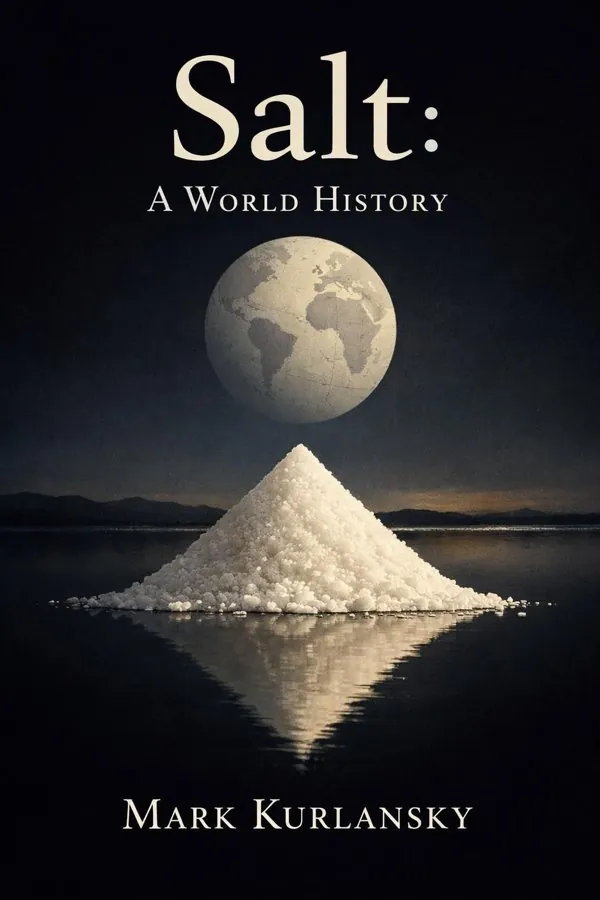
Salt: A World History: Summary & Key Insights
 10 min10 chaptersAudio available
What Is Salt: A World History About?
Salt: A World History by Mark Kurlansky is a world_history book spanning 10 pages. Salt: A World History es una obra de no ficción que explora la historia global de la sal, desde su papel en la economía y la política hasta su influencia en la cultura y la gastronomía. Kurlansky muestra cómo este mineral esencial ha moldeado civilizaciones, impulsado guerras y transformado el comercio mundial.
This FizzRead summary covers all 10 key chapters of Salt: A World History in approximately 10 minutes, distilling the most important ideas, arguments, and takeaways from Mark Kurlansky's work. Also available as an audio summary and Key Quotes Podcast.
Salt: A World History
Salt: A World History es una obra de no ficción que explora la historia global de la sal, desde su papel en la economía y la política hasta su influencia en la cultura y la gastronomía. Kurlansky muestra cómo este mineral esencial ha moldeado civilizaciones, impulsado guerras y transformado el comercio mundial.
Who Should Read Salt: A World History?
This book is perfect for anyone interested in world_history and looking to gain actionable insights in a short read. Whether you're a student, professional, or lifelong learner, the key ideas from Salt: A World History by Mark Kurlansky will help you think differently.
- ✓Readers who enjoy world_history and want practical takeaways
- ✓Professionals looking to apply new ideas to their work and life
- ✓Anyone who wants the core insights of Salt: A World History in just 10 minutes
Want the full summary?
Get instant access to this book summary and 100K+ more with Fizz Moment.
Get Free SummaryAvailable on App Store • Free to download
Key Chapters
When I trace the origins of salt, I start with humanity’s first encounters with the sea. In ancient China, as early as 6000 BCE, people discovered the art of evaporating salt from seawater in clay pots. What seems like a simple task today was then an act of ingenuity. The Chinese were among the first to perfect this process on an industrial scale, establishing state-controlled salt works that were vital to the empire’s survival.
Egyptians, too, mastered the craft. Their civilization was built beside a desert and a river — two opposites bridged by salt. They extracted it from dry lake beds and from the sea, using it not only to season food but to preserve the bodies of the dead. Mummification was, at its core, an act of salting — a belief that purity could withstand the passage of time. Salt meant continuity, and the Egyptians applied it as medicine, currency, and sacrament.
In Mesopotamia, salt shaped social hierarchies. Records inscribed in cuneiform tell us that salt rations were part of workers’ pay. Its value was so high that wars were waged for access to deposits. Across these lands, salt was both a gift and a monopoly—an emblem of power encoded into the earliest bureaucracies. The ingenuity of these ancient people, their experiments with brine and rock, laid the foundation for every subsequent age of trade and empire.
From those humble beginnings, salt became a catalyst for settlement and trade. Cities arose wherever salt was abundant or easily obtained. In Africa, towns such as Taghaza thrived in the Sahara not because of fertile soil but because of the white slabs extracted from underground. In Europe, Salzburg—literally 'the city of salt'—owed its wealth to Alpine deposits. These places remind us that geography is destiny, and salt defined it.
Trade routes formed in lines of salt. Caravans crossed deserts carrying it like treasure. Ships sailed across seas not only seeking spices or silk, but the precious mineral that preserved their provisions. The connection between salt and survival transformed economies. Coastal societies exchanged salt for inland goods, creating webs of interaction that would evolve into global commerce.
The development of civilization was inseparable from salt’s role as preserver and stabilizer. By allowing food to remain edible over long distances and seasons, salt extended the rhythm of human life. Farmers could store harvests; armies could march farther; families could endure lean times. With that stability came planning, surplus, and the possibility of governance. Civilization, at its essence, is organization—and salt provided the very foundation upon which organization could exist.
+ 8 more chapters — available in the FizzRead app
All Chapters in Salt: A World History
About the Author
Mark Kurlansky es un escritor y periodista estadounidense conocido por sus libros de historia cultural como Cod: A Biography of the Fish That Changed the World y Paper: Paging Through History. Su estilo combina investigación rigurosa con narración accesible.
Get This Summary in Your Preferred Format
Read or listen to the Salt: A World History summary by Mark Kurlansky anytime, anywhere. FizzRead offers multiple formats so you can learn on your terms — all free.
Available formats: App · Audio · PDF · EPUB — All included free with FizzRead
Download Salt: A World History PDF and EPUB Summary
Key Quotes from Salt: A World History
“When I trace the origins of salt, I start with humanity’s first encounters with the sea.”
“From those humble beginnings, salt became a catalyst for settlement and trade.”
Frequently Asked Questions about Salt: A World History
Salt: A World History by Mark Kurlansky is a world_history book that explores key ideas across 10 chapters. Salt: A World History es una obra de no ficción que explora la historia global de la sal, desde su papel en la economía y la política hasta su influencia en la cultura y la gastronomía. Kurlansky muestra cómo este mineral esencial ha moldeado civilizaciones, impulsado guerras y transformado el comercio mundial.
More by Mark Kurlansky
You Might Also Like
The Age of Capital
Eric Hobsbawm
10 min
The Gulag Archipelago
Aleksandr Solzhenitsyn
10 min
Jerusalem: The Biography
Simon Sebag Montefiore
10 min
The Anglo-Saxons
James Campbell
10 min
The Boer War
Thomas Pakenham
10 min
The Industrial Revolutionaries: The Making of the Modern World 1776–1914
Gavin Weightman
10 minBrowse by Category
Ready to read Salt: A World History?
Get the full summary and 100K+ more books with Fizz Moment.