
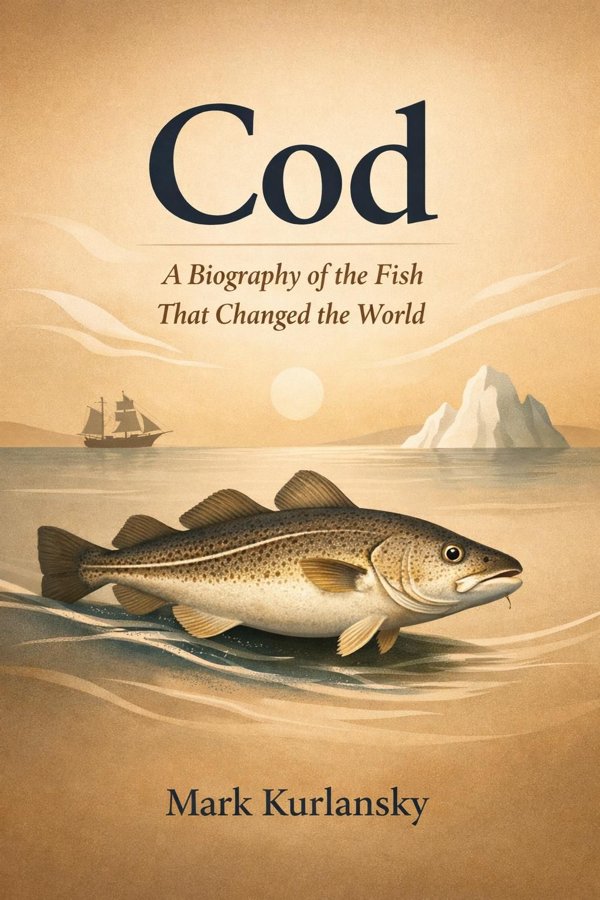
Cod: A Biography of the Fish That Changed the World: Summary & Key Insights
 10 min8 chaptersAudio available
What Is Cod: A Biography of the Fish That Changed the World About?
Cod: A Biography of the Fish That Changed the World by Mark Kurlansky is a world_history book spanning 8 pages. A sweeping history of the codfish and its profound influence on global trade, exploration, and culture. Mark Kurlansky traces how this humble fish shaped economies, diets, and even wars across a thousand years and four continents, from Viking voyages to modern industrial fishing.
This FizzRead summary covers all 8 key chapters of Cod: A Biography of the Fish That Changed the World in approximately 10 minutes, distilling the most important ideas, arguments, and takeaways from Mark Kurlansky's work. Also available as an audio summary and Key Quotes Podcast.
Cod: A Biography of the Fish That Changed the World
A sweeping history of the codfish and its profound influence on global trade, exploration, and culture. Mark Kurlansky traces how this humble fish shaped economies, diets, and even wars across a thousand years and four continents, from Viking voyages to modern industrial fishing.
Who Should Read Cod: A Biography of the Fish That Changed the World?
This book is perfect for anyone interested in world_history and looking to gain actionable insights in a short read. Whether you're a student, professional, or lifelong learner, the key ideas from Cod: A Biography of the Fish That Changed the World by Mark Kurlansky will help you think differently.
- ✓Readers who enjoy world_history and want practical takeaways
- ✓Professionals looking to apply new ideas to their work and life
- ✓Anyone who wants the core insights of Cod: A Biography of the Fish That Changed the World in just 10 minutes
Want the full summary?
Get instant access to this book summary and 100K+ more with Fizz Moment.
Get Free SummaryAvailable on App Store • Free to download
Key Chapters
To understand cod’s long and transformative role in history, we must begin with its earliest discoverers—the Viking sailors who roved the North Atlantic with both fear and fascination. They were among the first to find the immense schools off the coasts of Norway and Iceland. These people knew that cod was not just sustenance but survival. Its firm flesh could be dried easily in the northern winds without spoilage, preserving nourishment for long voyages and harsh winters. This practical knowledge was revolutionary—it allowed expansion, settlement, and maritime endurance.
Later came the Basques, the mysterious masters of the sea from northern Spain. While much of medieval Europe struggled to preserve food, the Basques perfected the art of salting cod. Though their techniques were shrouded in secrecy, the success of their cured fish spoke volumes. They kept their fishing grounds hidden, sailing ever farther west into waters that would later be known as Newfoundland. In their silent pursuit of cod, the Basques not only expanded trade routes but helped lay the foundation of the Atlantic world.
From Viking longships to Basque trawlers, cod became a silent yet powerful enabler of exploration. It allowed people to look beyond the known coastline, encouraged navigational innovation, and set into motion the centuries-long expansion of maritime economies. The fish became a bridge between isolation and connection. And though those early fishermen could not have foretold it, the abundance they found would one day become the center of world commerce—and conflict.
As European powers began their great age of discovery, cod was at the center of that momentum. In an era before refrigeration, a food that could be preserved and shipped halfway across the world was invaluable. Salted cod fed armies, sustained sailors, and nourished settlers. It became a currency as much as a commodity. When the English and French crossed the Atlantic to stake claims in Newfoundland, they were not merely seeking land—they were pursuing the fish that swam around that rocky coast.
The Newfoundland fisheries became one of the most fiercely contested zones of early imperial ambitions. England’s fishing fleets challenged France, Spain, and Portugal, each seeing cod as the lifeblood of their maritime economies. What was once a solitary Basque secret turned into an international enterprise. Village economies in Europe thrived on cod; merchants built fortunes on it; even religious practices were influenced by its presence. During periods of Catholic fasting, cod—being fish, not meat—became the ideal food for observant Christians. Thus, religious customs inadvertently fueled an expanding global trade.
In these years, cod revealed itself not just as a resource but as infrastructure. The colonies of the New World, especially along the North American coasts, grew around cod. It drew fishermen to remote regions, forced technological experimentation, and linked the worlds of Europe and America in a web of commerce. It was ironic and yet deeply revealing that a fish could be a force behind colonization itself—a reminder that economic desire often propels exploration far more powerfully than curiosity.
+ 6 more chapters — available in the FizzRead app
All Chapters in Cod: A Biography of the Fish That Changed the World
About the Author
Mark Kurlansky is an American journalist and author known for his works on food history and culture, including 'Salt: A World History' and 'The Basque History of the World'. His writing often explores how single commodities have influenced human civilization.
Get This Summary in Your Preferred Format
Read or listen to the Cod: A Biography of the Fish That Changed the World summary by Mark Kurlansky anytime, anywhere. FizzRead offers multiple formats so you can learn on your terms — all free.
Available formats: App · Audio · PDF · EPUB — All included free with FizzRead
Download Cod: A Biography of the Fish That Changed the World PDF and EPUB Summary
Key Quotes from Cod: A Biography of the Fish That Changed the World
“To understand cod’s long and transformative role in history, we must begin with its earliest discoverers—the Viking sailors who roved the North Atlantic with both fear and fascination.”
“As European powers began their great age of discovery, cod was at the center of that momentum.”
Frequently Asked Questions about Cod: A Biography of the Fish That Changed the World
Cod: A Biography of the Fish That Changed the World by Mark Kurlansky is a world_history book that explores key ideas across 8 chapters. A sweeping history of the codfish and its profound influence on global trade, exploration, and culture. Mark Kurlansky traces how this humble fish shaped economies, diets, and even wars across a thousand years and four continents, from Viking voyages to modern industrial fishing.
More by Mark Kurlansky
You Might Also Like
The Age of Capital
Eric Hobsbawm
10 min
The Gulag Archipelago
Aleksandr Solzhenitsyn
10 min
Jerusalem: The Biography
Simon Sebag Montefiore
10 min
The Anglo-Saxons
James Campbell
10 min
The Boer War
Thomas Pakenham
10 min
The Industrial Revolutionaries: The Making of the Modern World 1776–1914
Gavin Weightman
10 minBrowse by Category
Ready to read Cod: A Biography of the Fish That Changed the World?
Get the full summary and 100K+ more books with Fizz Moment.