
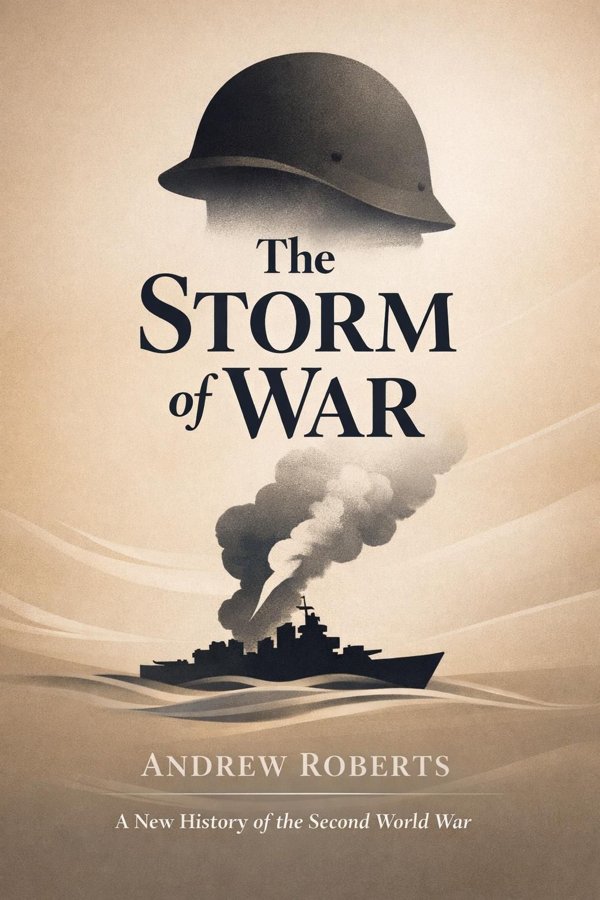
The Storm of War: A New History of the Second World War: Summary & Key Insights
 10 min9 chapters
Key Takeaways from The Storm of War: A New History of the Second World War
Great wars rarely begin in a vacuum; they grow from unresolved resentments, failed diplomacy, and leaders willing to weaponize grievance.
Speed alone does not win wars; coordinated speed does.
Sometimes the most important victory is simply refusing to lose.
Ambition becomes self-destruction when it outruns reality.
One global war contained several distinct wars, and Roberts insists that the Pacific conflict must be understood on its own terms.
What Is The Storm of War: A New History of the Second World War About?
The Storm of War: A New History of the Second World War by Andrew Roberts is a world_history book spanning 10 pages. Why did the Axis powers, after such astonishing early victories, ultimately lose the Second World War? In The Storm of War, historian Andrew Roberts tackles that question with narrative force, archival depth, and a clear argument: the outcome of the war was shaped not only by industrial capacity and battlefield decisions, but also by ideology, leadership, morale, and strategic error. This is not simply a chronological retelling of familiar events. Roberts revisits the conflict with a global lens, drawing on newly available documents and decades of scholarship to explain how Hitler, Mussolini, and Japan’s militarist leaders overreached, and how the Allies learned, adapted, and prevailed. What makes the book especially valuable is its balance of military history and moral seriousness. Roberts examines campaigns from Poland to the Pacific, but he also insists that the war cannot be understood apart from the genocidal ideology at its core. A distinguished British historian known for his work on Churchill, Napoleon, and modern political leadership, Roberts brings authority, clarity, and revisionist insight to one of history’s most consequential events. The result is a sweeping, accessible, and deeply argued account of how the modern world was forged in catastrophe.
This FizzRead summary covers all 9 key chapters of The Storm of War: A New History of the Second World War in approximately 10 minutes, distilling the most important ideas, arguments, and takeaways from Andrew Roberts's work.
The Storm of War: A New History of the Second World War
Why did the Axis powers, after such astonishing early victories, ultimately lose the Second World War? In The Storm of War, historian Andrew Roberts tackles that question with narrative force, archival depth, and a clear argument: the outcome of the war was shaped not only by industrial capacity and battlefield decisions, but also by ideology, leadership, morale, and strategic error. This is not simply a chronological retelling of familiar events. Roberts revisits the conflict with a global lens, drawing on newly available documents and decades of scholarship to explain how Hitler, Mussolini, and Japan’s militarist leaders overreached, and how the Allies learned, adapted, and prevailed.
What makes the book especially valuable is its balance of military history and moral seriousness. Roberts examines campaigns from Poland to the Pacific, but he also insists that the war cannot be understood apart from the genocidal ideology at its core. A distinguished British historian known for his work on Churchill, Napoleon, and modern political leadership, Roberts brings authority, clarity, and revisionist insight to one of history’s most consequential events. The result is a sweeping, accessible, and deeply argued account of how the modern world was forged in catastrophe.
Who Should Read The Storm of War: A New History of the Second World War?
This book is perfect for anyone interested in world_history and looking to gain actionable insights in a short read. Whether you're a student, professional, or lifelong learner, the key ideas from The Storm of War: A New History of the Second World War by Andrew Roberts will help you think differently.
- ✓Readers who enjoy world_history and want practical takeaways
- ✓Professionals looking to apply new ideas to their work and life
- ✓Anyone who wants the core insights of The Storm of War: A New History of the Second World War in just 10 minutes
Want the full summary?
Get instant access to this book summary and 100K+ more with Fizz Moment.
Get Free SummaryAvailable on App Store • Free to download
Key Chapters
Great wars rarely begin in a vacuum; they grow from unresolved resentments, failed diplomacy, and leaders willing to weaponize grievance. Roberts argues that the origins of the Second World War cannot be understood without looking back to the settlement of 1918 and the unstable peace that followed. The Treaty of Versailles punished Germany but did not create a durable European order. Economic turmoil, national humiliation, and political fragmentation gave Adolf Hitler the opening to present expansion, rearmament, and revenge as national redemption.
Roberts does not treat this as a simplistic story in which Versailles alone caused war. Instead, he shows how multiple forces converged: the weakness of the Weimar Republic, the Great Depression, the failures of collective security, and the unwillingness of Britain and France to confront aggression early. Japan’s imperial ambitions in Asia and Mussolini’s dreams of Roman-style grandeur further destabilized the international system. By the late 1930s, the Axis powers had tested the world’s resolve and found it lacking.
The lesson is broader than the 1930s. Statesmen who ignore aggressive revisionist powers often mistake delay for peace. The remilitarization of the Rhineland, the Anschluss, and Munich were not isolated episodes; they were stages in a pattern of unchecked escalation. Roberts shows that appeasement was not merely moral weakness but strategic misjudgment, because it bought time primarily for the aggressor.
A practical way to apply this insight is to look for patterns rather than isolated crises. Whether in geopolitics, business, or organizational life, repeated boundary testing usually signals larger ambition. The actionable takeaway: address destabilizing behavior early, before tactical concessions harden into strategic disaster.
Speed alone does not win wars; coordinated speed does. Roberts explains that Germany’s early success came from a style of warfare that shocked its enemies not because it was merely fast, but because it fused armor, infantry, artillery, communications, and air power into a single operational system. In Poland, Norway, the Low Countries, and above all France in 1940, the Wehrmacht exploited enemy rigidity with ruthless precision.
The fall of France remains one of the book’s most striking examples of how assumptions can kill. France possessed significant military strength, but its leadership prepared to fight the previous war. Defensive thinking, fragmented command, and an underestimation of German maneuver made catastrophe possible. Roberts emphasizes that German victory was not preordained. It resulted from bolder command decisions, better operational doctrine, and a willingness to exploit breakthroughs rapidly before opponents could regroup.
Yet Roberts also resists the myth of invincible German genius. Blitzkrieg had limits. It depended on surprise, logistics, favorable terrain, and vulnerable opponents. The very methods that worked in short campaigns became harder to sustain in prolonged wars of attrition across vast distances. Early brilliance masked deeper structural weaknesses in fuel, production, and long-term strategy.
This idea has relevance beyond military history. Institutions often fail not because they lack resources, but because they cannot adapt quickly when circumstances change. A nimble competitor with clear communication and decisive leadership can overwhelm a stronger but slower rival. Roberts’s examples from 1940 illustrate how innovation punishes complacency.
The actionable takeaway: never assume past success formulas will protect you in a changing environment; build systems that combine speed, coordination, and adaptability before crisis arrives.
Sometimes the most important victory is simply refusing to lose. After the fall of France, Britain stood in a position that looked nearly hopeless. Much of Europe was under Nazi control, the British Expeditionary Force had escaped at Dunkirk but left behind massive quantities of equipment, and invasion seemed a real possibility. Roberts argues that this moment was one of the decisive hinge points of the entire war, because if Britain had sought terms, the global balance might have shifted irreversibly.
Central to this chapter is leadership. Winston Churchill did not create Britain’s material strength overnight, but he transformed its political and psychological posture. Roberts portrays Churchill as crucial not because he was flawless, but because he understood that morale, rhetoric, and strategic clarity could buy time until Britain’s structural advantages and alliances matured. The Battle of Britain then demonstrated that Germany could be resisted. RAF Fighter Command, radar, effective command-and-control systems, and determined pilots prevented the Luftwaffe from securing the air superiority needed for invasion.
Roberts also highlights the importance of institutions over individual heroics alone. Britain’s survival depended on industrial mobilization, naval power, intelligence work, civilian endurance during the Blitz, and the ability to maintain imperial and transatlantic connections. Defiance was emotional, but it was also organizational.
In practical terms, this is a lesson in resilience under pressure. When conditions deteriorate, people often search for an ideal solution when what matters first is holding the line long enough for options to emerge. Britain in 1940 did not need immediate triumph; it needed survival, coherence, and confidence.
The actionable takeaway: in moments of crisis, focus first on preserving capability and morale; endurance can be the foundation on which later victory is built.
Ambition becomes self-destruction when it outruns reality. Roberts treats Operation Barbarossa, the 1941 invasion of the Soviet Union, as the greatest strategic gamble of the war and ultimately the decision that made German defeat highly likely. Hitler sought not merely military victory but ideological conquest: the destruction of Bolshevism, the seizure of living space, and the subjugation or elimination of entire populations. This fusion of military planning with racial fantasy distorted German strategy from the outset.
At first, the invasion seemed to confirm German supremacy. Soviet armies suffered enormous losses, vast territories were seized, and the Wehrmacht advanced deep into Soviet lands. But Roberts shows that Barbarossa contained fatal contradictions. Germany underestimated Soviet manpower, industrial relocation, and political endurance. It overestimated its own logistics, especially across immense distances and poor infrastructure. Just as important, Nazi brutality turned potential anti-Soviet sentiment in occupied areas into resistance. A less ideological occupier might have exploited local hostility to Stalin; Hitler instead radicalized the conflict further.
Roberts stresses that the Eastern Front became the central theater of the war in Europe. The scale of combat, casualties, and material consumption dwarfed anything in the West before 1944. Once Germany failed to destroy the Soviet Union quickly, it entered a war of attrition it could not win against a state with greater manpower, increasing industrial output, and eventually substantial Allied support.
The broader lesson is that strategy must align means with ends. When leaders confuse desire with capability, initial gains can conceal looming disaster. Overexpansion is common not only in war but in politics, business, and personal decision-making.
The actionable takeaway: before pursuing a bold objective, test whether your logistics, resources, and long-term assumptions support it; unchecked expansion often plants the seeds of collapse.
One global war contained several distinct wars, and Roberts insists that the Pacific conflict must be understood on its own terms. Japan’s path to war was shaped by imperial ambition, resource insecurity, military culture, and a belief that bold offensive action could compensate for long-term weakness. The attack on Pearl Harbor was tactically brilliant but strategically reckless. By bringing the United States fully into the war, Japan awakened an industrial and military giant it could not hope to defeat in a prolonged contest.
Roberts explains that the Pacific theater differed from Europe in geography, naval strategy, and political culture. Battles were fought across enormous oceanic distances, making aircraft carriers, submarines, island bases, and logistics decisive. Midway, Guadalcanal, and the wider island-hopping campaign showed how intelligence, production capacity, and operational learning shifted the balance. The United States and its allies did not simply overpower Japan with numbers; they adapted doctrine, improved coordination, and exploited Japan’s inability to replace experienced pilots and lost ships.
The ideological dimension also mattered. Japanese militarism encouraged fanatical resistance and contempt for surrender, intensifying the war’s brutality from China to the Pacific islands. Roberts places this within a wider analysis of how political culture shapes military behavior. The result was a conflict marked by extraordinary ferocity, civilian suffering, and difficult moral choices culminating in the atomic bombings.
The practical application here is that one-size-fits-all analysis often fails. Different environments demand different tools, assumptions, and timelines. Success in one arena does not guarantee success in another, especially when geography and institutional culture change the rules.
The actionable takeaway: tailor strategy to context rather than forcing familiar models onto new problems; mismatched assumptions are often more dangerous than visible obstacles.
The Second World War cannot be explained only through tanks, fleets, and campaigns, because at its heart lay a murderous ideology that transformed conquest into genocide. Roberts is especially clear that Nazism was not just authoritarian nationalism with extreme rhetoric. It was a racial worldview that sought annihilation. The Holocaust was not an accidental byproduct of war but a central expression of the regime’s beliefs, systems, and objectives.
By integrating military and moral history, Roberts shows how ideological warfare shaped events on the ground. Nazi occupation policies in Eastern Europe involved starvation, enslavement, mass shootings, ghettos, deportations, and extermination camps. These crimes were facilitated by bureaucracy, technology, obedience, and the participation of many actors beyond the top leadership. Roberts also situates Japanese atrocities and other wartime crimes within a broader pattern: ideology dehumanizes, and once enemies are cast as less than human, restraint collapses.
This dimension matters because purely operational histories can create a false neutrality. Roberts refuses that trap. He argues that understanding why the Allies fought requires acknowledging what Axis victory would have meant. The war was a power struggle, but it was also a moral emergency. That does not excuse every Allied action, yet it clarifies the stakes.
The contemporary relevance is profound. Societies often notice violence before they notice the language that normalizes it. Dehumanization, conspiracy myths, and pseudo-scientific claims of superiority are warning signs, not rhetorical noise. Institutions fail when they treat ideological extremism as mere style rather than substance.
The actionable takeaway: take dehumanizing ideas seriously at their earliest stages; the defense of humane norms begins long before violence becomes visible.
Wars are often remembered through great battles, but many are decided in factories, code rooms, and shipping lanes. Roberts argues that the turning of the tide against the Axis depended on more than battlefield courage. The Allies increasingly converted economic strength, scientific innovation, and intelligence superiority into military advantage. This shift did not happen instantly; it was built through painful learning and institutional coordination.
The Soviet victory at Stalingrad, the British and Commonwealth success at El Alamein, and the American triumph at Midway each marked turning points, but Roberts shows that these victories were interconnected with deeper trends. Allied production surged. German and Japanese leaders made strategic choices that wasted scarce resources. Intelligence breakthroughs, including codebreaking, improved operational decision-making. Control of the Atlantic shipping routes ensured that Britain survived, that American power could cross oceans, and that the Soviet Union could receive vital supplies.
Roberts is particularly good at explaining why endurance mattered. The Axis powers often fought impressively at the tactical level, but they lacked the capacity to sustain prolonged global war against coalitions with larger industrial bases and greater access to fuel, food, and finance. Good tactics could win battles; they could not solve systemic disadvantage.
This principle applies in modern competitive environments as well. Flashy execution can produce early gains, but long-term success usually belongs to organizations that build resilient supply chains, use information well, and align strategy with productive capacity. Hidden systems often matter more than visible drama.
The actionable takeaway: invest in the infrastructure behind performance; sustainable advantage comes from intelligence, logistics, and production, not just frontline brilliance.
Liberation required patience, preparation, and overwhelming coordination. Roberts presents D-Day and the subsequent liberation of Western Europe not as a single heroic episode but as the culmination of years of planning, coalition management, deception, and industrial mobilization. By June 1944, the Western Allies had learned from earlier failures and assembled an operation of immense complexity involving sea power, air superiority, logistics, intelligence, and multinational command.
What made the Normandy invasion decisive was not only the landing itself, but the strategic position behind it. Germany was already being ground down in the East and bombed from the air. D-Day opened the long-awaited western front that forced the Reich to fight an impossible multi-front war. Roberts also notes that the operation’s success was not inevitable. Weather, terrain, German defenses, and command friction all posed major risks. Yet Allied dominance in planning and material support created resilience even when parts of the operation went wrong.
The liberation of France and the push into Western Europe revealed another of Roberts’s themes: victory in coalition warfare requires political management as much as military competence. Americans, Britons, Canadians, Free French forces, resistance movements, and others had to align goals despite differing priorities. That cooperation, however imperfect, was a strategic achievement in itself.
In practical terms, D-Day is a case study in execution under complexity. Major undertakings succeed when leaders combine preparation with flexibility, establish clear command structures, and create backup options for when reality diverges from the plan.
The actionable takeaway: when facing a high-stakes challenge, do the hard preparatory work early; decisive outcomes usually rest on coordination and contingency planning more than on improvisation alone.
Defeat can arrive suddenly in appearance but slowly in preparation. Roberts shows that by 1945 the Axis powers were collapsing under pressures that had been accumulating for years: military overstretch, industrial inferiority, strategic miscalculation, and leadership detached from reality. Germany continued to fight with ferocity, but its cities were devastated, its armies exhausted, and its ability to replace losses shattered. Japan, too, faced naval destruction, economic strangulation, relentless bombing, and the loss of any realistic path to negotiated success.
Roberts does not present Allied victory as clean or uncomplicated. The endgame brought moral and political dilemmas alongside military triumph. The bombing campaigns against German and Japanese cities, the Soviet advance into Eastern Europe, and the atomic bombings all raise hard questions about means and ends. Yet Roberts’s central argument remains: the collapse of the Axis was necessary because the regimes themselves were engines of conquest and atrocity. The tragedy is that ending such systems required a war of extraordinary scale.
He also emphasizes that the peace inherited many contradictions. Europe was liberated from Nazism but partly absorbed into Soviet domination. The United States emerged as a global superpower. Empires weakened. The United Nations was born from the desire to prevent another catastrophe, even as the Cold War began almost immediately.
The larger lesson is that victory in any major struggle rarely restores the world exactly as it was before. Success solves one set of dangers while creating new responsibilities and tensions. Strategic thinking must therefore extend beyond winning to shaping the aftermath.
The actionable takeaway: define success not only by how a conflict ends, but by the order that follows; lasting outcomes depend on post-crisis planning as much as on the struggle itself.
All Chapters in The Storm of War: A New History of the Second World War
About the Author
Andrew Roberts is a British historian and bestselling author known for his work on military, political, and biographical history. He studied modern history at Cambridge and has built a reputation for combining rigorous research with clear, engaging prose for general readers. Roberts is the author of acclaimed books on major historical figures including Winston Churchill and Napoleon, as well as broader studies of war and leadership. He has written extensively on twentieth-century history, especially the Second World War, and is a frequent commentator in public debates about history, politics, and statecraft. His work is notable for its command of archival material, its confidence in big historical argument, and its willingness to challenge conventional interpretations while remaining accessible to a wide audience.
Get This Summary in Your Preferred Format
Read or listen to the The Storm of War: A New History of the Second World War summary by Andrew Roberts anytime, anywhere. FizzRead offers multiple formats so you can learn on your terms — all free.
Available formats: App · Audio · PDF · EPUB — All included free with FizzRead
Download The Storm of War: A New History of the Second World War PDF and EPUB Summary
Key Quotes from The Storm of War: A New History of the Second World War
“Great wars rarely begin in a vacuum; they grow from unresolved resentments, failed diplomacy, and leaders willing to weaponize grievance.”
“Speed alone does not win wars; coordinated speed does.”
“Sometimes the most important victory is simply refusing to lose.”
“Ambition becomes self-destruction when it outruns reality.”
“One global war contained several distinct wars, and Roberts insists that the Pacific conflict must be understood on its own terms.”
Frequently Asked Questions about The Storm of War: A New History of the Second World War
The Storm of War: A New History of the Second World War by Andrew Roberts is a world_history book that explores key ideas across 9 chapters. Why did the Axis powers, after such astonishing early victories, ultimately lose the Second World War? In The Storm of War, historian Andrew Roberts tackles that question with narrative force, archival depth, and a clear argument: the outcome of the war was shaped not only by industrial capacity and battlefield decisions, but also by ideology, leadership, morale, and strategic error. This is not simply a chronological retelling of familiar events. Roberts revisits the conflict with a global lens, drawing on newly available documents and decades of scholarship to explain how Hitler, Mussolini, and Japan’s militarist leaders overreached, and how the Allies learned, adapted, and prevailed. What makes the book especially valuable is its balance of military history and moral seriousness. Roberts examines campaigns from Poland to the Pacific, but he also insists that the war cannot be understood apart from the genocidal ideology at its core. A distinguished British historian known for his work on Churchill, Napoleon, and modern political leadership, Roberts brings authority, clarity, and revisionist insight to one of history’s most consequential events. The result is a sweeping, accessible, and deeply argued account of how the modern world was forged in catastrophe.
More by Andrew Roberts
You Might Also Like
The Age of Capital
Eric Hobsbawm
10 min
The Gulag Archipelago
Aleksandr Solzhenitsyn
10 min
Jerusalem: The Biography
Simon Sebag Montefiore
10 min
The Anglo-Saxons
James Campbell
10 min
The Boer War
Thomas Pakenham
10 min
The Industrial Revolutionaries: The Making of the Modern World 1776–1914
Gavin Weightman
10 minBrowse by Category
Ready to read The Storm of War: A New History of the Second World War?
Get the full summary and 100K+ more books with Fizz Moment.