
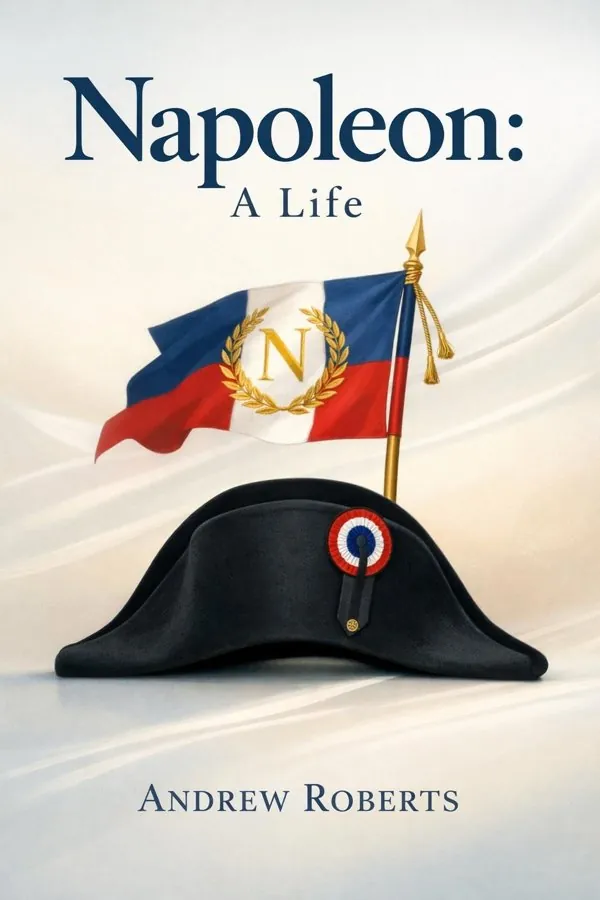
Napoleon: A Life: Summary & Key Insights
 10 min9 chaptersAudio available
Key Takeaways from Napoleon: A Life
Great historical figures are rarely born into inevitability; they are shaped by environments that teach them what power feels like before they ever hold it.
History often rewards those who can recognize when old rules are collapsing.
Some leaders are promoted into greatness, but others prove they can transform weak resources into overwhelming success.
Brilliance often becomes most dangerous when it starts believing it can outwit geography, logistics, and political reality.
Winning battles can make a person famous, but governing requires a different kind of intelligence: the ability to turn instability into order.
What Is Napoleon: A Life About?
Napoleon: A Life by Andrew Roberts is a biographies book spanning 7 pages. Andrew Roberts’s Napoleon: A Life is a sweeping, deeply researched biography of one of history’s most brilliant, controversial, and consequential figures. Rather than reducing Napoleon Bonaparte to either hero or tyrant, Roberts presents him as a man of extraordinary energy, intellect, ambition, and contradiction. Drawing on thousands of letters and newly available documents, the book traces Napoleon’s rise from provincial Corsican outsider to ruler of much of Europe, while also examining the personal qualities, political instincts, and military genius that made that rise possible. Just as importantly, it shows how overconfidence, relentless war, and the limits of human control contributed to his fall. What makes this biography especially valuable is Roberts’s balance: he neither romanticizes Napoleon nor dismisses him. Instead, he situates him within the upheavals of the French Revolution, the transformation of modern states, and the creation of enduring institutions such as the Napoleonic Code. Roberts is one of Britain’s leading historians, and his command of military, political, and personal detail gives the book both authority and narrative force.
This FizzRead summary covers all 9 key chapters of Napoleon: A Life in approximately 10 minutes, distilling the most important ideas, arguments, and takeaways from Andrew Roberts's work. Also available as an audio summary and Key Quotes Podcast.
Napoleon: A Life
Andrew Roberts’s Napoleon: A Life is a sweeping, deeply researched biography of one of history’s most brilliant, controversial, and consequential figures. Rather than reducing Napoleon Bonaparte to either hero or tyrant, Roberts presents him as a man of extraordinary energy, intellect, ambition, and contradiction. Drawing on thousands of letters and newly available documents, the book traces Napoleon’s rise from provincial Corsican outsider to ruler of much of Europe, while also examining the personal qualities, political instincts, and military genius that made that rise possible. Just as importantly, it shows how overconfidence, relentless war, and the limits of human control contributed to his fall. What makes this biography especially valuable is Roberts’s balance: he neither romanticizes Napoleon nor dismisses him. Instead, he situates him within the upheavals of the French Revolution, the transformation of modern states, and the creation of enduring institutions such as the Napoleonic Code. Roberts is one of Britain’s leading historians, and his command of military, political, and personal detail gives the book both authority and narrative force.
Who Should Read Napoleon: A Life?
This book is perfect for anyone interested in biographies and looking to gain actionable insights in a short read. Whether you're a student, professional, or lifelong learner, the key ideas from Napoleon: A Life by Andrew Roberts will help you think differently.
- ✓Readers who enjoy biographies and want practical takeaways
- ✓Professionals looking to apply new ideas to their work and life
- ✓Anyone who wants the core insights of Napoleon: A Life in just 10 minutes
Want the full summary?
Get instant access to this book summary and 100K+ more with Fizz Moment.
Get Free SummaryAvailable on App Store • Free to download
Key Chapters
Great historical figures are rarely born into inevitability; they are shaped by environments that teach them what power feels like before they ever hold it. Andrew Roberts begins Napoleon’s story in Corsica, and this is crucial because the island gave him his first lessons in pride, conflict, nationalism, and outsiderhood. Born in Ajaccio in 1769, shortly after France took control of Corsica, Napoleon grew up in a family that was respectable but not wealthy, ambitious but insecure. He inherited a fierce sense of family loyalty, a sensitivity to status, and an early awareness of political instability.
As a young boy sent to mainland France for education, Napoleon experienced cultural displacement. He spoke French with an accent, came from a peripheral background, and often felt looked down upon by wealthier classmates. Rather than weakening him, that exclusion sharpened his determination. Roberts shows that Napoleon’s emotional makeup was formed by this combination of wounded pride and relentless self-discipline. He became a voracious reader, especially of history, strategy, and great leaders of the past. He learned to convert resentment into ambition.
This early period matters because it explains more than Napoleon’s rise; it explains his temperament. He was intensely practical, suspicious of elites, attached to merit, and deeply committed to the idea that talent should outrank birth. His later reforms and military leadership cannot be separated from this background.
In modern life, many people underestimate how formative outsider experiences can be. Being underestimated can either become a grievance or a source of fuel. Napoleon turned it into fuel. Roberts’s portrait reminds us that identity, adversity, and self-education often matter more than privilege.
Actionable takeaway: Reflect on one early disadvantage or exclusion in your life and reframe it as a source of strength, discipline, and long-term ambition.
History often rewards those who can recognize when old rules are collapsing. The French Revolution created chaos, but it also broke open a rigid social order that had previously limited advancement. Roberts shows that Napoleon’s rise was not simply the result of luck or military brilliance in isolation; it was also a product of timing. The Revolution dismantled aristocratic privilege in the officer corps, making room for men of ability. Napoleon, an artillery officer with technical skill and unusual boldness, understood that moments of upheaval favor decision-makers.
He first distinguished himself at Toulon in 1793, where his grasp of artillery and battlefield positioning helped secure a major victory for revolutionary forces. Later, in Paris, he played a decisive role in suppressing an uprising against the government. These episodes revealed a defining trait: he was willing to act quickly when others hesitated. Roberts emphasizes that Napoleon’s success rested not only on intelligence, but on clarity under pressure. He combined preparation with nerve.
This phase of Napoleon’s life illustrates an enduring principle: systems in transition elevate people who can connect expertise with action. Many people have knowledge; fewer can deploy it at the critical moment. Napoleon did not wait to be fully approved by the establishment. He seized responsibility and produced results.
There is a practical lesson here for professionals, leaders, and creators. In periods of organizational change, economic disruption, or political uncertainty, advancement often goes to those who solve urgent problems calmly and visibly. Credentials matter less than usefulness when institutions are under strain.
Roberts also reminds us that revolutions create moral ambiguity. Opportunity can arise in turbulent conditions, but ambition in such moments also tests character. Napoleon’s rise began in merit but soon expanded into personal power.
Actionable takeaway: In times of change, focus on becoming the person who can solve one important problem decisively and publicly.
Some leaders are promoted into greatness, but others prove they can transform weak resources into overwhelming success. Napoleon’s Italian campaign of 1796-1797 was the moment he emerged as a major historical force. Roberts portrays this campaign as a masterclass in speed, concentration, morale, and imagination. Given command of the Army of Italy, Napoleon inherited troops that were underfed, underpaid, and demoralized. Within months, he turned them into a victorious force that repeatedly defeated larger enemy armies.
His method was not magic. Roberts explains that Napoleon excelled at movement, timing, and psychological command. He struck enemies before they could coordinate, concentrated force at decisive points, and used stirring proclamations to make soldiers believe hardship would be rewarded by glory and plunder. He saw war as both physical and mental. Victory came not just from battlefield maneuvers, but from shaping the confidence of his own side and the uncertainty of the other.
The Italian campaign also shows Napoleon’s growing political instinct. He did not merely win battles; he redrew states, negotiated settlements, and began to understand that military triumph could be converted into personal authority. Here we see the fusion that would define his career: general, propagandist, administrator, and opportunist in one.
For modern readers, the campaign offers lessons in leadership under constraint. Great performance does not require perfect conditions. It requires clarity of objective, energy of execution, and the ability to inspire effort in difficult environments. Teams often perform not according to resources alone, but according to whether their leader creates momentum and belief.
Yet Roberts also hints at the danger: repeated success can create a taste for control that becomes self-justifying. What begins as competence can grow into domination.
Actionable takeaway: When leading a struggling team, define a clear near-term objective, create momentum through quick wins, and communicate belief with specificity and confidence.
Brilliance often becomes most dangerous when it starts believing it can outwit geography, logistics, and political reality. Napoleon’s Egyptian expedition was bold, theatrical, and in many ways intellectually fascinating, but Roberts treats it as a revealing mixture of achievement and illusion. On one level, the campaign showed Napoleon’s restless imagination. He hoped to threaten British interests, enhance French prestige, and perhaps build an eastern empire. He brought not only soldiers but scholars, scientists, and artists, linking conquest with knowledge production.
This duality is important. Napoleon understood the symbolic power of civilization, learning, and spectacle. The expedition produced serious scholarship and helped stimulate European interest in Egypt. But militarily and strategically, the campaign exposed the limits of his reach. The destruction of the French fleet by Nelson at the Battle of the Nile left Napoleon’s army isolated. Conditions deteriorated, resistance persisted, and long-term success became implausible.
Roberts uses this episode to show that Napoleon was never just a battlefield technician. He thought in civilizational terms, but he also had a tendency to overestimate what force and genius could accomplish. Egypt demonstrated both his capacity for grand vision and his inclination to discount constraints that did not fit his ambitions.
This is a deeply modern lesson. In business, politics, or personal projects, expansion into new territory can feel exciting precisely because it flatters our self-image. But ambition without logistical realism often leads to costly overreach. Vision matters, but so do supply chains, local resistance, and exit strategies.
The Egyptian campaign did not destroy Napoleon. In fact, he returned to France and used his reputation to advance further. But Roberts makes clear that the seeds of later overconfidence were already visible.
Actionable takeaway: Before launching any ambitious venture, pair your boldest vision with a brutally honest review of resources, risks, and what success would realistically require.
Winning battles can make a person famous, but governing requires a different kind of intelligence: the ability to turn instability into order. Roberts shows that Napoleon’s seizure of power in the coup of 18 Brumaire was not merely a grab for office; it was a response to a France exhausted by revolutionary violence, weak government, and constant uncertainty. Many French citizens wanted not ideology, but competence. Napoleon understood that fatigue with chaos creates an appetite for authority.
As First Consul, he demonstrated administrative gifts that are sometimes overshadowed by his military reputation. Roberts details how Napoleon reformed taxation, strengthened state finances, centralized administration, reconciled with elements of French society previously at odds, and established institutions designed to outlast immediate political turmoil. He selected talented officials, monitored implementation obsessively, and valued efficiency. This was not democratic leadership in a modern sense, but it was undeniably effective state-building.
Perhaps his greatest achievement in this period was the creation of durable order after revolutionary disorder. He institutionalized meritocratic advancement in many areas and worked to make the state function more predictably. Roberts suggests that Napoleon’s genius lay partly in understanding that legitimacy can be rebuilt through results. People may disagree about ideology, but they recognize roads, schools, tax systems, courts, and administrative competence.
The practical application is straightforward. Leadership is not just about inspiring change; it is about building systems that work after the speech ends. Many organizations celebrate visionary disruption but neglect operational follow-through. Napoleon excelled at converting momentum into structure.
At the same time, Roberts warns that effective administration can coexist with rising personal domination. Competence can legitimize concentration of power. That tension sits at the center of Napoleon’s career.
Actionable takeaway: If you want lasting influence, focus less on dramatic announcements and more on designing systems, routines, and institutions that continue working without constant crisis.
The most enduring legacy of many rulers is not what they conquered, but what they codified. One of Roberts’s strongest contributions is his insistence that Napoleon should be judged not only by his wars, but by the institutional architecture he left behind. The Napoleonic Code, educational reforms, administrative centralization, banking initiatives, and legal standardization all helped shape modern governance far beyond France. These reforms mattered because they translated revolutionary principles into durable, usable structures.
The Napoleonic Code in particular stands out. It promoted equality before the law for men, protected property rights, and reduced feudal legal complexity. While hardly perfect by modern standards, it was clearer, more uniform, and more rational than much of what preceded it. Roberts emphasizes that Napoleon had a rare ability to understand that power becomes durable when embedded in institutions rather than left to personality alone.
He also invested in schools, bureaucratic structures, and the machinery of state. In doing so, he helped define a more modern idea of governance: centralized, merit-oriented, and administratively capable. This legacy spread across Europe both through voluntary adoption and through conquest. Even places that resisted him often retained elements of the systems his rule introduced.
For readers today, this is a reminder that real impact is often procedural. We admire dramatic leaders, but the world is usually changed more deeply by laws, rules, incentives, and institutions than by charisma alone. In workplaces, families, and civic life, lasting progress usually comes from creating fair, repeatable systems.
Roberts does not ignore the costs of Napoleon’s authoritarianism, but he insists that dismissing him as merely a warmonger misses the breadth of his statecraft.
Actionable takeaway: When trying to improve any group or organization, ask what rule, process, or structure could make the improvement durable rather than dependent on your personal effort.
Victory can teach the wrong lesson: not that a strategy worked under certain conditions, but that the person who used it is nearly infallible. As Napoleon crowned himself Emperor and extended French dominance across Europe, Roberts shows how success magnified both his strengths and his blind spots. At his peak, Napoleon defeated coalitions, reorganized territories, placed family members on thrones, and seemed capable of remaking the continent according to his will. His administrative talent and military brilliance were real, but empire encouraged him to mistake repeated triumph for unlimited capacity.
Roberts presents this period with balance. Napoleon was not simply intoxicated by vanity; he often faced genuine strategic pressures from hostile powers determined to reverse French gains. Yet the scale of his response increasingly reflected personal overreach. He sought control not only over France’s security but over the political architecture of Europe itself. The Continental System, designed to undermine Britain economically, imposed huge strains and proved difficult to enforce. The more he expanded, the more resistance he generated.
This is a common leadership trap. What drives early success—intensity, confidence, central control, refusal to compromise—can become destructive when circumstances change. Systems grow more complex, subordinates become less effective, and every new frontier creates fresh vulnerabilities. Roberts makes clear that Napoleon’s empire was strongest when it relied on concentrated strategic brilliance and weakest when it depended on universal compliance.
The broader lesson is that scale changes the nature of management. What works brilliantly in a smaller domain may fail when multiplied across cultures, institutions, or geographies. Leaders who do not adapt become prisoners of their own methods.
Actionable takeaway: After a major success, ask not only “What should we do more of?” but also “What new limits, complexities, and risks has this success created?”
The collapse of great careers often begins with one fatal assumption: that past mastery guarantees future control. Roberts treats the 1812 invasion of Russia as the clearest demonstration that even Napoleon’s extraordinary abilities could not overcome distance, climate, logistics, and the enemy’s willingness to avoid decisive engagement. The campaign began with massive force and immense confidence, but it unraveled as the Russians retreated, scorched resources, and stretched French supply lines beyond sustainability.
Napoleon did reach Moscow, but Roberts makes clear that occupation was not victory. The city burned, the Tsar did not capitulate, and winter turned retreat into catastrophe. Hunger, exhaustion, disease, cold, and constant harassment devastated the Grande Armée. What makes this episode so powerful in Roberts’s telling is that it was not just a military defeat; it was a systems failure born from overextension. Napoleon had built a machine capable of astonishing offensive action, but not of sustaining itself under these conditions.
This chapter offers one of the book’s most useful lessons for modern readers: intelligence does not cancel reality. Ambitious leaders often believe superior planning can outmatch structural constraints. Sometimes it can. Often it cannot. Supply, endurance, local conditions, morale, and contingency planning matter as much as brilliance. Complex endeavors fail when leaders become emotionally committed to a vision that facts no longer support.
After Russia, the aura of invincibility disappeared. Enemies were emboldened, allies wavered, and Napoleon was forced increasingly into reactive struggle. Roberts shows that decline can happen quickly once confidence, resources, and legitimacy begin to erode together.
Actionable takeaway: In any large project, build your plans around logistics, resilience, and exit options, not just the most optimistic path to success.
Some figures lose power and vanish; others lose power and become symbols larger than themselves. After defeat, abdication, exile to Elba, the dramatic return during the Hundred Days, and final collapse at Waterloo, Napoleon entered a different phase of greatness: the making of legend. Roberts is especially strong in showing that Saint Helena was not simply a prison island, but a workshop of memory. There, Napoleon shaped how posterity would see him. He reflected, defended, justified, edited, and mythologized.
This matters because historical reputation is never formed by facts alone. It is also shaped by narrative. Napoleon understood image better than many modern politicians. Even in defeat, he framed himself as the embodiment of merit, glory, and modernity, set against reactionary forces. Roberts does not fully endorse this self-portrait, but he takes seriously the sophistication with which Napoleon curated it. The result was a posthumous life almost as powerful as his political one.
His legend influenced literature, nationalism, military thought, and political imagination across Europe and beyond. To admirers, he was a champion of talent over birth. To critics, he was a warning about ambition unrestrained by principle. Both interpretations endure because Napoleon genuinely contained both possibilities.
There is a practical lesson here about legacy. People do not control everything that happens to them, but they can influence how their story is told through reflection, communication, and the meaning they attach to their actions. Narrative does not erase consequences, but it shapes memory.
Roberts leaves us with a man diminished in circumstance but not in psychological force. Saint Helena closed Napoleon’s life, not his influence.
Actionable takeaway: Think consciously about your legacy by articulating the values, decisions, and lessons you want your work and life to represent.
All Chapters in Napoleon: A Life
About the Author
Andrew Roberts is a British historian, biographer, and public intellectual known for his vivid, deeply researched works on major political and military figures. Educated at Gonville and Caius College, Cambridge, he has written acclaimed biographies of Winston Churchill and studies of twentieth-century conflict and leadership. Roberts is respected for combining archival scholarship with a clear narrative style that makes complex history accessible to a broad audience. He has held prominent academic and literary positions, including recognition as a Fellow of the Royal Society of Literature, and has taught and lectured widely on war, politics, and statesmanship. In Napoleon: A Life, Roberts brings these strengths together, drawing on extensive primary documents and correspondence to offer a balanced, authoritative portrait of one of history’s most influential and contested leaders.
Get This Summary in Your Preferred Format
Read or listen to the Napoleon: A Life summary by Andrew Roberts anytime, anywhere. FizzRead offers multiple formats so you can learn on your terms — all free.
Available formats: App · Audio · PDF · EPUB — All included free with FizzRead
Download Napoleon: A Life PDF and EPUB Summary
Key Quotes from Napoleon: A Life
“Great historical figures are rarely born into inevitability; they are shaped by environments that teach them what power feels like before they ever hold it.”
“History often rewards those who can recognize when old rules are collapsing.”
“Some leaders are promoted into greatness, but others prove they can transform weak resources into overwhelming success.”
“Brilliance often becomes most dangerous when it starts believing it can outwit geography, logistics, and political reality.”
“Winning battles can make a person famous, but governing requires a different kind of intelligence: the ability to turn instability into order.”
Frequently Asked Questions about Napoleon: A Life
Napoleon: A Life by Andrew Roberts is a biographies book that explores key ideas across 9 chapters. Andrew Roberts’s Napoleon: A Life is a sweeping, deeply researched biography of one of history’s most brilliant, controversial, and consequential figures. Rather than reducing Napoleon Bonaparte to either hero or tyrant, Roberts presents him as a man of extraordinary energy, intellect, ambition, and contradiction. Drawing on thousands of letters and newly available documents, the book traces Napoleon’s rise from provincial Corsican outsider to ruler of much of Europe, while also examining the personal qualities, political instincts, and military genius that made that rise possible. Just as importantly, it shows how overconfidence, relentless war, and the limits of human control contributed to his fall. What makes this biography especially valuable is Roberts’s balance: he neither romanticizes Napoleon nor dismisses him. Instead, he situates him within the upheavals of the French Revolution, the transformation of modern states, and the creation of enduring institutions such as the Napoleonic Code. Roberts is one of Britain’s leading historians, and his command of military, political, and personal detail gives the book both authority and narrative force.
More by Andrew Roberts
You Might Also Like

An American Marriage
Tayari Jones
10 min
Benjamin Franklin: An American Life
Walter Isaacson
10 min
I Know Why The Caged Bird Sings
Maya Angelou
10 min
Long Walk to Freedom
Nelson Mandela
10 min
Persepolis
Marjane Satrapi
10 min
Surely You're Joking, Mr. Feynman!
Richard P. Feynman
10 minBrowse by Category
Ready to read Napoleon: A Life?
Get the full summary and 100K+ more books with Fizz Moment.