
Napoleon The Great: Summary & Key Insights
 10 min8 chapters
Key Takeaways from Napoleon The Great
Great leaders are often remembered for their loudest achievements, but their deepest influence usually lies elsewhere.
Raw ambition is common; disciplined ambition is rare.
Brilliance in command is not only about grand vision; it is also about mastering small realities.
Some rulers leave monuments; others leave machinery.
Societies change when talent gains a path upward.
What Is Napoleon The Great About?
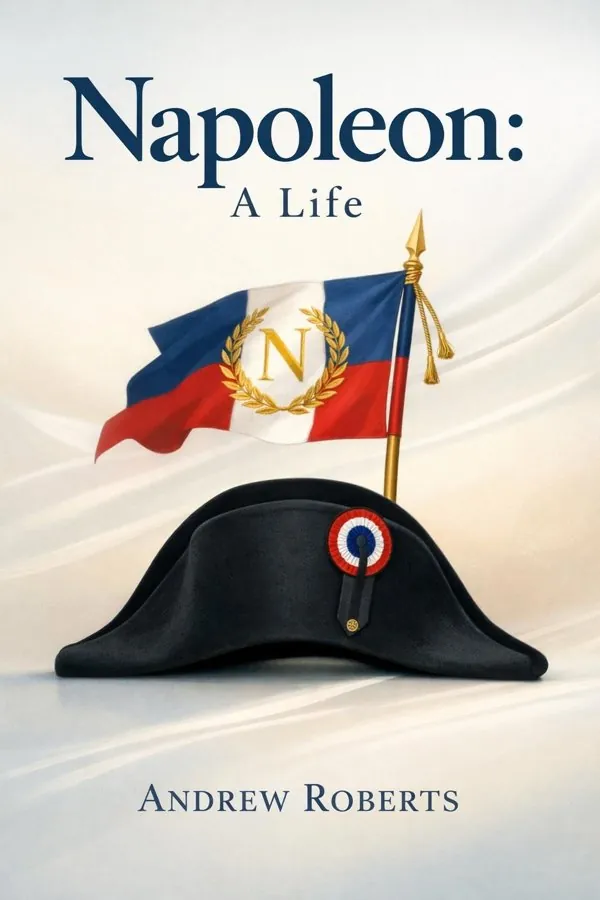
Napoleon The Great by Andrew Roberts is a general book. Andrew Roberts’s Napoleon The Great is a sweeping, revisionist biography that argues Napoleon Bonaparte was not merely a brilliant general or authoritarian ruler, but one of history’s most consequential state-builders. Drawing on newly available primary sources, including Napoleon’s own letters, Roberts reexamines a figure often trapped between myth and caricature. Instead of repeating familiar legends, he shows how Napoleon combined military genius, administrative discipline, political imagination, and relentless personal energy to reshape France and much of Europe. What makes this book especially important is its refusal to flatten Napoleon into either hero or villain. Roberts acknowledges the wars, ambition, censorship, and human cost, yet he also demonstrates Napoleon’s extraordinary achievements in law, education, meritocracy, governance, and institutional reform. The result is a portrait of a leader whose influence still echoes in modern states. Roberts writes with the authority of a distinguished historian, and his command of military, political, and personal detail gives the book unusual depth. For readers interested in leadership, power, strategy, and the making of modern Europe, Napoleon The Great offers a vivid and challenging reassessment of one of history’s most fascinating figures.
This FizzRead summary covers all 8 key chapters of Napoleon The Great in approximately 10 minutes, distilling the most important ideas, arguments, and takeaways from Andrew Roberts's work.
Napoleon The Great
Andrew Roberts’s Napoleon The Great is a sweeping, revisionist biography that argues Napoleon Bonaparte was not merely a brilliant general or authoritarian ruler, but one of history’s most consequential state-builders. Drawing on newly available primary sources, including Napoleon’s own letters, Roberts reexamines a figure often trapped between myth and caricature. Instead of repeating familiar legends, he shows how Napoleon combined military genius, administrative discipline, political imagination, and relentless personal energy to reshape France and much of Europe.
What makes this book especially important is its refusal to flatten Napoleon into either hero or villain. Roberts acknowledges the wars, ambition, censorship, and human cost, yet he also demonstrates Napoleon’s extraordinary achievements in law, education, meritocracy, governance, and institutional reform. The result is a portrait of a leader whose influence still echoes in modern states.
Roberts writes with the authority of a distinguished historian, and his command of military, political, and personal detail gives the book unusual depth. For readers interested in leadership, power, strategy, and the making of modern Europe, Napoleon The Great offers a vivid and challenging reassessment of one of history’s most fascinating figures.
Who Should Read Napoleon The Great?
This book is perfect for anyone interested in general and looking to gain actionable insights in a short read. Whether you're a student, professional, or lifelong learner, the key ideas from Napoleon The Great by Andrew Roberts will help you think differently.
- ✓Readers who enjoy general and want practical takeaways
- ✓Professionals looking to apply new ideas to their work and life
- ✓Anyone who wants the core insights of Napoleon The Great in just 10 minutes
Want the full summary?
Get instant access to this book summary and 100K+ more with Fizz Moment.
Get Free SummaryAvailable on App Store • Free to download
Key Chapters
Great leaders are often remembered for their loudest achievements, but their deepest influence usually lies elsewhere. One of Andrew Roberts’s central arguments is that Napoleon should not be understood only as a conqueror riding from battlefield to battlefield. His military campaigns were spectacular, but Roberts insists that Napoleon’s lasting significance came from what he built: legal systems, administrative structures, educational institutions, and a style of governance rooted in competence and central direction.
This matters because popular memory tends to reduce complex figures into simple labels. Napoleon becomes either a tyrant obsessed with war or a romantic genius in uniform. Roberts pushes beyond both simplifications. He shows that Napoleon reorganized France after the chaos of revolution, stabilized state finances, established the Banque de France, promoted the Civil Code, and created institutions that outlasted his empire. In other words, he did not simply seize power; he used power to impose order on a fractured society.
A practical way to think about this is through modern leadership. In business, politics, or organizations, some people are known for bold moves, public victories, or dramatic turnarounds. But their true value lies in whether they create systems that function after the applause fades. Napoleon’s example suggests that enduring impact comes from institution-building, not just crisis management.
Roberts does not deny the costs of Napoleon’s ambition. Instead, he asks readers to judge the whole record. The actionable takeaway is simple: when evaluating leaders, look beyond visible wins and ask what durable structures they leave behind.
Raw ambition is common; disciplined ambition is rare. Roberts portrays Napoleon as a man of staggering drive, but what distinguished him was not desire alone. It was his capacity to turn ambition into preparation, concentration, and relentless execution. He read widely, studied military history obsessively, mastered logistics, and developed an astonishing memory for detail. His rise was not accidental brilliance; it was cultivated capability.
This is one of the book’s most useful insights. Napoleon did not wait for ideal conditions before acting. He educated himself aggressively, learned from every campaign, and treated setbacks as sources of tactical refinement. Roberts shows that the young artillery officer who emerged during the French Revolution had already spent years sharpening his mind. Later, as ruler, he maintained the same tempo, reviewing documents late into the night and involving himself in everything from roads to schooling to legal reform.
In modern terms, Napoleon’s career illustrates the difference between wanting influence and becoming competent enough to handle it. A professional may dream of leadership, but unless that ambition is backed by deep study and repeated practice, the results will be shallow. Students, founders, managers, and public servants can all draw from this model: mastery compounds.
At the same time, Roberts hints at the danger of limitless ambition. The same force that drove Napoleon upward eventually pushed him toward overreach. Discipline can magnify ability, but it can also magnify error if self-correction disappears.
The actionable takeaway: pair ambition with rigorous preparation, and regularly test whether your drive is still serving reality rather than your ego.
Brilliance in command is not only about grand vision; it is also about mastering small realities. Roberts presents Napoleon as one of history’s greatest military thinkers precisely because he combined strategic imagination with operational precision. He understood speed, surprise, terrain, morale, artillery placement, communication, and the timing of concentration better than most of his enemies. His victories were rarely magical. They were engineered.
A major strength of the book is its demonstration that Napoleon’s battlefield success came from integration. He could see an entire campaign in motion while also remembering the state of roads, supplies, river crossings, and unit positions. Roberts shows how Napoleon moved armies quickly, split forces to confuse opponents, then concentrated strength at decisive points. This was not reckless improvisation. It was carefully structured flexibility.
There is a clear application beyond warfare. In any complex project, leaders often fail because they emphasize either vision or detail, but not both. A company launching a product may have a compelling strategy yet collapse in execution because customer support, delivery systems, or internal communication are neglected. Napoleon’s operational genius reminds us that success depends on aligning the high-level objective with the mechanics that make it real.
Roberts also reveals a lesson about momentum. Napoleon often seized initiative and forced enemies into reactive positions. In competitive environments, the actor who defines tempo often shapes outcomes. But the book equally warns that systems break down when tempo outruns sustainability.
The actionable takeaway: if you want superior results, unite big-picture thinking with command of execution, and never assume vision alone can carry a plan to victory.
Some rulers leave monuments; others leave machinery. Roberts emphasizes that Napoleon’s most profound contribution may have been the modernization of the French state. The Napoleonic Code, centralized administration, prefect system, educational reforms, merit-based advancement, and institutional coherence all helped create a more functional and predictable society. Even after his fall, much of what he established remained.
This is a powerful reminder that historical impact is often measured less by territorial reach than by administrative durability. Empires rise and collapse, but laws and institutions can continue shaping daily life for generations. Roberts argues that Napoleon understood this deeply. He was not content merely to dominate. He wanted to organize. He brought rationalization to taxation, promoted careers open to talent, and used state power to create consistency where revolution had produced fragmentation.
For modern readers, this insight applies to organizational design. Whether in government, schools, nonprofits, or businesses, unstable systems create waste, confusion, and dependence on heroic personalities. Strong institutions reduce friction and make performance repeatable. A founder who centralizes everything personally may look powerful, but a leader who builds clear processes, fair standards, and competent teams creates resilience.
Roberts does not claim Napoleon was liberal in the modern sense. His state was authoritative and often coercive. Yet its effectiveness is part of why his legacy endured. The book encourages readers to distinguish between charisma and structure.
The actionable takeaway: build systems that can function without constant personal intervention, because the strongest legacy is not personal control but institutional continuity.
Societies change when talent gains a path upward. Roberts highlights Napoleon’s commitment, however imperfect, to rewarding ability over inherited privilege. In the aftermath of revolution, this mattered enormously. Napoleon promoted officers and administrators based on competence, energy, and loyalty rather than old aristocratic entitlement alone. That approach helped him assemble a highly effective elite and gave ambitious individuals a reason to serve the new order.
The importance of this idea extends beyond military promotion. Roberts suggests that Napoleon represented a new political logic: the state could be staffed by talent drawn from broader society. This did not mean equality in a modern democratic sense, and Napoleon certainly created his own hierarchy. But compared with the rigid structures of the old regime, his system widened opportunity and aligned advancement with performance.
In practical terms, meritocracy remains one of the most powerful drivers of institutional strength. A company that promotes only based on tenure or personal connections will eventually stagnate. A school system that ignores excellence in favor of habit discourages aspiration. Even in families or communities, trust grows when people believe effort and competence are recognized fairly.
Roberts also helps readers see the tension within meritocracy. Systems that reward ability can still become centralized, political, or unequal. Napoleon rewarded talent, but he also demanded obedience. The lesson is not that merit solves everything, but that it can dramatically improve state or organizational capacity when paired with standards and accountability.
The actionable takeaway: create environments where advancement is earned through demonstrated ability, and audit your systems regularly to ensure opportunity is not being quietly replaced by favoritism.
The same qualities that create greatness can also cause ruin. One of the most compelling themes in Roberts’s biography is that Napoleon’s extraordinary confidence, speed of decision, and appetite for action were inseparable from his eventual overreach. His rise was powered by audacity, but that audacity later encouraged decisions whose costs outstripped their gains, especially in Spain and Russia.
Roberts does not present decline as simple moral punishment. Instead, he shows how successful leaders can become trapped by the habits that once made them exceptional. Napoleon had repeatedly defeated coalitions, outmaneuvered cautious opponents, and recovered from danger. Such a record can create an illusion of permanent recoverability. Over time, prudence begins to look like weakness and limits start to seem negotiable.
This pattern is highly relevant today. Entrepreneurs overexpand after a string of wins. executives ignore warning signs because previous risks paid off. Political leaders assume public support is endless. In each case, success dulls sensitivity to constraint. Roberts’s treatment of Napoleon offers a timeless caution: intelligence and experience do not automatically protect leaders from self-deception.
The book also shows that scale matters. A brilliant commander can still fail when geography, supply lines, climate, local resistance, and coalition politics align against him. Capability cannot erase structural limits.
The actionable takeaway: after every major success, deliberately ask what conditions made that success possible and whether those conditions still exist, because unchecked confidence is often the first stage of strategic failure.
History is never just what happened; it is also what later generations choose to remember. Roberts devotes considerable energy to correcting distorted views of Napoleon that emerged through hostile propaganda, national mythmaking, and selective moral judgment. He does not excuse everything Napoleon did, but he insists that the emperor has often been judged through stories crafted by his enemies rather than by balanced evidence.
This is one of the book’s most intellectually valuable contributions. Roberts asks readers to reconsider how reputations are formed. A defeated leader is especially vulnerable to simplification. If posterity inherits only the victor’s narrative, complexity disappears. Napoleon becomes a cartoon despot, and the legal, institutional, and modernizing elements of his rule are minimized. By returning to documents, correspondence, and battlefield records, Roberts demonstrates that biography can challenge inherited consensus.
The idea applies broadly. In workplaces, public life, and personal relationships, reputations often depend on who tells the story first and most persuasively. A failed project may define a talented person for years, while their larger contributions are forgotten. A public figure may be reduced to one scandal or one triumph. Critical thinking requires stepping back and asking what evidence is missing.
Roberts’s approach is not blind rehabilitation. It is disciplined reassessment. That distinction matters. Reputational correction should not mean denial of faults; it should mean proportion, context, and fairness.
The actionable takeaway: whenever you inherit a strong opinion about a person or event, examine the sources behind it and ask whose interests shaped the dominant narrative.
Defeat does not end influence if a person can still shape meaning. Roberts’s account of Napoleon’s exile, especially on Saint Helena, shows that even when stripped of armies and empire, he remained active in constructing his legacy. He reflected on campaigns, justified decisions, blamed enemies, dramatized suffering, and contributed to the making of the Napoleonic legend. In failure, he became both subject and author of history.
This is important because leadership includes post-defeat behavior. Some figures vanish once power disappears. Napoleon did not. Roberts suggests that his mental energy, resilience, and instinct for narrative survived military collapse. He understood that memory itself is a battleground. By framing his career as a struggle against reactionary powers and by emphasizing his reforms and achievements, he influenced how later generations would interpret him.
Modern readers can learn from this without embracing self-mythology. Careers include losses, demotions, public setbacks, and failed ventures. What matters next is how a person processes defeat. Reflection can produce clarity, accountability, and renewed purpose. Reinvention often begins with storytelling, but it must be anchored in truth rather than vanity.
Roberts also reminds us that adversity can magnify character. Exile exposed both Napoleon’s resilience and his ego. He remained mentally formidable, but he also continued shaping events to protect his self-image. That duality makes him human and historically compelling.
The actionable takeaway: when facing setback, take control of your response by documenting lessons honestly, preserving perspective, and shaping a future-oriented narrative that neither denies mistakes nor surrenders your larger purpose.
All Chapters in Napoleon The Great
About the Author
Andrew Roberts is a British historian and biographer widely known for his works on major political and military figures. Educated at Cambridge, he has built a reputation for combining rigorous archival research with clear, engaging narrative style. His books include acclaimed studies of Winston Churchill, George III, and leadership during the Second World War. Roberts is especially valued for revisiting familiar historical subjects with fresh evidence and a willingness to challenge conventional interpretations. In Napoleon The Great, he draws on extensive primary material, including Napoleon’s correspondence, to present a vivid and revisionist portrait of the French emperor. His work appeals to both scholarly readers and general audiences interested in power, leadership, war, and statecraft.
Get This Summary in Your Preferred Format
Read or listen to the Napoleon The Great summary by Andrew Roberts anytime, anywhere. FizzRead offers multiple formats so you can learn on your terms — all free.
Available formats: App · Audio · PDF · EPUB — All included free with FizzRead
Download Napoleon The Great PDF and EPUB Summary
Key Quotes from Napoleon The Great
“Great leaders are often remembered for their loudest achievements, but their deepest influence usually lies elsewhere.”
“Raw ambition is common; disciplined ambition is rare.”
“Brilliance in command is not only about grand vision; it is also about mastering small realities.”
“Some rulers leave monuments; others leave machinery.”
“Societies change when talent gains a path upward.”
Frequently Asked Questions about Napoleon The Great
Napoleon The Great by Andrew Roberts is a general book that explores key ideas across 8 chapters. Andrew Roberts’s Napoleon The Great is a sweeping, revisionist biography that argues Napoleon Bonaparte was not merely a brilliant general or authoritarian ruler, but one of history’s most consequential state-builders. Drawing on newly available primary sources, including Napoleon’s own letters, Roberts reexamines a figure often trapped between myth and caricature. Instead of repeating familiar legends, he shows how Napoleon combined military genius, administrative discipline, political imagination, and relentless personal energy to reshape France and much of Europe. What makes this book especially important is its refusal to flatten Napoleon into either hero or villain. Roberts acknowledges the wars, ambition, censorship, and human cost, yet he also demonstrates Napoleon’s extraordinary achievements in law, education, meritocracy, governance, and institutional reform. The result is a portrait of a leader whose influence still echoes in modern states. Roberts writes with the authority of a distinguished historian, and his command of military, political, and personal detail gives the book unusual depth. For readers interested in leadership, power, strategy, and the making of modern Europe, Napoleon The Great offers a vivid and challenging reassessment of one of history’s most fascinating figures.
More by Andrew Roberts
You Might Also Like
Duct Tape Marketing: The World's Most Practical Small Business Marketing Guide
John Jantsch
10 minDusk, Night, Dawn: On Revival and Courage
Anne Lamott
10 minFinish Big: How Great Entrepreneurs Exit Their Companies on Top
Bo Burlingham
10 minFirst As Tragedy, Then As Farce
Slavoj Zizek
10 minFirst Principles: What America's Founders Learned from the Greeks and Romans and How That Shaped Our Country
Thomas E. Ricks
10 minGood Habits, Bad Habits: The Science of Making Positive Changes That Stick
Wendy Wood
10 minBrowse by Category
Ready to read Napoleon The Great?
Get the full summary and 100K+ more books with Fizz Moment.