
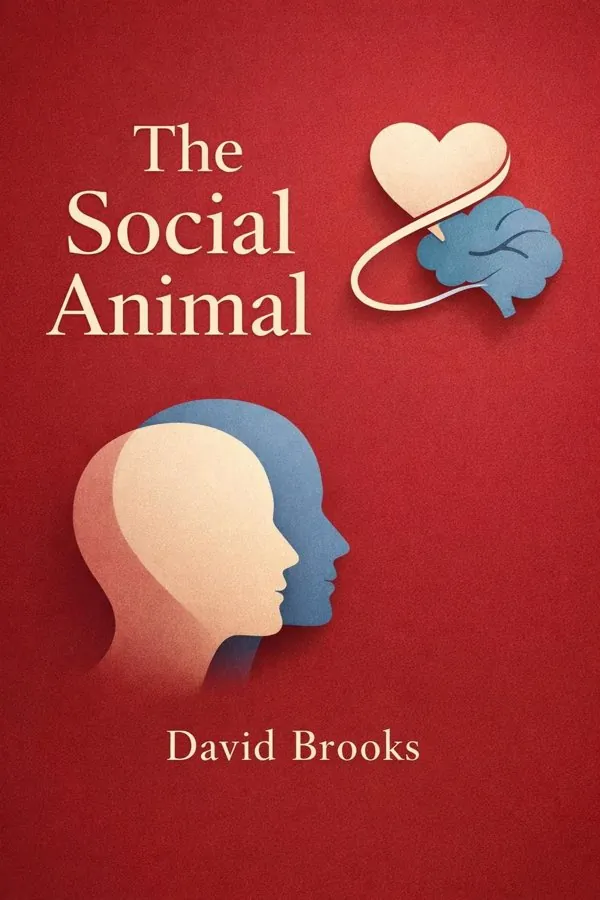
The Social Animal: The Hidden Sources of Love, Character, and Achievement: Summary & Key Insights
by David Brooks
 10 min9 chaptersAudio available
Key Takeaways from The Social Animal: The Hidden Sources of Love, Character, and Achievement
A life is not built in dramatic moments alone; it is formed through thousands of subtle interactions that teach us what to expect from ourselves and from others.
Before children learn to reason clearly, they learn to feel safely or unsafely in the world.
The best education does not merely fill the mind; it forms perception, discipline, taste, and character.
Romantic love feels spontaneous, but lasting intimacy is built through the slow art of understanding another inner world.
Career progress, creativity, leadership, and influence are not driven by IQ alone.
What Is The Social Animal: The Hidden Sources of Love, Character, and Achievement About?
The Social Animal: The Hidden Sources of Love, Character, and Achievement by David Brooks is a sociology book spanning 9 pages. The Social Animal is David Brooks’s ambitious attempt to explain how people actually become who they are. Rather than treating human beings as purely rational decision-makers, Brooks argues that much of life is shaped by emotion, intuition, habit, social context, and the largely unconscious processes beneath awareness. To make these ideas vivid, he follows the imagined lives of Harold and Erica, two fictional characters whose childhoods, education, relationships, careers, setbacks, and later years reveal how character and achievement emerge over time. Drawing on psychology, neuroscience, sociology, and behavioral economics, Brooks connects scientific research to everyday experiences such as parenting, falling in love, building a career, facing loss, and searching for meaning. The book matters because it challenges a shallow view of success based only on IQ, credentials, or willpower. Instead, it shows that empathy, attachment, moral formation, and social belonging play a decisive role in human flourishing. As a longtime journalist and cultural commentator, Brooks brings wide-ranging research together in an accessible, story-driven way, making this book especially useful for readers who want a richer understanding of love, character, and a life well lived.
This FizzRead summary covers all 9 key chapters of The Social Animal: The Hidden Sources of Love, Character, and Achievement in approximately 10 minutes, distilling the most important ideas, arguments, and takeaways from David Brooks's work. Also available as an audio summary and Key Quotes Podcast.
The Social Animal: The Hidden Sources of Love, Character, and Achievement
The Social Animal is David Brooks’s ambitious attempt to explain how people actually become who they are. Rather than treating human beings as purely rational decision-makers, Brooks argues that much of life is shaped by emotion, intuition, habit, social context, and the largely unconscious processes beneath awareness. To make these ideas vivid, he follows the imagined lives of Harold and Erica, two fictional characters whose childhoods, education, relationships, careers, setbacks, and later years reveal how character and achievement emerge over time. Drawing on psychology, neuroscience, sociology, and behavioral economics, Brooks connects scientific research to everyday experiences such as parenting, falling in love, building a career, facing loss, and searching for meaning. The book matters because it challenges a shallow view of success based only on IQ, credentials, or willpower. Instead, it shows that empathy, attachment, moral formation, and social belonging play a decisive role in human flourishing. As a longtime journalist and cultural commentator, Brooks brings wide-ranging research together in an accessible, story-driven way, making this book especially useful for readers who want a richer understanding of love, character, and a life well lived.
Who Should Read The Social Animal: The Hidden Sources of Love, Character, and Achievement?
This book is perfect for anyone interested in sociology and looking to gain actionable insights in a short read. Whether you're a student, professional, or lifelong learner, the key ideas from The Social Animal: The Hidden Sources of Love, Character, and Achievement by David Brooks will help you think differently.
- ✓Readers who enjoy sociology and want practical takeaways
- ✓Professionals looking to apply new ideas to their work and life
- ✓Anyone who wants the core insights of The Social Animal: The Hidden Sources of Love, Character, and Achievement in just 10 minutes
Want the full summary?
Get instant access to this book summary and 100K+ more with Fizz Moment.
Get Free SummaryAvailable on App Store • Free to download
Key Chapters
A life is not built in dramatic moments alone; it is formed through thousands of subtle interactions that teach us what to expect from ourselves and from others. Brooks uses Harold and Erica not merely as characters but as mirrors for modern life. Their intertwined stories illustrate how background, family atmosphere, emotional cues, and social environment shape identity long before people consciously choose their values. Harold grows up in a secure, privileged home where emotional restraint and achievement are quietly rewarded. Erica’s early life is marked by instability, but also by a different intensity of feeling and adaptation. Their trajectories show that people do not begin life as blank slates or independent calculators. They are molded by tone, rhythm, relationships, expectations, and hidden signals embedded in family and culture.
This narrative device allows Brooks to translate abstract research into lived experience. Instead of merely citing studies about attachment, motivation, or status, he shows how these forces work inside daily life: at the dinner table, in classrooms, during awkward conversations, and in moments of ambition or heartbreak. The point is not that destiny is fixed by childhood, but that human development is social from the start. We inherit emotional styles and scripts long before we learn to explain them.
In practical terms, this means people should look beyond surface behavior when trying to understand themselves or others. A colleague’s defensiveness, a partner’s silence, or a child’s restlessness may reflect deep-seated patterns rather than simple intention. Actionable takeaway: examine the emotional environments you create and inhabit, because character is often shaped less by what is explicitly taught than by what is repeatedly felt.
Before children learn to reason clearly, they learn to feel safely or unsafely in the world. One of Brooks’s central insights is that childhood development is not only about acquiring language or knowledge; it is about wiring the emotional brain. Through attachment, parental responsiveness, mirroring, and routine interactions, children build internal models of trust, self-worth, and social expectation. These early experiences influence empathy, resilience, impulse control, and the ability to form healthy relationships later in life.
Brooks draws on developmental psychology and neuroscience to argue that much of what matters most in a child’s future cannot be measured by test scores alone. A parent who responds warmly to distress teaches emotional regulation. A caregiver who notices facial expressions and reflects them back helps a child build self-awareness. Repeated experiences of neglect, chaos, or inconsistency, by contrast, can produce vigilance, insecurity, or difficulty interpreting social cues. The lesson is not that parenting must be perfect. It is that ordinary patterns of attunement matter enormously.
This has wide application beyond the family. Teachers, mentors, coaches, and community leaders also shape emotional development by providing stable attention, expectations, and belonging. Schools that focus only on information transfer miss a deeper task: helping young people become socially and emotionally capable human beings.
For adults, this insight is equally important. Many personal struggles that appear as laziness, anxiety, or relational conflict may be rooted in earlier emotional patterns. Actionable takeaway: invest in warm, consistent, attentive relationships with children, and if you are an adult, identify one early emotional script that still influences your reactions so you can begin to consciously reshape it.
The best education does not merely fill the mind; it forms perception, discipline, taste, and character. Brooks challenges the narrow idea that learning is mainly the transfer of explicit knowledge from expert to student. In his view, education works at a deeper level. It trains attention, shapes habits of interpretation, and socializes people into communities with standards, values, and aspirations. Through Harold and Erica’s educational experiences, Brooks shows that schools are not only places where facts are delivered but environments where students absorb emotional cues about confidence, belonging, ambition, and purpose.
This broader understanding explains why great teachers matter so much. A memorable teacher does more than explain content clearly. Such a person models curiosity, seriousness, empathy, and standards of excellence. Students often internalize the teacher’s posture toward the world before they internalize the lesson itself. Brooks also suggests that learning depends heavily on relationship and motivation. People work harder and think more deeply when they feel seen, challenged, and invited into something meaningful.
The idea has practical implications for parents, educators, and self-learners. A student who struggles may not need more raw information so much as a better environment for attention and confidence. Workplaces, too, should recognize that training is cultural as well as technical. New employees learn norms, emotional tone, and assumptions through observation long before formal instruction takes effect.
For individuals, this means growth comes from immersion as much as analysis. The books you read, the peers you admire, and the communities you join all become educators. Actionable takeaway: when seeking to learn anything important, choose environments and mentors that shape your habits, identity, and standards—not just your store of information.
Romantic love feels spontaneous, but lasting intimacy is built through the slow art of understanding another inner world. In Brooks’s account, love is not just chemistry or compatibility on paper. It is a process in which two people gradually perceive, interpret, and respond to each other’s hidden hopes, fears, habits, and vulnerabilities. The relationship between Harold and Erica illustrates how attraction often begins with mystery, but depth comes from the repeated choices to notice, adapt, forgive, and remain present.
Brooks places relationships within the larger framework of unconscious social intelligence. People are constantly reading facial expressions, tone of voice, timing, and subtle signals. Healthy couples become skilled at these forms of silent communication. They learn how to soothe each other, challenge each other, and make room for imperfection. This is why strong relationships often depend less on verbal brilliance than on attentiveness, emotional regulation, and generosity. Love becomes a school of character because it forces people to move beyond self-protection and self-absorption.
This insight is useful far beyond romance. Friendships, marriages, and family bonds all deepen when people feel accurately seen rather than merely judged. Practical applications include listening without preparing a rebuttal, noticing recurring emotional patterns in conflict, and learning a loved one’s stress signals before a disagreement escalates.
Brooks also implies that love is sustained by shared rituals, moral commitments, and the willingness to serve a reality larger than momentary desire. Passion matters, but enduring attachment depends on daily acts of care. Actionable takeaway: strengthen your closest relationship by paying attention to one subtle emotional cue you usually miss and responding with curiosity instead of assumption.
People like to believe they think first and act second, yet much of human judgment happens before conscious reasoning catches up. One of Brooks’s core arguments is that the unconscious mind is not a dark irrational enemy but a sophisticated system for pattern recognition, emotional evaluation, and social interpretation. Everyday decisions—whom to trust, what opportunities feel right, how to respond in a tense conversation—are often shaped by intuitions built from accumulated experience. Conscious thought still matters, but it usually rides on top of deeper processes.
Brooks draws from psychology and behavioral research to show that people are constantly making fast assessments based on cues they cannot fully articulate. This can be remarkably useful. A seasoned teacher may sense a student’s distress before hearing a word. A skilled manager may detect tension in a team from subtle changes in interaction. But unconscious judgment can also be biased, distorted by stereotypes, fear, or past wounds. The hidden mind is powerful, not infallible.
The practical lesson is balance. We should respect intuition where experience has trained it, yet also create habits that test instinct against reflection. Important choices benefit from both modes: the fast intelligence that senses patterns and the slower reasoning that checks for error. This is especially true in hiring, leadership, relationships, and moral judgment.
Brooks’s broader point is humbling. We are less transparent to ourselves than we assume. Self-knowledge requires observing repeated patterns, not just trusting our explanations after the fact. Actionable takeaway: the next time you make a strong snap judgment, pause to ask what experience or bias may be feeding it, then test that intuition with one deliberate question or piece of evidence.
Character does not develop in isolation; it is cultivated within webs of belonging, expectation, and shared moral language. Brooks argues that morality is not simply a list of rules individuals apply from a distance. It is something people absorb through families, neighborhoods, schools, workplaces, religious traditions, and civic institutions. Communities teach what is admirable, what is shameful, what sacrifices are worth making, and what kind of life deserves respect.
This insight challenges the modern assumption that fulfillment is mainly a private project. Brooks suggests that people become fully human by participating in moral ecologies larger than themselves. When individuals are embedded in communities with strong norms of care, responsibility, and service, they are more likely to develop conscience and commitment. When those bonds weaken, people may gain freedom but lose orientation. They may struggle to answer not just what they want, but what they owe.
Through Harold and Erica’s lives, Brooks shows how social settings can either elevate or erode moral vision. A workplace can foster vanity and competition, or trust and responsibility. A neighborhood can encourage anonymity, or mutual aid. A family can teach entitlement, or gratitude and duty. This means moral education is always partly environmental.
Practically, the book invites readers to evaluate the communities shaping them. Do your circles reward empathy or performance alone? Do they normalize cynicism or responsibility? It also suggests that if we want stronger character in society, we must build institutions that form people well, not just preach values abstractly.
Actionable takeaway: strengthen one community you belong to by creating a small ritual of responsibility—such as regular check-ins, shared service, or intentional hospitality—that reinforces mutual care.
People rarely choose suffering, yet some of life’s deepest transformations come through loss, failure, humiliation, and disruption. Brooks treats adversity not as something automatically beneficial, but as a force that can strip away illusion and reveal hidden resources. When Harold and Erica confront disappointment and pain, they are forced to revise their identities. The selves they had built around success, control, or expectation become insufficient, and a more honest form of maturity begins to emerge.
This is one of the book’s most important moral insights. Achievement may expand a life, but adversity often deepens it. Hard experiences can increase empathy, humility, gratitude, and seriousness. They can break narcissism and make relationships more real. But growth is not guaranteed. Pain can also embitter, isolate, or harden people if they face it alone or interpret it only as meaningless damage. The difference often lies in whether suffering is met with support, reflection, and a framework that allows a person to integrate the experience.
Brooks implies that modern culture often undervalues this kind of growth because it prizes comfort, speed, and visible success. Yet many of the wisest people become wise precisely because life has defeated their illusions. In practical life, this means we should not judge ourselves too quickly during periods of failure. What appears to be derailment may become moral formation.
For leaders, parents, and friends, the lesson is not to remove every hardship but to help others build the emotional and communal resources to endure it well. Actionable takeaway: when facing a setback, ask not only, "How do I recover?" but also, "What false assumption is this experience exposing, and what stronger quality might it be calling me to develop?"
As life advances, the metrics that once seemed decisive—status, image, speed, accomplishment—begin to lose their grip. Brooks uses the later stages of Harold and Erica’s lives to show that aging can bring a clarifying wisdom. Over time, people see more clearly which ambitions were shallow, which relationships were essential, and which habits formed the architecture of their character. Old age, in this sense, is not merely decline. It can be a period of moral and spiritual reckoning in which the hidden shape of a life becomes visible.
Brooks’s treatment of aging emphasizes memory, legacy, and perspective. The elderly often understand that life cannot be measured solely by peak moments of achievement. What endures are the patterns of love, the quality of one’s service, the communities one helped build, and the character one cultivated through ordinary days. This insight offers a counterweight to cultures obsessed with novelty and external success.
The practical value of this chapter is immediate, even for younger readers. If the later years reveal what mattered most all along, then wisdom consists partly in living now by those future standards. That means asking whether your daily routines are creating a life you would later respect. Are you investing in relationships that will still matter decades from now? Are you forming habits of attention, gratitude, and moral steadiness that can survive changing circumstances?
Brooks also suggests that older people have a vital social role: transmitting perspective, tenderness, and moral memory to younger generations. Actionable takeaway: imagine looking back on your life from old age, then choose one current priority to reduce and one relationship or value to strengthen in light of that long view.
All Chapters in The Social Animal: The Hidden Sources of Love, Character, and Achievement
About the Author
David Brooks is an American journalist, author, and commentator whose work focuses on politics, culture, morality, and the social forces that shape human life. He is best known as a columnist for The New York Times and as a longtime commentator on PBS NewsHour. Over the course of his career, Brooks has developed a reputation for blending reporting and public affairs analysis with insights from psychology, philosophy, and sociology. His books often explore questions of character, community, meaning, and the tensions between individual ambition and social responsibility. In The Social Animal, he brings these interests together in a narrative-driven examination of how love, achievement, and moral character emerge through hidden emotional and social processes. Brooks is widely read for his thoughtful, accessible approach to complex cultural and intellectual themes.
Get This Summary in Your Preferred Format
Read or listen to the The Social Animal: The Hidden Sources of Love, Character, and Achievement summary by David Brooks anytime, anywhere. FizzRead offers multiple formats so you can learn on your terms — all free.
Available formats: App · Audio · PDF · EPUB — All included free with FizzRead
Download The Social Animal: The Hidden Sources of Love, Character, and Achievement PDF and EPUB Summary
Key Quotes from The Social Animal: The Hidden Sources of Love, Character, and Achievement
“A life is not built in dramatic moments alone; it is formed through thousands of subtle interactions that teach us what to expect from ourselves and from others.”
“Before children learn to reason clearly, they learn to feel safely or unsafely in the world.”
“The best education does not merely fill the mind; it forms perception, discipline, taste, and character.”
“Romantic love feels spontaneous, but lasting intimacy is built through the slow art of understanding another inner world.”
“Success is often described as the reward for talent and effort, but Brooks argues that achievement grows from social and moral qualities that are less visible and often undervalued.”
Frequently Asked Questions about The Social Animal: The Hidden Sources of Love, Character, and Achievement
The Social Animal: The Hidden Sources of Love, Character, and Achievement by David Brooks is a sociology book that explores key ideas across 9 chapters. The Social Animal is David Brooks’s ambitious attempt to explain how people actually become who they are. Rather than treating human beings as purely rational decision-makers, Brooks argues that much of life is shaped by emotion, intuition, habit, social context, and the largely unconscious processes beneath awareness. To make these ideas vivid, he follows the imagined lives of Harold and Erica, two fictional characters whose childhoods, education, relationships, careers, setbacks, and later years reveal how character and achievement emerge over time. Drawing on psychology, neuroscience, sociology, and behavioral economics, Brooks connects scientific research to everyday experiences such as parenting, falling in love, building a career, facing loss, and searching for meaning. The book matters because it challenges a shallow view of success based only on IQ, credentials, or willpower. Instead, it shows that empathy, attachment, moral formation, and social belonging play a decisive role in human flourishing. As a longtime journalist and cultural commentator, Brooks brings wide-ranging research together in an accessible, story-driven way, making this book especially useful for readers who want a richer understanding of love, character, and a life well lived.
More by David Brooks


You Might Also Like

Between the World and Me
Ta-Nehisi Coates
10 min
Half the Sky
Nicholas D. Kristof, Sheryl WuDunn
10 min
Men Explain Things To Me
Rebecca Solnit
10 min
Rational Ritual
Michael Suk-Young Chwe
10 min
The New Jim Crow
Michelle Alexander
10 min
Beyond Culture
Edward T. Hall
10 minBrowse by Category
Ready to read The Social Animal: The Hidden Sources of Love, Character, and Achievement?
Get the full summary and 100K+ more books with Fizz Moment.