
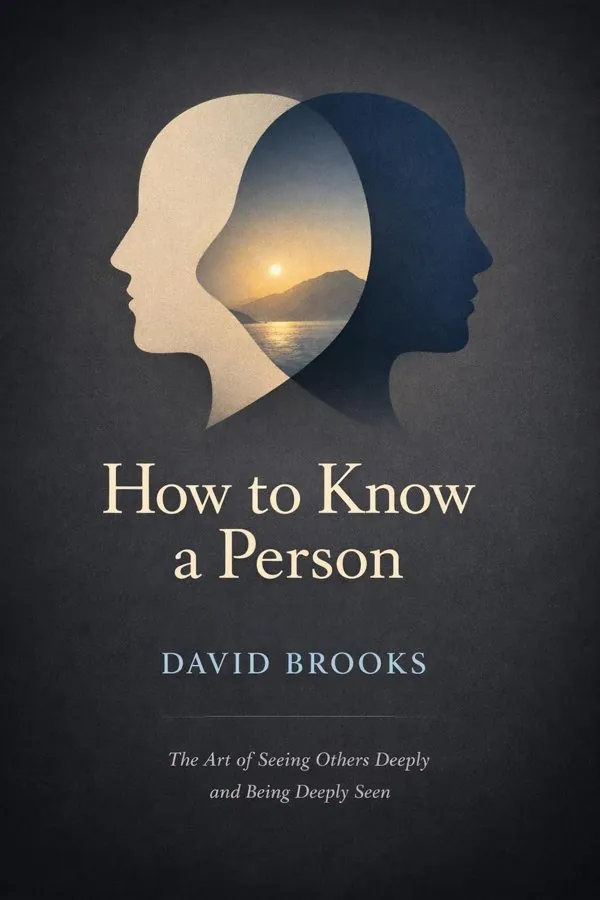
How to Know a Person: The Art of Seeing Others Deeply and Being Deeply Seen: Summary & Key Insights
by David Brooks
 10 min11 chaptersAudio available
What Is How to Know a Person: The Art of Seeing Others Deeply and Being Deeply Seen About?
How to Know a Person: The Art of Seeing Others Deeply and Being Deeply Seen by David Brooks is a psychology book spanning 11 pages. In this book, David Brooks explores the essential human skill of truly understanding others. Drawing on psychology, philosophy, and personal experience, he examines how empathy, attention, and moral imagination allow people to connect meaningfully. Brooks argues that knowing another person deeply is both an art and a moral act, offering practical insights for improving relationships and fostering compassion in a divided world.
This FizzRead summary covers all 11 key chapters of How to Know a Person: The Art of Seeing Others Deeply and Being Deeply Seen in approximately 10 minutes, distilling the most important ideas, arguments, and takeaways from David Brooks's work. Also available as an audio summary and Key Quotes Podcast.
How to Know a Person: The Art of Seeing Others Deeply and Being Deeply Seen
In this book, David Brooks explores the essential human skill of truly understanding others. Drawing on psychology, philosophy, and personal experience, he examines how empathy, attention, and moral imagination allow people to connect meaningfully. Brooks argues that knowing another person deeply is both an art and a moral act, offering practical insights for improving relationships and fostering compassion in a divided world.
Who Should Read How to Know a Person: The Art of Seeing Others Deeply and Being Deeply Seen?
This book is perfect for anyone interested in psychology and looking to gain actionable insights in a short read. Whether you're a student, professional, or lifelong learner, the key ideas from How to Know a Person: The Art of Seeing Others Deeply and Being Deeply Seen by David Brooks will help you think differently.
- ✓Readers who enjoy psychology and want practical takeaways
- ✓Professionals looking to apply new ideas to their work and life
- ✓Anyone who wants the core insights of How to Know a Person: The Art of Seeing Others Deeply and Being Deeply Seen in just 10 minutes
Want the full summary?
Get instant access to this book summary and 100K+ more with Fizz Moment.
Get Free SummaryAvailable on App Store • Free to download
Key Chapters
We live amid a profound crisis of invisibility. In my travels and conversations, I’ve often met people who tell me, “I feel unseen,” and I’ve come to realize that this yearning runs through many of our lives. Despite the explosion of connectivity, loneliness is at record levels. Our culture rewards self-presentation more than understanding, performance more than attention. We have turned our public life into a stage and our private life into a series of hidden anxieties. In such a world, to be seen for who we really are feels like a distant dream.
This invisibility breeds division and despair. When people feel unseen, they retreat behind armor—cynicism, anger, performative confidence. Communities fracture into tribes that define themselves against others rather than with them. Technology amplifies the problem, feeding us constant images and headlines that flatten the complexity of human beings into stereotypes or outrage. The result is moral blindness. We lose the habit of curiosity, the skill of conversation, and the capacity for empathy.
The crisis of invisibility is not only cultural but also moral. It reveals a failure of attention—a collective unwillingness to notice the full humanity of those around us. If a society is to nurture compassion and meaning, it must create spaces where people are truly seen. Every interaction, however brief, holds the possibility of recognition, but that recognition demands intention. To counter the crisis of invisibility, we have to re-learn how to look at others with moral imagination rather than moral judgment. Only by reclaiming this art can we begin to rebuild the connective tissue of our shared world.
Attention is the foundation of knowing. If invisibility is the disease of our age, sustained attention is its cure. But real attention requires more than simply noticing someone—it means allowing your mind to dwell where the other person’s reality resides. It means resisting the impulse to turn every conversation back toward yourself.
When we pay deep attention, we signal to others that they matter. This act, though simple, is transformative. I’ve learned that when you look at someone as if they have something to teach you, they show you who they are. The difference between being seen and being scanned is the difference between intimacy and loneliness.
Psychologically, attention is energy. It shapes the contours of our moral life. When we focus our attention, we’re saying: “You are worth my time.” This is why distraction is not just a cognitive problem—it’s a moral one. The flood of digital stimuli fragments our awareness and leaves us with less space for empathy. To see others, we must learn to silence the noise inside ourselves, to suspend judgment long enough to perceive the world through another’s eyes.
Attention also requires presence—physical, emotional, moral. It invites us to move from ‘knowing about’ someone to ‘knowing with’ them, to share their frame of experience however briefly. When we practice this kind of attention, we reawaken the most human part of ourselves: the capacity to care. The art of knowing someone begins here, in the moment when we allow our gaze to rest on another person with patient curiosity and respect.
+ 9 more chapters — available in the FizzRead app
All Chapters in How to Know a Person: The Art of Seeing Others Deeply and Being Deeply Seen
About the Author
David Brooks is an American journalist, author, and commentator known for his work with The New York Times. He writes on politics, culture, and social psychology, and has authored several influential books including 'The Road to Character' and 'The Second Mountain'. His work often focuses on moral development and the pursuit of meaning in modern life.
Get This Summary in Your Preferred Format
Read or listen to the How to Know a Person: The Art of Seeing Others Deeply and Being Deeply Seen summary by David Brooks anytime, anywhere. FizzRead offers multiple formats so you can learn on your terms — all free.
Available formats: App · Audio · PDF · EPUB — All included free with FizzRead
Download How to Know a Person: The Art of Seeing Others Deeply and Being Deeply Seen PDF and EPUB Summary
Key Quotes from How to Know a Person: The Art of Seeing Others Deeply and Being Deeply Seen
“We live amid a profound crisis of invisibility.”
“If invisibility is the disease of our age, sustained attention is its cure.”
Frequently Asked Questions about How to Know a Person: The Art of Seeing Others Deeply and Being Deeply Seen
How to Know a Person: The Art of Seeing Others Deeply and Being Deeply Seen by David Brooks is a psychology book that explores key ideas across 11 chapters. In this book, David Brooks explores the essential human skill of truly understanding others. Drawing on psychology, philosophy, and personal experience, he examines how empathy, attention, and moral imagination allow people to connect meaningfully. Brooks argues that knowing another person deeply is both an art and a moral act, offering practical insights for improving relationships and fostering compassion in a divided world.
More by David Brooks


You Might Also Like
The Body Keeps the Score
Bessel van der Kolk
10 min
Surrounded by Idiots
Thomas Erikson
10 min
Emotional Intelligence
Daniel Goleman
10 min
Attached
Amir Levine
10 min
Why Does He Do That
Lundy Bancroft
10 min
Women Who Run with the Wolves
Clarissa Pinkola Estés
10 minBrowse by Category
Ready to read How to Know a Person: The Art of Seeing Others Deeply and Being Deeply Seen?
Get the full summary and 100K+ more books with Fizz Moment.