
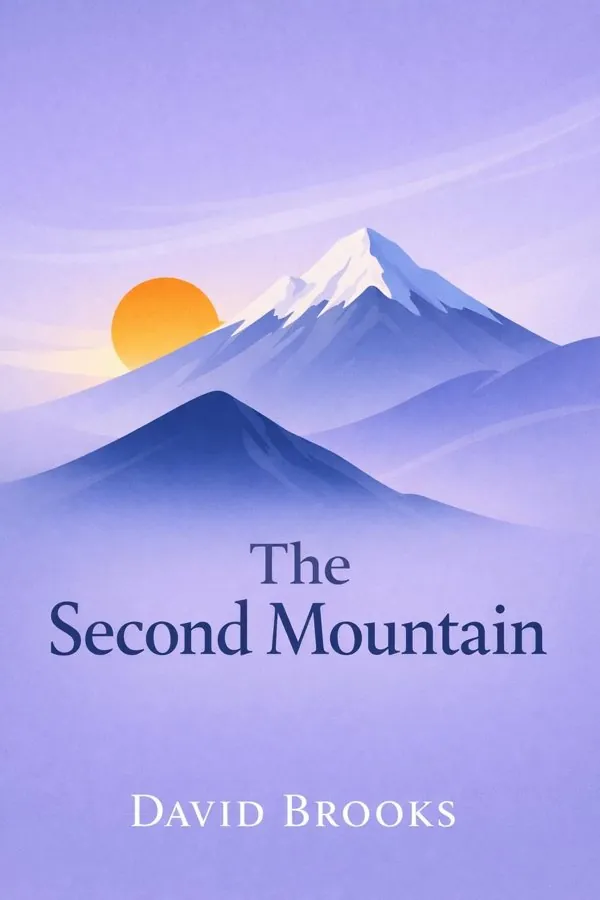
The Second Mountain: The Quest for a Moral Life: Summary & Key Insights
by David Brooks
 10 min9 chaptersAudio available
Key Takeaways from The Second Mountain: The Quest for a Moral Life
Many of us spend the first half of life chasing goals we never seriously chose.
The most important turning points in life often begin with some form of breaking.
A meaningful life rarely begins with a grand plan; it often begins with a summons.
Love becomes transformative when it moves beyond feeling and becomes a promise.
The modern world tells us to find a job that fits our talents and ambitions.
What Is The Second Mountain: The Quest for a Moral Life About?
The Second Mountain: The Quest for a Moral Life by David Brooks is a mindset book spanning 6 pages. What if the life society trains you to want is not the life that will finally satisfy you? In The Second Mountain, David Brooks argues that many people begin adulthood climbing a “first mountain” defined by achievement, independence, success, and personal happiness. Yet for all its rewards, that path often leaves people spiritually restless, especially after disappointment, failure, heartbreak, or loss. The deeper life begins only when the ego-centered script breaks down and a new calling emerges: a life rooted in commitment, service, love, faith, and responsibility. Brooks blends memoir, moral philosophy, sociology, religion, and cultural criticism to explore this transition from self-centered ambition to a more meaningful moral life. He organizes the journey around four major commitments: to a person, a vocation, a philosophy or faith, and a community. In doing so, he offers not just a diagnosis of modern loneliness and fragmentation, but a practical vision for rebuilding both the self and society. As a longtime New York Times columnist and cultural observer, Brooks brings intellectual range and emotional honesty, making this book especially valuable for anyone questioning what success is really for.
This FizzRead summary covers all 9 key chapters of The Second Mountain: The Quest for a Moral Life in approximately 10 minutes, distilling the most important ideas, arguments, and takeaways from David Brooks's work. Also available as an audio summary and Key Quotes Podcast.
The Second Mountain: The Quest for a Moral Life
What if the life society trains you to want is not the life that will finally satisfy you? In The Second Mountain, David Brooks argues that many people begin adulthood climbing a “first mountain” defined by achievement, independence, success, and personal happiness. Yet for all its rewards, that path often leaves people spiritually restless, especially after disappointment, failure, heartbreak, or loss. The deeper life begins only when the ego-centered script breaks down and a new calling emerges: a life rooted in commitment, service, love, faith, and responsibility.
Brooks blends memoir, moral philosophy, sociology, religion, and cultural criticism to explore this transition from self-centered ambition to a more meaningful moral life. He organizes the journey around four major commitments: to a person, a vocation, a philosophy or faith, and a community. In doing so, he offers not just a diagnosis of modern loneliness and fragmentation, but a practical vision for rebuilding both the self and society. As a longtime New York Times columnist and cultural observer, Brooks brings intellectual range and emotional honesty, making this book especially valuable for anyone questioning what success is really for.
Who Should Read The Second Mountain: The Quest for a Moral Life?
This book is perfect for anyone interested in mindset and looking to gain actionable insights in a short read. Whether you're a student, professional, or lifelong learner, the key ideas from The Second Mountain: The Quest for a Moral Life by David Brooks will help you think differently.
- ✓Readers who enjoy mindset and want practical takeaways
- ✓Professionals looking to apply new ideas to their work and life
- ✓Anyone who wants the core insights of The Second Mountain: The Quest for a Moral Life in just 10 minutes
Want the full summary?
Get instant access to this book summary and 100K+ more with Fizz Moment.
Get Free SummaryAvailable on App Store • Free to download
Key Chapters
Many of us spend the first half of life chasing goals we never seriously chose. Brooks calls this stage the “first mountain,” the climb shaped by modern culture’s favorite values: individual success, personal freedom, recognition, wealth, and self-advancement. From childhood onward, people are taught to build résumés, optimize performance, and stand out from the crowd. The assumption is simple: if you achieve enough, happiness and meaning will follow.
The first mountain is not inherently wrong. Ambition can build discipline, confidence, and excellence. Careers matter, talent should be developed, and striving can be energizing. The problem begins when achievement becomes the whole story of life. A person may collect promotions, credentials, and praise yet still feel emotionally thin, morally underdeveloped, and relationally disconnected. Brooks argues that the culture of hyper-individualism trains people to ask, “What do I want from life?” rather than, “What is life asking of me?”
In practical terms, this helps explain why outwardly successful people often report emptiness. The executive who wins status but loses intimacy, the student who performs brilliantly but has no inner compass, or the entrepreneur who builds a company while neglecting family all discover the same truth: accomplishment alone cannot anchor identity. The first mountain rewards competence, but it does not guarantee belonging, purpose, or love.
Brooks invites readers to treat this realization not as failure but as awakening. Success is useful, but it is not ultimate. The key is to notice when your goals are feeding your ego rather than your soul. Actionable takeaway: list the ambitions currently driving your life, then ask of each one, “Does this deepen my character and relationships, or only my status?”
The most important turning points in life often begin with some form of breaking. Brooks describes the “valley” as the season of loss, humiliation, grief, loneliness, or failure that interrupts the first mountain climb. It may come through divorce, death, addiction, illness, job loss, public embarrassment, or quiet internal collapse. In the valley, the identity you built stops working, and the story you told yourself about who you are falls apart.
Brooks writes from personal experience here, making the idea especially powerful. The valley strips away illusion. It reveals that self-sufficiency is a myth and that much of modern life is organized around denial of dependence. In ordinary times, people can hide behind busyness, success, or control. In the valley, those shields vanish. What remains is vulnerability, and vulnerability often becomes the doorway to wisdom.
This is not a romantic celebration of suffering. Pain is painful. Yet Brooks argues that the valley can become morally formative if it softens the ego and opens a person to reality. Someone who has endured deep loss may become more compassionate, less judgmental, and more capable of genuine connection. The person who once valued image may begin to value presence. The one who used to seek admiration may begin to seek meaning.
In everyday life, this insight changes how we respond to crisis. Instead of asking only, “How do I get back to normal?” we can also ask, “What truth is this hardship revealing?” Journaling, therapy, prayer, trusted friendships, and honest self-examination can help turn suffering into transformation rather than bitterness.
Actionable takeaway: identify one difficult experience that reshaped you, and write down what false belief it exposed and what deeper value it taught you to honor.
A meaningful life rarely begins with a grand plan; it often begins with a summons. After the valley, Brooks says, many people discover the “second mountain,” a life no longer centered on self-expression but on self-giving. The second mountain is not about asking how to maximize personal happiness. It is about recognizing a call to devote yourself to something or someone beyond yourself.
This shift is profound because it replaces a market logic with a covenantal logic. On the first mountain, life is often transactional: What can I get? What fits my preferences? What advances my goals? On the second mountain, life becomes relational and moral: Who needs me? What am I responsible for? What promise am I being asked to keep? The self is not erased, but it is reordered. Freedom is no longer mere independence; it becomes the capacity to bind yourself to worthy commitments.
A person may hear this call through parenthood, a mentoring relationship, a faith awakening, service to the poor, dedication to a craft, or loyalty to a struggling neighborhood. What matters is not dramatic scale but depth of devotion. A schoolteacher who commits to her students, a son who cares for an aging parent, or a citizen who works to heal civic distrust may all be climbing the second mountain.
Brooks emphasizes that this life brings joy not because it is easy but because it is anchored. The second mountain gives people a reason to endure difficulty. Meaning comes not from endless options, but from chosen obligations.
Actionable takeaway: ask yourself where you feel a recurring pull of responsibility, then take one concrete step this week to honor it—make the call, show up, volunteer, apologize, or begin the work.
Love becomes transformative when it moves beyond feeling and becomes a promise. One of Brooks’s central arguments is that commitment to a spouse and family is one of the most powerful schools of moral formation. In a culture that prizes autonomy and optionality, lifelong commitment can seem restrictive. Brooks argues the opposite: deep commitment enlarges the self by teaching sacrifice, patience, fidelity, and care.
Marriage, at its best, is not merely a private arrangement for mutual satisfaction. It is a covenant in which two people pledge to become a refuge for one another and to build a shared moral world. Family life confronts people with demands that cannot be met by convenience alone. Children need constancy, partners need forgiveness, and households survive through ordinary acts of service that rarely earn applause. These repeated acts shape character.
Brooks does not present family life sentimentally. It is difficult, messy, and often exhausting. But precisely because it requires sustained devotion, it teaches people to love another person not for utility or image but for their inherent worth. The daily discipline of showing up, listening, compromising, and enduring disappointment trains the heart away from narcissism.
This applies beyond traditional family structures. Any enduring bond of care—raising children, supporting extended family, tending to fragile relationships—can cultivate the same moral habits. In practice, that may mean setting boundaries around work, creating rituals of attention like shared meals, or learning to repair conflict instead of escaping it.
Actionable takeaway: choose one relationship you want to strengthen, and create a recurring act of commitment around it, such as a weekly check-in, uninterrupted meal, apology conversation, or standing act of service.
The modern world tells us to find a job that fits our talents and ambitions. Brooks asks for something deeper: what if your work is not just a career choice, but a vocation? A career is often about advancement, prestige, income, and personal preference. A vocation is a calling that places a claim on you. It may align with your gifts, but it is defined less by what you enjoy and more by what you feel morally summoned to do.
This distinction matters because many people succeed professionally while remaining disconnected from purpose. They may be efficient but not devoted, productive but not fulfilled. Brooks suggests that vocation emerges where ability, need, and moral responsibility intersect. The question shifts from “What job do I want?” to “What work would be worth giving my life to?”
A vocation does not have to be glamorous. A nurse who treats each patient with dignity, a carpenter committed to excellent craftsmanship, a pastor serving a wounded congregation, or a local business owner creating stable jobs may all be answering a call. The mark of vocation is not fame, but faithful contribution.
Viewing work this way also changes how we endure difficulty. Every meaningful vocation includes drudgery, frustration, and sacrifice. But when labor is tied to service, even uncelebrated tasks gain moral weight. The person is no longer just earning a living; they are participating in repair, care, creation, or justice.
Actionable takeaway: write a one-sentence vocation statement beginning with “I am called to…” Then compare your calendar to that sentence and remove one recurring activity that distracts from your deeper work.
A life of commitment requires more than good intentions; it needs a moral framework. Brooks argues that people flourish when they are rooted in a philosophy, faith, or worldview that helps them interpret suffering, duty, love, and human dignity. Without such grounding, modern life can feel morally improvisational. People are left with preferences, not principles, and identity becomes fragile because it depends on mood, tribe, or circumstance.
Brooks draws significantly from religious traditions, especially the idea that humans are not isolated individuals but relational beings bound by obligations. Faith, in his account, is not merely assent to doctrine. It is a way of seeing the world that trains humility, gratitude, repentance, reverence, and hope. Even readers who are not religious can recognize the need for some durable source of moral direction.
In practical life, this may involve regular worship, prayer, meditation, sacred reading, philosophical study, or participation in a community of moral practice. The point is not abstract belief alone, but formation. What stories shape your imagination? What rituals remind you that life is not all about you? What language helps you make sense of guilt, forgiveness, and grace?
Brooks’s deeper warning is that a culture without shared moral language becomes brittle and lonely. People know how to express outrage and desire, but not repentance, devotion, or covenant. Recovering a moral vocabulary helps people live with steadiness and depth.
Actionable takeaway: choose one practice that roots you beyond impulse—daily prayer, reflective reading, Sabbath time, meditation, or philosophical journaling—and keep it consistently for 30 days to build moral clarity.
One of the great failures of modern individualism is that it leaves people free but alone. Brooks argues that the good life cannot be built in isolation because human beings are fundamentally social and embedded. The second mountain therefore includes commitment not only to private relationships but to a community—a neighborhood, institution, congregation, school, town, or civic network where people practice mutual care and shared responsibility.
A true community is more than a collection of like-minded individuals. It is a web of obligation where people know one another, depend on one another, and sacrifice for one another. In such places, identity is not merely self-declared; it is also shaped by belonging. People become accountable, useful, and seen. This kind of communal life counters the anonymity and fragmentation that define so much of contemporary society.
Brooks points out that many social problems—loneliness, distrust, polarization, alienation—cannot be solved by personal success alone. They require institutions and habits that rebuild solidarity. That might look like joining a local volunteer effort, becoming active in a faith community, coaching youth sports, participating in neighborhood problem-solving, or supporting local schools and civic rituals.
Community also changes moral imagination. When you know your neighbors, political abstractions become human realities. Service is no longer theoretical. You begin to care because lives are intertwined with yours. This is how social trust is rebuilt: not through slogans, but through repeated acts of presence.
Actionable takeaway: choose one local community you already touch—your block, school, workplace, congregation, or club—and commit to one visible act of contribution each week for the next month.
Pleasure is enjoyable, but joy has a different source. Brooks distinguishes between the happiness sought on the first mountain and the deeper joy found on the second. Pleasure often comes from satisfying desires, securing comfort, or achieving goals. Joy arises when the self is absorbed in loving commitment, meaningful labor, and shared purpose. It is less about feeling good in the moment and more about being rightly attached to what matters.
This is a countercultural claim. Consumer society trains people to treat life as a series of experiences to optimize. If something stops being satisfying, move on. Brooks argues that this mindset produces restlessness because the self becomes trapped in constant evaluation: Am I happy enough? Am I getting enough? Joy appears when that self-monitoring softens and attention turns outward.
Think of the parent caring for a child in the middle of the night, the volunteer spending weekends on a difficult cause, or the musician immersed in a collective performance. These moments may include fatigue, sacrifice, and frustration, yet they often carry a fullness that pleasure alone cannot provide. Joy is intensified by devotion, not convenience.
This insight can reshape daily choices. Instead of filling every spare hour with entertainment, a person might invest in mentoring, hospitality, craft, or service. Instead of measuring life by ease, they might ask whether they are deeply engaged with something worthy. Joy often comes as a byproduct of forgetting oneself in love and responsibility.
Actionable takeaway: replace one low-value comfort habit this week—mindless scrolling, excess consumption, passive distraction—with one act of meaningful service or contribution, and observe the difference in your sense of aliveness.
Personal transformation is not enough if the surrounding culture continues to reward fragmentation. Brooks broadens his argument from individual morality to social renewal, claiming that many of today’s civic crises stem from excessive individualism. When a society teaches people to prioritize personal choice above all else, institutions weaken, trust declines, and common life frays. Families become unstable, neighborhoods thin out, politics turns tribal, and citizens lose the habits needed for cooperation.
Brooks proposes a shift from a culture of contract to a culture of covenant. Contracts are transactional: I give as long as I get. Covenants are relational and enduring: I bind myself because this bond has moral worth. A healthy society depends on covenantal institutions—strong families, trustworthy schools, civic associations, faith communities, and local networks of care—that teach people how to live for more than themselves.
This does not mean nostalgia or rigid moralism. It means rebuilding social norms around responsibility, dignity, and mutual obligation. In practical terms, leaders can create workplaces that value mentoring over extraction, schools can teach character alongside achievement, and citizens can support institutions that build belonging rather than merely consume services. Cultural repair begins locally.
Brooks’s contribution here is hopeful realism. He does not imagine a perfect society, but he insists that renewal starts when enough people choose devotion over detachment. The social fabric is rewoven through millions of small acts of loyalty, service, and trust-building.
Actionable takeaway: identify one institution you rely on but rarely support—such as a school, library, local nonprofit, neighborhood group, or congregation—and make a specific contribution of time, money, advocacy, or leadership this month.
All Chapters in The Second Mountain: The Quest for a Moral Life
About the Author
David Brooks is an American journalist, author, and public commentator known for writing about politics, culture, morality, and the inner life. He is a longtime columnist for The New York Times and a commentator on PBS NewsHour, where he has built a reputation for thoughtful analysis that goes beyond partisan headlines. Brooks often explores how social structures, personal character, and moral values shape modern life. His books include works on social behavior, character formation, and civic culture, reflecting his interest in how people build meaningful lives in an age of individualism. In The Second Mountain, he combines reporting, philosophy, religious reflection, and personal experience to argue for a life grounded in commitment, service, and community rather than status and self-advancement.
Get This Summary in Your Preferred Format
Read or listen to the The Second Mountain: The Quest for a Moral Life summary by David Brooks anytime, anywhere. FizzRead offers multiple formats so you can learn on your terms — all free.
Available formats: App · Audio · PDF · EPUB — All included free with FizzRead
Download The Second Mountain: The Quest for a Moral Life PDF and EPUB Summary
Key Quotes from The Second Mountain: The Quest for a Moral Life
“Many of us spend the first half of life chasing goals we never seriously chose.”
“The most important turning points in life often begin with some form of breaking.”
“A meaningful life rarely begins with a grand plan; it often begins with a summons.”
“Love becomes transformative when it moves beyond feeling and becomes a promise.”
“The modern world tells us to find a job that fits our talents and ambitions.”
Frequently Asked Questions about The Second Mountain: The Quest for a Moral Life
The Second Mountain: The Quest for a Moral Life by David Brooks is a mindset book that explores key ideas across 9 chapters. What if the life society trains you to want is not the life that will finally satisfy you? In The Second Mountain, David Brooks argues that many people begin adulthood climbing a “first mountain” defined by achievement, independence, success, and personal happiness. Yet for all its rewards, that path often leaves people spiritually restless, especially after disappointment, failure, heartbreak, or loss. The deeper life begins only when the ego-centered script breaks down and a new calling emerges: a life rooted in commitment, service, love, faith, and responsibility. Brooks blends memoir, moral philosophy, sociology, religion, and cultural criticism to explore this transition from self-centered ambition to a more meaningful moral life. He organizes the journey around four major commitments: to a person, a vocation, a philosophy or faith, and a community. In doing so, he offers not just a diagnosis of modern loneliness and fragmentation, but a practical vision for rebuilding both the self and society. As a longtime New York Times columnist and cultural observer, Brooks brings intellectual range and emotional honesty, making this book especially valuable for anyone questioning what success is really for.
More by David Brooks

You Might Also Like


Browse by Category
Ready to read The Second Mountain: The Quest for a Moral Life?
Get the full summary and 100K+ more books with Fizz Moment.